User Management Settings - Firewall Analyzer
Users
Add Users
Click the User Management > Users link to create and manage the different users who are allowed to access the Firewall Analyzer server.
The different types of users and their respective privileges are described in the table below:
| User | Description |
|---|---|
| Administrator | This user can do all operations including configuring Syslog servers, setting up file archiving, adding additional users, and more |
| Operator | This user can do all operations except configuring the Intranet settings, and user management |
By default, an Administrator user with username as admin and password as admin.
Note: We highly recommend that you change the password upon logging in for the first time.
If you have logged in as an Administrator user, the User Management page lists all the users created so far.
Viewing Login Details
If you have logged in as an Administrator user, click the User Audit View link against a user to view the corresponding user audits. The User Audit page shows the remote host IP address from which the user logged on, the timestamp of the login, and the duration of the session.
The description the user details available in the user list table are explained below:
Delete
Select all users check box if you want to delete all the users and individual user(s) check boxes to delete the selected users. There is a check box against each user below the all user check box. Click Delete button to delete all the or selected user(s) from the list of users accessing Firewall Analyzer.
Adding a New User
- Click the Add User link to add another user to access Firewall Analyzer.
- Configure User Details screen opens up.
- In the User Details section of the screen, select the role of the user from the Role drop box: Administrator or Operator
- Select the role of the user type from the User Type drop box: Local Authentication or RADIUS Authentication
- Enter e-mail address of the user in the Email ID text box
- Select the photo of the user to add
- Enter phone number of the user in the Phone Number text box
- Enter mobile number of the user in the Mobile Number text box
- Enter the user's password in the Password text box. The password should be of 5 to 20 characters long.
- Re-enter the user's password in the Re-type Password text box.
- Select time zone for NetFlow reports from the Time Zone drop box
- Click Next and go to the Scope section of the screen
- Select the firewall devices to which the user will have access and push them from Available devices to Selected devices
- Click Save to add this user to the list of users accessing Firewall Analyzer. Click Cancel to cancel the adding user operation. Click Back to go to the User Details section.
Note to reset password:
- The Forgot Password option in the login page can be used to reset the password.
- Make sure the Mail Server Settings is configured and User's email ID is configured above. The auto generated password will be sent to the email ID entered as the User's email ID.
Editing User Details
If you have logged in as an Administrator user, the User Management page lists all the users created so far.
- Click the Edit link to edit the user details. You can change the access level, password, and optionally, the default e-mail address for this user.
- You can edit the host groups associated with the user. Select the host group to which the user will be having access. All the available host groups are listed in the Available HostGroup(s) list. Select the host groups and click right arrow. The selected host groups are displayed in the Selected HostGroup(s) list. If you want to remove any host group from the Selected HostGroup(s) list, select the host groups and click left arrow. The removed host groups will be listed back in the Available HostGroup(s) list.
- Once you are done, click OK to save the new changes. Click Cancel to cancel editing the user operation.
OR
If you have logged in as an Operator or Guest user, click on the Account Settings link to change your password and default e-mail address.
Once you are done, click OK to save the new changes. Click Cancel to cancel editing the user operation.
How to reset Firewall Analyzer user password?
Firewall Analyzer User Privileges
Types of User Privileges in Firewall Analyzer
- Administrator - Can perform Add/Edit/Delete operations of all product configurations and Firewalls.
- Operator - Can perform Add/Edit/Delete operations of the Firewalls assigned to him and product configurations except Intranet Settings and User Management.
Comparison of Feature Access to the Users
Sl No | Feature Name | ||
| 1 | User Management Create/Modify/Delete users | Yes | No |
| 2 | Predefined Reports and ReportProfiles | The user can view all predefined reports of all the firewalls. The user can perform Add/Edit/Delete operation of Report profiles created by all users. | The user can view all predefined reports of Firewalls assigned to him. The user can perform Add/Edit/Delete operation of Report profiles created by himself. |
| 3 | Alert Profiles and Alert Administration | The user can perform Add/Edit/Delete operation of Alert profiles created by all users. Administration of Alerts created by All Alert Profiles | The user can perform Add/Edit/Delete operation of Alert profiles created by himself. Administration of Alerts created by his own Alert Profiles |
| 4 | Edit/Delete Device | All Firewalls | Only for Firewalls assigned to him. |
| 5 | Dashboard View Customization | For all Firewalls | Only for Firewalls assigned to him. |
| 6 | Advanced Search | Yes | Yes |
| 7 | Intranet Settings Configuring Firewall based LAN settings | Yes | No |
| 8 | Bookmark | The user can view only his bookmarks. | The user can view only his bookmarks. |
| 9 | Configuration Settings listed in the Settings tab.
| Yes | Yes |
| 10 | Configuration views present in the Settings Tab.
| Yes | Yes |
| 11 | User Assistance
| Yes | No |
User Roles
There are three types of User Roles in Firewall Analyzer:
1. Administrator User
Administrator Users have unrestricted access to perform read/ write operations in Firewall Analyzer. They add/remove devices, troubleshoot issues, change configurations and more without any limitations i.e they have complete access.
2. Operator User
Operator Users have read-only/ restricted access in Firewall Analyzer. They can be granted further access by the Administrator User.
3. Custom User Roles
The level of access for users across different modules in Firewall Analyzer can be customized individually through Custom User Roles. The different levels of access that can be provided in Firewall Analyzer for users through custom roles include: Read/Write, Read and No Access.
RADIUS Server Settings
Firewall Analyzer provides one more external authentication apart from the local authentication. It is Remote Authentication Dial-in User Service (RADIUS) authentication. If you add a RADIUS server details, you will find the Log on to field below the Password field in the Firewall Analyzer Client UI Login screen. The Log on to field will list the following options:
- Local Authentication - If the user details are available in local Firewall Analyzer server user database
- Radius Authentication - If the user details are available in RADIUS server and dummy user entry should be available in local Firewall Analyzer server user database
- Domain Name(s) - If the details of the user of a domain is imported from Active Directory into the local Firewall Analyzer server user database
Enter the User Name and Password. Select one of the two options in Log on to (Local Authentication or Radius Authentication). Click Login button to log in to Firewall Analyzer Client UI.
RADIUS Server Configuration Settings
You can also leverage the RADIUS authentication for user access bypassing the local authentication provided by Firewall Analyzer. In the RADIUS server authentication the users credentials are sent to the RADIUS server. The server checks for the user credentials and sends the authentication successful message to Firewall Analyzer server.
| Note: | If the user has only RADIUS server authentication, create the user in Firewall Analyzer with dummy password. On user logging in with RADIUS server authentication, the dummy password in the local server is ignored and the user credentials are sent to RADIUS server for authentication. Refer the procedure given in the Adding Users document to add a new user with dummy password. |
You can make Firewall Analyzer work with RADIUS server in your environment. This section explains the configurations involved in integrating RADIUS server with Firewall Analyzer.
Procedure to configure RADIUS server settings
To configure RADIUS server in Firewall Analyzer, provide the following basic details about RADIUS server and credentials to establish connection:
Click the RADIUS Server Settings link under the Settings > User Management tab to configure the RADIUS server configuration. On clicking the RADIUS Server Settings tab, the configuration fields are displayed. In that page, you will find the following fields:
RADIUS Server Settings | Description |
Server IP | The IP Address of the machine in which the RADIUS server is running. Enter the IP address of the host where RADIUS server is running |
| Authentication Port | The port used by the RADIUS server for authenticating users. Enter the port used for RADIUS server authentication. By default, RADIUS has been assigned the UDP port 1812 for RADIUS Authentication. |
| Server Secret | The secret string used for connecting RADIUS client (Firewall Analyzer) with the server. Enter the RADIUS secret used by the server for authentication |
| Protocol | The protocol used by the RADIUS server for authenticating users. Select the protocol that is used to authenticate users. Choose from four protocols:
|
| Authentication Retries | The number of retries the RADIUS server to permit for authenticating users. Select the number of times you wish to retry authentication in the event of an authentication failure |
Active Directory Configuration Settings
Procedure to configure AD settings
Add an AD Domain
To add a domain:
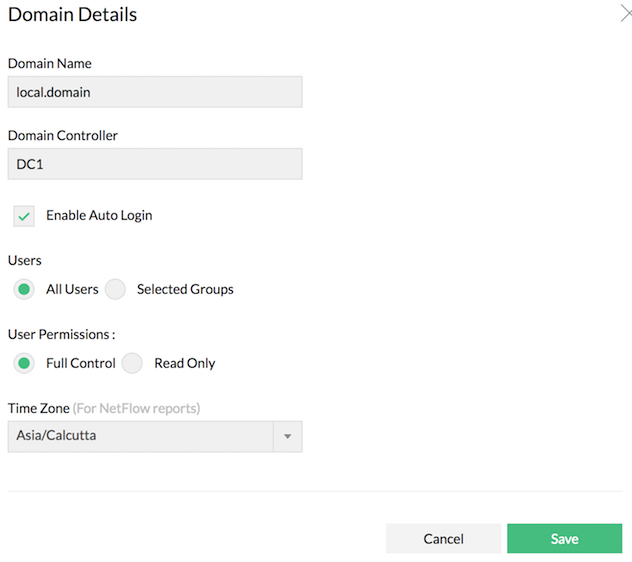
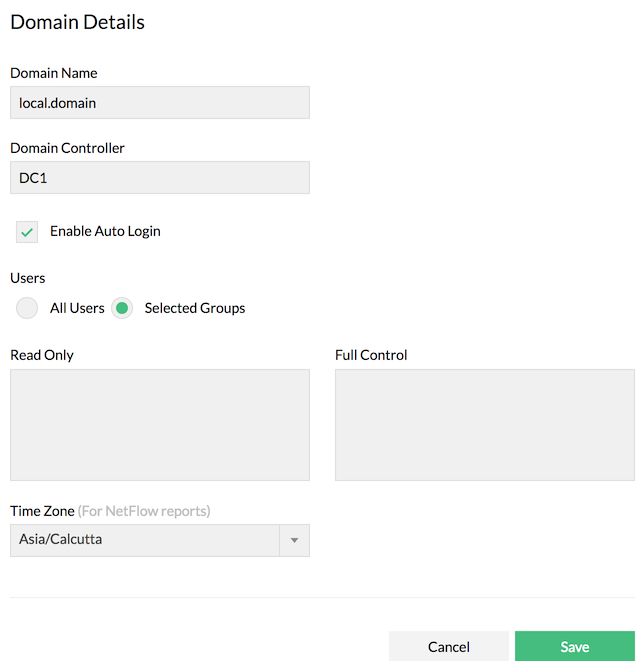
- Go to Settings > User Management > AD Authentication > Add.
- Enter the Domain Name.
- Enter the Domain Controller name.
- Select Enable Auto Login.
- Select either All Users or Selected Groups.
- All Users: The auto login will be enabled to all the users. Select the permissions that you want to assign - Read Only (Operator User) or Full Control (Administrator User). Select User Permissions either Read Only or Full Control.
- Selected Groups: The auto login will be enabled to the groups you specify. Enter the name of the groups in Read Only and Full Control columns. The access to groups will be enabled accordingly. Note: Configure one Group Name per line. The names are case-sensitive and should be configured as given in your AD.
- Click Save.
A new domain has been successfully added.
Password Policy
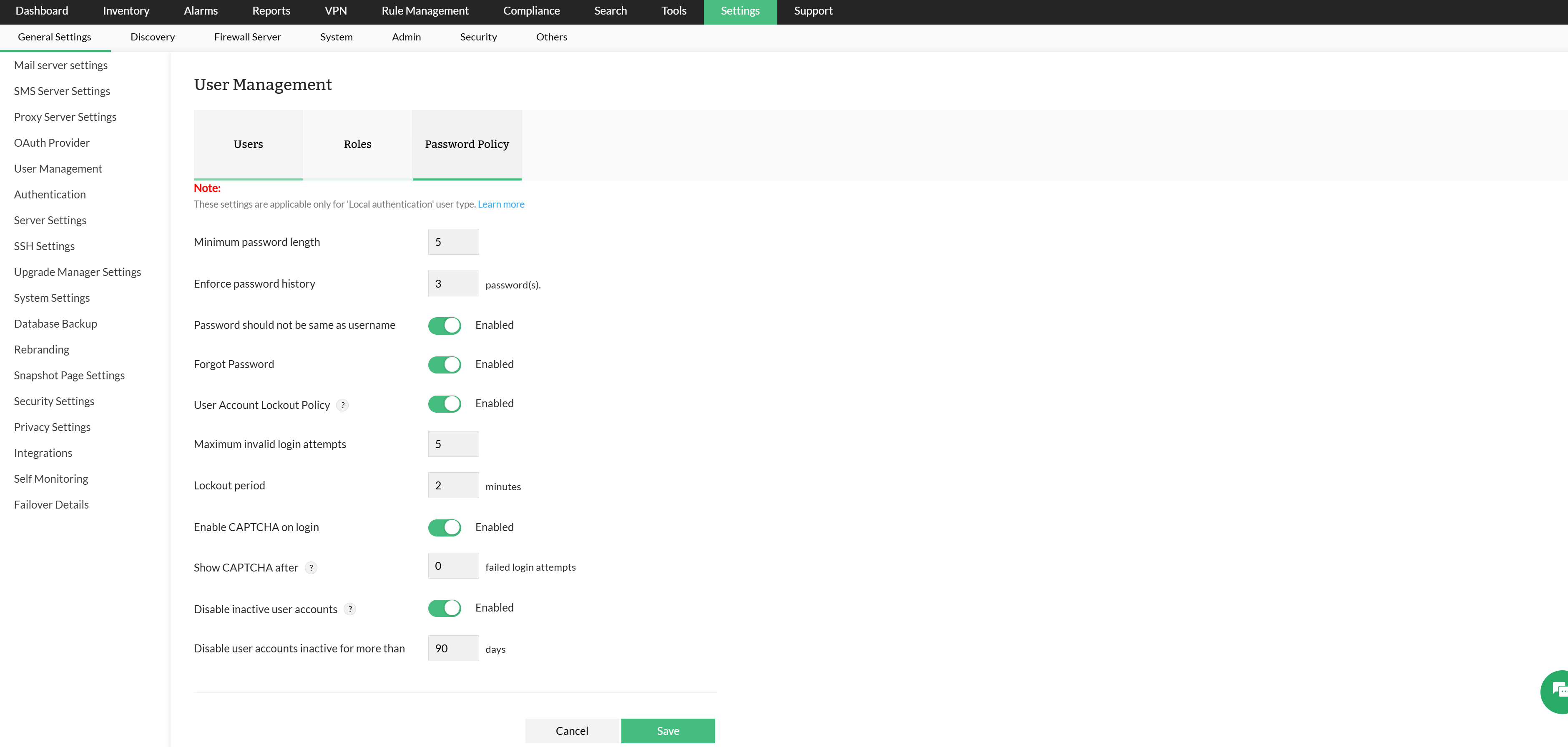
A password policy is a set of rules designed to enhance security by encouraging users to employ strong passwords. Another possible defense against password-guessing attacks is enabling an account-lockout, which means the account will be locked after a specified number of invalid or failed login attempts.
To configure a password policy in Firewall Analyzer, go to Settings > Basic Settings > User Management > Password Policy.
Minimum password length: Specify the minimum number of characters required in a password. It should be within 5-25 characters.
Enforce password history: Number of unique passwords that must be associated with a user account before re-using an old password.
Password complexity: Level of complexity to be associated with a password.
Simple
1. Minimum characters as specified above
2. Maximum 25 characters
Complex
1. Minimum characters as specified above
2. Maximum 25 characters
3. Minimum 1 uppercase, 1 lowercase and 1 special character (! ~ @ # $ % ^ & + = _ *).
Password should not be same as username: Enable this to option to prevent duplication of a username in the password.
User Account Lockout Policy: The User Account Lockout setting allows the administrator to lockout accounts after a specified number of invalid login attempts. A locked out account cannot be used until reset by an administrator or until the account lockout duration has expired. For instance, if invalid credentials have been provided for over 5 times, the account will be locked out for 2 mins. This lockout interval and the number of bad login attempts can be configured.
Maximum invalid login attempts: Specify the maximum invalid login attempts before an account gets locked out.
Lockout period: Specify the lockout duration in minutes.
Enable CAPTCHA on login: Enable this option to display a CAPTCHA on the login page as an additional layer of security against automated login attempts.
Show CAPTCHA after: Specify the number of failed login attempts after which the CAPTCHA will be displayed. A value of 0 means the CAPTCHA will be shown for every login attempt.
Disable inactive user accounts: Enable this option to automatically disable user accounts that remain inactive for more than the configured number of days.
Disable user accounts inactive for more than: Specify the number of days after which inactive user accounts will be automatically disabled. A notification email will be sent to the user 7 days before the account is disabled.