
- Overview
- Configuration
Zendesk
Streamline IT operations with Zendesk and ADManager Plus integration
Integrating Zendesk with ManageEngine ADManager Plus reduces the burden on IT staff by automating tickets and user lifecycle management and security operations at your organization. By synchronizing the data between Zendesk and Active Directory, IT teams will now have the option to manage user provisioning, password resets and updates, groups, and permissions directly from the Zendesk console.
Automated user provisioning
Configure automated workflows to fetch ticket details from Zendesk to automate user creation, modification, or deletion tasks across AD, Exchange, M365 and other systems.
Simplified user account management
Reset passwords, unlock user accounts, enable or disable user accounts right from your Zendesk console.
Role-based access controls
With ADManager Plus- Zendesk integration, you can automatically adjust and assign permissions for Zendesk users based on their roles in Active Directory.
Integrating Zendesk with ADManager Plus
ADManager Plus offers two ways to integrate with Zendesk:
- Widget Perform Active Directory (AD) actions directly from the Zendesk console using the ADManager Plus widget.
- API-based application integration Facilitates automated ticket handling by periodically importing relevant tickets from Zendesk and executing the required AD actions in ADManager Plus.
How to configure the Zendesk plug-in integration in ADManager Plus
- Log in to Zendesk.
- Download ADManager Plus from Zendesk's Marketplace.
- On the Installation page, set the role and group-based restrictions for accessing ADManager Plus and click Install.
- Once it is installed, click the ADManager Plus icon in the left pane and click the Integrate Now! button.
- Copy the Referrer URL, and open ADManager Plus.
- Log in to ADManager Plus and navigate to the Admin tab.
- Under System Settings, click Integrations.
- Under ITSM/Help Desk Tools click Zendesk.
- Paste the referrer URL from your Zendesk instance in the Referrer URL field. Click Save.
- Navigate back to Zendesk, and click Next.
- Enter the URL of the server where ADManager Plus is running in the ADManager Plus' Server URL field, and click Next.
- Enter the ADManager Plus technician's authtoken in the Authtoken field, and click Validate to ensure it's linked to the correct technician account in ADManager Plus. Note: The technician's authtoken can be obtained by navigating to Delegation > Configuration > Technician Authtokens in ADManager Plus.
- Once the technician's details are auto-populated in the Technician field, click Finish.
- You can add more technicians in Zendesk by navigating to the Associate Users tab under ADManager Plus. Click Associate Users, specify the technician's authtoken in the ADManager Plus Technician Authtoken field, and click Validate. Once the technician's details are auto-populated, click Save. Note: Authtokens can be edited by clicking the Edit icon next to the Authtoken field.
- You can now perform AD-related actions directly from the right pane of the Zendesk's tickets page, allowing you to execute available AD management operations without leaving the ticket view.
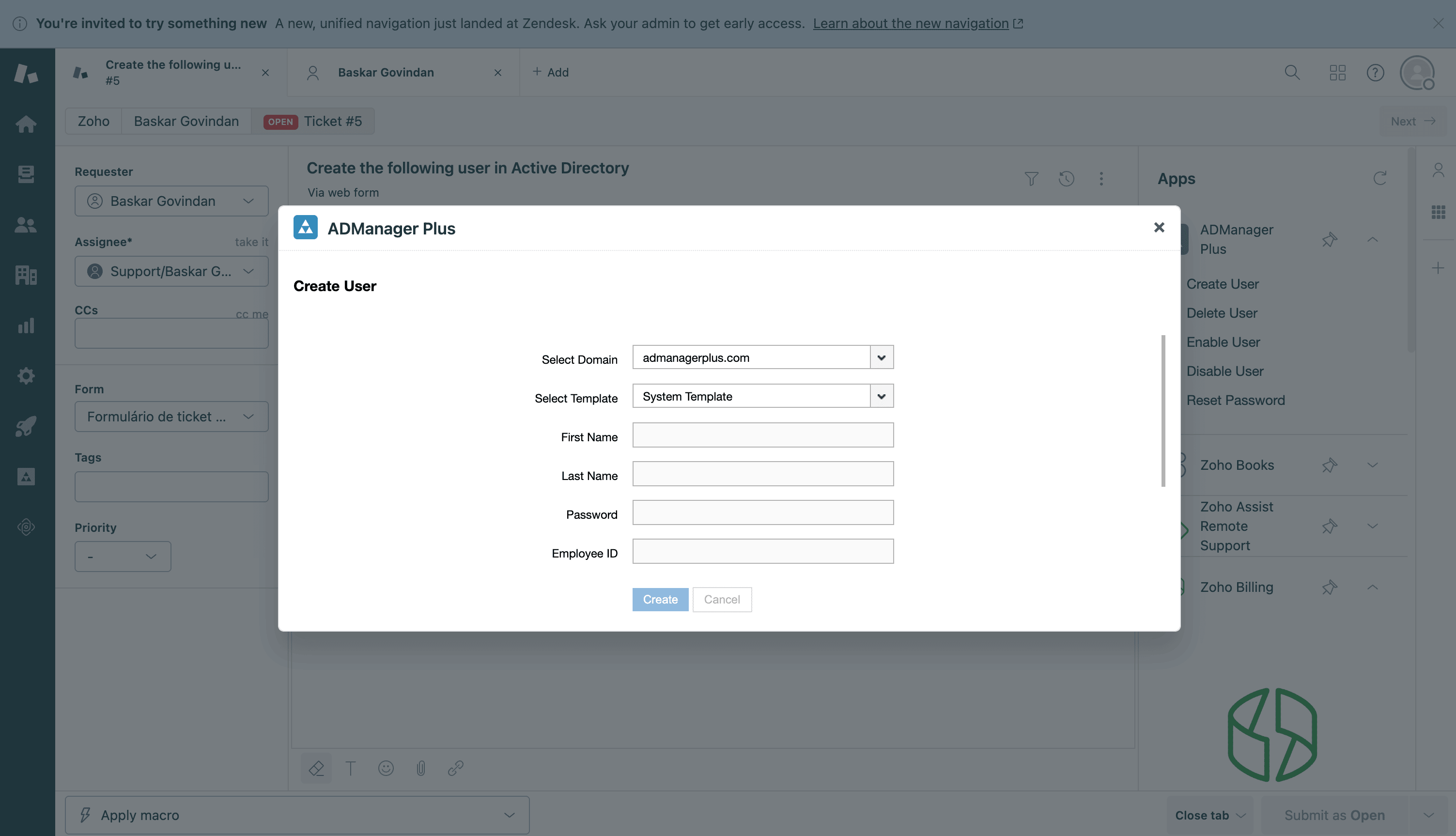
Customizing the user creation form in Zendesk
- Log in to Zendesk.
- In the left pane, click ADManager Plus.
- Navigate to the Actions tab in the navigation bar.
- Hover and click the Edit icon next to the Create User option.
- In User Creation Fields:
- Click the + icon to add a field from the list of available fields to the user creation form in Zendesk.
- To remove a field, hover over the field and click X.
- To make a field mandatory, hover over the field and click Set as Mandatory.
- Click Save to update the changes.
- User creation fields can be customized in instances integrated with ADManager Plus builds 7185 and above, and Zendesk plugin versions 2.1 and above.
- The user creation fields are text boxes and require technicians to enter a value.
- Fields can also be added or removed and made silent or read-only in the User Creation Templates in ADManager Plus. Therefore, it is recommended to add only the required fields to the user creation form in Zendesk.
How to integrate Zendesk Suite with ADManager Plus using APIs
Prerequisites
- Zendesk Suite uses basic authentication credentials to authorize API requests.
- Authentication credentials required: Zendesk instance username and password.
Privileges
- To import users (inbound action): Ensure the account used for authorization has permission to read all user accounts.
- To perform any action or query in Zendesk Suite (outbound action): Ensure the account used for authorization has permission to perform the desired action.
Authorization configuration
- Log in to ADManager Plus and navigate to Directory/Application Settings.
- Go to Application Integrations, then search for and select Zendesk Suite.
- Toggle the Enable Zendesk Suite Integration button on.
- In the Zendesk Suite Configuration page, click Authorization.
- Enter the authentication credentials. Use the Zendesk instance's username and password.
- Click Configure.
Inbound webhook configuration
An inbound webhook enables you to fetch user data from Zendesk Suite and send it to ADManager Plus. To configure an inbound webhook for Zendesk Suite:
- Under Inbound Webhook, click Zendesk Suite Endpoint Configuration.
- An endpoint, Zendesk Suite Users Endpoint, comes
preconfigured with Endpoint URL, HTTP Method, Headers, and Parameters
fields to fetch user accounts from Zendesk Suite. It uses the repeat
calling option to retrieve up to 100 users per API call and continues
fetching data until no users remain. If you prefer to use a new endpoint
to import users, you can configure one by clicking + Add API
Endpoint and filling in the required fields according to Zendesk Suite's API references. To learn how,
see this help
document. Note:
- Authorization Header is preconfigured as a header for authenticating API requests as configured during authorization configuration.
- You can add macros to your endpoint configuration to dynamically change it as per your requirement using the macro chooser component.
- Refer to Zendesk Suite's API references and configure additional headers and parameters, if needed.
- Once done, click Test & Save to validate and save
the endpoint, or click Save as Draft to store the
configuration as a draft without testing the endpoint. If you choose
Test & Save, a response window will be displayed.
This response window includes the following tabs:
- Response: Displays API response parameters in a
tree structure. You can set the datatype for each field:
- Text (default)
- Number
- Timestamp
- Array
- Response Details: Displays the complete response message in text format.
- Request: Displays the request headers, parameters, and message body.
- Response: Displays API response parameters in a
tree structure. You can set the datatype for each field:
- Click Save. Note: You can configure multiple endpoints for Zendesk using the + Add API Endpoint button. To learn how, see this help document.
- Click Data Source - LDAP Attribute Mapping to match endpoints and to map AD LDAP attributes with the respective attributes in Zendesk Suite. ADManager Plus also lets you customize the attribute format from Zendesk Suite.
- Click + Add New Configuration and perform the
following:
- Enter the Configuration Name and Description and select the Automation Category from the drop-down menu.
- In the Select endpoint field, select the desired endpoint and a Primary Key that is unique to a user (e.g., employeeIdentifier). Note: When multiple endpoints are configured, this attribute must hold the same value in all the endpoints.
- In the Attribute Mapping field, select the attribute from the LDAP Attribute Name drop-down menu and map it with the respective column in Zendesk Suite. If you would like to create a new custom format for this, click Add New Format.
- Click Save.
Outbound webhook configuration
An outbound webhook enables you to update the changes made in AD using ADManager Plus in Zendesk Suite or fetch or forward the required details from Zendesk Suite and synchronize them with AD. To configure an outbound webhook for Zendesk Suite:
- Under Outbound Webhook, click Zendesk Suite Webhook Configuration.
- Three endpoint configurations—Zendesk Add Ticket Endpoint, Zendesk Update Ticket Endpoint, and Zendesk Close Ticket Endpoint—are available to create, update, and delete tickets in Zendesk. When using the preconfigured endpoint, substitute {subdomain} with the domain name of your Zendesk instance and {ticket_id} with the relevant ticket ID in the Endpoint URL field.
- Alternatively, if you prefer to create a new endpoint, click + Add Webhook.
- Enter a name and description for this webhook.
- Decide on the action that will be performed and refer to Zendesk Suite's API references for the API details, such as the URL, headers, parameters, and other requirements. Enter the employee details value in the Parameter field.
- Select the HTTP method that will enable you to perform the desired action on the endpoint from the drop-down menu.
- Enter the endpoint URL.
- Configure the Headers, Parameters, and Message Type in the appropriate format based on the API call that you would like to perform. Note: Macros can be added to the endpoint URL, headers, parameters, and message body to dynamically modify the configuration using the macro chooser.
- Click Test & Save to validate and save the webhook, or click Save to store the webhook as a draft without testing.
- If you select Test & Save, a response window will
be displayed. Choose the user or group on which the API request should
be tested and click OK. This triggers a real-time call
to the endpoint URL, allowing you to verify whether macros are applied
correctly. You may skip selecting a user or group. However, if you do
make a selection, the macros present in the webhook will be parsed using
the selected object’s values:
- Response: Displays API response parameters in a
tree structure. You can set the datatype for each field:
- Text (default)
- Number
- Timestamp
- Response Details: Displays the complete response message in text format.
- Request: Displays the request headers, parameters, and message body.
- Response: Displays API response parameters in a
tree structure. You can set the datatype for each field:
- Verify them for the expected API behavior and click Save.
Actions supported:
- Reset passwords in AD
- Enable or disable AD user accounts
- Unlock AD user accounts
- Delete AD user accounts
- Provision users in AD, Microsoft 365, Exchange Server, Skype for Business, Lync, and Google Workspace, in parallel, using templates