What are data silos? Breaking down IT's visibility gap
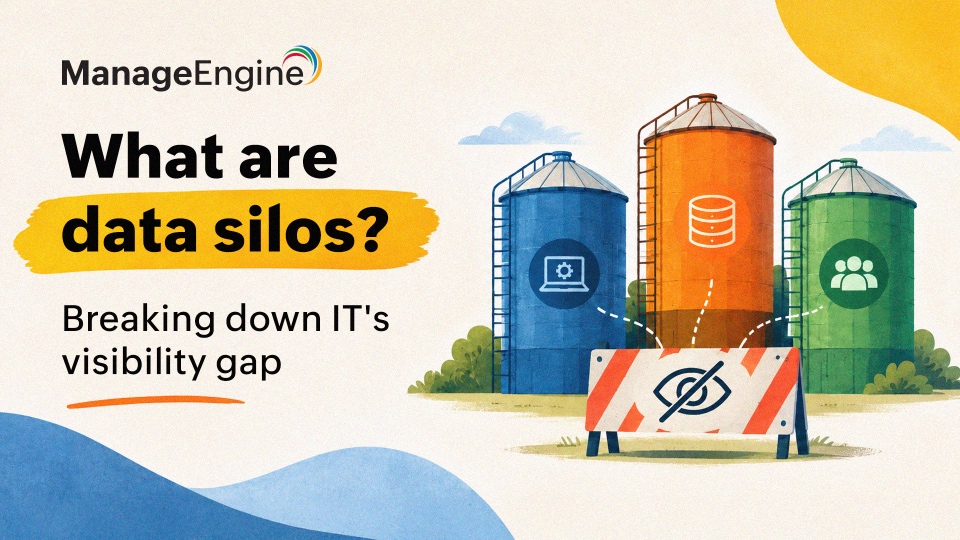
Data silos are where IT data gets locked up in isolated, disconnected systems, and you can't get a view across service management, security, and operations. They're the result of organizational boundaries, legacy tools, and poor data governance. For IT managers looking to tackle silos, the first step is to identify where data is currently stored and who has access—practical actions like conducting a data audit or mapping existing silos provide a clear starting point. Documenting which teams and systems hold what information shines a light on trouble spots and guides further work. To get rid of silos completely, you need a centralized data architecture and a single, unified analytics platform that gives IT one common view of their environment.
Data siloing occurs when different teams have their own data collection, data management, and data storage arrangements, often with access restricted to just the people on that team. It can be along product lines. It can be the result of an acquisition where the two companies' tech stacks were bolted together without being properly harmonized.
That’s why we’ve prepared this article about data silos in the enterprise IT context. It looks at what they are, why they keep on appearing, the damage they do to visibility and the ability to make decisions, and what is required to close the gap with a look at how unified analytics takes the disparate data and presents it as a single, coherent picture.
What does a data silo look like in enterprise IT?
A data silo is exactly what it sounds like: data in one system, completely isolated from the rest of the organization and requiring a lot of manual effort to get at. A fairly standard IT department would be a good example. The service desk has their tickets in one system, the security team has their vulnerabilities in another, and endpoint data will be in a third system that neither of those teams can access. Each team will have a very clear view of their own part of the environment, but no one will have the full picture.
That separation creates real friction. You can't access the data, you can't share the data, and you can't integrate the data with other systems. It makes the most basic of tasks, such as pulling a combined report, a real pain.
It's vital to make the distinction between data silos and a somewhat more fundamental issue of information silos. A data silo is just raw data. An information silo is the knowledge and context that has been built up around that data. The people who possess that knowledge and context are effectively cut off from the rest of the organization. You can have a complete suite of integrated tools and still have a collaboration fail because you have information silos. Fixing the data silo issue doesn't automatically fix the information silo issue.
Why does data get fragmented in the first place?
Data silos don't just appear overnight. They build up over time, and the reasons for them generally fall into two camps: how the organization is structured and how its systems were built.
On the org structure side, the silos often map directly to the org chart. Different business units and product groups will have their own data collection and data management processes (sometimes for perfectly legitimate reasons, that is, confidentiality, and sometimes just down to habit). The various disciplines (engineering, marketing, finance, etc.) have different data needs and different priorities, so they naturally end up with their own tools that suit their ways of working.
Communication gaps make it all the worse. If teams aren't talking to each other regularly, they'll end up re-doing work without realizing it, or sitting on data that another team could easily use. Over time, independently developed systems become incompatible and sharing data becomes a project rather than a simple request.
On the technical side, old platforms that typically don't work with newer tools are a common cause of problems. Another frequent issue is inconsistent data governance, such as the absence of common definitions so that the naming conventions for two systems can describe the same thing in two utterly incompatible ways. Mergers and acquisitions are a big issue too, in that you can end up with two systems that were never intended to work together even though you've merged them.
As Databricks points out, fragmentation isn't the outlier in enterprise IT at all. It's the state that most organizations operate in. This doesn’t automatically make this situation ideal, however.
How do data silos affect IT visibility and the ability to make decisions?
Fragmented data has a direct and compounding effect on decision quality. If the data is spread out, you can't properly analyze it in aggregate. You end up with teams spending time reconciling duplicate records and working around gaps where the data didn't make it from one system to the next. That's all before you get to the decision you were actually trying to make.
The downstream costs are fairly predictable in that they manifest in poor decision-making, wasted effort, a much slower response to change, and governance, which, in many cases, requires multiple separate models to stay compliant. None of these are minor issues, and each of them in turn reduces the IT team's ability to move quickly and, with confidence.
This is also a very real AI issue that we can't afford to ignore. Databricks makes the case that if your structured data is in one warehouse and your unstructured data is in a separate lake, then you're simply not going to be able to do any real machine learning or generative AI. Gartner forecasts that by the end of 2028, which isn’t far away, organizations that have adopted and maintained a mature AI strategy will achieve at least 25% better business outcomes ahead of their peers who havent. Those organizations that still have their data in silos are going to be several steps behind in that race.
What effect do data silos have on service management, security and cost?
Security is where fragmentation becomes actually risky rather than just inconvenient. Good cyber security data management is about seeing the presence of unauthorized software, the absence of critical patches, and the age of the asset as one holistic picture. If that data is in silos, then you're pretty much left guessing when it comes to assigning any meaningful risk score to an asset.
Costs creep up in ways that are extremely easy to underestimate. Each siloed team has its own infrastructure and its own IT headcount to support its data. That distributed cost structure disappears when you bring the data together and consolidate the technology stack. On the security side, the true cost of an incident is completely invisible when your data is in silos. That's the cost of equipment replacement, the cost of the extra headcount to get services back up and running, and the cost of lost productivity due to downtime.
Service management teams often feel this. If your tickets, assets, and endpoints are in different systems, then the service desk team is going to spend a lot of time pulling together context that should already be in front of them. That's time being taken away from actually resolving the issue with the user.
How do you break down the data silos in an IT organization?
Fixing a silo problem starts with finding it. Databricks SRE recommends running regular data audits and tracking and documenting data sources across the business to get a clear picture of where you are before you do anything else. In practice, this often starts small with someone saying "it takes too long to put together that report" or a manager noticing that two teams have completely different numbers for the same metric. Those are the first indications of a much bigger problem.
Once the silos are mapped, the fix has to run on two parallel tracks. The technical track is about consolidating the data into a central architecture which is flexible enough to take both structured and unstructured data without every team having to reengineer their processes. The other track is the organizational one, and that's just as important in that it's about putting in place governance and data management policies so you don't end up with another set of silos quietly forming six months later. To make these improvements stick, consider adopting clear data stewardship roles where individuals or teams take responsibility for data quality, access, and life cycle across systems.
Establishing a cross-team data governance council is another proven approach, ensuring ongoing communication and resolving conflicts as new tools or needs arise. Popular frameworks like the Data Management Association (DAMA-DMBOK) best practices or the implementation of Responsible, Accountable, Consulted, Informed (RACI) matrices for data-related decisions can also help maintain accountability and alignment as the organization evolves.
Executive sponsorship makes a real difference. To secure executive buy-in for a centralization project, it's essential to present a clear case that connects IT improvements to business outcomes. Focus on the short- and long-term benefits: explain what existing work will be done faster or at a lower cost, outline new capabilities centralization will unlock, and quantify potential reductions in operational risk. Provide concrete examples, such as how unified data can speed up compliance reporting or avoid high-profile incidents caused by missed security vulnerabilities.
Highlighting the return on investment (ROI) can make your case stronger, compare ongoing costs of siloed systems versus anticipated savings from consolidation, and demonstrate how improved visibility positions your organization to respond more quickly to changing business needs. If possible, show how closing silos can lead to competitive advantage, such as enabling faster rollout of new products or services. Try framing the discussion around risk reduction, efficiency gains, and how centralization aligns with broader strategic goals. Technology on its own won't solve a partially cultural issue, so making these business impacts clear to leadership will go a long way toward securing the support you need.
How does unified analytics create shared context across IT data?
Unified analytics takes audit and governance a lot further in that it provides a single shared view rather than a dozen separate dashboards that will never agree. Rather than the service desk, security, and endpoint teams each having their own reporting tool in their own silo, you have a unified analytics layer that brings the data from all those disparate sources together in one place so everyone works from the same numbers.
This isn't just about a cleaner dashboard. ManageEngine Analytics Plus is a demonstration of what you can achieve when your data is actually in one place. You can correlate technician load with endpoint vulnerabilities; you can assess the impact of a security update on help desk ticket volume; you can plan a security rollout to have the least possible impact on end users. You can't answer such cross-domain questions if your data is in silos.
How ManageEngine closes visibility gaps
Breaking down data silos is a challenge ManageEngine addresses across its entire product suite, not just at the reporting layer. ServiceDesk Plus centralizes service management, Endpoint Central brings endpoint and patch data into one place, and PAM360 closes the privileged access gap that often goes unmonitored in siloed environments. What these products have in common is a shared intelligence layer built around Zia, ManageEngine's AI assistant, which runs across the suite and gives every user, from a service desk technician to a security analyst, the ability to surface answers, generate dashboards, and diagnose problems in plain language without switching tools. This democratizes access to data, and associate information and insights, hence, breaking down previously existing barriers.
Close the gaps that data silos create
Data silos aren't a single problem with a single solution. They're the outcome of organizational habits and technical debt that have built up over the years, and they impact everything from how quickly a technician can resolve a ticket to how confident a security team can be in their risk scoring. The Databricks research and the Gartner forecasts referenced in this post both come to the same conclusion: fragmentation is the norm in most enterprise IT environments, and it will only get worse as data continues to spread out beyond the centralized systems.
Closing the gap requires commitment on two fronts. Identification and governance will help you find the silos and stop new ones from appearing. Unified analytics then takes that single source of truth and enables the teams to use it together rather than having six different versions of the truth.
Frequently asked questions
What are data silos (in simple terms)?
Data silos are essentially isolated "pockets" of data that are stored and managed separately from the rest of the organization, making the data very difficult to access, share, and integrate with other systems (Databricks).
How are data silos created in an IT organization?
Data silos arise from organizational reasons (departmental boundaries, different tools used by different teams) and technical reasons (legacy systems that don't integrate well, lack of data governance).
How do data silos impact IT decision-making?
Fragmented data makes it very difficult to get a holistic view of the information and, as a result, leads to duplication of effort, slower response to change, and decisions being made on incomplete information as the full dataset resides somewhere else.
What's the first step to breaking down data silos?
Start with a data audit by track downing and documenting where the data actually is across the organization before you even think about doing any technical fix.
How does unified analytics help to close the visibility gap?
Unified analytics combines data from multiple IT sources, like service desk, security, and endpoint platforms, into a single analytics layer. This gives every team the same shared context to correlate issues like technician workload and endpoint vulnerabilities that would otherwise stay invisible.
Who should be responsible for fixing data silos: IT or leadership?
Both. The technical work of consolidating systems typically falls on IT. Still, lasting change requires executive sponsorship and governance policies that prevent new silos from forming after the initial cleanup.