Integrating OpManager with SIEM tools
IT teams must sift through thousands of log entries every minute they monitor firewall alerts, configuration changes, and performance metrics to find genuine threats or operational issues in larger enterprises. Manual analysis is no longer viable; organizations need automated, real-time log correlation and analytics or risk catastrophic gaps in visibility and response.
Consider the 2018 healthcare data breach in Singapore: One of Singapore’s largest healthcare providers suffered the country’s most serious personal data breach when attackers exfiltrated 1.5 million patient records over nine days without detection. A Committee of Inquiry later found:
- Bulk data dump queries against the Patient Care Database went unnoticed from June 26 to July 4 because there were no SIEM correlation rules or real-time alerts in place.
- The high volume of records accessed never triggered alarms, as logs remained siloed.
- Database logs weren’t tied to other security streams, such as firewall events or authentication logs, leaving security teams without a holistic view.
The breach caused severe reputational damage, regulatory scrutiny, and triggered a nationwide overhaul of Singapore’s public sector cybersecurity practices.
This incident underscores a critical lesson: Centralized SIEM correlation transforms raw log data into actionable intelligence, stopping short-lived intrusions from becoming prolonged, high-impact breaches. Had OpManager, or any network monitoring tool, forwarded audit and access logs to a SIEM platform, the abnormal query patterns could have been detected and flagged early.
SIEM Integrations with OpManager
Early threat detection with OpManager-SIEM integration
When integrated with a SIEM platform, OpManager can help detect and act on early warning signs of potential breaches before they escalate into major incidents.
- Real-time anomaly detection: OpManager’s access and audit logs would have captured unusual spikes in database access and query volume. These logs, when forwarded to a SIEM solution, could trigger alerts based on abnormal behavioral patterns.
- Event correlation across systems: A SIEM tool would have correlated the sudden database activity with other events, such as off-hours logins, failed access attempts, or firewall traffic anomalies, connecting the dots early in the attack sequence.
- Automated alerting and escalation: As soon as thresholds were breached (e.g., excessive data reads or unknown IP access), the SIEM platform could have triggered an automated alert or workflow.
- Centralized visibility for faster investigation: With OpManager feeding access and audit logs into a SIEM dashboard, the security team would have had a unified view of infrastructure behavior, reducing the time to detect, investigate, and respond to abnormal activities.
- Historical baselines and machine learning: Leveraging historical performance baselines from OpManager, the SIEM solution’s machine learning capabilities could have identified the data access patterns as an anomaly, even if they initially mimicked legitimate usage.

Integrating OpManager with your SIEM platform bridges the gap between network monitoring and security intelligence, enabling early detection, swift mitigation, and complete visibility.
OpManager's seamless integration with Splunk
While OpManager can integrate with a range of SIEM tools, Splunk is a popular choice among enterprises due to its strong data processing and visualization capabilities. Let’s take a closer look at how OpManager and Splunk work together to enhance security and operational efficiency.
OpManager seamlessly integrates with Splunk, forwarding logs, including syslogs, SNMP traps, access logs, and audit trails from routers, switches, firewalls, servers, and other devices for centralized indexing, correlation, and analysis.
Unified visibility: Splunk’s dashboards enable teams to visualize performance trends or anomalies in real time during outages or attacks. Security events from OpManager, such as unauthorized logins or configuration changes, can be correlated with other security data to reveal complex attack patterns.
Simplified compliance reporting: OpManager’s audit logs show exactly who changed what and when. When these logs are ingested into Splunk, compliance teams can generate reports for standards like HIPAA, the PCI DSS, or ISO 27001, without combing through raw data.

Automated workflows with Splunk's SOAR: When OpManager detects a critical event (e.g., high CPU usage or suspicious login behavior), Splunk can trigger SOAR workflows, such as alerting the SOC, creating a ticket, or executing a remediation script.
OpManager integration with Log360 Cloud
Bring network monitoring and security intelligence together with OpManager and Log360 Cloud. Forward OpManager alarms, syslogs, debug logs, audit logs and network security events to Log360 Cloud to centrally analyze the network security data, correlate events across your environment, and detect potential threats faster—all through a scalable, cloud-based SIEM platform.
Log360 Cloud provides advanced SIEM capabilities such as log management, event correlation, threat detection, security analytics, and automated response as a cloud service. By integrating OpManager with Log360 Cloud, network and security teams can gain deeper visibility into network activity, identify suspicious patterns, streamline incident response, and simplify compliance monitoring.
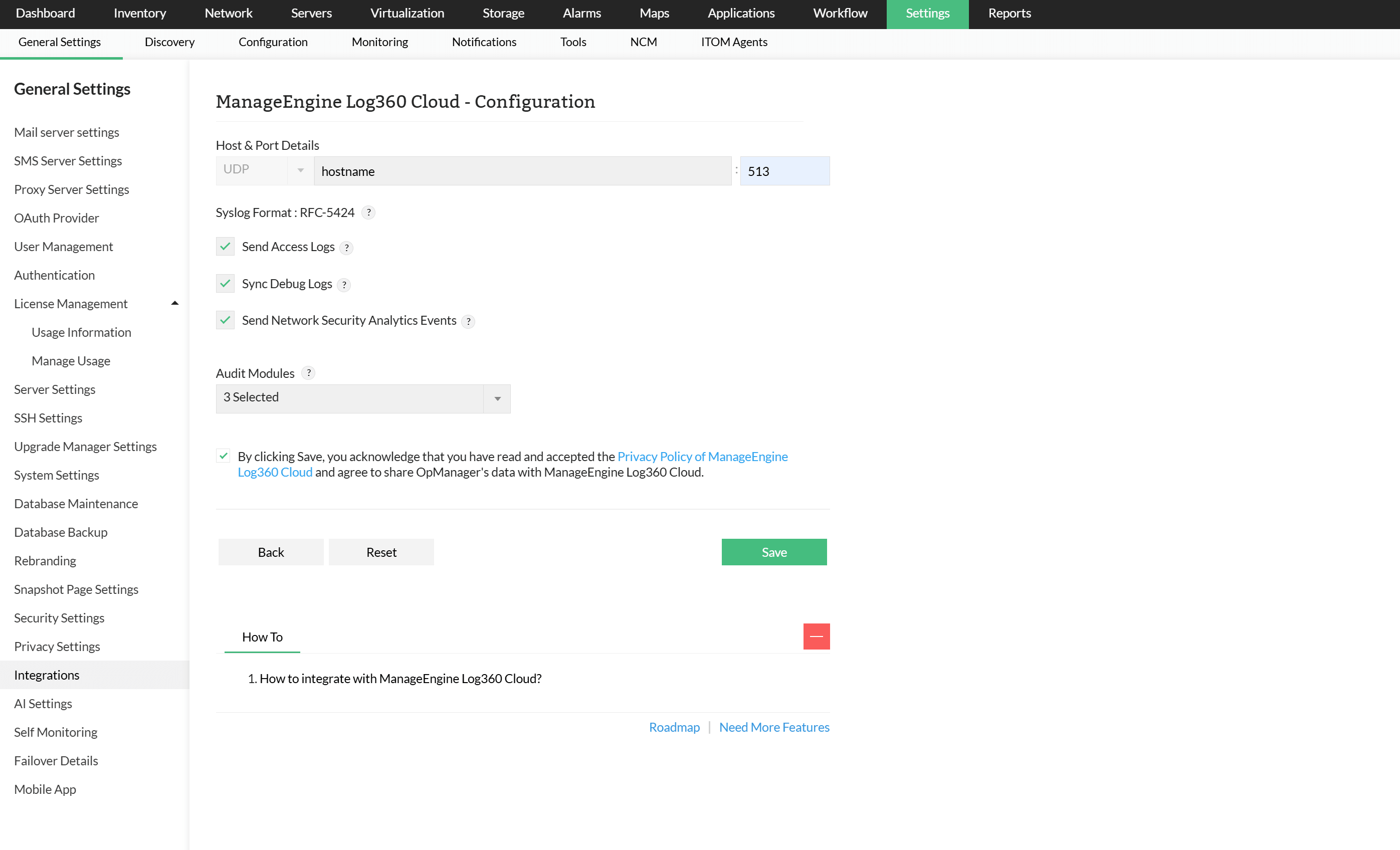
Unified visibility: Bring OpManager's alarms and logs together with security data from across your IT environment in Log360 Cloud. Its centralized dashboards provide visibility into performance trends, anomalies, security events, and audit activity, helping IT and security teams correlate seemingly unrelated events and identify complex attack patterns.
Enhanced security with centralized log analysis: Forward OpManager's access, debug, audit, syslog data and network security events to Log360 Cloud for centralized analysis. Track who accessed OpManager, monitor configuration changes and other critical activities, and correlate these events with security data from other sources to identify suspicious behavior and potential security threats.
Faster threat detection and incident response: Correlate network events with security information from across your environment to detect threats and investigate incidents faster. Log360 Cloud's built-in security analytics and automated response workflows help teams take action quickly, streamline incident handling, and reduce mean time to respond (MTTR).
Scalable cloud-based log management: As OpManager logs grow, users will not need to add on-premises storage with this integration. Log360 Cloud offers a cloud-based solution that scales with the required parameters. It easily collects, stores, and analyzes logs, making log management simpler as the network infrastructure expands.
Simplified compliance and auditing: Centralize OpManager's audit and access logs in Log360 Cloud to simplify security auditing and compliance monitoring. By retaining and analyzing critical log data in a centralized platform, organizations can gain the visibility needed to support compliance requirements and security frameworks such as HIPAA and PCI DSS.
With OpManager and Log360 Cloud, organizations can combine network visibility with security intelligence to detect threats faster, respond to incidents efficiently, and maintain a centralized, audit-ready view of their IT environment.
By integrating OpManager with a SIEM platform like Splunk, IBM QRadar, Log360 Cloud, or LogRhythm, you gain real-time threat detection, smarter incident response, and complete control over your IT infrastructure. Start turning raw logs into meaningful insights, strengthen your defenses, stay audit-ready, and resolve issues before they impact operations.
Integrate OpManager seamlessly with your third-party tools
Download 30-day free trialCustomer reviews

Case Studies - OpManager
Awards & Honors
- Recognized as a May 2019 Gartner Peer Insights Customers' Choice for Network Performance Monitoring and Diagnostics Software
- Recognised as an April 2019 Gartner Peer Insights Customers' Choice for IT Infrastructure Monitoring Tools.
- Network Management and Monitor Vendor of the Year 2018, 2019
- Entered the 2019 Gartner NPMD Magic Quadrant.
- Ranked #2 in the Infotech Research Software Reviews Data Quadrant 2018.