DevOps for business leaders: Driving organizational agility and efficiency

Summary
DevOps has evolved into a strategic enabler that helps organizations align technology execution with business priorities. By breaking down silos between development and operations, DevOps improves delivery speed, system reliability, and security while enabling teams to respond faster to changing market demands. For business leaders, it represents a shift toward building resilient, adaptable IT foundations that support long-term growth.
Through practices such as automation, infrastructure as code, and continuous delivery, DevOps streamlines operations, reduces downtime, and improves service quality. When combined with cloud-native platforms and AI-driven insights, it enables predictive operations, smarter scaling, and better cost control. Ultimately, DevOps fosters a culture of continuous improvement, positioning organizations to innovate faster, operate more efficiently, and remain competitive in an increasingly digital economy.
In the age of digital disruption, ITOps are the backbone of modern enterprises, making it critical for business leaders to align IT capabilities with business goals. DevOps, with its emphasis on breaking down silos between development and operations, offers the agility and efficiency needed to adapt swiftly to changing market conditions. DevOps in enterprise leadership isn't just about speeding up development, it's about creating a more resilient, responsive, and innovative organization.
What is DevOps for business leadership?
At its core, DevOps refers to the integration of software development and IT operations to promote collaboration, automation, and process improvements. Beyond being a technical practice, DevOps is a strategic tool for business leaders looking to drive innovation, improve customer satisfaction, and navigate complex IT landscapes. DevOps accelerates delivery, increases reliability, and fosters adaptability, making it invaluable in today’s dynamic market.
Why should business leaders should care about DevOps?
For ITOps leaders, DevOps means more efficient incident management, streamlined software rollouts, and higher system availability—all vital for maintaining operational excellence and minimizing costly downtime. Recognizing DevOps as a method for operational resilience and IT stability empowers business leaders to ensure that their IT infrastructure is always prepared to support business growth.
Strategic gains: Why DevOps is key to successful ITOps
According to a report by MarketsandMarkets, the DevOps market size is expected to reach $25.5 billion in 2028. For CXOs, implementing DevOps practices results in significant strategic advantages, especially in IT and operational settings where speed, reliability, and security are paramount. DevOps not only enhances product delivery but also improves overall operational resilience, infrastructure stability, and cost efficiency in several ways.
- Accelerated delivery and time to market
With DevOps, the automation of repetitive tasks and frequent release cycles ensures faster product deliveries and updates. This speed is crucial in ITOps, where reducing downtime and responding promptly to emerging business needs directly impacts service quality and customer satisfaction. Automated testing, integration, and deployment pipelines ensure that businesses can adapt to new opportunities faster than competitors, providing a vital edge in competitive digital landscapes.
- Boosting infrastructure resilience and reliability
DevOps promotes a collaborative culture, backed by continuous monitoring, to ensure reliable systems. It enables cross-functional teams to detect and fix issues before they escalate, leading to higher availability and resilient infrastructure. This reliability is particularly essential in ITOps, where interruptions affect core business functions and customer trust. By embedding robust monitoring practices, organizations significantly reduce incidents, increase uptime, and improve customer experiences.
A well-known example of DevOps at scale is Netflix. As its platform expanded globally, Netflix adopted cloud-native DevOps practices such as microservices, continuous deployment, and deep automation to support rapid innovation without sacrificing availability. By embedding resilience into operations through practices like chaos engineering, Netflix ensured systems could withstand failures while continuing to deliver uninterrupted service.
- Stronger security and feedback loops
In addition to enhancing reliability, DevOps provides stronger security through practices like DevSecOps, where security is seamlessly integrated into every stage of the development life cycle. This proactive approach ensures that vulnerabilities are identified and addressed early, reducing the risk of costly breaches and compliance violations. Continuous security testing, automated vulnerability scans, and real-time threat monitoring foster a culture of shared responsibility across development, operations, and security teams. By embedding security into workflows, organizations can maintain agility without compromising on safety, ensuring robust protection against evolving cyber threats while accelerating delivery timelines.
Furthermore, DevOps provides rapid feedback loops, enabling real-time performance tracking, faster issue identification, and rapid course correction. These feedback loops also improve operational resilience and keep systems secure, aligned with the constant demands of modern IT.
- Operational efficiency and cost management
DevOps delivers transformative efficiencies to ITOps by reducing manual workloads and centralizing infrastructure management through infrastructure as code (IaC). A core DevOps practice, IaC allows teams to define, deploy, and manage infrastructure through code, ensuring consistency and scalability. This method not only reduces the likelihood of configuration errors but also makes infrastructure provisioning faster and more cost-effective. Combined with automation, IaC lowers operational overheads, enabling teams to focus on innovation instead of routine tasks.
Winning DevOps practices: A framework for business leaders
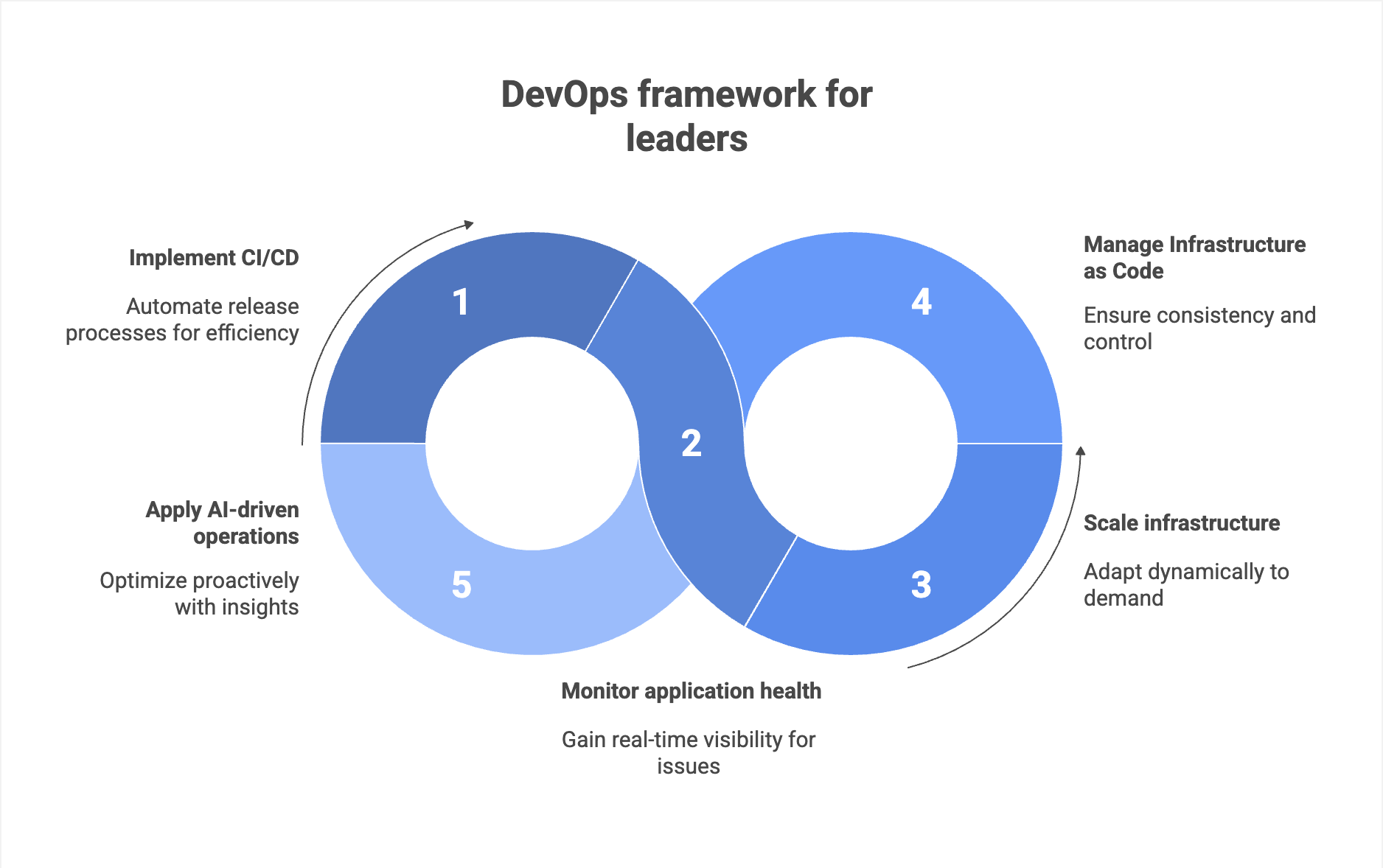
Adopting a DevOps framework for leaders effectively requires more than just implementing tools and processes. It’s about fostering a culture of collaboration, embracing automation, and leveraging modern technologies to enhance agility. The following practices provide a foundation for integrating DevOps successfully within an organization, ensuring increased efficiency, reliability, and strategic alignment.
Continuous deployment and intelligent monitoring
Continuous integration and continuous deployment (CI/CD) pipelines reduce release risk by introducing smaller, more frequent changes with built-in quality checks. When paired with intelligent monitoring, teams gain real-time visibility into application and infrastructure health, allowing them to detect issues early and respond before they escalate. This tight feedback loop helps maintain service reliability while supporting rapid change.Cloud-native architectures and scalable design
Cloud-native technologies such as containers and microservices enable systems to scale independently and recover gracefully from failures. DevOps practices align naturally with these architectures, allowing infrastructure and applications to adapt dynamically to demand. For ITOps teams, this translates into better resource efficiency, improved fault tolerance, and the ability to support business growth without constant re-architecture.Infrastructure as code for consistency and control
Infrastructure as code (IaC) replaces manual configuration with version-controlled, repeatable definitions of infrastructure. This approach improves consistency across environments, reduces configuration drift, and accelerates provisioning. IaC also strengthens governance and disaster recovery by making infrastructure changes auditable, reversible, and easy to reproduce.AI-driven operations and predictive insight
AI and analytics extend DevOps beyond reactive operations. AIOps platforms analyze telemetry across applications and infrastructure to detect anomalies, forecast capacity issues, and recommend corrective actions. This shifts ITOps teams from incident-driven firefighting to proactive optimization, improving service quality while lowering operational overhead.
Embracing DevOps: A path to agility and operational excellence
DevOps is not just a technical framework—it is a business enabler that drives measurable outcomes. By aligning IT processes with strategic goals, it empowers organizations to innovate at speed, respond dynamically to market demands, and deliver exceptional customer experiences. Adopting DevOps reduces time to market for products, ensures operational resilience, and fosters a culture of continuous improvement—all of which are critical for staying ahead in a competitive landscape.
For business leaders, the value of DevOps lies in its ability to unlock agility and efficiency while lowering costs and mitigating risks. It creates an environment where technology supports rapid growth and where teams work in unison to achieve business objectives. Companies that embrace DevOps as a strategic initiative position themselves to outpace competitors, adapt to disruptions, and capitalize on new opportunities with confidence.