Summary
Autonomous AI systems can sense, decide, and act on their own within set boundaries, and they learn from their actions without needing human approval at every step. Most companies are currently at Level 1 or 2 of the five-level autonomy scale, handling routine tasks like scaling resources or restarting services. Full autonomy everywhere is still far off. The main goal now is to know exactly which level your organization is at.
Cruise control and self-driving cars both 'drive the car,' but it's clear they're not the same as soon as you let go of the wheel. In IT, a similar gap exists between systems, yet both often get called "autonomous". This article explains what autonomous AI actually is, where it sits on the autonomy scale, and what that means for your IT operations today.
It's important to be clear about what lies beyond that gap. Autonomous AI systems can sense, decide, and act on their own within set boundaries, and they learn from their actions. This is not the same as a chatbot, which only responds when you type something. It's also different from a script, which just follows instructions. And it's not Artificial General Intelligence (AGI), which, despite what headlines suggest, doesn't exist yet.
Most organizations are still early in their journey with autonomous operations. They can automate predictable tasks like scaling resources or restarting services, but unexpected problems still need an engineer's attention, and that's normal. One cannot fully expect an autonomous IT anytime soon. But it is important to understand your organization’s position presently and what you should do next. Not long ago, AI in IT mostly just flagged issues on dashboards. Now, some platforms can investigate and fix certain problems before an operator even finishes reading the alert.
This will not apply to every situation or every system. Still, the shift is real. Because AI is moving from simply pointing out problems to actually fixing them. And in some parts of IT, that shift is happening faster than many of the teams expect.
The term 'autonomous AI' is used for many things, from customer service bots to self-driving cars, which can make it hard to know what you're really getting. Here’s a practical definition, followed by the key points that matter most.
What is autonomous AI?
Autonomous AI goes beyond following predefined rules. It can understand what's happening around it, decide on the most appropriate action, carry it out, and improve based on the outcome—all without requiring step-by-step human guidance. That's what sets it apart from traditional automation, which can only execute workflows that someone has already designed.
That last part is the whole difference. A script does exactly what it was told, every time, including the wrong thing if the situation has changed since someone wrote it. An autonomous system is built to notice when the situation has changed and adjust.
Autonomous AI vs. related concepts
People use "autonomous," "agentic," and "automated" almost interchangeably, which causes real confusion in planning conversations. They're not the same thing.
| Dimension | Autonomous AI | Agentic AI | AI automation | AGI |
|---|---|---|---|---|
| Core idea | Self-governs within a domain over time | Pursues goals through multi-step actions and tool use | Executes predefined workflows faster than humans | Matches or exceeds human cognition across all domains |
| Analogy | A self-driving car on a familiar route: it handles the whole drive and only calls you if something happens it's never seen | A capable assistant who plans your trip and books everything, but still checks with you before charging your card | A vending machine: dependable on the exact transaction it was built for, and nothing else | A person who could step into any job, in any field, and do it well: doesn't exist yet |
| Scope | System-level | Task-level | Process-level | Universal |
| Human role | Sets policy and guardrails | Defines goals, reviews output | Designs and maintains rules | Undefined |
| Adaptability | Handles novel situations within its domain | Plans multi-step approaches to new tasks | Follows fixed logic; breaks on exceptions | Theoretically unlimited |
| Learning | Continuously learns and self-corrects | May or may not learn between tasks | Does not learn | Learns across domains |
| Example | Self-healing IT infrastructure | An AI coding assistant | A scheduled database backup script | Doesn't exist yet |
The clean way to hold the two easily confused ones apart: agentic is about how the AI works (it takes multiple steps, calls tools, reasons through a plan). Autonomous is about how much human oversight it still needs while doing that.
All autonomous AI is agentic, but not all agentic AI is autonomous. A coding assistant is agentic. It plans, it uses tools, it takes multiple steps. But it waits for your prompt and hands you the result to review. That's not autonomy, that's a very capable assistant. An autonomous system, by contrast, typically runs multiple agents as part of one self-governing operation, with nobody reviewing each step.
The five levels of AI autonomy
Autonomy isn't a switch. It's a slider, and this framework, adapted from SAE International's driving automation levels (the same J3016 standard behind "Level 3 self-driving"), maps that slider onto enterprise IT.
- Level 0: Manual: No AI. Humans monitor, analyze, decide, and act on everything.
- Level 1: Assisted: AI recommends, a human decides and acts. A monitoring tool flags a spike in error rates and suggests a likely cause. An engineer investigates and applies the fix by hand.
- Level 2: Partial autonomy: AI acts on the routine stuff, a human handles exceptions. CPU usage crosses a threshold, the system scales resources on its own and logs what it did. An error pattern it hasn't seen before gets escalated instead of guessed at.
- Level 3: Conditional autonomy: At this stage, AI can make decisions and take action on its own—but only within clearly defined guardrails. Confidence scores and policy rules determine when it can move ahead and when it should hand the decision back to a human.
- Level 4: High autonomy: The AI runs the entire workflow, while humans oversee the outcome instead of approving every step.
- Level 5: Full autonomy: AI can monitor, decide, act, learn, and adapt on its own, without requiring human involvement at any stage.
Here's the honest part: Level 5 is basically theoretical right now. Even Google's own site reliability engineering team, publishing on how they build these systems internally, describes a deliberately conservative rollout. Their agents start at Level 2, proposing fixes for human approval, and only earn their way up to higher autonomy for narrow, well-bounded incident types after proving out against verified evaluation data. That's Google, with some of the most mature AI infrastructure on the planet, still keeping humans in the loop by design, not by limitation.
Most enterprises sit at Level 1 or 2. That's not a failure. That's where the safe, valuable work actually is right now. If you're evaluating where your infrastructure stands, the AIOps platform page covers what that looks like in practice.
How autonomous AI works
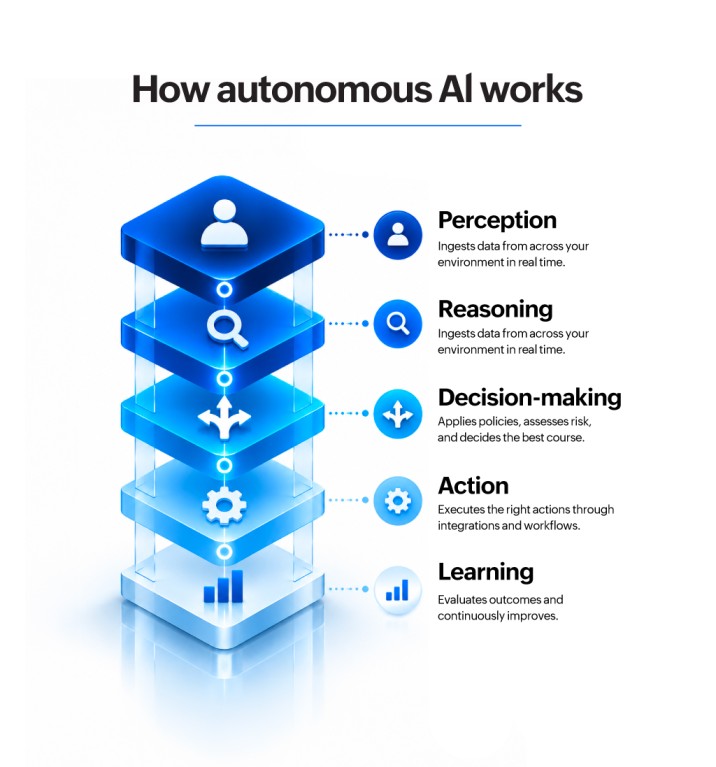
Under the hood, these systems follow a five-layer architecture. Skip any one layer and the whole thing falls apart.
- Perception: The system ingests metrics, logs, events, API responses, and network data in real time. It can't act on what it can't see, which is why observability is the foundation layer nobody talks about, the one everything else depends on.
- Reasoning: Large language models handle the "what does this mean" part. Specialized ML models handle anomaly detection and forecasting. Knowledge graphs connect the dots, tying a slow application to a recent deployment, a database lock, and a traffic spike that happened twenty minutes earlier.
- Decision-making: Policy engines define what the system is allowed to do. Risk scoring estimates how much damage a wrong move could cause. Confidence thresholds decide whether to act or to hand the decision to a person. This layer is the actual difference between Level 2 and Level 4. Everything else is mostly the same technology wearing a different level of trust.
- Action: The system carries out the required steps through API integrations, whether that's running remediation playbooks, triggering orchestration workflows, creating ITSM tickets, or rolling back a change if the fix introduces new issues.
- Learning: After every action, the system evaluates the outcome and improves over time. If a particular remediation consistently resolves a specific issue, it becomes more confident in applying it in the future. That's the key difference between autonomous AI and traditional automation—a script repeats the same action every time, while an autonomous system learns when it's the right action.
Benefits of autonomous AI
None of this matters if it doesn't translate into something you can actually point to. Here's what autonomy earns you in return for the trust you put in it.
- Faster resolution, because the queue disappears. A Level 2 system that scales resources when CPU crosses a threshold doesn't wait for someone to notice the alert, open a ticket, and get to it between other things. It acts in the time it takes to evaluate the rule, then logs what it did. For a recognized error pattern, that's the difference between a fix that lands in seconds and one that lands whenever a human's queue clears.
- The fifth time is as sharp as the first. A person handling the same category of incident for the fifth time that week is, understandably, a little less careful than they were on the first one. An autonomous system applies the exact same decision logic to incident five as it did to incident one, whether that's early in a shift or late in one.
- One playbook, not five interpretations. Give the same routine problem to five different engineers and you'll likely get five slightly different fixes, some better than others, depending on who's on call. An autonomous system runs the one playbook you've defined and tested, every time, which is what actually makes root-cause data trustworthy across a large environment instead of noisy.
- More of your team's time on the incident nobody's seen before. If routine remediation, alert correlation, and resource scaling get absorbed by the system, the hours that used to go into clearing that queue go instead to the one incident that doesn't match any known pattern, which is exactly the kind of problem a person, not a policy engine, should be reasoning through.
Risks and challenges in autonomous AI
This is the part worth reading slowly, because it's where most autonomous AI projects actually go wrong, not in the technology, but in what gets skipped on the way there.
Who's accountable when it's wrong: When an autonomous system causes harm, the question of who's responsible doesn't go away just because any human was in the loop. The EU AI Act requires meaningful human oversight for high-risk AI systems for exactly this reason. Without a clear audit trail showing what the system saw, decided, and did, you have no safety net.
Speed cuts both ways: The same trait that makes autonomous AI valuable, acting faster than a human could, also means it can make mistakes faster than a human can catch them. The guardrails you build before granting autonomy matter more than how capable the underlying model is.
The unglamorous cost of doing this right: Before an agent gets Level 3 authority, someone has to define what "high impact" means for your environment: any action touching a production database, any change affecting more than one region, any rollback during business hours? This work takes real time and doesn't demo well. Teams that skip it learn why it mattered the hard way.
Skill atrophy:The better an autonomous system gets at a job, the less your team practices doing that job. Two years of the system handling database failures perfectly can leave no one who knows the manual steps. Keep the runbook written and practice it occasionally.
Garbage in, garbage out, at machine speed: Feed a human inaccurate data and they'll usually notice something's off before acting on it. Feed an autonomous system the same inaccurate data, and it acts on it instantly, at scale, across every incident it touches, with no one pausing to double-check. Data quality isn't optional here. It's the thing everything else depends on.
This is not an argument against autonomous AI. It is a reminder to deploy it carefully, with the right safety checks in place, instead of rushing in because the technology is exciting.
How to get started
Frameworks are easy to nod along to. Here's what actually moves you from Level 1 to Level 2, in an order that won't blow up in your face.
- Figure out your actual level. Use the five-level framework honestly. Most organizations are at Level 1 or 2, and knowing that prevents two different mistakes: overreaching into autonomy you're not ready to govern, and underinvesting because you assume you're further behind than you are.
- Start with the obvious wins. Automate repetitive tasks like log anomaly triage, alert correlation, resource scaling, and remediation of known issues. These are low risk and deliver value quickly. Keep humans involved where decisions carry higher impact.
- Build confidence one step at a time. Start with task-specific agents, then expand into broader autonomous workflows as your data quality, guardrails, and trust improve. Define confidence thresholds and escalation paths before you increase the level of autonomy.
- Invest in observability before you invest in autonomy. You can't safely autonomize what you can't see clearly. Full-stack visibility across infrastructure, applications, and cloud environments is the perception layer every other part of this depends on, and it's worth getting right before anything else.
The competitive edge here isn't reaching full autonomy first. It's knowing precisely which level you're actually running, and having the discipline to earn the next one instead of assuming it.
Curious where your own IT operations actually sit on this scale? OpManager Nexus, with Zia AI and Zia Agents built in, is designed to help you find out and move up a level safely.
Frequently asked questions
1. What's the difference between autonomous AI and RPA?
Robotic process automation (RPA) is like an employee who follows a checklist exactly—this works well until something changes. If the system changes, RPA can break. Autonomous AI, on the other hand, understands the situation and decides what to do next, making it much more flexible. However, this adaptability means it needs safeguards that RPA never needed.
2. Is autonomous AI the same as agentic AI?
They are similar, but not the same. Agentic AI describes how a system works—it takes several steps, uses tools, and follows a plan. Autonomous AI is about how much you are still involved while it does this. You can have one without the other, but they often appear together.
3. How do I know if my organization is ready for Level 3 autonomy?
Ask yourself four questions: Do your Level 2 decisions have a good track record? Is every action logged with a clear audit trail? Do confidence thresholds flag unusual cases for a human? Have you tested your rollback paths before you needed them? If any answer is 'not yet,' start there instead of moving to the next level.
4. What happens when an autonomous system gets it wrong?
A well-designed system doesn't fail without notice. It records its decisions, saves the supporting data, and sends anything risky to a human before acting. This record lets your team review what happened and adjust the thresholds to prevent future mistakes.
5. Does more autonomy mean less work for IT teams?
Yes, but the difficult cases—those that are unclear or require judgment and don’t fit a standard playbook—still remain. Autonomy lets your team focus on these challenging problems instead of routine tasks. It changes the type of work, not how much thinking is needed.
6. Can OpManager Nexus help monitor the infrastructure that autonomous AI depends on?
Yes. OpManager Nexus gives you full-stack visibility across your infrastructure, applications, networks, and cloud environments — the same telemetry layer that autonomous AI depends on to sense, reason, and act. If a customer-facing service degrades or the digital experience drops, OpManager Nexus surfaces it. And when infrastructure-level automation or remediation needs to run, that's handled in the same platform.
7. Does OpManager Nexus support autonomous incident remediation?
Yes. It processes many alerts and groups them into real problems, finds the root cause across your infrastructure, and runs remediation playbooks, all within the limits you set. If confidence is low or the risk is too high, it escalates the issue instead of guessing.
8. What's the difference between Zia Agents and Workflow Automation?
Workflow Automation is best for known problems with clear solutions—these are predictable and follow set rules. Zia Agents are used when things are more complicated, with no obvious cause and too many variables for a script. When this article discusses autonomous AI in action, it usually refers to Zia Agents.
9. Is autonomous AI safe to use in production?
Yes, as long as the right foundations are in place. You need confidence thresholds, limits on impact, audit trails, and clear escalation paths. These are not optional—they are what separate safe autonomy from risky behavior. OpManager Nexus’s automated workflows are built with these safeguards. The real risk is not in using autonomous AI, but in skipping the groundwork to move quickly.
10. How is autonomous AI different from a chatbot?
A chatbot waits for your input and then responds. Autonomous AI constantly monitors its environment and acts without being prompted. This move from reacting to acting on its own is what makes it powerful, and it’s also why having safeguards is even more important.