

On this page
Introduction: The breach you didn't plan for
Picture this: It is a Tuesday morning and your security operations center flags an anomaly. By noon, you are fairly certain customer data has been exfiltrated. By evening, your legal team is telling you exactly how quickly you need to notify affected individuals—and the clock is already running— your CEO is asking what you can say publicly, and you are calculating whether your current logging infrastructure will support the regulatory inquiry that is now almost inevitable.
If you do not already have a clear answer to each of those questions, this article is for you.
India's Digital Personal Data Protection Act (DPDPA) has fundamentally changed the calculus of data breach management for enterprises operating in the country. For the first time, organizations face codified obligations around breach notification, data minimization, and purpose limitation, with the prospect of significant financial penalties for non-compliance. Simultaneously, the broader threat environment has grown considerably more hostile: ransomware groups have shifted focus toward South Asian enterprises, supply chain attacks have compromised organizations through their vendor relationships, and phishing campaigns have grown in both sophistication and volume.
Organizations that manage this environment well are not necessarily the ones with the largest security budgets. They are the ones that have thought through the scenarios in advance, documented their response plans, and built the governance structures to execute those plans when the pressure is on.
This article addresses the three areas where most Indian enterprises still have meaningful gaps: understanding and quantifying cyber risk, building genuine breach readiness, and meeting reporting obligations in a way that satisfies regulators without creating additional legal exposure.
Understanding cyber risk in the Indian context
Most organizations know they face cyber risk. Far fewer can explain what that risk actually costs them—or prove it to anyone who matters.
Why risk quantification matters
Security teams have historically spoken in qualitative terms: high, medium, low. That language made sense when security was primarily a technical conversation. It becomes inadequate when the conversation involves the board, the CFO, or an external auditor who wants to understand financial exposure.
Cyber risk quantification translates threat scenarios into financial impact estimates. The most widely adopted methodology is Factor Analysis of Information Risk (FAIR™), which models risk as a function of loss event frequency and probable loss magnitude. In practice, this means asking: How often is a given attack scenario likely to occur, and what would it cost when it does?
The goal of risk quantification is not a precise number. It is a defensible estimate that is good enough to prioritize security investment and communicate exposure to stakeholders who do not speak in CVE scores.
The threat landscape specific to Indian enterprises
The threats are not theoretical. Several attack patterns have become consistent enough in the Indian context to warrant specific preparation.
Ransomware targeting critical sectors
Healthcare, manufacturing, and financial services organizations in India have faced a disproportionate share of ransomware incidents. The pattern is consistent: initial access through phishing or unpatched remote access infrastructure, lateral movement through poorly segmented networks, and data exfiltration preceding encryption to maximize leverage.
Business email compromise
Business email compromise (BEC) continues to be one of the highest-value attack vectors for financially motivated actors. Attackers compromise or impersonate executive email accounts to redirect payments or manipulate internal approvals. The losses per incident are typically higher than most ransomware events.
Supply chain and third-party risk
Indian enterprises frequently rely on many managed service providers, IT vendors, and cloud platforms. A compromise at any point in that chain can create a breach at the enterprise level, even if the enterprise's own infrastructure is well defended.
Insider threats
Both malicious insiders and negligent employees remain significant contributors to data incidents. The DPDPA's provisions on data processing by employees make this an area of increasing legal relevance.
Building a risk register that works under scrutiny
A risk register is only useful if it reflects the actual threat environment, is maintained on a regular cadence, and connects identified risks to specific controls. Registers that are created once during an audit cycle and filed away until the next one do not serve their purpose.
Each entry in a working risk register should capture the threat scenario, the assets at risk, the likelihood of occurrence over a defined period, the estimated financial impact, the controls currently in place to reduce that risk, and the residual risk after those controls are applied. It should be reviewed at least quarterly, with updates triggered by significant changes in the threat environment or the internal control environment.
| Threat scenario | Assets at risk | Likelihood | Impact | Residual risk |
|---|---|---|---|---|
| Ransomware via phishing | Production systems, customer data | High | Critical | Medium |
| Third-party vendor compromise | Shared systems, API integrations | Medium | High | Medium |
| Insider data exfiltration | Customer PII, financial records | Medium | High | Low |
This is a sample risk register format. Likelihood and impact ratings should be defined with consistent criteria across the organization.
Data breach readiness: What good looks like
Readiness is not a checklist you complete. It is a capability you build and maintain.
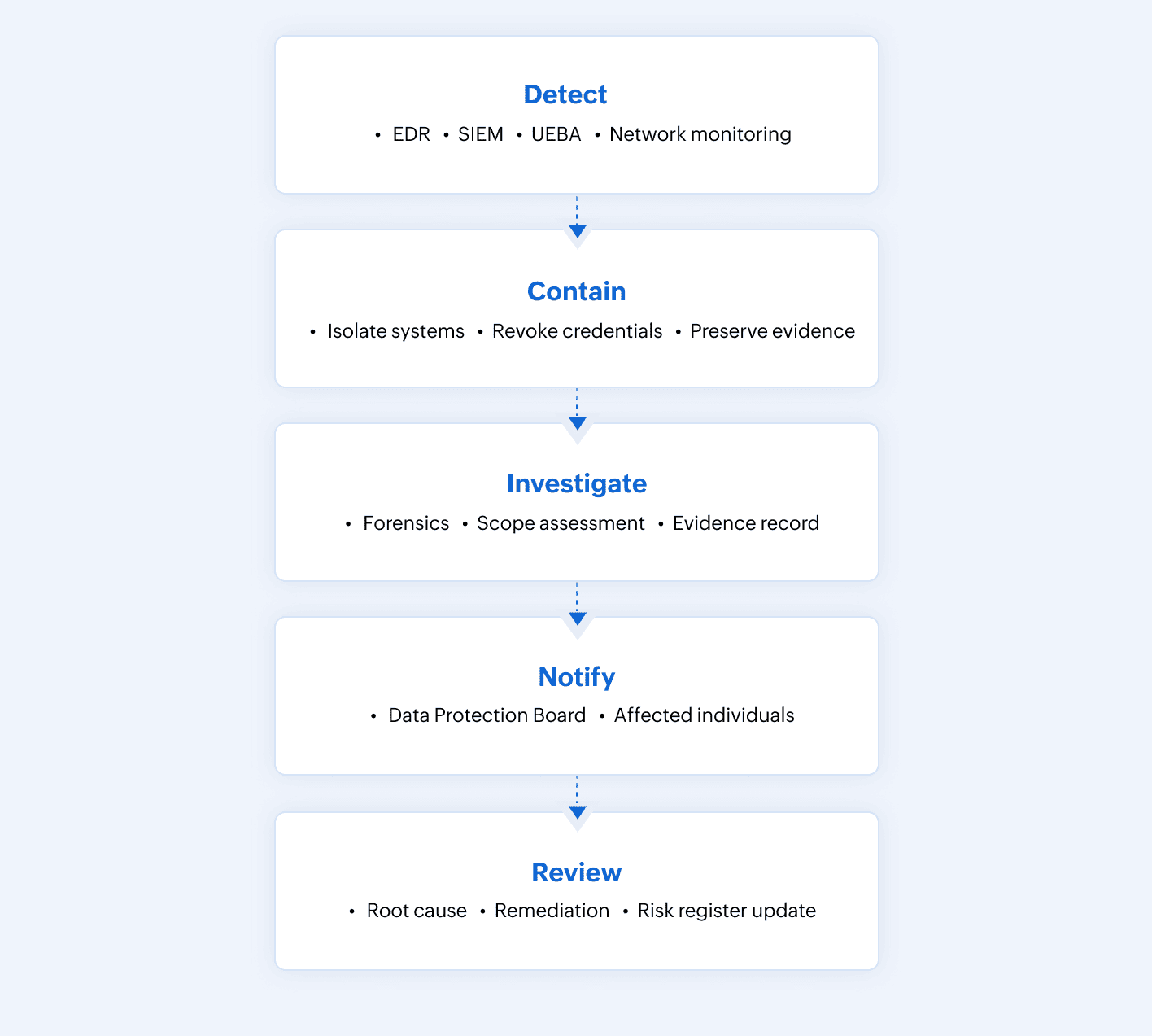
Five stages every Indian enterprise must have documented and tested. Each stage must produce documented, timestamped evidence for regulatory reporting under the DPDPA.
The difference between a plan and a program
Most organizations have an incident response plan. It lives in a folder, which was written eighteen months ago, and has never been tested against a realistic scenario. That is not a program; it is a document. A program involves regular testing, assigned ownership, updated playbooks, and integration with the tools your team actually uses during an incident.
Breach readiness has four components that must work together: detection, containment, investigation, and notification. A weakness in any one of them creates downstream problems.
The question to ask your security team is not "do we have an incident response plan?" It is "when did we last run a tabletop exercise, and what changed after it?"
Detection: Knowing something is wrong
The average dwell time for attackers in enterprise environments—the period between initial compromise and detection—remains measured in weeks or months rather than hours. That gap exists because detection is hard, alert volumes are overwhelming, and many organizations lack the telemetry needed to identify subtle indicators of compromise.
Effective detection requires a layered approach: endpoint detection and response (EDR) across all managed devices, with behavioral analysis capable of identifying fileless malware and lateral movement techniques; network traffic analysis to detect unusual data flows, protocol anomalies, and communication with known-malicious infrastructure; user and entity behavior analytics (UEBA) to identify access patterns that deviate from established baselines; and a centralized security information and event management ( SIEM ) platform that correlates events across sources. Without correlation, individual logs are noise. With it, they become signals.
Containment: Limiting the damage
Once an incident is detected, the first objective is containment—stopping the bleeding before it becomes a hemorrhage. Effective containment requires the ability to isolate affected systems rapidly, revoke compromised credentials without disrupting business operations, and preserve the forensic evidence needed for subsequent investigation.
Two failure modes are particularly common here. The first is over-containment: taking systems offline prematurely in ways that disrupt critical business functions and destroy forensic evidence. The second is under-containment: failing to identify and isolate all affected systems because the initial scope assessment was too narrow. Both require experience to avoid.
Playbooks for common incident types—ransomware, credential compromise, data exfiltration, BEC—should be developed in advance and tested against realistic scenarios. The playbook should define decision authorities: who can authorize taking a production system offline, who has the authority to engage external forensic support, and who makes the call to initiate regulatory notification procedures.
The DPDPA and breach notification obligations
The DPDPA 2023 represents India's most significant data protection legislation since the IT Act. For breach response teams, the notification provisions are the most immediately operationally relevant.
Under the DPDPA, data fiduciaries are required to notify the Data Protection Board of India and affected data principals in the event of a personal data breach. The specific timelines and detailed procedural requirements will be defined by rules to be issued under the Act, which are currently in development. Organizations should monitor for these rules and build notification workflows that can accommodate the expected timelines once they are published.
What organizations can do to prepare now:
- Establish a documented process for breach identification and initial severity assessment, including criteria for determining whether personal data is involved.
- Designate a data protection officer or equivalent role with clear authority and responsibility for managing regulatory notifications.
- Build a breach notification template library covering the key information categories: nature of the breach, categories and approximate number of individuals affected, likely consequences, and measures taken or proposed to address the breach.
- Create a legal review workflow that can operate under time pressure—notification decisions should not wait for a committee meeting.
The notification process is not simply a compliance obligation. How an organization communicates a breach significantly affects the reputational damage that follows. Organizations that notify proactively, clearly, and with evidence of a genuine remediation effort consistently fare better in subsequent regulatory scrutiny than those that communicate defensively or incompletely.
The investigation phase: Building an evidence record
The forensic investigation serves multiple purposes: understanding how the breach occurred, determining its full scope, supporting remediation, and generating the evidence record that will be required if regulatory inquiries follow.
Log integrity is the foundation of that evidence record. Logs that have been tampered with, overwritten, or simply not retained long enough are not evidence. Organizations should configure log retention policies with regulatory requirements in mind: for most enterprises, ninety days of hot storage with twelve months of cold archive represents a defensible baseline, though specific regulatory frameworks may require more.
Write once, read many (WORM) storage for critical audit logs prevents tampering and satisfies the tamper-evidence requirements that regulators increasingly look for. SIEM integration enables both real-time detection and retrospective investigation.
Building a privacy-centric security culture
Controls keep the doors locked. Culture determines whether people bother to close them.
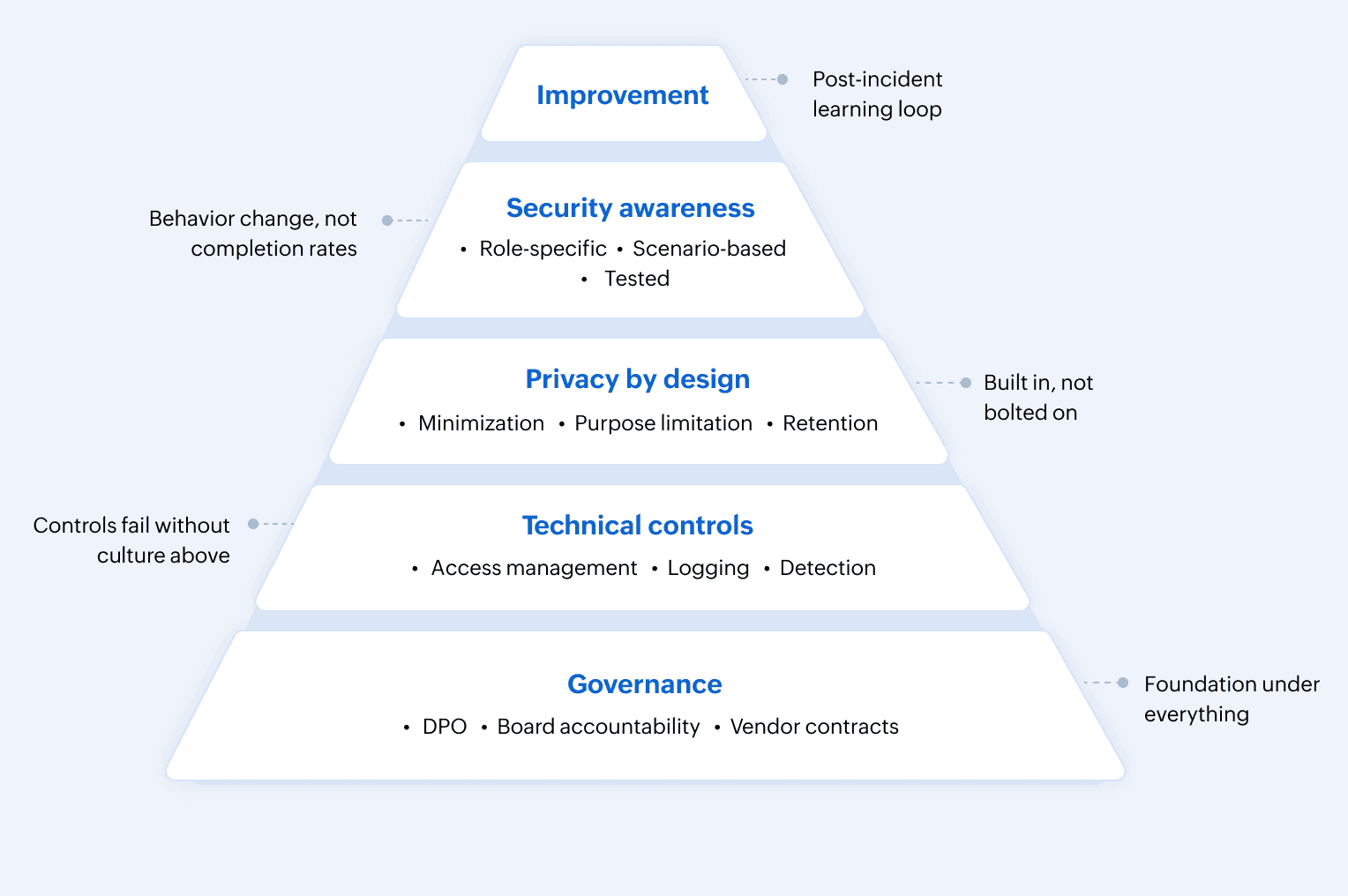
Each layer depends on the one below it. Culture without governance is decoration.
Why culture is not a soft topic
Technology controls fail when people route around them. The most sophisticated endpoint detection platform is undermined if employees feel entitled to email sensitive data to personal accounts. The most rigorous access control policy does not help if managers approve access requests without reading them.
Security culture is the aggregate of habits, norms, and attitudes that determine how an organization's people actually behave around security. Building a privacy-centric security culture means making data protection a default behavior rather than an occasional compliance exercise.
Privacy by design
Privacy by design is a principle that has existed in data protection literature for decades and has been given legal weight by frameworks including the DPDPA and its equivalents internationally. In operational terms, it means building privacy considerations into system design, data processing workflows, and vendor contracts from the outset, rather than reviewing them after the fact.
For Indian enterprises, the most practical applications of privacy by design are:
Data minimization: Collect only the personal data that is necessary for the stated purpose. Every additional data element collected is additional liability. Audit existing data collection practices to identify fields that are collected routinely but never actually used.
Purpose limitation: Personal data collected for one purpose should not be used for another without fresh consent. This requires mapping data flows so that it is actually clear what data is collected, where it goes, and what it is used for.
Access controls aligned with role: Not everyone in the organization needs access to personal data. Role-based access controls, regularly reviewed through access certification campaigns, reduce the exposure to insider threats and limit the blast radius of a credential compromise.
Retention and deletion: Personal data that is no longer needed for its original purpose should be deleted or anonymized. Retaining data indefinitely creates both regulatory exposure and security risk.
The role of leadership and governance
Security culture does not change through awareness training alone. It changes when leadership visibly prioritizes security, when accountability for data protection is assigned rather than assumed, and when the organizational incentive structure rewards security-conscious behavior rather than just operational speed.
Board and senior leadership accountability for data protection is becoming more explicit as regulatory frameworks mature. The DPDPA's provisions on organizational accountability are consistent with a global trend: regulators are increasingly interested in governance structures and evidence of senior-level engagement, not just technical control implementations.
Practical governance measures that signal seriousness: a named data protection officer with direct access to senior leadership and a clearly defined mandate; regular board-level reporting on the organization's risk posture, including metrics on security incidents, access control compliance, and audit findings; an internal security review process for new products and services, with documented approval before personal data processing begins; and third-party vendor contracts that include data protection obligations, audit rights, and breach notification requirements. A vendor's breach that involves your customer data is your breach from a regulatory perspective.
Security awareness that actually changes behavior
Generic security awareness training is largely ineffective. Employees know they should not click suspicious links; they click them anyway because the link looked credible, they were in a hurry, or they have never seen a realistic example of what a phishing email targeting their organization actually looks like.
Effective security awareness programs are role-specific, scenario-based, and regularly tested with simulated phishing or social engineering exercises. A finance team needs awareness training that focuses on BEC and fraudulent payment requests. A developer team needs secure coding practices and guidance on handling secrets in code repositories. A customer service team needs clear protocols for verifying identity before disclosing account information.
The metric that matters is not training completion rate. It is behavior change: phishing simulation click rates over time, number of security incidents attributable to employee error, and the proportion of employees who report suspicious activity rather than ignore it.
Regulatory reporting: Getting it right
What you say to regulators matters almost as much as what you did before the breach.
What regulators look for
Regulatory inquiries following a data breach are fundamentally an examination of governance. Regulators want to understand whether: the organization had appropriate controls in place, it detected the breach in a reasonable timeframe, it responded appropriately, and it communicated honestly with affected individuals and authorities.
The organizations that fare best in regulatory inquiries are those that can demonstrate a documented control environment, produce audit-quality evidence of their response activities, and show that they took the breach seriously and acted to prevent recurrence. The organizations that fare worst are those that know of gaps and do nothing about them, or that communicate in ways that appear evasive or incomplete.
Documentation as compliance output
Every step of the incident response process should produce contemporaneous documentation. This is not purely a compliance exercise—detailed records help the response team track what has been done, what decisions were made and by whom, and what the current scope assessment is. The documentation also forms the evidence record for any subsequent regulatory review.
Key documentation outputs that should be generated during every significant security incident:
- An incident log: A timestamped, continuously updated record of events, decisions, and actions taken from initial detection through closure.
- A scope assessment document: A continuously updated record of the systems, data, and individuals affected, based on forensic findings.
- Decision records: For significant decisions—containment actions, notification decisions, external engagement—a brief record of who made the decision, on what basis, and when.
- Communications records: Copies of all notifications sent to regulators, affected individuals, and other parties, with timestamps.
Notification content: What to say and how to say it
Regulatory notifications and individual notifications serve different audiences and purposes. Regulatory notifications are primarily an accountability mechanism—they allow the regulator to assess whether the organization has responded appropriately and whether enforcement action is warranted. Individual notifications are primarily a protection mechanism—they give affected individuals the information they need to protect themselves.
Both should address the same core questions: what happened, when did it happen, what data was affected, what risks does it create for affected individuals, and what is the organization doing about it? Individual notifications should be written in plain language that a non-technical reader can understand.
Avoid legal language that obscures rather than informs. A notification that reads like a liability waiver may satisfy the letter of the law while failing its intent—and regulators have noticed.
Post-incident review: Closing the loop
The post-incident review is where organizations either improve or repeat themselves. A rigorous post-incident review identifies root causes rather than symptoms, assesses whether controls functioned as intended, identifies gaps that allowed the incident to occur or persist, and generates specific, time-bound remediation actions with assigned owners.
Post-incident reviews should also assess the response process itself: was the incident detected quickly enough, did the notification process work under pressure, and were the right people involved at the right times? These process findings inform improvements to playbooks and governance structures.
The findings of post-incident reviews should be documented and should feed into the updates to the risk register. A breach that resulted from a known control gap that was risk-accepted is a different finding from a breach that resulted from an unknown vulnerability. Both have implications for how the organization updates its risk posture.
Closing thoughts
Cyber risk, breach readiness, and regulatory reporting are three areas that are typically discussed in separate conversations: risk management, security operations, and legal compliance. The organizations that manage them best treat them as a single discipline with shared infrastructure—the same logging environment that supports detection also produces the evidence record for regulatory reporting; the same access governance that reduces the exposure to insider threats also generates the audit trail that demonstrates control to a regulator.
India's DPDPA represents a maturation of the regulatory environment that most sectors were already anticipating. The organizations that have invested in foundational capabilities—good logging, strong access controls, documented response procedures—will find compliance substantially less disruptive than those that are building from the ground up under regulatory pressure.
The principle is straightforward, even if the implementation is not: know what data you hold, control who can access it, detect when something goes wrong, and respond in a way that is documented and can be defended. Those four principles are not a compliance checklist. They are the description of an organization that takes data protection seriously.
Related solutions
ManageEngine AD360 addresses the access governance dimension of data protection. Automate the joiner-mover-leaver life cycle, enforce role-based access across Active Directory and connected applications, and generate the timestamped access audit trail that demonstrates to regulators that personal data was accessed only by those authorized to access it.
Schedule a personalized demoManageEngine Log360 provides the detection and evidence infrastructure that breach readiness depends on. Correlate logs across endpoints, cloud platforms, and network devices, surface anomalous user behavior through built-in UEBA, and preserve audit records in tamper-evident WORM storage that holds up under DPDPA regulatory scrutiny.
Request a personalized demo