What are network mapping protocols?
Network mapping protocols are the communication protocols and data sources that network mapping tools use to discover devices, identify network relationships, and build accurate network maps. Since no single protocol can fully represent an enterprise network, modern mapping solutions combine multiple discovery methods to understand devices, connectivity, routing, and network structure.
This article explains why network mapping relies on multiple protocols, what each one contributes, where protocol-based discovery falls short, how modern mapping solutions overcome those limitations, and how to choose the right protocol stack for your environment.
Why network mapping relies on multiple protocols
To build an accurate network map, a mapping solution has to answer several different questions about the network.
- What devices exist?
- Which devices are connected to one another?
- How does traffic move between different parts of the network?
- Is this information still current?
Each question depends on a different type of network information.
A device may respond to ICMP, confirming that it is reachable, but not where it connects. LLDP and CDP identify neighboring devices, but not how traffic traverses multiple networks. SNMP exposes detailed device and interface information, but cannot, by itself, describe the network's complete topology.
No protocol is valuable in isolation. The value emerges when their observations are combined to answer questions no individual protocol can answer alone. Understanding this starts with knowing what each protocol contributes to the mapping process.
The common network mapping protocols and what each contributes
| Protocol / Data Source | Primary purpose | What it contributes to network mapping | Typical limitation |
|---|---|---|---|
| ICMP | Host discovery | Identifies reachable devices and live IP addresses | Doesn't reveal device relationships or topology. |
| SNMP | Device interrogation | Discovers device identity, interfaces, system information, and operational attributes. | Depends on credentials, supported MIBs, and device configuration. |
| LLDP | Layer 2 neighbor discovery | Identifies directly connected neighboring devices across multi-vendor environments. | Only discovers adjacent neighbors. |
| CDP | Cisco neighbor discovery | Discovers neighboring Cisco devices and their interfaces. | Limited to Cisco environments. |
| ARP | Address resolution | Associates IP addresses with MAC addresses, helping place endpoints within the network. | Limited to the local Layer 2 broadcast domain. |
| MAC address tables | Layer 2 forwarding information | Associates endpoints with switch ports and Layer 2 forwarding paths. | Depends on populated forwarding tables. |
| Routing tables | Layer 3 discovery | Reveals routing paths, next hops, and network reachability. | Doesn't describe physical connectivity between devices. |
| SSH / WMI / Cloud APIs | Configuration and platform discovery | Collects configuration details, virtualization metadata, and cloud relationships that traditional discovery protocols cannot expose. | Requires credentials, platform support, and appropriate access. |
How multiple discovery protocols work together to build network visibility
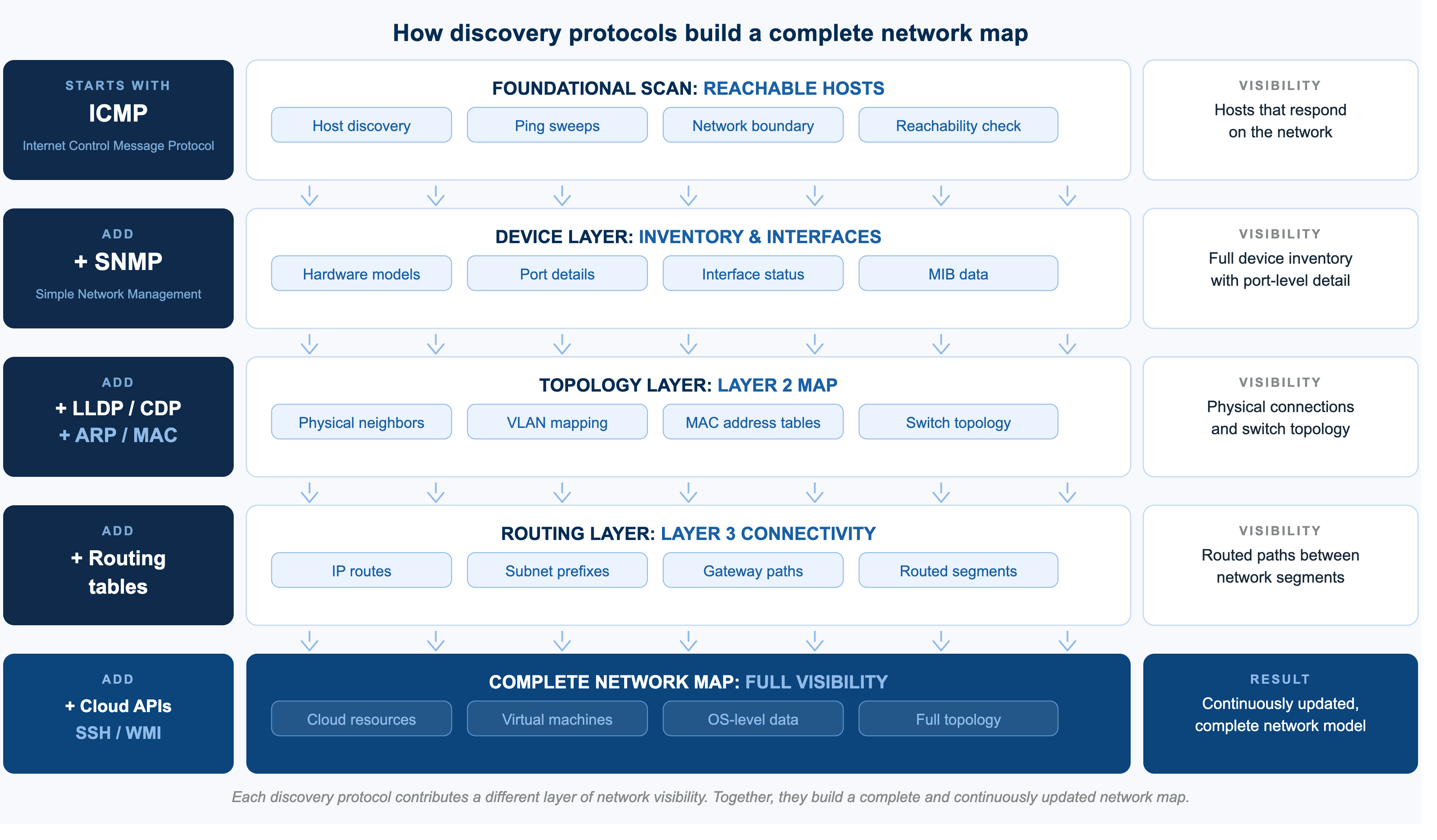
The table above explains what each protocol contributes individually. The illustration below shows how those contributions build on one another to create a complete network map.
Where protocol-based discovery falls short and how modern tools overcome it
Every discovery protocol has limitations. Enterprise networks add another layer of complexity, making complete discovery difficult without combining multiple sources of information.
Neighbor discovery isn't always available
LLDP and CDP rely on neighboring devices advertising their identities. If these protocols are disabled, unsupported, or unavailable on parts of the network, discovery may miss legitimate connections even though the physical links exist.
How modern tools address this: Rather than relying solely on neighbor discovery, modern mapping solutions correlate information from SNMP, ARP tables, MAC address tables, routing information, and other discovery sources to reconstruct missing relationships.
Discovery sources don't always agree
Different discovery protocols can occasionally report conflicting information because they observe the network from different perspectives or at different points in time. For example, LLDP may identify one neighboring device while ARP or MAC address tables reflect information that has not yet converged or has become stale.
How modern tools address this: Rather than treating one protocol as authoritative, modern mapping solutions correlate observations from multiple discovery sources and reconcile inconsistencies to build the most accurate network model possible.
Device interrogation depends on access
Protocols such as SNMP can expose rich information about devices, interfaces, and operational attributes—but only when credentials, permissions, and supported MIBs allow it. Restricted access, incomplete MIB implementations, or inconsistent device configurations can reduce discovery coverage.
How mapping tools address this: Enterprise mapping tools supplement SNMP with additional discovery methods, reducing dependence on any single protocol and improving overall discovery accuracy.
Modern infrastructure hides relationships
Cloud resources, virtual machines, containers, SD-WAN overlays, and software-defined networks introduce relationships that traditional discovery protocols were never designed to expose.
How modern tools address this: Cloud APIs, virtualization platforms, configuration data, and infrastructure-specific connectors extend discovery beyond traditional network protocols, allowing topology maps to represent hybrid environments more accurately.
Security intentionally limits visibility
Firewalls, ACLs, segmented management networks, and other security controls often restrict discovery traffic. In many environments, incomplete visibility is an intentional security decision rather than a discovery failure.
How modern tools address this: Instead of treating missing information as missing connectivity, modern mapping solutions continuously correlate information gathered across repeated discovery cycles, gradually improving the completeness of the network map as additional evidence becomes available.
How to choose the right protocol stack for your environment
The right protocol stack depends on the level of visibility your environment requires. As networks become larger and more distributed, additional discovery methods become necessary to accurately identify devices, understand connectivity, and maintain current topology maps.
| Environment | Recommended protocol stack | What it enables |
|---|---|---|
| Home labs and small networks | ICMP + SNMP | Discovers live devices, builds a basic inventory, and supports foundational monitoring. |
| Small and mid-sized business networks | ICMP + SNMP + LLDP/CDP | Adds Layer 2 topology, making it easier to understand how managed devices connect. |
| Enterprise networks | ICMP + SNMP + LLDP/CDP + ARP + MAC address tables + Routing tables | Builds accurate Layer 2 and Layer 3 topology across distributed environments. |
| Hybrid and cloud environments | Enterprise protocol stack + Cloud APIs + SSH/WMI (where applicable) | Extends discovery into cloud platforms, virtualization layers, and software-defined infrastructure. |
Protocol-based considerations in choosing a mapping tool
Protocol support alone doesn't determine mapping quality. An effective mapping solution should use those protocols to build a network map that's accurate, current, and complete enough for the operational demands of your environment.
It should:
- Support the right discovery protocols your environment relies on, including SNMP, LLDP, CDP, routing information, and cloud-native discovery where applicable.
- Correlate discovery data collected through different protocols into one consistent network model rather than treating each discovery source independently.
- Discover across vendors by supporting both vendor-neutral and vendor-specific protocols to accurately map mixed-vendor environments.
- Extend discovery beyond the network, including cloud resources, virtual infrastructure, SD-WAN, and software-defined environments alongside traditional network devices.
- Keep topology synchronized by continuously rediscovering the network so topology maps remain aligned with infrastructure changes.
ManageEngine OpManager: Multi-protocol discovery for enterprise network mapping
ManageEngine OpManager combines automated network discovery, topology mapping, and network monitoring into a unified workflow.
Using protocols such as SNMP, LLDP, CDP, ARP, routing information, and other supported discovery methods, OpManager discovers devices, identifies Layer 2 and Layer 3 relationships, and automatically updates topology maps as the network changes.
Because topology mapping is integrated with monitoring, administrators can move directly from a topology view to device health, interface performance, fault alerts, dependency information, and root-cause analysis without switching between separate tools. The result is a continuously updated view of both how the network is connected and how it is performing.
Frequently asked questions
What is the optimal mix of protocols for network mapping?
Can network mapping protocols discover cloud resources?
Why do some devices or links not appear in the map?
What is the difference between CDP and LLDP?
What are the safest protocols for network mapping?
By Javith Razvi,
ManageEngine Team