Predictive networks
With increased customer expectations and highly demanding SLAs, IT admins have minimal wiggle room when it comes to managing their networks. Apart from keeping the lights on, organizations now also have to ensure the optimum performance of their network devices and the applications that run on them. Today's resource-intensive applications make staying out of network disruptions and ensuring a reliable QoS a major challenge for organizations.
Conventional network management practices can't scale to meet the needs of modern networks. To overcome operational bottlenecks, improve efficiency, and deliver an enhanced end-user experience, organizations are leveraging modern technologies to deliver the best possible results.
Challenges in network monitoring
While modern day technologies have made networks more agile and resilient, they also add complexity. Some challenges with monitoring today's networks involve:
- Software-defined networks: While software-defined networks help organizations automate their IT operations, they also generate a vast amount of data, which must be stored and processed. Furthermore, with the abstraction of software resources from the underlying hardware infrastructure, they can also lead to decreased network visibility.
- Cloud adoption and transition: According to a recent survey by Google, 41.4% of IT leaders are increasing their adoption of cloud-based technologies and services. While cloud adoption helps organizations scale their network at will, it also involves monitoring their on-premises and cloud environments alike, which further hinders network visibility.
- Distributed environment: Business networks are moving from a conventional, centralized architecture to a distributed environment to reduce latency and enhance efficiency. However, this also means that network admins have to monitor the data from multiple data centers, cloud platforms, and on-premises locations. Furthermore, due to the high traffic across the network, a more distributed environment might lead to higher network congestion.
- IoT and edge computing: The advent of IoT devices and edge computing has emphasized the importance of endpoint security. With multiple entry points into the network, network admins have to be more cautious than ever while monitoring incoming and outgoing traffic patterns and the health of edge devices—all of which is easier said than done.
To combat these ever-changing complexities, network admins have to take a proactive stance towards network monitoring. This helps them to stay ahead of network bottlenecks and enables them to mitigate mishaps as and when they occur.
What are predictive networks and how do they work?
Predictive network technology incorporates AI and ML to predict network trends, identify meaningful usage patterns, and detect anomalies in network behavior. This helps network admins anticipate performance and security issues well before they occur, thereby enhancing network performance and availability.
Predictive network gathers historical data and real-time metrics, which is stored and sent to analysis software for processing. The software uses AI and ML algorithms to create a data model based on the gathered information, which can be used to predict network behavior and performance trends.
As opposed to conventional networks, which initiate corrective actions only after an incident has already occurred, predictive networking offers a more proactive stance. Network admins can use predictive analytics to enhance the availability, performance, and operational efficiency of their networks.
What are the key benefits of predictive networks?
Here are some of the major benefits of deploying predictive networks:
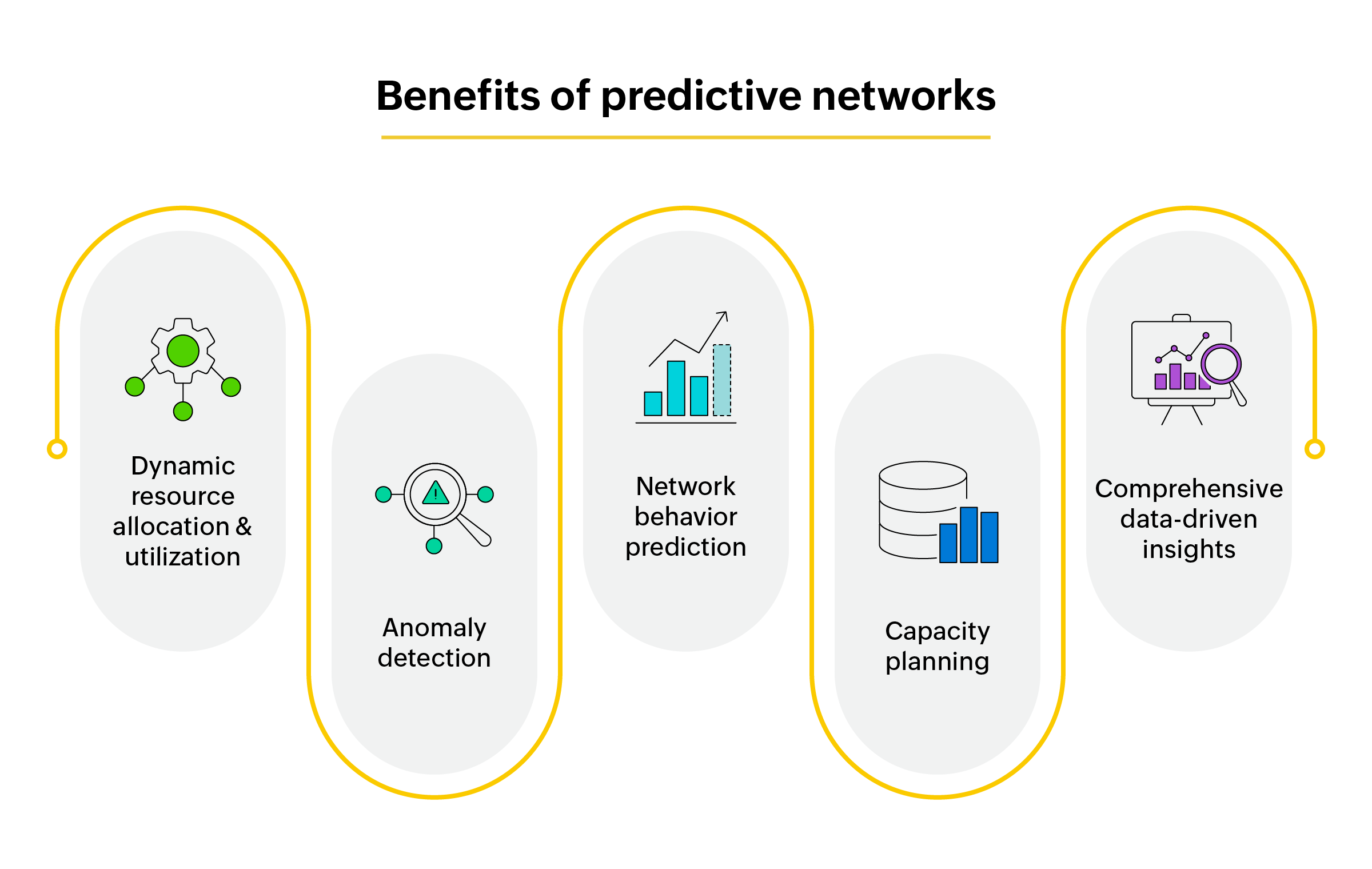
- Dynamic resource allocation and utilization: Predictive networks study the network's current state and requirements and allocates resources dynamically. This ensures that all business-critical devices and applications are equipped with the right amount of resources for their optimum functioning while reducing manual errors.
- Anomaly detection: Predictive networks are capable of detecting anomalies in network trends. After careful evaluation of the devices' historical and real-time data, predictive analytics can understand the network's usage patterns and then identify any inconsistencies, which may be a sign of an external security attack, or performance bottlenecks, which can be remediated by initiating the corrective actions.
- Network behavior prediction: By predicting network behavior, network admins can understand their network's requirements efficiently enough to identify and fix performance issues well before they occur. Furthermore, by analyzing network performance and traffic patterns, network admins can find areas for performance optimization.
- Capacity planning: Predictive networks, with the help of historical and real-time data, help network admins with capacity planning. It helps them optimize network performance, procure and provision resources efficiently, and bring down network operating costs.
- Comprehensive data-driven insights: Predictive networks help network admins with comprehensive data-driven insights, which are arrived at using both historical and real-time data. These insights can be used to formulate better network monitoring strategies that are aligned with business goals.
By using a network monitoring solution to collect, gather, and analyze data to forecast network trends, network admins can develop and sustain a predictive network that's less susceptible to outages, disruptions, and performance inefficiencies.
How ManageEngine OpManager helps you monitor and predict network trends
ManageEngine OpManager is a comprehensive network monitoring solution that leverages the power of AI and ML to dynamically allocate thresholds to individual devices based on their historical data and usage patterns. OpManager also brings automation to its multi-vendor and multi-cloud monitoring capabilities, helping you have comprehensive visibility into your network while averting frequent outages and disruptions.
With OpManager, you can leverage these key features to enhance your network monitoring strategy:
- Automated network discovery: Automatically discover all your network devices, along with their device dependencies using our automated network discovery feature. You can also take manual control of your device discovery by scheduling the discovery process to happen when it suits you. And, with OpManager's discovery rule engine, you can automate post-discovery actions.
- Automated threshold configuration: Automate your monitoring efforts by putting your threshold configuration process on autopilot with adaptive thresholds. Instead of manually studying the networks' historical and real-time data to establish performance baselines, you can automate this process, helping you save time and resources.
- Network behavior prediction: Predict your network's trends by forecasting performance trends. This helps you with capacity planning and resource allocation.
- Network visualization: Gain a granular representation of your entire network using our out-of-the-box network visualization features. With OpManager's comprehensive layouts, you can eliminate network blind spots, identify performance bottlenecks, pinpoint potential issues, and take corrective actions.
- Automated fault remediation: Initiate preliminary remediation measures using automated IT workflows. This helps you reduce manual intervention and also decreases the time taken to get a service back up and running.
- Seamless integrations: Integrate OpManager with the market's best ITSM tools, helping you to foster collaboration with various operation teams while simultaneously identifying and resolving issues quickly. By generating alerts and relaying them to the concerned technician, OpManager optimizes mean time to repair and helps keep network downtime to a minimum.
Want to know more about OpManager? Download a 30-day, free trial for a hands-on experience. Or, request a personalized demo with one of our product experts here!