
IT Fault Management is the end-to-end process of detecting, isolating, correlating, and resolving network or system faults to minimize downtime, reduce business impact, and maintain service-level agreements (SLAs).
Understanding fault management
Fault management is a foundational part of the FCAPS model (Fault, Configuration, Accounting, Performance, and Security) and ensures that enterprises maintain optimal uptime, user experience, and SLA compliance.
When a router crashes, a switch port goes down, or packet loss spikes, fault management steps in: first by identifying the fault, then diagnosing its cause, and finally restoring service. In modern hybrid environments spanning cloud, on-prem, and edge devices, this process demands automation, intelligence, and real-time visibility.
The Evolution: Traditional vs. Modern Fault Management
Fault management has shifted from reactive firefighting to proactive, predictive operations. The table below summarizes how the landscape has changed across key dimensions:
| Aspect | Traditional (Reactive) | Modern (Proactive) |
|---|---|---|
| Core Problem | Downtime detected after failure | Predicting faults before they affect services |
| Method | Manual log checks, ticket-driven troubleshooting | Real-time monitoring, AI-driven anomaly detection, automated workflows |
| RCA Process | Human-driven, device-by-device | AI/ML-assisted, correlates historical & real-time data |
| Tooling | SNMP polling, basic consoles, spreadsheets | Unified monitoring platforms with dashboards, topology maps, ITSM integrations |
| Resolution | Manual intervention & fixes | Automated remediation, failover, self-healing workflows |
| Speed & Efficiency | Slow, dependent on admin availability | Rapid detection & response, reduced MTTR |
| Business Impact / Decision Support | Limited insights, reactive SLA compliance | Proactive uptime, SLA assurance, predictive insights for decision-making |
While traditional fault management focused on fixing problems after they occurred, modern fault management emphasizes prediction, automation, and business continuity, helping IT teams minimize MTTR and maximize network resilience.
Common fault types in modern networks
To maintain uptime and service reliability, IT teams need to understand the major network fault types, which can arise from hardware, software, communication, security, or environmental issues. Recognizing these fault types helps detect problems early, isolate them quickly, and resolve them effectively.
| Fault types | What they are | How they're detected | Example |
|---|---|---|---|
| Hardware Faults | Malfunctioning routers, switches, or server components (NICs, power supplies). | SNMP traps, device health sensors, or SMART disk alerts. | A router fan failure or NIC crash causing partial connectivity loss. |
| Software Faults | Bugs, misconfigurations, or patch-related issues affecting devices, servers, or applications. | Syslog messages, configuration change alerts, and application performance monitors. | Misconfigured firewall rules blocking legitimate traffic. |
| Communication Faults | Packet loss, routing failures, or high latency impacting data transmission. | Traffic monitoring, synthetic probes, and anomaly alerts. | Dropped VoIP calls or slow application performance. |
| Security-Related Faults | Unauthorized access, DDoS attacks, or malware infections. | Abnormal traffic patterns, authentication logs, or intrusion alerts. | Suspicious login attempts triggering early warnings. |
| Environmental Faults | Power outages, overheating, or humidity fluctuations. | Environmental sensors like temperature monitors and UPS systems. | A data center temperature spike triggering preventive shutdowns. |
Fault management workflow
A well-structured fault management workflow helps network admins respond faster, minimize service impact, and ensure network reliability.
The 6 stages of the fault management lifecycle
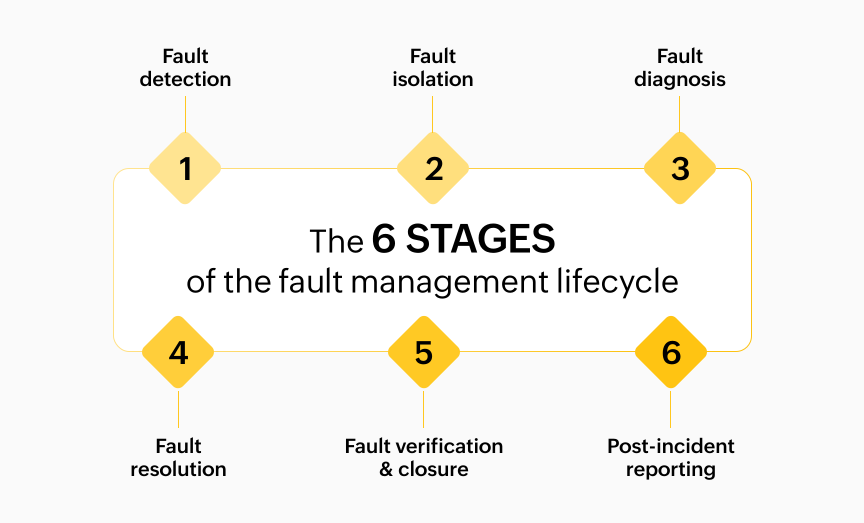
1. Fault detection
The process starts when the system detects an anomaly or event that signals abnormal behavior.
- Techniques: SNMP traps, syslogs, ICMP polling, and real-time telemetry streams.
- Modern approach: Instead of reacting to raw alerts, intelligent platforms use event correlation and anomaly detection to filter out false positives and highlight actionable insights.
- Example: If multiple routers in a region report link-down alerts, correlation tools can identify whether the real culprit is an upstream ISP issue.
2. Fault isolation
Once a fault is detected, the next step is pinpointing where and why it occurred.
- Methods: Root cause analysis (RCA), topology-based dependency mapping, and correlation engines.
- Goal: Identify the origin of the fault and prevent redundant alerts from flooding your console.
- Example: A spike in switch CPU utilization might initially appear as multiple link faults, but RCA reveals it’s due to a single misbehaving VLAN.
3. Fault diagnosis
At this stage, the focus shifts to understanding the impact and scope of the issue.
- Questions answered: Which services are affected? How severe is the impact? What’s the risk if not fixed immediately?
- Approach: Automated diagnostics, AI pattern recognition, and cross-layer data correlation (network, server, and application layers).
4. Fault resolution
This is where recovery begins. Fault resolution may involve:
- Manual interventions like restarting a service or replacing hardware.
- Automated workflows such as self-healing scripts triggered when certain thresholds are breached.
- Escalation protocols that alert relevant personnel based on incident severity.
- Example: When a link goes down, the system can automatically reroute traffic via redundant paths using SDN logic.
5. Fault verification & closure
Once resolved, the system verifies that the service has returned to normal.
- Techniques: Retesting device status, confirming service uptime, and clearing alert conditions.
- Goal: Ensure the issue is genuinely resolved, not temporarily suppressed.
6. Post-incident reporting
Finally, analytics come into play. Post-incident reviews identify trends, recurring fault patterns, and opportunities for prevention.
- Deliverables: Root cause reports, MTTR metrics, SLA compliance dashboards, and predictive insights for future fault avoidance.
In essence, this workflow ensures that fault management isn’t just about fixing problems; it’s about learning from them to build more resilient networks.
Why fault management is a core business strategy
For today’s digital enterprises, fault management goes beyond keeping systems online; it’s a business continuity enabler. Every minute of downtime affects customer trust, employee productivity, and revenue.
A robust fault management strategy directly supports:
- Operational resilience: Detecting and preventing outages before they spread.
- Compliance and governance: Maintaining audit trails and uptime SLAs.
- Customer experience: Ensuring consistent application and network performance.
Businesses that integrate fault management into their IT strategy not only reduce downtime but also demonstrate a commitment to service reliability; a competitive differentiator in 2025.
Fault isolation and recovery strategies
Fault isolation and recovery define how quickly an organization bounces back from incidents.
Key strategies include:
- Topology-aware isolation: Understanding interdependencies helps zero in on the true source of disruption.
- Policy-based automation: Predefined recovery scripts (like service restarts or traffic reroutes) triggered automatically.
- AI-based anomaly prediction: Using ML models to predict component failures before they occur.
- Cross-domain correlation: Integrating network, server, and application monitoring for holistic fault visibility.
The goal is to shorten MTTR (Mean Time to Repair) while minimizing manual intervention.
A 7-point checklist: Best practices for proactive fault isolation and recovery
Modern networks can’t wait for failures; they need proactive fault management. This checklist shows how IT teams detect, isolate, and resolve issues quickly to minimize downtime and keep services running smoothly.
1. Implement end-to-end visibility
- Comprehensive dashboards and topology maps for on-prem, cloud, and hybrid systems.
- Eliminates blind spots and enables instant fault isolation.
Tip: Integrate network, server, and application monitoring in a single interface.
2. Automate Fault Detection and Correlation
- Event correlation engines and AI noise suppression reduce false positives.
- Identify root causes instead of chasing symptoms.
Example: Suppress downstream “device unreachable” alerts and highlight the core switch causing the issue.
3. Adopt intelligent Root-Cause Analysis (RCA)
- ML-assisted RCA predicts probable fault sources from historical and real-time data.
- Accelerates isolation, reduces MTTR, and lowers operational noise.
4. Build automated recovery playbooks
- Scripts restart services, clear caches, reroute traffic, or rollback configurations automatically.
- Turns monitoring tools into self-healing systems.
5. Integrate fault management with ITSM workflows
- Platforms like ServiceNow or Jira automate alert tracking, resolution, and documentation.
- Maintains audit trails and SLA compliance.
Example: Automated reroute triggers a ticket and notifies the responsible team simultaneously.
6. Use Post-Incident Analytics to prevent recurrence
- Conduct analytics to detect trends and recurring issues.
- Transform incident data into predictive insights and preventive measures.
7. Continuously test and refine recovery policies
- Regularly review automation scripts, escalation paths, and redundancy mechanisms.
- Simulate faults in controlled environments to validate system response.
Pro tip: “Fire drill” simulations ensure your self-healing workflows are effective in real scenarios.
Takeaway: Combining visibility, automation, analytics, and continuous refinement results in faster isolation, smarter recovery, and stronger business continuity
ROI of effective fault management
Investing in a robust fault management strategy yields measurable returns.
| Metric | Without Fault Management | With Proactive Fault Management |
|---|---|---|
| Mean Time to Repair (MTTR) | 4–6 hours average | <1 hour with automation |
| Alert Fatigue | High; thousands of false alarms | 70% reduction with correlation |
| Network Downtime | Frequent and unplanned | Predictive prevention |
| Cost of Outages | High (lost productivity & SLA breaches) | 40–60% reduction |
| User Satisfaction | Unstable | Consistently high uptime |
Beyond metrics, the biggest ROI lies in predictive resilience; preventing issues before they impact users or revenue.
Real-world use case
A global logistics firm managing 3,000+ network devices struggled with random service outages. Manual troubleshooting consumed hours, and root causes often went unidentified.
After deploying an automated fault management system with event correlation:
- MTTR dropped from 4 hours to 30 minutes.
- Repeated link failure alerts were traced to a single faulty fiber switch.
- Predictive analytics identified routers likely to fail, enabling pre-emptive replacements.
The result: 99.97% uptime and smoother logistics operations worldwide.
Choosing the right fault management tool
The ideal fault management solution should unify visibility across hybrid environments and simplify incident response. You should look for tools that offer:
- AI-driven event correlation and anomaly detection.
- Automated workflows for fault isolation and recovery.
- Integration with ITSM platforms for streamlined ticketing.
- Comprehensive dashboards for RCA and trend analytics.
Tools like ManageEngine OpManager combine real-time monitoring, AI-driven fault correlation, and automated recovery workflows helping IT teams detect, diagnose, and resolve network issues before they affect business operations.
With OpManager, you can:
- Detect faults before they impact users through predictive analytics.
- Automatically isolate and remediate issues with self-healing scripts.
- Integrate seamlessly with ITSM platforms to maintain SLA compliance and detailed audit trails.
- Visualize network dependencies and trends to optimize future planning.
In short, OpManager transforms fault management from a reactive task into a proactive, intelligent strategy, helping businesses maintain uptime, improve operational efficiency, and reduce the risk of costly outages.
Wrapping up
Fault management has evolved from a reactive process to a predictive, data-driven discipline. In 2025, as networks grow more complex, the key isn’t just resolving faults; it’s anticipating them.
With AI-powered automation, contextual event correlation, and unified visibility, fault management empowers IT teams to maintain uptime, cut operational costs, and strengthen business resilience.
FAQs on network fault management:
What is the FCAPS model?
FCAPS is an ITU-T framework that defines the five categories of network management: Fault, Configuration, Accounting, Performance, and Security. Fault management is the foundational layer focused on ensuring network reliability.
What is the difference between fault management and performance management?
They are closely related. Fault management is primarily reactive and event-driven (e.g., "This device is down"). Performance management is proactive and trend-based (e.g., "This device's response time is slowing and will cause a fault soon"). A modern tool like OpManager combines both.
What are MTTR, MTTD, and MTBF?
These are key metrics used to measure the effectiveness of fault management:
MTTR (Mean Time to Resolution): The average time it takes to fix a fault after it's detected. This is the #1 metric to reduce.
MTTD (Mean Time to Detection): The average time it takes to notice a fault.
MTBF (Mean Time Between Failures): The average time a device runs before it fails.
How does AI actually help in fault management?
AI's primary role is to find patterns in massive amounts of data. It helps by:
1. Detecting anomalies that humans would miss,
2. Setting dynamic baselines to reduce false alerts, and
3. Correlating events to find the root cause automatically, which is the key to reducing alert fatigue.

By Monicaa,
Product Marketer, ManageEngine