OpenTelemetry Integration with Applications Manager
Application requests travel across APIs, containers, databases, queues, and cloud services before reaching the end user. When one component slows down, the impact spreads quickly across the entire application stack. With the OpenTelemetry integration, Applications Manager helps to ingest, correlate, and analyze distributed trace telemetry from applications in one unified monitoring platform.
From distributed traces to transaction visibility, engineering teams gain the visibility required to detect issues early, and reduce troubleshooting time, which in turn improves application reliability.
Why teams adopt OpenTelemetry
OpenTelemetry has become the preferred framework for telemetry instrumentation, owing to its consistent and vendor-neutral approach to observability. Instead of relying on separate monitoring agents for different technologies, teams can instrument applications once and export telemetry data wherever needed with Applications Manager's OpenTelemetry monitoring.
What this means in practice
| Challenge | How OpenTelemetry Helps |
|---|---|
| Fragmented monitoring tools | Standardizes telemetry collection across environments |
| Limited visibility into microservices | Tracks requests across distributed architectures |
| Complex vendor-specific instrumentation | Uses open APIs and SDKs |
| Difficulty tracing transactions across services | Connects telemetry signals across services |
| Rapid cloud-native adoption | Supports containers, Kubernetes, and modern workloads |
What Applications Manager brings to OpenTelemetry
Applications Manager extends OpenTelemetry beyond telemetry collection. It transforms distributed trace data into actionable performance insights.
Unified observability for distributed systems
Telemetry data from multiple services appear within a centralized monitoring layer, which makes it easier to understand application behavior across environments. Teams can:
- Trace service-to-service communication.
- Visualize application dependencies.
- Detect cascading failures across services.
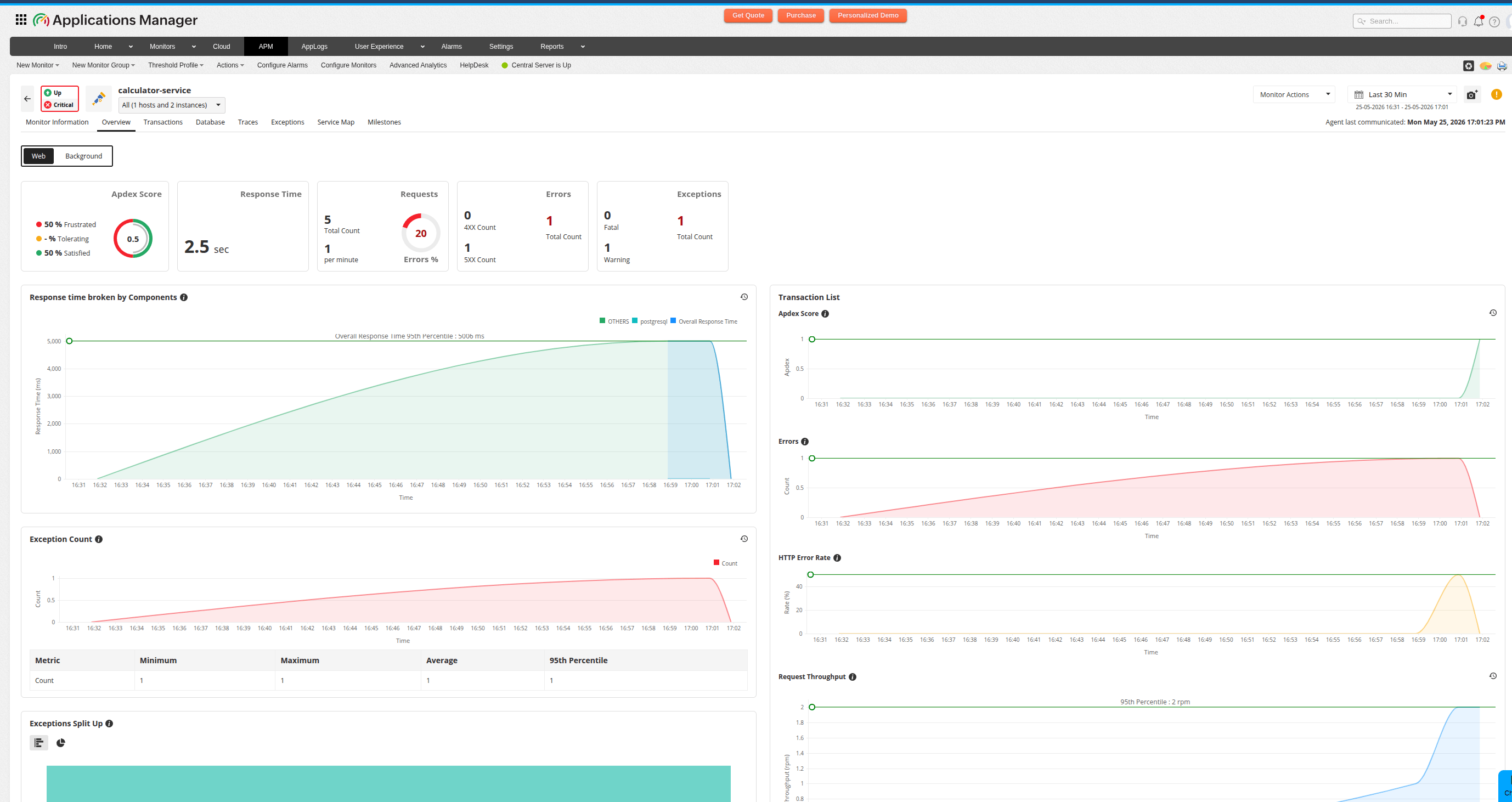
Analyze transaction performance end to end Interactive monitoring experience
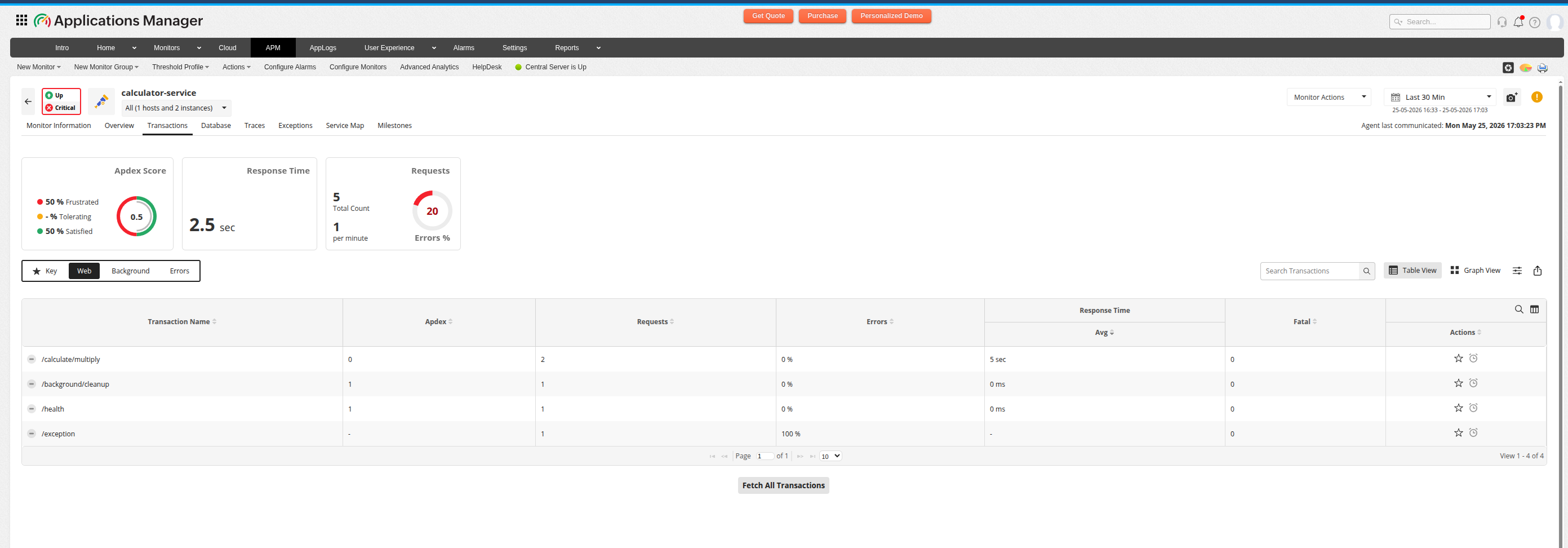
Instead of static monitoring views, Applications Manager delivers an exploratory observability experience where teams can move between traces, transactions, and application dependencies instantly.
Explore telemetry from multiple angles
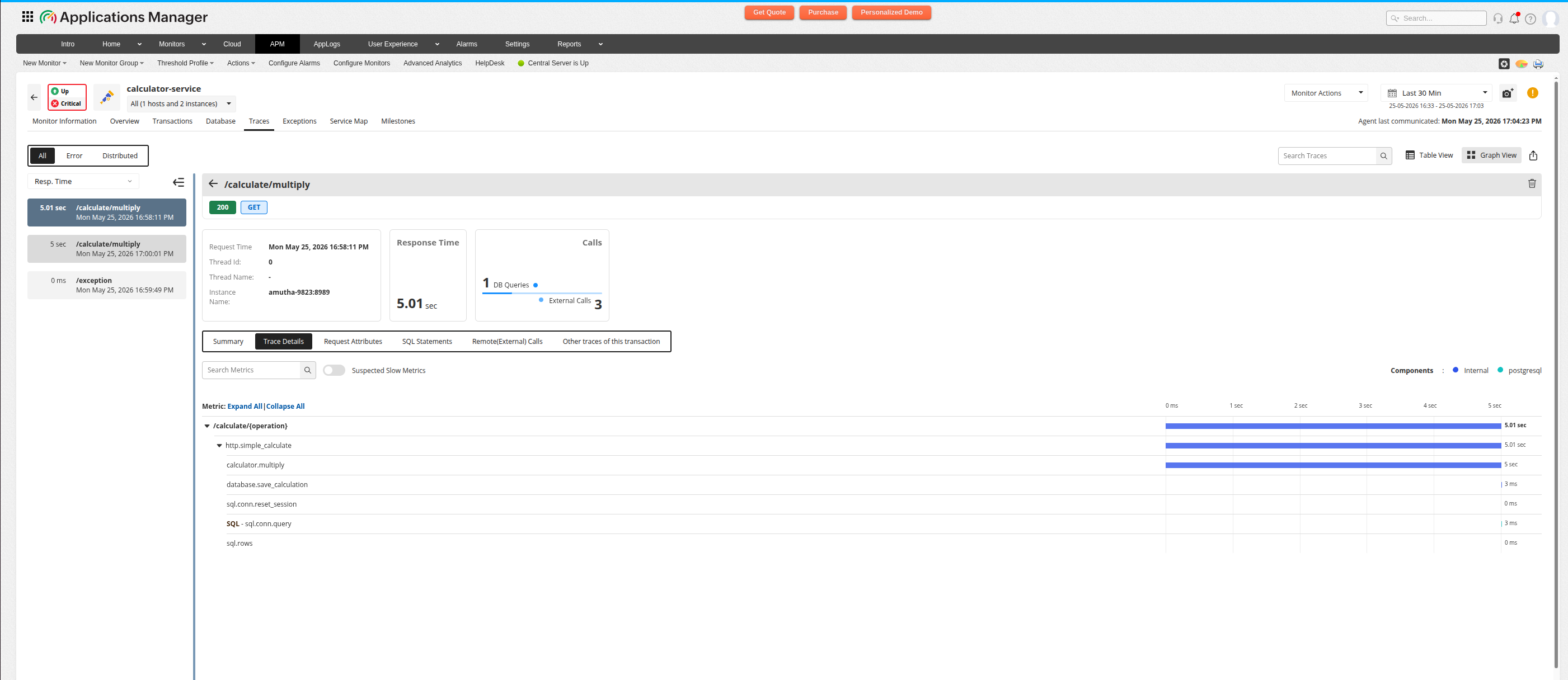
- Trace-level analysis: Track requests across microservices and identify where latency originates.
- Service dependency mapping: Visualize how services interact and understand downstream impact during failures.
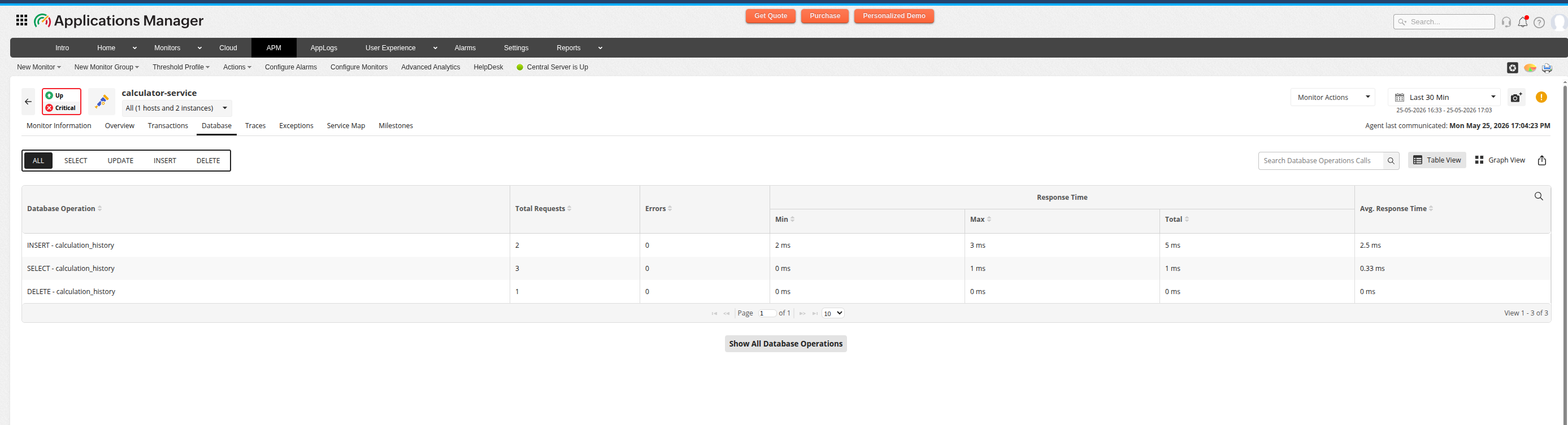
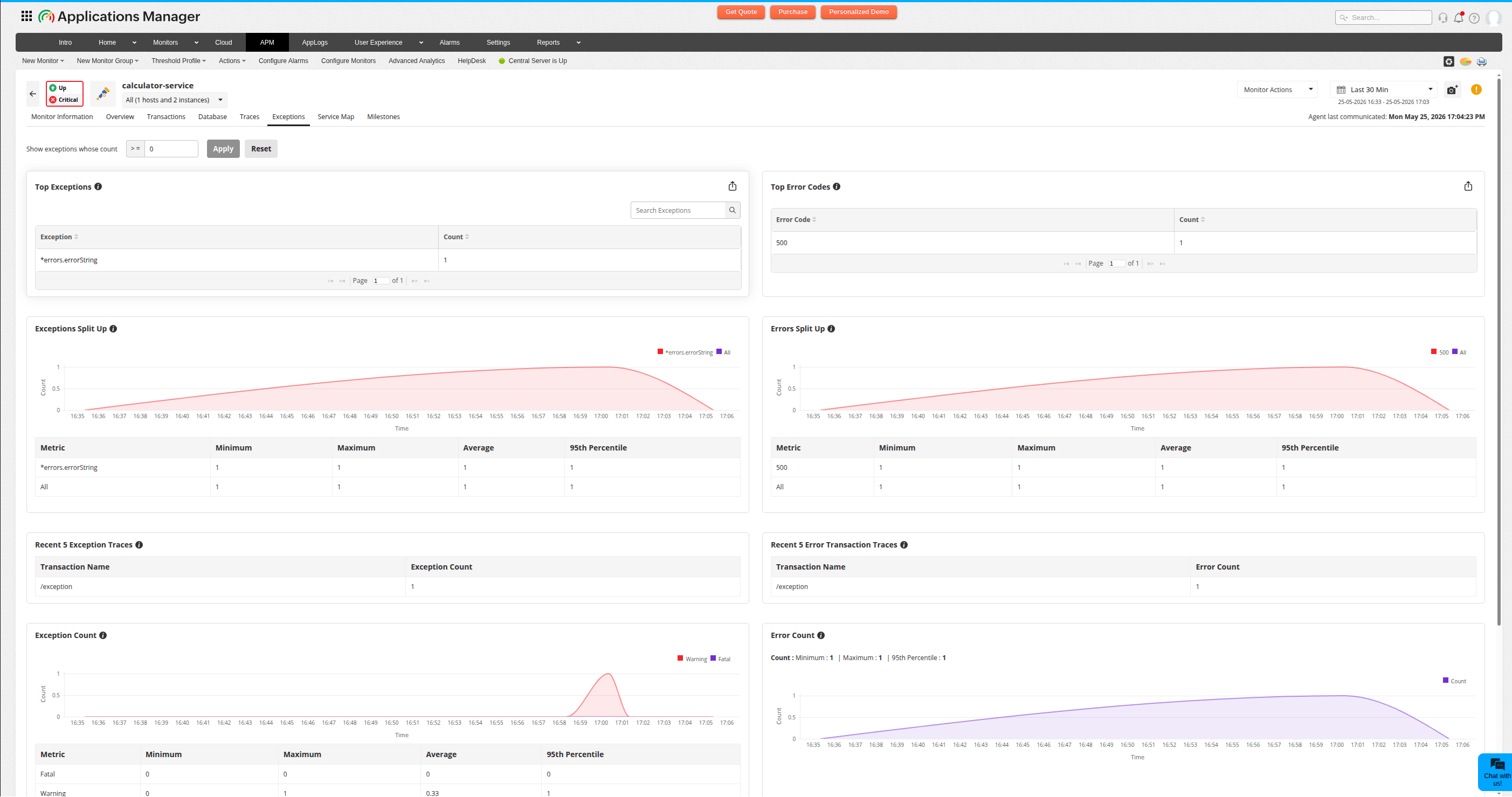
- Transaction visibility: Analyze response times, failed requests, database operations, exceptions, and SQL execution behavior.
- Intelligent alerting:Receive alerts based on abnormal telemetry patterns before users notice disruptions.
Supported OpenTelemetry languages and SDKs
Applications Manager supports telemetry ingestion from OpenTelemetry-instrumented applications across major programming ecosystems.
| Supported Technologies | ||
|---|---|---|
| Node.js | Java | .NET |
| Python | Go | Ruby |
| Elixir | PHP | C++ |
| C# | Rust | Swift |
This flexibility allows engineering teams to standardize observability across hybrid and multi-language environments.
From telemetry data to faster troubleshooting
Distributed architectures make troubleshooting difficult because a single transaction may travel through dozens of services. OpenTelemetry trace analysis helps teams isolate performance bottlenecks faster.
Common issues teams can identify quickly
| Performance Issue | Visibility Provided |
|---|---|
| Slow API responses | Identify high-latency services |
| Database bottlenecks | Detect delayed queries and transactions |
| Failed microservice calls | Pinpoint failing dependencies |
| Service congestion | Analyze request saturation trends |
| Intermittent outages | Correlate traces with infrastructure events |
This shortens mean time to resolution and reduces operational overhead for engineering teams.
How the telemetry pipeline works
Built for cloud-native observability
Applications today run across:
- Kubernetes clusters
- Containers
- Virtual machines
- Hybrid infrastructure
- Public cloud services
- Serverless environments
OpenTelemetry integration allows Applications Manager to unify distributed trace visibility across these environments without introducing fragmented monitoring workflows.
Telemetry ingestion without operational complexity
Many observability platforms require extensive configuration before monitoring begins. Applications Manager simplifies telemetry onboarding with:
- OTLP-compatible ingestion support
- Flexible telemetry pipeline configuration
- Centralized observability dashboards
- Rapid deployment workflows
- Scalable trace processing
Teams can begin monitoring distributed applications faster while reducing operational overhead.
Proactive monitoring and remediation
Monitoring should help teams prevent outages, not simply react to them. Applications Manager supports proactive observability through:
- Threshold-based alerting
- Performance anomaly detection
- Real-time trace analysis
- Automated remediation workflows
- Intelligent escalation policies
This enables operations teams to identify unusual application behavior before it impacts users.
Visual analytics designed for engineering teams
Observability data becomes more valuable when teams can interpret it quickly. Applications Manager provides visual telemetry analytics that help teams:
- Compare service performance trends
- Visualize dependencies between components
- Investigate spikes in latency
These insights support faster root cause analysis and more informed operational decisions.
Start monitoring distributed applications with OpenTelemetry
Modern application environments generate enormous amounts of telemetry across services, infrastructure layers, and cloud-native workloads. By combining OpenTelemetry with Applications Manager, organizations gain deeper operational visibility, clearer dependency mapping, and faster incident investigation workflows across distributed systems.
More on OpenTelemetry monitoring
What is OpenTelemetry - Applications Manager User Guide
OpenTelemetry Integration for Distributed Tracing - Applications Manager User Guide
OpenTelemetry Performance Metrics in APM Insight - Applications Manager User Guide
Export OpenTelemetry data to APM Insight - Applications Manager User Guide