What is IPAM?
IP address management (IPAM) refers to the software systems, platforms, and policies used to plan, assign, track, and manage IP addresses and related network services such as DHCP and DNS across enterprise environments.
While DHCP assigns IPs and DNS resolves them to hostnames, IPAM acts as a single authoritative source of truth to manage the lifecycle of every IP address and hostname across your infrastructure from on-premises and cloud to hybrid and edge IT.
Unlike point tools or manual spreadsheets, modern IPAM solutions are automation-ready, API-integrated, and observability-enabled, allowing organizations to scale and secure their networks with confidence.
IPAM solutions are becoming the foundation of scalable, observable, and secure network operations.
In this page, we dive into,
- How does IPAM work
- 5 key aspects of IPAM
- Key IPAM metrics to monitor
- Why enterprises need IPAM
- Real-world IPAM use cases
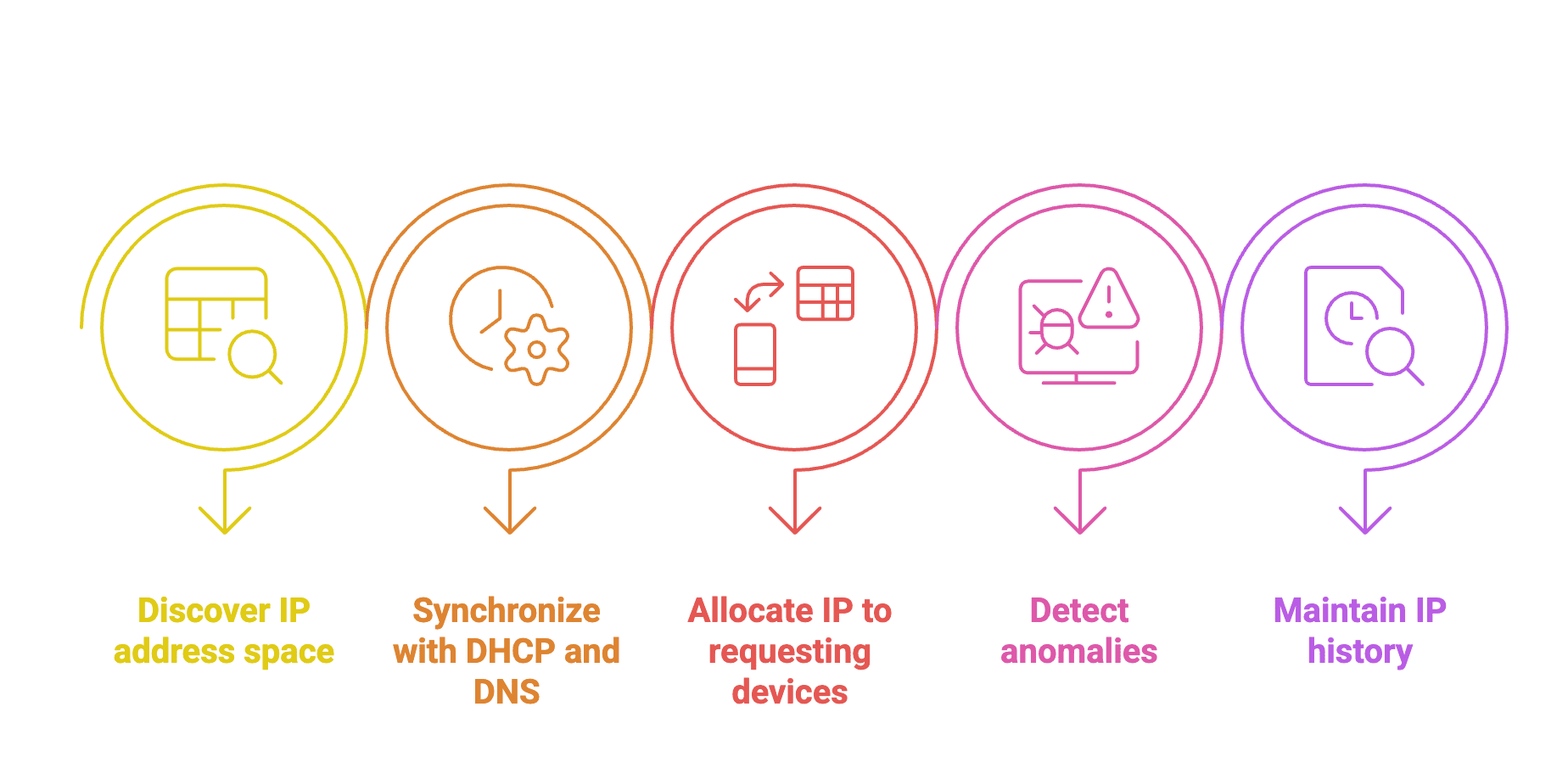
How does IPAM work?
At its core, IPAM solutions:
- Discover used and available IP addresses via scanning network components such as routers using different network scanning protocols.
- Synchronize with DHCP/DNS services to keep IP assignments and records accurate.
- Allocate IPs for subnets, VLANs, virtual networks, and cloud environments.
- Detect anomalies like duplicate IPs, rogue devices, or configuration drifts.
- Maintain history of ownership, allocation, and changes for forensic investigations.
Advanced IPAM tools also offer:
| Capability | Technical benefit |
|---|---|
| DHCP/DNS API integration | Enables dynamic provisioning and real-time updates |
| Role-based access control (RBAC) | Protects critical address infrastructure with least-privilege access |
| IPv6 support and subnet hierarchy | Future-proofs address planning |
| REST APIs | Integrates seamlessly into CI/CD, orchestration, and monitoring pipelines |
| SNMP & CLI discovery | Complements asset visibility in multi-vendor networks |
5 key aspects of IPAM
IPAM solutions have become more than just a point tool or an add-on. These solutions are a critical enabler of effective ITOM. Here's how it fits:
1. Centralized management of IP address spaces
All IP address data across VLANs, subnets, cloud, and physical infrastructure are now collected and unified into one pane of glass. This centralization allows for:
- Real-time inventory of all used, available, and reserved IPs.
- Role-based access for network, cloud, and DevOps teams.
- Standardization of subnet and DNS naming conventions.
This ensures network admins don't have to depend on siloed tools or tribal knowledge, just unified visibility.
2. Historical and real-time IP address tracking
Every IP is tied to metadata like hostname, MAC address, device type, last logged-on user, and DHCP lease history that’s scanned in real time. With historical IP address tracking, you can:
- Trace IP history and activity over time.
- Identify transient or orphaned IP addresses.
- Map usage to users, VMs, or applications in your network.
These tracking features make IPs traceable assets, not just numbers.
3. IP conflict detection to ensure uninterrupted network connectivity.
Conflicts are silent performance and availability killers in large networks. IPAM tools detect:
- Duplicate IP usage via ping, SNMP, and DHCP log tracking.
- Rogue devices bypassing DHCP and maliciously acting in your network.
- Misconfigured static IP assignments.
This helps you prevent outages and accelerates troubleshooting in case of network issues.
4. DHCP and DNS integration for comprehensive IP address space management
IPAM integrates tightly with your DNS and DHCP systems to:
- Automatically update records when IPs are allocated or reclaimed.
- Synchronize hostname-to-IP address mappings.
- Reserve IPs in DHCP scopes based on policy.
With integrated DNS, DHCP, and IP (DDI) management, address IP tracking accuracy improves, drift reduces, and zero-touch IP provisioning becomes possible.
5. Policy enforcement and network governance
A comprehensive IPAM solution that enables managing your complete IP address space including IPv4 and IPv6 addresses, subnets, and supernets, helps define network provisioning policies for:
- IP pool segmentation as per site, zone, and department.
- Lease duration and IP reservations in DHCP servers.
- Naming standards and allocation rules for easy documentation and logging.
A complete IPAM solution that enables effective policy enforcement and governance eliminates guesswork and shadow IT behavior.
Key IPAM metrics to monitor
To truly operationalize IPAM, ensure you track key metrics and not just static reports. Here are some key metrics that drive observability and effectiveness with an IP address management tool:
| Metric | What it tells you | Why it matters |
|---|---|---|
| Used vs. available IPs | Current utilization of IP pools | Prevents IP exhaustion |
| IP conflict rate | Frequency of address conflicts | Indicates stability and IP address space integrity |
| DHCP lease expiry | Upcoming expiring leases | Ensures continuous IP availability and network connectivity |
| DNS record accuracy | Validity of A/AAAA and PTR records | Reduces resolution failures |
| Transient IPs | IPs assigned to inactive devices | Optimizes space and security |
| IP churn rate | Frequency of IP reassignment | Tracks provisioning patterns |
| Subnet utilization | Usage per subnet or VLAN | Guides capacity planning |
| Scan coverage | Percentage of address space actively scanned | Maintains observability accuracy |
| Unauthorized allocations | IPs in use without reservation | Flags shadow IT or rogue devices |
| Time to conflict resolution | Average time to identify & resolve IP conflicts | Affects SLA and uptime guarantees |
Why enterprises need IPAM: Beyond address tracking
For large IT environments, IP address sprawl is a serious operational challenge. IPAM offers far more than IP allocation, it becomes a core part of the resource allocation system of the network layer, empowering:
- Automated IP provisioning across multi-site and multi-cloud architectures
- Granular audit trails to meet compliance and security mandates
- End-to-end IP lifecycle visibility is critical for troubleshooting and incident response
- Data integrity across dynamic infrastructure, especially in virtualized and containerized deployments
IPAM eliminates the risks of spreadsheet-based, manual or outdated tracking mechanisms to ensure high availability, agility, and governance of your address space.
Use Cases: Deep-dive into real-world IPAM applications
Let’s look at how modern organizations apply IPAM solutions in real-world IT environments.
1. IPAM for network observability & root cause analysis (RCA)
IPAM is a core part of observability platforms. When an alert surfaces on a monitoring dashboard, knowing which IP is associated with which host, service, or segment is critical. This helps your network admin and incident management team to:
- Correlate IPs with device types, owners, and locations
- Cross-reference DNS and DHCP logs with incident timelines
- Feed enriched IP data into SIEM or network performance management platforms such as OpManager
IPAM helps reduce Mean Time to Identify (MTTI) and Mean Time to Resolve (MTTR) by giving operators instant context about any IP address.
2. Simplifying data center infrastructure management (DCIM)
Modern data centers have fluid boundaries. Racks host physical servers, virtual machines, and containers—all requiring IPs. Without proper IP lifecycle management:
- Resource provisioning stalls
- VLAN overlaps occur
- Network segmentation breaks
IPAM bridges physical and virtual infrastructure by:
- Providing IP templates for provisioning tools such as Ansible
- Mapping IPs to racks, servers, clusters, and zones
- Enabling zone-aware address planning across staging, production, and DR environments
In DCIM, IPAM acts as the connective bridge between compute, network, and facilities layers.
3. Hybrid and multi-cloud address governance with IPAM solutions
Hybrid cloud introduces overlapping subnets, elastic IPs, and shifting network topologies. IPAM ensures:
- Centralized visibility across Azure VNets, AWS VPCs, and on-prem networks
- Avoidance of IP duplication and misconfigured NAT gateways
- Automating IP reservations during VM/container deployments via orchestration hooks
IPAM gives you single-pane-of-glass visibility into your public and private IP space, no more guessing what's active or transient.
Meet OpUtils, your reliable IPAM solution for uninterrupted network availability
In today’s hybrid IT environments, managing IP addresses isn’t just about avoiding conflicts. It’s about achieving network-wide visibility, operational efficiency, and automation at scale.
That’s where ManageEngine OpUtils comes in.
As a core component of IT operations management (ITOM), OpUtils' IPAM solution helps enterprises maintain clean address spaces, accelerate provisioning, reduce incidents, and gain real-time insights across data centers, campuses, and cloud environments.
Interested? Try a free demo or download our free edition and explore hands-on everything ManageEngine OpUtils has to offer.
Frequently asked questions on IPAM
Why is IPAM important?
+5 features to look for when selecting an IPAM software
+Why should you use an IPAM solution?
+What is the difference between IPAM & DHCP?
+Ensure simplified IPAM with OpUtils
Try OpUtils for free today