How AI Agents Impact IT Service Desk Operations
December 22 | 09 mins read
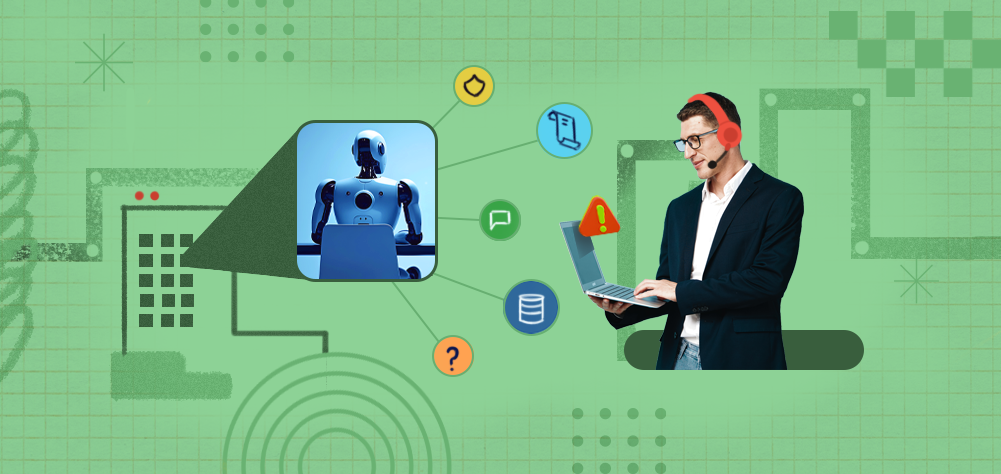
After the excitement of generative artificial intelligence (AI), on the back of the ChatGPT media attention, and its many applications in IT service management (ITSM), the ITSM industry is now experiencing the opportunities of Agentic AI, where AI agents have "agency" to act on their own. A recent ManageEngine survey asked about this interest in AI agents and their use in ITSM operations, when AI agents were defined as: "...an intelligent model that can detect user intent from a ticket, email, or through conversations and autonomously gather contextual data, make decisions, and perform tasks. AI agents can be deployed for service desk tasks such as incident management or service request fulfilment."
This blog shares some of the survey’s insights, but first, it’s important to understand how AI agents differ from generative AI capabilities, such as virtual agents.
AI agents versus virtual agents
We can all be sloppy in our use of terminology, maybe using "AI" when we need to be more specific about the type of AI we’re referring to for a particular ITSM use case. It’s therefore important to appreciate that the term "AI agents" refers to the use of Agentic AI rather than the use of AI in a virtual agent or chatbot.
A simple way to differentiate between virtual agents and AI agents is that:
- Virtual agents focus on end-user interactions, responding to human prompts and inquiries. For example, a conversational chatbot that serves as the initial point of contact for Level 1 IT support.
- AI agents achieve specific goals through their actions, and they may not engage in conversation with humans in the process. They could also collaborate with other AI agents to reach a larger goal. For example, during employee onboarding, different AI agents will work together, each focused on their area of specialization.
Working with AI agents on IT service desks
The ManageEngine survey posed three questions regarding how the adoption of AI agents would impact IT service desks. The first was "How do you think the role of IT technicians will primarily change with the introduction of AI agents?"
The survey respondents felt that AI agents were more likely to work alongside IT technicians than to replace them. Specifically, 38% of respondents thought IT technicians would supervise the AI agents, while 30% believed that AI agent use would free up IT technicians to focus on more complex tasks. Only 18% thought that AI agents would replace IT technicians, with the final 13% believing that there would be no significant change in the role of IT technicians.
While this question and its responses offer some interesting insights into how respondents perceive the impact of AI agents on IT technician roles, there’s considerable overlap in the response options. For example, the choice of "IT technicians will focus on more complex tasks" doesn’t mean that the respondent doesn’t think that "IT technicians will be replaced by AI agents." This is the most likely explanation for the significant difference in the results for the next survey question.
The Impact of AI agents on IT service desk headcount
A more focused and narrower survey question — "Do you think that AI agents will replace humans in the IT workforce?" — found that 59% of respondents thought that AI agents would replace humans in the IT workforce. This data point is likely a more accurate representation of the impact of AI agents on the IT workforce. While IT technicians will have AI-management roles and will be freed up for more complex work, the efficiency benefits of AI agents will also likely result in the need for fewer IT technicians. Interestingly, the level of respondents’ opinions was pretty similar across organizations of different sizes.
This view of AI agents replacing humans in the IT workforce was replicated in the third AI agent survey question — 62% of survey respondents believed that introducing AI agents for ITSM would change their organization’s hiring plan (including the number of technicians to be hired in the future). Only 12% thought not, with another 26% stating it’s too early to know. Again, the level of respondents’ opinions was pretty similar across organizations of different sizes.
But what about service quality and speed?
The ManageEngine survey inquired about the impact of AI agents on staffing levels for IT service desks. However, this is just one perspective of the corporate benefits of AI agents, with this achieved through autonomous ticket resolution (that can be viewed in labor cost savings, scalability, or both).
Agentic AI will also impact IT service desk operations in other ways that improve service quality (including experiences) and speed. For example, AI agents can:
- Proactively prevent issues by monitoring systems, detecting anomalies, and acting to prevent issues and the associated tickets. For example, restarting services before a service outage occurs.Facilitate complex workflow orchestration by acting in a coordination role across tools and teams (and working with other AI agents), with the ability to trigger workflows that span multiple systems. For example, automating IT provisioning and deprovisioning in the human resources (HR) onboarding and offboarding processes, respectively.
- Enable knowledge management by identifying knowledge gaps and automatically applying the available knowledge in past tickets and resolutions. For example, suggesting new or updated knowledge articles based on ticket trends.
- Deliver "policy-aware" automation, following governance and security policies while executing tasks. For example, granting temporary admin rights only when change windows and approvals align.
All of these use case examples, along with others, are beneficial to your IT service desk operations, whether they impact staffing levels or not. Enhancing service quality and the overall experience. However, the possibility that the introduction of AI agents will reduce your IT service desk’s headcount should not be overlooked. As stated in the ManageEngine survey report:
"The efficiencies brought about by AI agents are likely to affect staffing volumes and costs despite the changing roles of IT technicians. It’s something your organization should be planning for so that any change can be brought about organically."
Please ensure that your IT organization leverages the opportunities of AI agents in a people-focused manner. If you know about the power of organizational change management (OCM) in business transformation, you’ll also know that applying the key OCM tools and techniques will significantly improve the probability of your success.
If you want to download the full "The advent of AI agents in ITSM: Perception and future impact report," it’s available here.