Performance trend forecasting for AI-driven monitoring
- Predict bottlenecks before they happen
- Reduce firefighting and resource crunches
- Get data-driven insights
- Identify capacity needs with ease
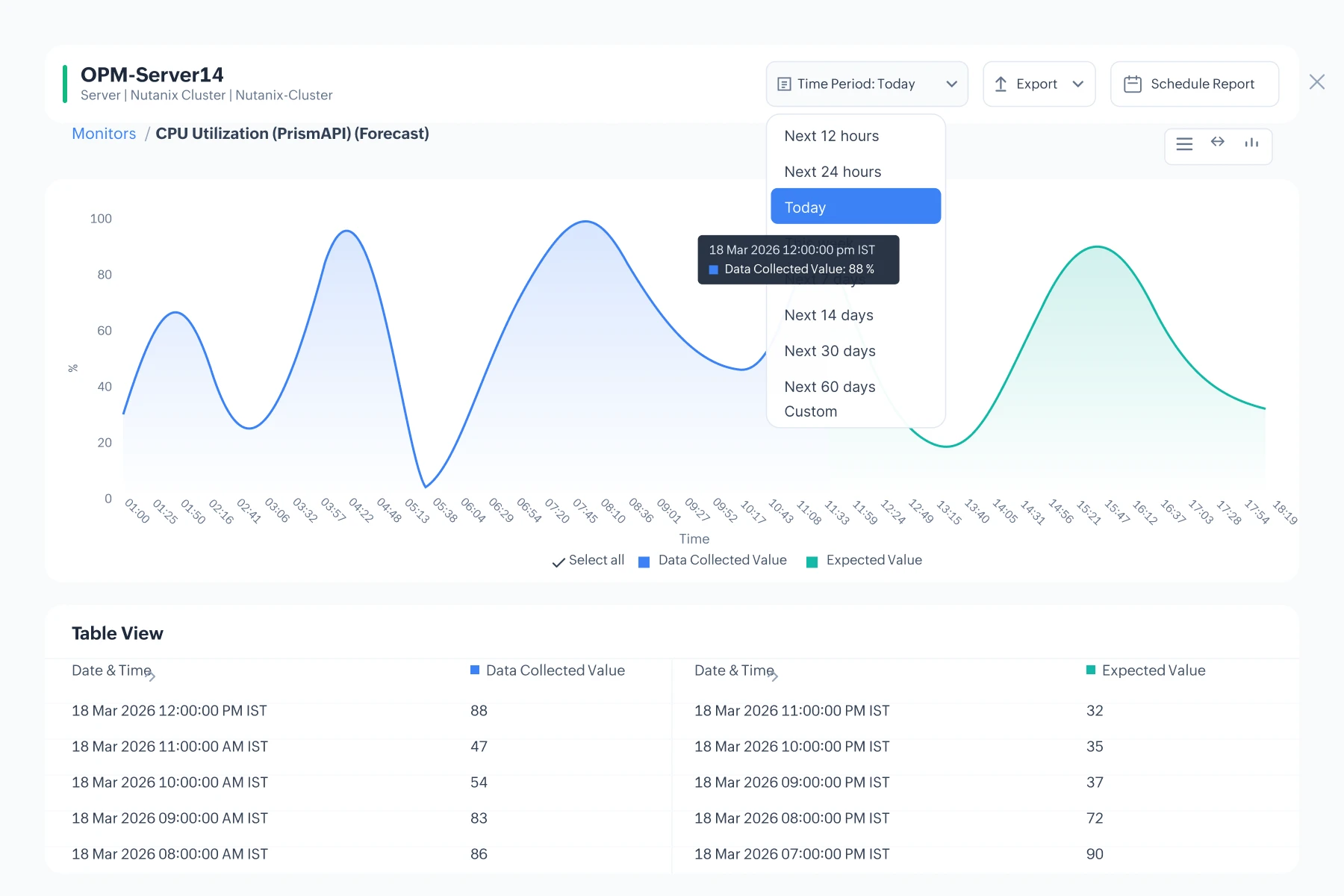
Intelligent forecasting for your network performance
Managing IT environments involves analyzing system resource usage and estimating when it may run out. Without predictive data, you are stuck in a reactive cycle: you either over-provision hardware to play it safe, or you wait for a threshold to breach during a production crisis. OpManager’s performance trend forecasting solves this by leveraging machine learning to provide a strategic forecasts and warnings.
Forecasting performance trends in OpManager
Zia AI forecasts
OpManager's Zia ML engine trains on network data for 14 days to understand your environment's behavior. It calculates expected values for every performance metric for the next hours, days, and weeks. To maintain accuracy, Zia constantly updates the predictions.
- Smarter capacity planning: Identify over-provisioned and under-provisioned devices. Re-balance your infrastructure load based on impact assessments and remediation recommendations.
- Evidence-based procurement: Use projected utilization trends to justify infrastructure spend. Move budget conversations away from guesswork and toward data-backed requirements.
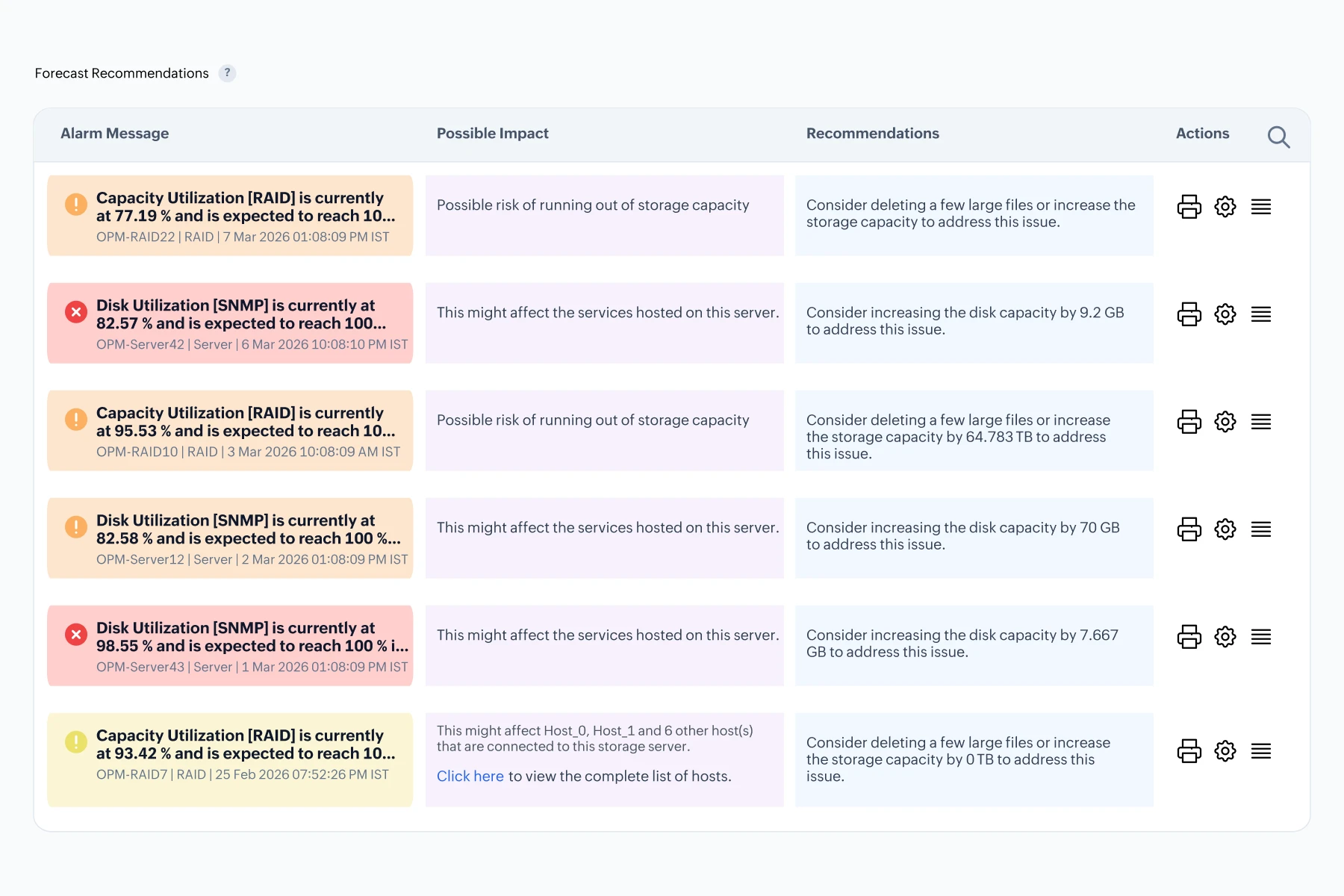
Forecasting performance trends
Automate forecasting for your infrastructure by predicting the future trends of any performance metric from the next 12 hours to three months.
- Visual clarity: See historical and expected values represented in colour-coded graphs and detailed tables, making it the most intuitive way to visualize potential bottlenecks.
- Scalability support: As you scale, the ML engine supports your growth, calculating trends for over 3,000 metrics across multi-vendor environments.
Forecast alerts & reports
Identify risks to service delivery before they manifest as outages by ML-driven alerting and extensive forecast reports.
- Proactive alerts: You can set up forecast alerts to warn you about resource exhaustion a set number of days before they actually run out.
- Forecast reports: Get a detailed report of your IT assets and predict the number of days left till they reach critical utilization milestones.
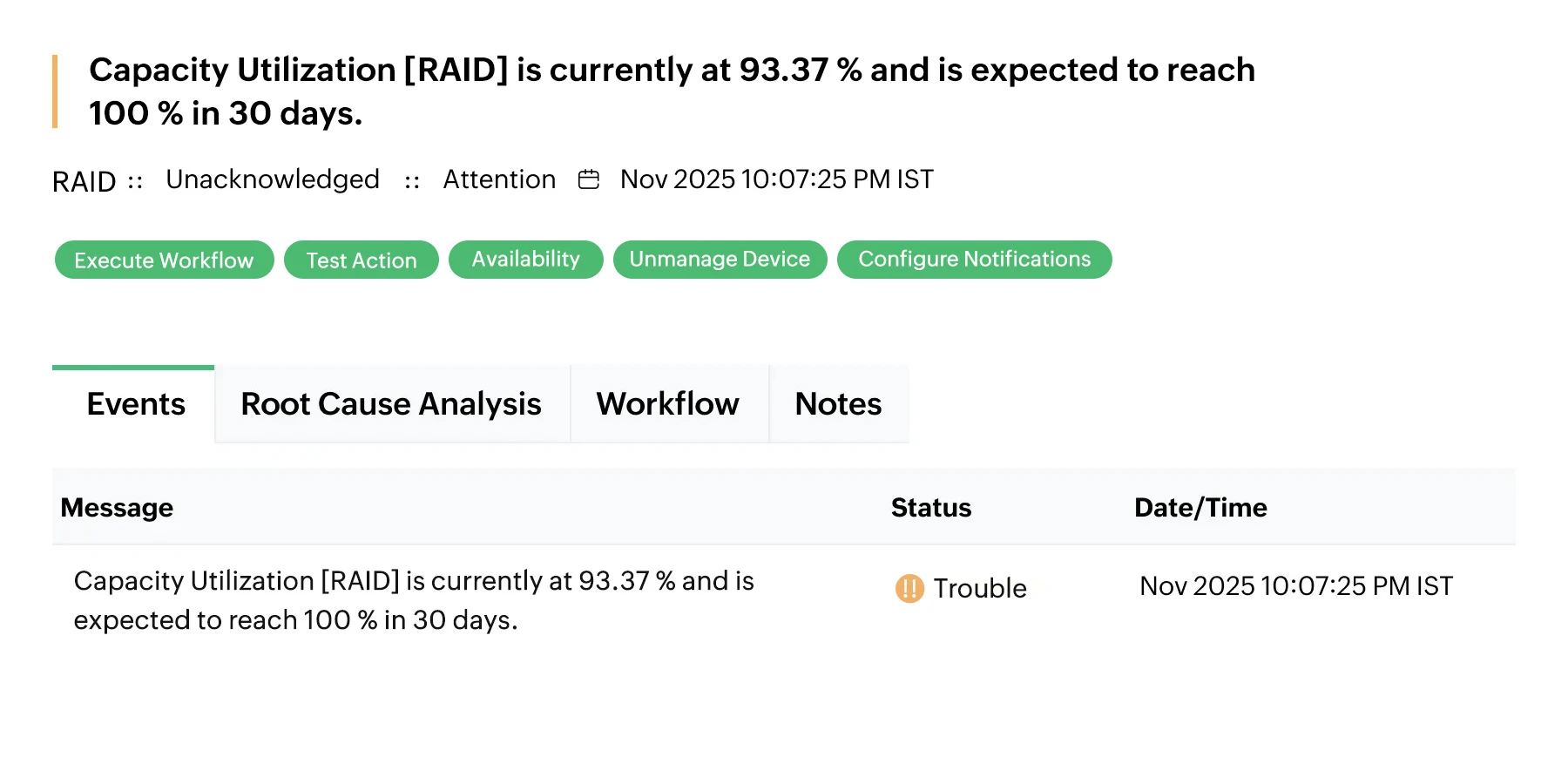
When should I enable performance forecasts?
To ensure the highest level of predictive accuracy, it is recommended to let OpManager collect at least 14 days of performance data before enabling forecasting.
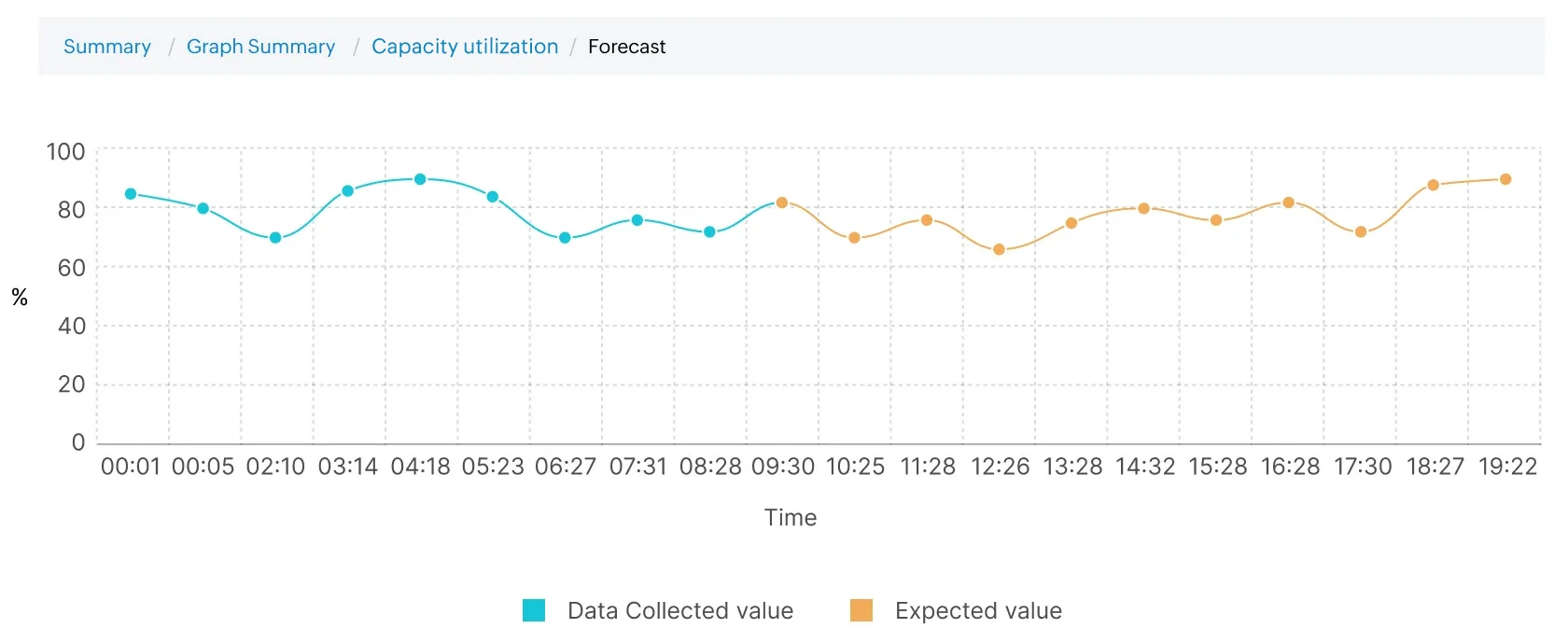
What are the benefits of using performance trend forecasting?
Proactive insights
Receive the information you need to act during planned windows rather than production crises.
ML-powered certainty
Stop guessing about resource needs. Use historical patterns to predict exactly when a device will reach its limit.
Optimized infrastructure spend
Avoid over-provisioning expensive resources by only paying for the capacity you are forecasted to need.
Full-stack scalability
Apply predictive intelligence across thousands of devices and metrics simultaneously with zero manual intervention.
Performance forecasting in practical usage-scenarios
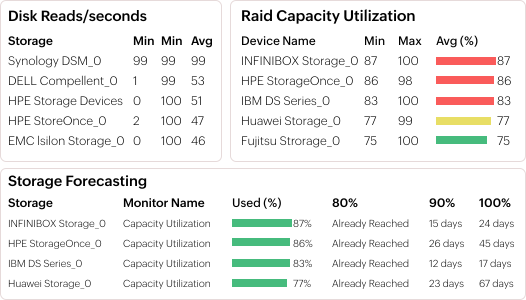
Proactive risk mitigation
By visualizing potential dips and spikes as a continuation of historical data, IT teams can identify risks to service delivery before they manifest as outages.
- Preparing servers for peak-load seasons: OpManager forecasts year-end memory trends, allowing IT teams to schedule proactive upgrades during maintenance windows rather than reacting to a production crisis during peak seasons.
- Identifying aging hardware before failures: Forecasting CPU temperature and power trends helps admins identify hardware operating inefficiently, allowing them to replace failing units before they cause total system failure.
Strategic IT procurement
Forecast data plays a vital role in organizational processes by providing the evidence needed for budgeting and resource allocation.
- Justifying IT infrastructure spend with forecast data: Forecast reports prove exactly when clusters will hit maximum capacity. This data-driven approach shifts budget procurement from guesswork to an evidence-based, justified process.
- Optimizing cloud spend by forecasting resources: Forecasting on-premise utilization determines the exact timeline needed for cloud bursting. This prevents over-provisioning expensive cloud instances, ensuring you only pay for predicted capacity.
FAQs
- Intelligent planning for normal network growth: As forecasts utilize real-time network data to update the predictive analysis, you can leverage them to keep tabs of existing infrastructure components and their natural growth over time.
- Resource utilization analysis and optimization: Forecasts are valuable tools in sizing and capacity planning. You can use them to see whether the allocated hardware resources are over-provisioned or under-provisioned by checking the expected growth trends.
- Detecting abnormal network trends: As forecasts keep track of normal network behaviour, any trends that aren't predicted are likely to abnormal network behaviour you might want to look out for. Forecasts, along with OpManager's adaptive thresholds are perfectly suited to identify such anomalies.
- Data collection/Ingestion: Monitoring tools feature data collection mechanisms that poll devices on a regular basis to gather KPIs (Key performance indicators). Data collection usually rely on network protocols like SNMP (agent-less monitoring) or specialized software installed in devices (Agent-based monitoring) to perform data collection.
- Data processing/analysis: AIOps-enabled tools use machine learning (ML) algorithms to aggregate, analyze, and predict data patterns. In OpManager, the AIOps engine is developed natively and incorporated within the product to deliver seamless operation.
- Data visualization/representation: Once performance patterns are analyzed and predicted, they have to be presented visually and contextually to ensure that the insights can be leveraged in the best way. OpManager used visual graphs and tables to present forecasted insights.
- Feedback/training: Predictive analysis also involves constant data feedback and training. OpManager's Zia ML engine constantly trains and updates forecasts to ensure accurate forecasts.
- Smart event correlation for faster root cause analysis
- Auto-adaptive alarm thresholds
- Forecast alarms and reports for resource utilization
- MCP server for Gen-AI integration
- Zia chatbot, dashboard, and insights
- Automated workflows for faster incident response
Resources to dig deeper
The technical playbook for deploying agentic AI in production ITOps
From alerts to action: How agentic AI will change your ITOps
Download Whitepaper→