Create Web Groups
Group similar websites for one-shot policy deployment, and stock an extension repository so add-ons roll out automatically instead of one machine at a time.
Setup
Create Website Groups
Bundle similar websites and web apps together so a single policy can target the whole group.
Grouping websites
Websites and web applications of a similar nature can be added into groups to simplify management. They're typically used within Download Filter and Web Filter policies, letting you deploy a policy to the whole group in one go.
- Go to Manage → Website Group.
- Click Create Website Group.
- Give the group a name and description.
- Add websites either manually or by uploading a CSV file.

If you modify a website group associated with a deployed policy, the changes take effect within the next 90-minute refresh cycle.
Prepare a website CSV import
Use a plain CSV with one website entry per row and no descriptive header. Save as UTF-8 without a byte-order mark. Do not put different websites in multiple columns on one row.
This import path rejects empty files and more than 1,000 unique nonempty entries in one import. This does not establish the total capacity of an existing Website Group. For Incorrect format, check encoding, headers and row structure, then test a small file.
example.comportal.example.orgSetup
Extension Repository
Stock the repository once, then distribute extensions to computer groups automatically.
Adding extensions to the repository
Extensions can be efficiently deployed to computer groups by adding them to Endpoint Central's extension repository. This automated distribution eliminates the need for individual installations.
- Go to Manage → Extension Repository.
- Click Add Extensions and choose the desired browser.
- Add the extension either by uploading it directly or through the Web Store by entering the extension identifier, then click Add.
- Refer below for more information on obtaining extension identifiers.
- Once you've added extensions to the repository, see Distribute Extensions to push them out to target devices.
Uploading extensions directly is only supported in the on-premise version.

Obtaining Chrome Extension Identifiers
An extension identifier is a unique code assigned to each browser extension in the Chrome Web Store that enables you to add and manage extensions through the Extension Repository.
How to Find a Chrome Extension Identifier
- Navigate to the Google Chrome Web Store extensions section.
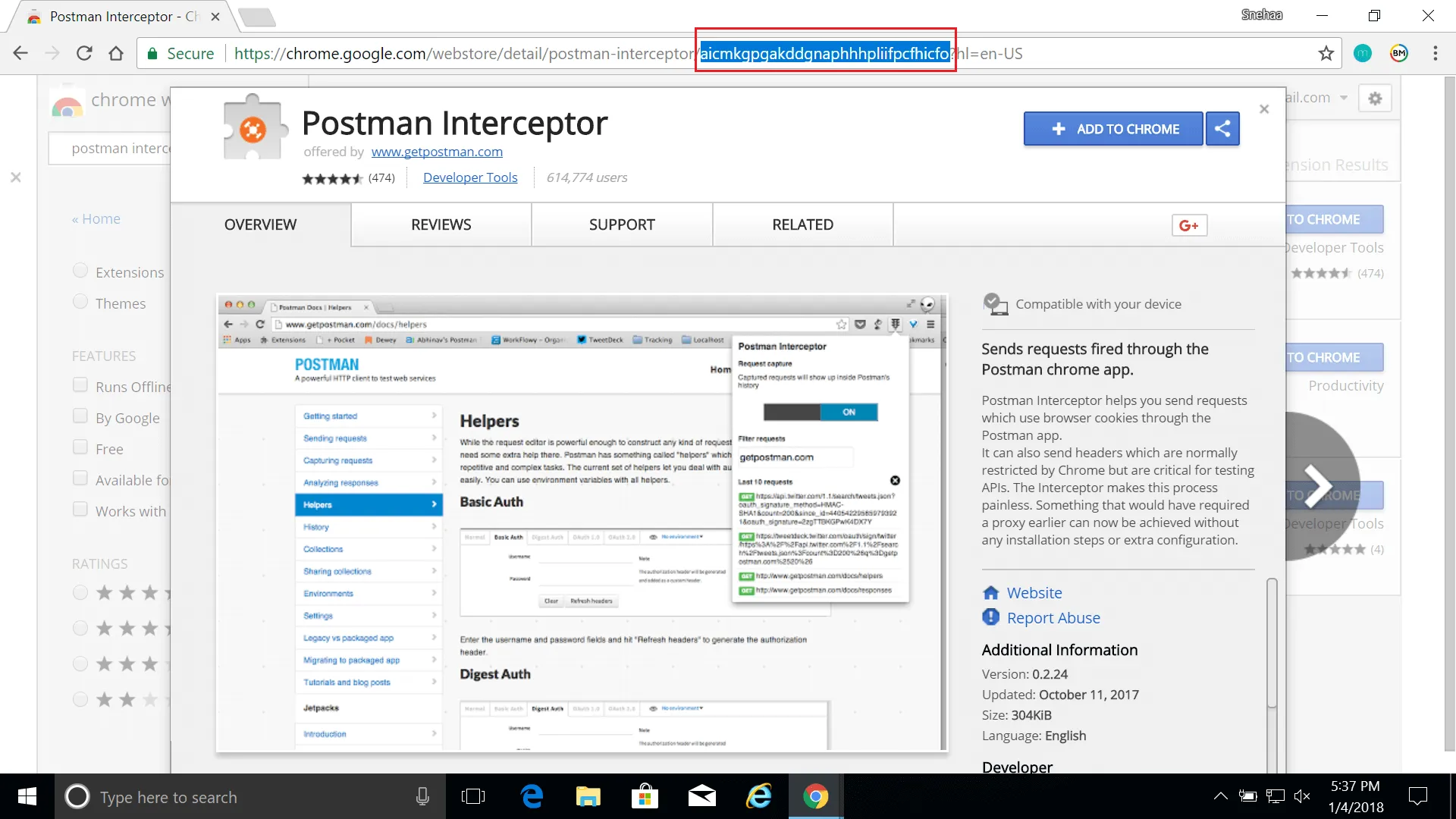
- Search for the extension you want to deploy (for example, "Postman Interceptor").
- Open the extension's page in the Chrome Web Store.
- Look at the URL bar. The extension identifier is the unique code located between the "/" and "?" characters.
- Copy this identifier and paste it into the Extension Identifier field in your Extension Repository interface.
If the URL is:https://chrome.google.com/webstore/detail/postman-interceptor/aicmkgpgakddgnaphhjpplbacjbuhafa?hl=en
The extension identifier is: aicmkgpgakddgnaphhjpplbacjbuhafa
File Formats and Requirements
When adding extensions to the repository, you must use the correct file format and URL structure depending on the browser type.
Supported File Formats
- .CRX (Chromium Extension): Required for Chrome, Edge, and Chromium-based browsers. This is the compiled binary format for custom extensions you upload directly.
- .XPI (Firefox Extension): Required for Firefox. Use the direct download URL from Mozilla Add-ons (not the add-on page URL).
- .XML (Manifest): Not supported. You must provide the compiled extension package (.crx or .xpi), not the XML manifest file alone.
If you have only an XML manifest file, contact the extension developer to obtain the compiled .crx or .xpi package.
Adding Firefox Extensions
When adding Firefox extensions, use the correct direct download URL, not the add-on page URL.
How to Find the Correct URL:
- Navigate to the Firefox Add-ons page:
https://addons.mozilla.org/firefox/addon/[EXTENSION_NAME] - Right-click on the Add to Firefox button and select Copy Link Address.
- The copied URL should be in the direct download format (.xpi file).
- Paste this URL when adding the extension to the Extension Repository.
Correct Format:
https://addons.mozilla.org/firefox/downloads/file/[ID]/[EXTENSION_NAME]-[VERSION].xpiExample:
https://addons.mozilla.org/firefox/downloads/file/3845234/1password_x_password_manager-8.9.10.xpiWrong Format (Add-on Page):
https://addons.mozilla.org/en-US/firefox/addon/1password-x-password-manager/Use the identifier for the selected browser
For Microsoft Edge, open the extension’s Edge Add-ons listing and copy its identifier from the listing URL. Enter the identifier alone for Edge. Do not include a query string or assume the Chrome identifier for the same extension is identical.
For first-party Browser Security Plus on Firefox, use the build-appropriate package in the official installation instructions. Do not guess a Mozilla store listing.
For Something went wrong, Kindly contact customer support., check the selected browser and identifier format. If a valid supported value still fails, collect the error and sanitized request for support. The message alone does not identify a cause.
Report
Browser Extension Inventory Reporting
Generate reports of browser extensions installed across your managed devices.
- By Extension: View all computers where a specific extension is installed
- Go to Insights → Browser Add-ons → Extensions
- Click on an extension name to see its Installation Count
- The list shows all computers with that extension installed
- By Computer: View all extensions installed on a specific computer
- Go to Manage → Groups & Computers → Computers
- Select a computer and click Extensions tab
- The list shows all browser extensions detected on that machine
Currently, there is no built-in "Browser Extension by Computer" report that lists all extensions against all computers in a single consolidated view when dealing with large inventories (thousands of extensions). For large extension inventories (8000+ extensions), the one-at-a-time drill-down method becomes impractical.