Discovering subnets through Cisco Meraki Controller
Managing subnets can be a complex and time-consuming task for network administrators. However, integrating Cisco Meraki with OpUtils offers a simplified, automated approach to discover and manage subnets efficiently. This feature enables automatic subnet discovery and real-time IP address tracking, providing seamless IP management for networks of all sizes.
OpUtils integrates with Cisco Meraki to enhance the efficiency of subnet discovery. Here's how.
Integrating Meraki for Automated Subnet Discovery in OpUtils
Integrating Cisco Meraki into OpUtils is a simple process that brings powerful capabilities to your fingertips. Here’s a high-level overview of how it works:
Enable API access in Cisco Meraki
The first step is to enable API access in your Cisco Meraki dashboard. This key acts as a credential, authorizing OpUtils to securely communicate with your Meraki account and retrieve necessary network configuration data, specifically your subnet information automatically.
Link your Meraki dashboard with OpUtils
Once API access is enabled, simply enter the generated API key into OpUtils. The system will fetch your Meraki organization details, allowing OpUtils to discover all the subnets managed by your Meraki network.
Automatic subnet discovery
Once connected, OpUtils automatically fetches and displays all subnets that are being managed by your Cisco Meraki network. The integration is designed to streamline the process, ensuring you have an up-to-date view of your network’s IP infrastructure. This eliminates the need for manual subnet entry, significantly reducing the potential for errors and saving valuable administrative time. It ensures that OpUtils always has an up-to-date representation of your Meraki network segments.
Manage and monitor your subnets
With your subnets now discovered in OpUtils, you can easily manage and monitor them. View detailed information about each subnet, including real-time IP status, utilization, associated switch details, and more. You can also set up alerts to notify you about important network events, ensuring that you're always in the know.
For a more detailed, step-by-step guide on setting up Meraki integration, visit our help page.


Benefits of Cisco Meraki API integration with OpUtils
Integrating the Cisco Meraki API for subnet discovery within OpUtils has several key advantages:
- Enhanced automation: Eliminate the need for manual subnet management, saving time and reducing errors.
- Comprehensive network visibility: Monitor and track all Meraki-managed subnets with a single platform.
- Customizable alerts and scans: Set up automated scans and real-time alerts from pre-defined scenarios to keep the network under constant surveillance.
- Streamlined network management: Simplify the process of organizing, tracking, and managing IP addresses and subnets.
- Real-time tracking: Continuous IP address tracking ensures up-to-date network data.
- Improved network efficiency: Reduces human error and enhances the accuracy of subnet management.
Other ways to discover subnets in OpUtils
While the Cisco Meraki integration offers a seamless, API-based approach to subnet discovery, OpUtils also supports multiple other discovery methods to suit diverse network environments.
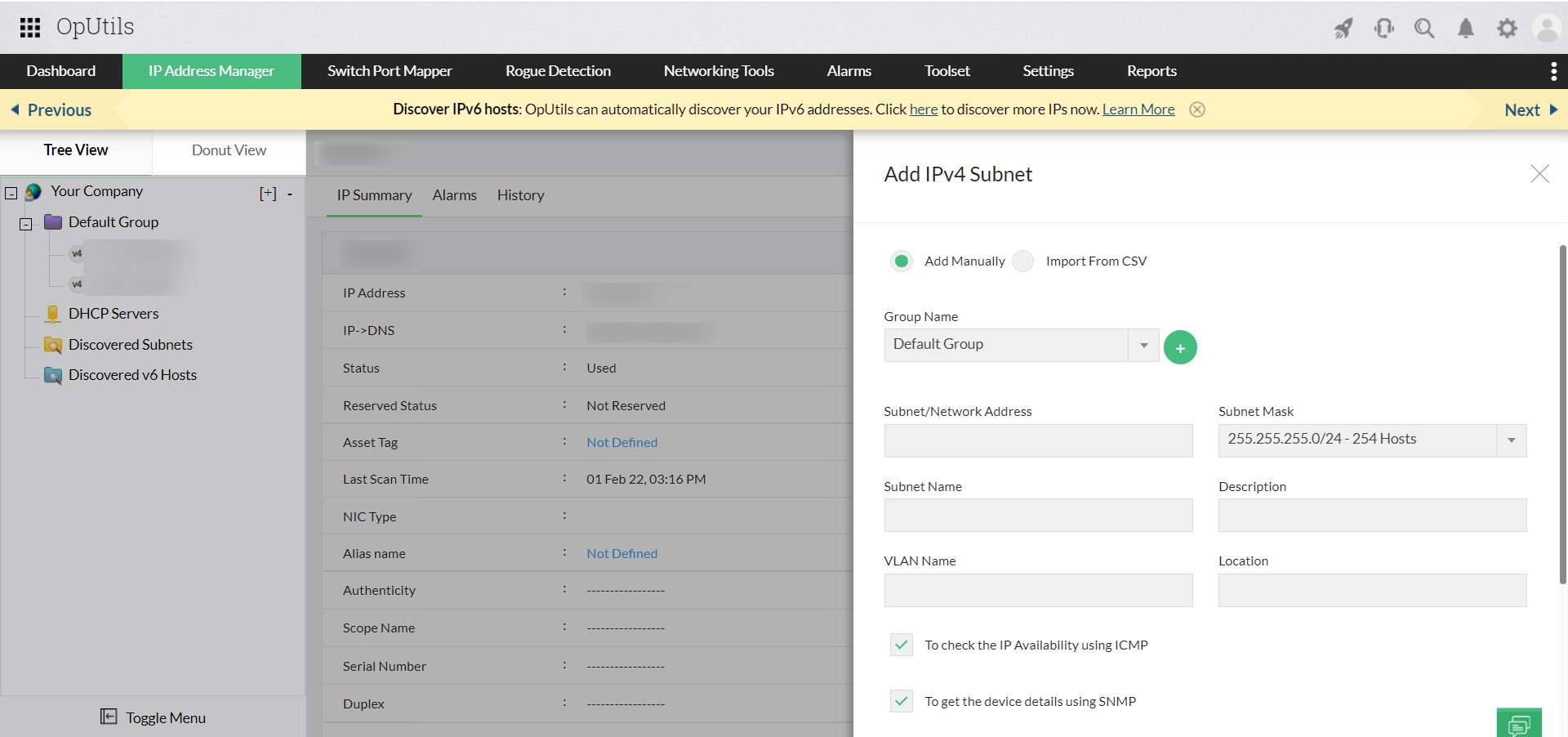
You can manually add subnets, import them via CSV, or use router-based discovery to fetch subnets directly from Layer 3 devices using SNMP.
These flexible options ensure that OpUtils adapts to your existing infrastructure, whether you're managing cloud, hybrid, or on-premises networks. However, for organizations using Cisco Meraki, the dedicated controller-based integration offers the most automated and real-time discovery experience.
Download a free 30-day trial, or schedule a personalized demo today and we'll connect you with the right product expert to address all your questions.