Synergy in action
Case study: ManageEngine-BrightVision partnership
ManageEngine has been working with GSIs for over a decade. However, our focused engagement started in 2019 when we formed an alliance team to spearhead the Global Alliances and Strategic Partnerships program. Currently, we work closely with a dozen GSIs.
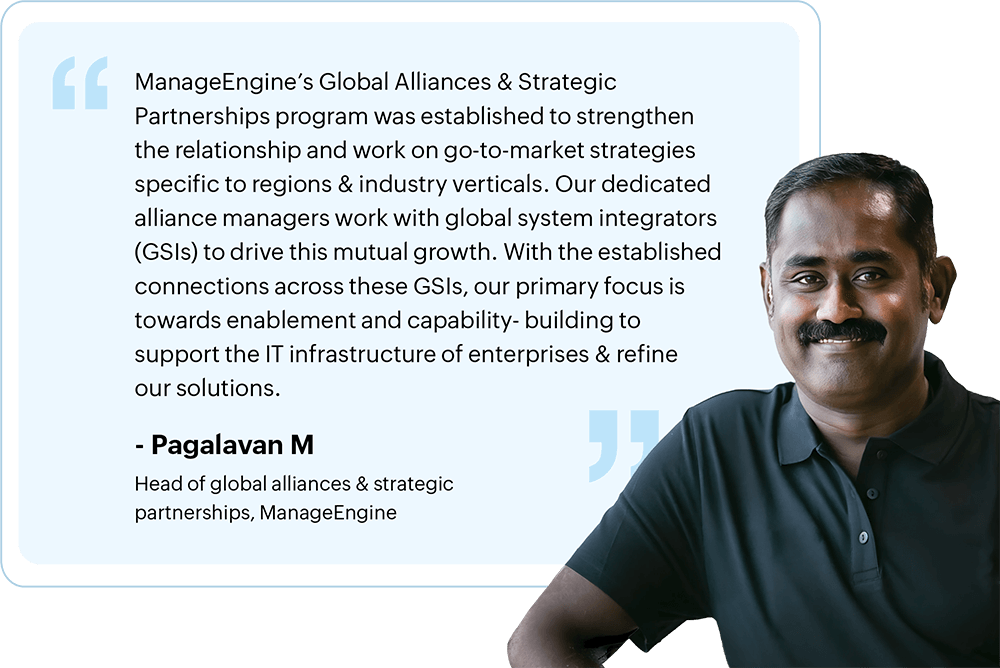
Since 2020, ManageEngine has been the preferred tool of choice for BrightVision Tech (name changed for privacy), a notable GSI and multinational technology company based in India. With its presence in over 50 countries across the globe, they offer implementation services for millions of users in various industries. So, how did this partnership come to life?
ManageEngine is not new to the partner ecosystem. We’ve worked with various partners across the globe. Partners are typically based in one region or have short-term, transactional relationships. The target customers for these partners are usually SMBs and mid-sized firms. GSIs, on the other hand, work on an enterprise level. Working with Fortune 500 or Fortune 1000 companies, they operate as consultants.
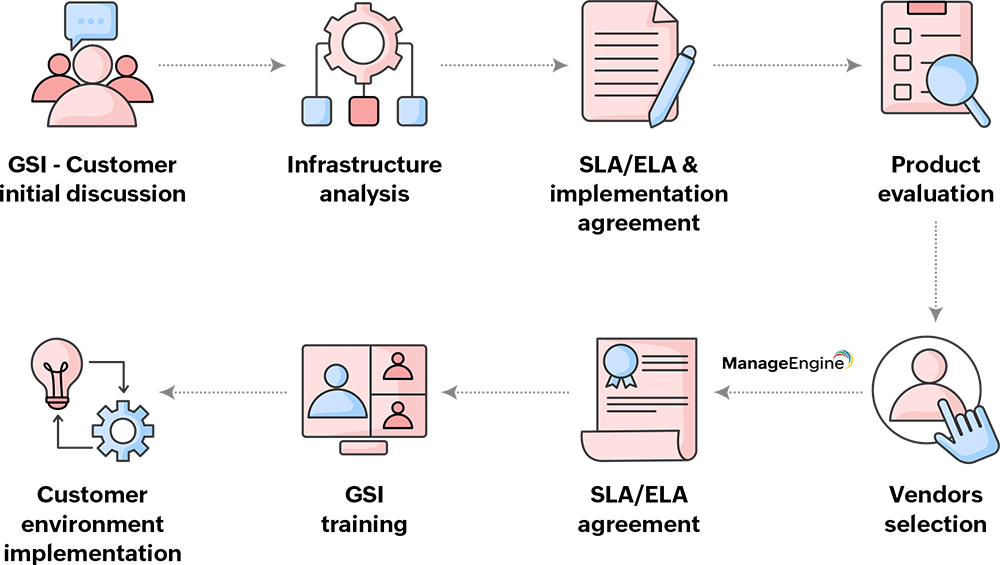
Customers outsource their IT operations to GSIs based on predetermined service-level agreements (SLAs) or experience-level agreements (ELAs). Beyond just outsourcing, GSIs also play a role in the transition journey for their customers—cloud migration, digital transformation, or application modernization—whatever their infrastructure requirements may be.
As technology vendors, we offer software and provide solutions to address multiple concerns in the IT infrastructure, ranging from help desk to endpoint monitoring. BrightVisions works on projects where they may have to deploy 500 field technicians (FTs) per account and manage applications and data centers. We establish centers of excellence (COEs) across our GSI partnerships. These COEs have industry-specific proof-of-concept setups to facilitate customer demonstrations. This allows GSIs to evaluate ManageEngine’s solutions and select the right solutions for customer requirements.
Role of the global alliance team:
- Interact with GSIs to bring awareness about ManageEngine and its core principles.
- Take them through the suite of products and provide a POC.
- Set up a COE in the GSI’s ecosystem based on the customer’s infrastructure and needs.
- Communicate unique capabilities/requirements to product teams for development.
Each vertical (e.g., presales, marketing, support) under each product team has a point of contact for the GSI partnership. Their role is to assist BrightVision on demand. Having specific roles is imperative to our GSI operations, because our team must be aware of the implementation history to provide faster, more accurate responses and results in support. Under the Global Alliances program, our partnership with BrightVision is thriving and continues to support mutual growth.
Why does this GSI partnership work?
The first factor in this success formula is alignment. Being on the same page is crucial for any successful partnership. Right from day one, our teams were able to build a cohesive relationship owing to similarities in core values, long-term vision, mission, and key practices. In this particular partnership, our roots also played a strong role. We take pride in being an Indian company made for the world; so does BrightVision. We see that in our discussions as well.
Second, our ability to be their one-stop shop: GSIs find ManageEngine to be a suitable option since we have solutions for a wide range of IT needs, making integrations a lot easier than with other OEMs. For us, this also means more opportunities for upsell with our comprehensive suite of products.
Third, and perhaps the most important aspect, is the fact that our products are extremely user-friendly. BrightVision’s technicians were able to adapt to our solutions quickly, requiring less manpower. This helps BrightVision reduce implementation and management costs. Even when they present us with new requirements or capabilities, keeping the product light and easy to use is always a top priority.
Putting these factors together, we are able to establish ourselves as a suitable partner for GSIs. As we expand our solutions and scale up for enterprise customers, we aim to deliver top quality solutions that address the needs of various industries and resolve specific IT problems. And BrightVision plays a key role in our foray into the enterprise market.
How has our approach to GSIs evolved?
Chandrassekar JS, manager of the Global Alliances team, shares his views on the BrightVision partnership and how our approach to such partnerships has evolved over decades.
“ManageEngine offers over 120 tools to manage and secure IT environments. Initially, our approach was to present all our major solutions to decision-makers, but we later realized it can be counter-productive and overwhelming. Now, we provide a high-level overview and focus on products based on the product teams that are involved. This approach of giving tailored information to the decisionmakers to meet their current requirements has helped us create a better rapport with our partners.”
Benefits of a GSI partnership
GSIs play a crucial role in the IT ecosystem by bridging the gap between technology providers (us) and end customers, particularly for large enterprises and multinational corporations. Partnering with organizations like BrightVision offers numerous benefits, such as:
Exposure to a larger market
The GSI’s extensive network allows us to tap into new markets and customer segments. Working with BrightVision has helped us gain more insight into the needs of enterprise customers— intricacies we wouldn’t find online, at conferences, or through competitor analysis. The feedback they give on the way the tools work and the features they look for helps shape our product roadmap.
Financial & reputational gains
Associating with a well-known GSI enhances credibility. It provides increased product visibility and trust in the organization’s offerings, offering substantial revenue opportunities. GSIs also typically work with customers based on long-term contracts. This means a GSI-led implementation could be a recurring revenue source for vendors that increases customer retention.
Product innovation & growth
Being at the forefront of digital transformation means identifying new ways to retrofit products to meet clients’ evolving needs. As partners, we have the opportunity to develop new products and features and integrate them into other technologies. This integration also helps create a seamless user experience for customers, increasing the likelihood of adoption.
Scalable support & implementation
GSIs have well-equipped support and implementation teams that can handle largescale deployments and complex integrations. Their ability to scale across multiple regions and industries helps reach a wider audience without the need for extensive internal resources. This scalability also helps manage the complexity and risks associated with large-scale implementations.
ManageEngine Marketplace
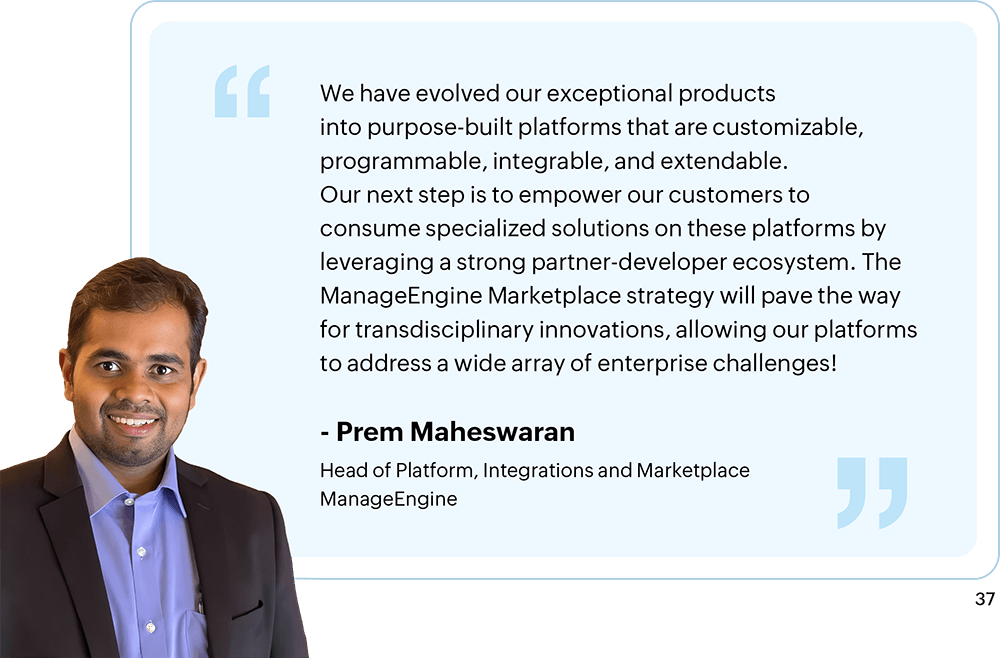
A platform enables growth through connections: its value comes not only from its own features but from its ability to extend to external tools, teams, data, and processes. As a core pillar of ManageEngine’s platform strategy, ManageEngine Marketplace aims to meet the extensive array of enterprise customer requirements through an advanced partner-developer ecosystem. It provides a space to interface ManageEngine’s advanced enterprise customers with the partner-developer ecosystem. This enables customers to request and consume enterprise grade extensions built and delivered by partner-developers who are experts in various domains.
Why Marketplace? There are three angles to this: ManageEngine, customers, and partner developers.
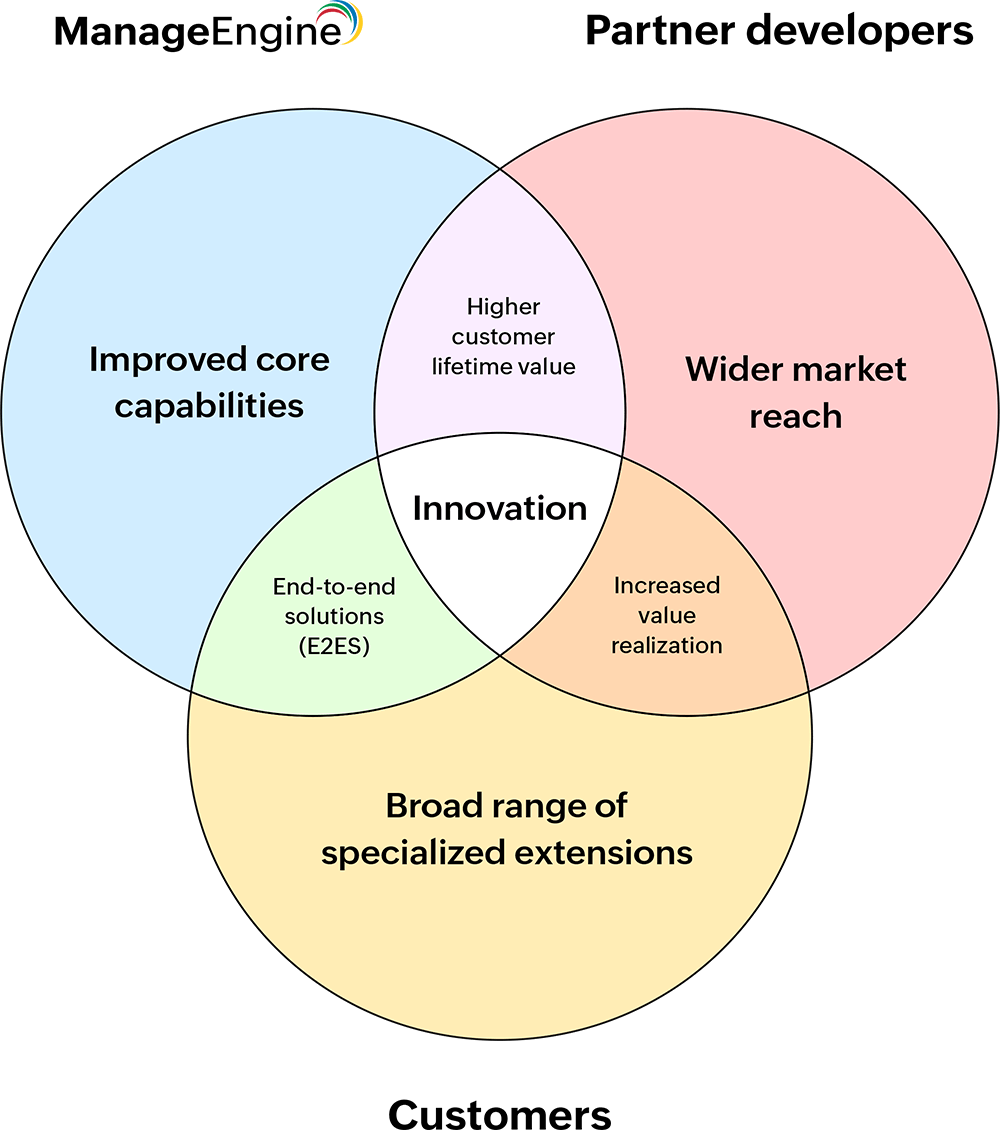
From our perspective:
- Working with partners allows us to accelerate the development of new extensions that can empower our customer ecosystem. This is particularly helpful with third-party integrations that are best built, maintained, and supported by partner-developers who are domain experts of various verticals.
- The extension route provides ease of use, a smooth experience through ecosystem delivery models, flexibility of usage, and customization options. This broadens the range of use cases the core product can address, making it more attractive to a wider audience.
- When the bespoke enterprise requirements are delivered by the partner-developer ecosystem, it lifts the strain off our engineers, thereby enabling them to focus on developing high-end platform components and improve core capabilities to handle the heavy demands of enterprises.
- These approaches create a long-term value chain for both our customers as well as our partner developers. It’s a win-win.
From a partner’s perspective:
- Developers get an opportunity to showcase and serve ManageEngine’s large enterprise customer base, increasing their visibility.
- They can widen the reach of their work beyond geographical boundaries through the Launchpad program, which comes with a diverse selection of marketing and promotional activities for the extensions listed on the platform.
- Being part of the heavily scrutinized ManageEngine Marketplace ecosystem enables them to build credibility amongst our customer base. This association over a period makes them a trustworthy partner for our enterprise customers, which can win them more specialized projects.
- Partners can leverage ManageEngine’s infrastructure, development tools, and business programs to accelerate the develop, deploy, go-to-market cycle, reducing the time and cost required to develop new features. This allows them to focus on innovation rather than worrying about the upfront costs needed for these resources if they had to do it on their own.
From a customer’s perspective:
- Users can customize the core product to their specific needs through extensions. This allows them to create a solution that perfectly fits their unique workflows, preferences, and business requirements.
- Enhances their user experience with turn-key integrations that can be managed from a single platform while managing scalability as needed.
- Customers can increase their ROI when they utilize ManageEngine platforms to their fullest potential through ManageEngine Marketplace extensions.
How we partner up
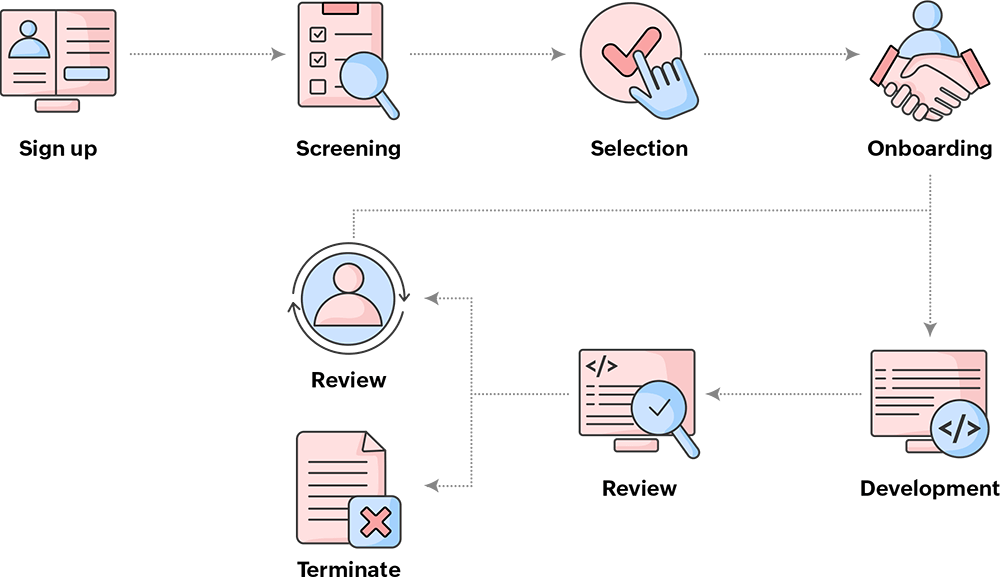
- Sign up: Developers fill up the application form through the Marketplace portal, which creates a ticket in the Marketplace Pitstop portal.
- Screening: When reviewing partner developer applicants, the Marketplace team establishes eligibility criteria. They look for a proven track record of success in the partner’s respective industries, implying a strong reputation for innovation, reliability, and customer satisfaction. Solution fit is also an important requirement. The partner must ensure that its third-party solutions integrate seamlessly with ManageEngine’s products and offer the functionalities and features that are relevant to our customers. Factors evaluated include ease of use, scalability, and security.
- Selection: Based on the criteria, the team carefully curates a list of independent software vendors (ISVs), OEMs and SIs who can offer high-quality solutions that complement our core product and features, and assist our customers.
- Onboarding: Developers are introduced to ManageEngine’s ecosystem with commencement meetings; presentations on ManageEngine’s product line-up; and compliance, legal, and Marketplace policies. Their product development accounts are set up, and they are ready to go.
- Development: Now that partner developers are equipped with the necessary resources, they can begin working on extensions. They work with ManageEngine through a partner console where members can share feedback and engage in meetings with the Marketplace team.
- Review: The extension developed by partners must be evaluated before it’s listed. Based on the complexity of the extension, the team validates authentication mechanisms, secure connections, access to sensitive data, user roles, and permissions. The respective product development team will perform functional, security, and privacy testing and share the QA report. The Marketplace team then validates these reports and approves the internal workflow. The admin and user guide submitted by partner developers are also reviewed for accuracy. Post successful listing, quarterly interactions with partner developers keep stakeholders in sync with security releases and patches.
- Renew/terminate: Renewal and termination for product-specific licenses are monitored by a dedicated licensing team to document records like products being used for development, licenses, and editions allocated. The Marketplace team reviews the license renewal process for each partner on a quarterly basis.
Functionality check
The aim is to provide high quality extensions through the Marketplace that address customer requirements and add value to our products. Product-specific PM teams study the business use case being offered, understand the scope of integration, and collaborate with the Marketplace team and partner developers to create these extensions.
The Early Adopter program
Designed as an initiative to collaborate with a select group of partner developers, the Early Adopter program was established by the Marketplace team in 2023. It aims to create a thriving ecosystem where businesses can familiarize themselves with ManageEngine Marketplace’s platform and business resources. Through this initiative we convert our existing reseller partners, aspiring boutique SIs, and new organizations to become a part of the ManageEngine ecosystem business model.
Participating developers receive free partner-developer training, certification, developer accounts, and licenses for the ManageEngine platform. This allows them to explore all the solutions available and work on building their extensions. Product support teams ensure partners have access to all the resources they need and help them resolve any technical challenges. At this stage, product teams actively engage with partners to gather feedback on their experiences and the features that are most beneficial. They gain deeper understanding of industry-specific use cases and how the products are applied in each scenario.
In addition to training, the program conducts periodic sessions with partners to discuss competitors and market trends, region-specific software launches, and other third-party integrations. Going beyond development, the program offers a collaborative environment where developers can experiment, provide feedback, and be a part of a larger community.
Best practices for tech partnerships
Forming a successful tech partnership, while highly rewarding, does come with its challenges. Here are some commonly faced hurdles and how to handle them.
Challenge: Misalignment of goals and expectations
Each business enters the partnership with its own markers for success, which may not necessarily align with your own objectives. For instance, we might measure success by increased user adoption rates, while the reseller turned partner-developer would look at the instant revenue that it is used to. The result, whether considered a success or failure, can vary based on priorities, strategic goals, and market strategies. So, when does this become a challenge?
ManageEngine is known for its value-driven, enterprise grade solutions. Let’s say we partner up with an organization that primarily caters to high-end enterprise customers. Being accustomed to selling “premium-priced” software, the firm may operate with an intention to price a premium that is disproportionate to the value delivered. This is against ManageEngine’s long-held culture and values. The firm may attempt to appeal to enterprise buyers while downplaying its affordability and ease of use. This approach alienates SMBs, as they may find the messaging out of touch with their needs and budgets. On the other hand, enterprise clients may feel the product lacks the robustness of more expensive competitors. This disconnect hampers the company’s ability to maintain market traction.
The bottom line? When partners do not align with a company’s existing market positioning, it may dilute the company’s brand identity.
Best practices:
- Include partners in your growth plan: a joint plan with clearly outlined goals, shared objectives, roles and responsibilities, and milestones to define progress. Document these discussions and make room to renegotiate terms if either party’s priorities shift.
- Maintain ongoing communication with regular meetings to revisit goals, review progress, and address any changes in strategic direction. It also provides a forum for airing concerns and resolving conflicts before they escalate.
- Establish conflict resolution mechanisms to handle disputes constructively. Examples include mediation by a third party or a formal arbitration process.
- Focus on the win-win situations. Continually highlighting the mutual benefits of the partnership helps maintain a collaborative, positive mindset.
Challenge: Intellectual property (IP) protection
When there’s a collaboration between two or more companies, there’s also an exchange of proprietary information, technology, and innovations. This is essential for developing new products, integrating systems, or creating joint solutions.
However, it also raises concerns about how each partner’s IP will be protected and used. Risks include IP theft or misuse, ambiguity in IP ownership, and even differing IP policies and jurisdictions when working with international partners. Similarly, there is a possibility of exposing sensitive IPs when integrating software, APIs, or platforms.
It can be tricky to protect information while ensuring effective integration. Without a guarantee that their IP is safe, partners may refrain from open collaboration and limit the sharing of critical insights or technologies, thus reducing the partnership’s potential value.
Best practices:
- Develop clear IP agreements that define the ownership, usage rights, and protection of IP. Specify what constitutes proprietary information, how it can be used, who owns new developments, and the consequences of IP misuse.
- Implement NDAs to ensure that all parties are legally bound to protect each other’s confidential information. Ensure all stakeholders fully understand and agree to the terms before the partnership begins.
- Address jurisdictional differences with the guidance of legal experts and understand how geographical differences can impact IP protection.
- Establish key practices like regular audits and compliance checks, encryption, strict access controls, and other cybersecurity measures to safeguard proprietary data.
- Create joint IP management frameworks if needed. In some cases, partners may opt for co-ownership agreements, licensing arrangements, or royalty structures that fairly compensate stakeholders for their contributions.
Challenge: Integrating with existing technology
Combining new, third-party technologies with the organization’s current systems and workflows may be a struggle. Technological incompatibilities, particularly with legacy systems, require extensive workarounds and effort from both parties. It may also be caused by differences in software architecture, programming languages, or data formats.
Resolution is resource-consuming in terms of cost, time, and manpower. Technology aside, relying on an external vendor means depending on their support and ability to deliver updates or solutions promptly. Any roadblocks in their tools or operations could have a direct impact on the partnership as well. Other hurdles like security threats, potential disruption to services, and cultural resistance to adopting new solutions also pose a threat to partnerships and prevent them from achieving their full potential.
Best practices:
- Conduct compatibility assessments on criteria such as software architectures and APIs. Involve IT teams early in the process to anticipate integration challenges and map out resource allocation accordingly.
- Develop a comprehensive integration plan that prioritizes data security and compliance. Just as a product manager would develop a PRD for a new product or feature, an integration also requires a detailed outline of key steps, timelines, roles and responsibilities, and resources required.
- Plan for minimal disruptions to operations. Schedule integration activities during off-peak hours, use sandbox environments for testing before deployment, and ensure contingency plans are in place in case of unexpected issues.
- Promote user adoption and awareness internally. Make use of training sessions and educational materials, communicate the benefits, and provide additional support where needed.
- Negotiate SLAs with vendors to ensure reliable support and timely resolution of issues. Gain a clear understanding of their operations and support capabilities before committing to a partnership.
Challenge: Update product knowledge
Partners must have an in-depth understanding of the product’s capabilities, bug fixes, new features, and the latest updates to help customers effectively. With a product portfolio as vast as ours, it can be difficult to keep up. There may also be differences in product absorption within an organization. Some partner technicians may be experienced with the solutions, while others may still be in the learning phase. And with varying levels of expertise, the quality of support is likely to be inconsistent.
Unreliable customer support can harm the company’s brand reputation. This challenge is more pronounced when there are regional differences and language barriers. Partners in different regions may need localized content, different marketing strategies, or specific legal compliance information. Ensuring that all stakeholders are equipped with the necessary knowledge while maintaining overall quality standards is a complex task.
Best practices:
- Conduct training programs for partners that cover all aspects of the product, from basic functionality to advanced features. It is crucial that the training sessions are ongoing to match the product’s evolution rather than being a one-time onboarding occurrence. As an incentive, these programs can also offer certifications.
- Establish a centralized knowledge hub or portal where partners can access up-to-date product information, documentation, training materials, FAQs, and marketing collateral. A single source of truth helps ensure that all partners have accurate information.
- Maintain regular communication with partners through the portal or other channels. Having strong feedback loops provides better insight into their challenges and helps teams address concerns and identify areas where they need more support. It also helps to have a dedicated partner support team for real-time assistance with product-related queries or issues.
- Create forums and product-specific user groups where partners can share experiences, learn from each other, and discuss best practices. This community-driven approach can help fill knowledge gaps and promote a culture of continuous learning.
Looking ahead
By prioritizing customer-centricity and encouraging diversity in our range of partnerships, ManageEngine is not only investing in immediate growth but also laying the foundation for lasting success in an increasingly competitive market.
We aim to continue nurturing these alliances by focusing on avenues like improved feedback mechanisms, co-development initiatives, and providing visibility into the product development process. Events like the annual Partner Meet further solidify our relationship and are a platform to validate that we’re moving in the right direction. Ultimately, partnerships are the catalyst for pushing boundaries and building products that our customers are proud to use.

About the author
Mahanya is a content writer who specializes in IT stories, documenting the journey of enterprises like ManageEngine - their ups and downs, internal processes, and core principles. She is keenly interested in interacting with IT thought leaders to get their perspective on digital transformation. A true zillennial at heart, she spends her spare time on social media finding homes for rescue dogs.
About
As the IT management division of Zoho Corporation, ManageEngine prioritizes flexible solutions that work for all businesses, regardless of size or budget. ManageEngine crafts comprehensive IT management software with a focus on making your job easier. Our 120+ awardwinning products and free tools cover everything your IT needs. From network and device management to security and service desk software, we’re bringing IT together for an integrated, overarching approach to optimize your IT.