Fueling business growth through tech partnerships
Introduction: An insider’s look into our partner ecosystem
When we travel to a new and unfamiliar country, it’s natural for many of us to look out for familiar fast-food chains. Why? It’s because of the undeniable consistency in taste; we know exactly what to expect when eating at these establishments.
In a restaurant franchise model, the parent brand provides proprietary assets, closely guarded recipes (think of KFC’s 11 secret herbs and spices), training, and brand identity, ensuring quality in products and services across locations. The franchisees, in turn, bring valuable local market insights and connections to manage operations and cultivate community relationships. This symbiotic relationship drives a common objective—sustainable, scalable success that neither could attain on their own. A win-win.
The same logic applies to technology and IT solutions. In a sector characterized by rapid advancements and evolving user demands, partnerships have emerged as a vital component of business strategy. Organizations that prioritize building and nurturing these alliances will be better positioned to navigate challenges, seize opportunities, stand apart from competitors, & achieve long-term success.
Partners have played a significant role in ManageEngine’s growth, right from our AdventNet days. In this e-book, we’ll take a closer look at this fundamental relationship and how we’ve harnessed the power of collaboration.
What’s ahead?
- We begin by examining the structure of an enterprise partnership. This includes the various types of partners, the criteria we prioritize for a sustainable association, the teams involved in the process, and the tools we implement to make the experience seamless and mutually beneficial for stakeholders.
- Partnerships bring different perspectives. Here, we take a closer look at our approach through a real-life example of working with a global system integrator (GSI). Additionally, we engage in conversation with partners to gain insights on their side of operations, the challenges they encounter, and their long-term visions.
- Created with the goal of being a one-stop shop for our customers, ManageEngine’s Marketplace is gaining traction amongst customers with new integrations and more innovation opportunities with partner developers. In the third chapter, we take a closer look at this ecosystem and how it helps us build customizable, world-class products.
- Gain insights from ManageEngine’s leaders on our commitment to fostering strong relationships rooted in trust and co-innovation. We conclude by addressing the challenges organizations encounter when entering tech partnerships and offering best practices to navigate these obstacles effectively.
We’ve got a full plate ahead, so let’s dive right in!
ManageEngine’s relationship
with partners
To us, being a strategic partner means going beyond a transactional relationship to a deeper, mutually beneficial alliance. It means leveraging each other’s strengths and resources to create greater value than either could achieve independently.
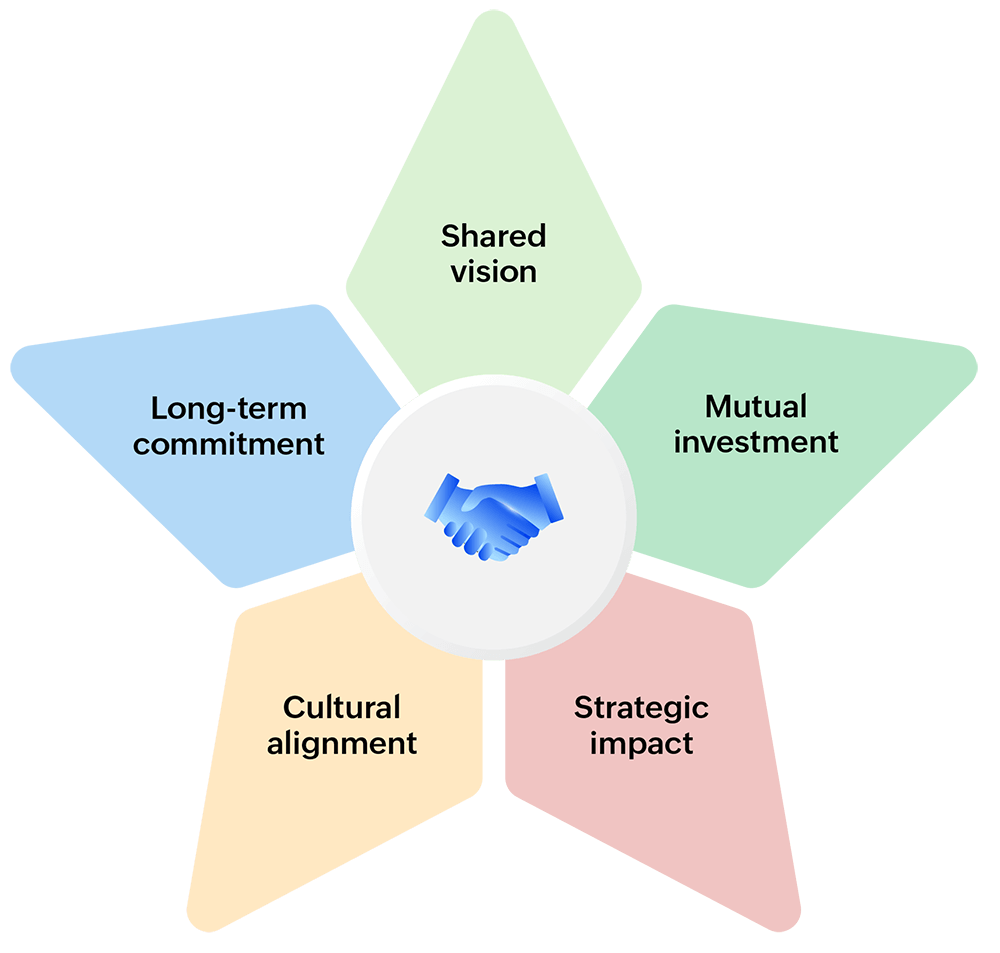
Shared vision
Partnership involves sharing common goals and aligning efforts to reach them. It should make sense in the context of each organization’s broader strategy. For instance, a SaaS solutions provider looking to enter a new market would partner with someone who has the expertise in the area or domain and shared interest in expanding their services. Together, they can set goals like revenue targets, user onboarding metrics, or product development milestones that they can collaboratively achieve. This mutual understanding sets the stage for fruitful collaboration.
Mutual investment
A partnership investment is not limited to financial capital. It can go beyond finance to include technology, personnel, or expertise. In technology-driven partnerships, sharing infrastructure and technology is common. For instance, ManageEngine might provide access to its platform or APIs to a partner developer, while the developer contributes its technical expertise to build integrations or extensions. ManageEngine’s product teams also invest heavily in implementation training, ensuring partners are equipped to handle any real-world challenges posed by customers in their environments. We also conduct workshops and events where stakeholders can exchange insights and learn from each others’ experiences.
Strategic impact
How can a partnership change the competitive landscape and create significant value? The ultimate strategic impact of a partnership is often measured by the value it creates for customers. When a collaboration results in a unique value proposition, it leads to increased influence in the market and sets industry trends. Impact is also closely tied to the ability of a partnership to drive innovation. By working closely together, partners can share best practices, challenge each other’s thought processes, and inspire creative solutions to complex problems. ManageEngine’s partnerships have consistently led to positive results, which can be credited to the culture of continuous improvement in ManageEngine’s DNA.
Cultural alignment
When partners share similar cultural values, they’re more likely to approach challenges and opportunities in a compatible manner. Being on the same page is crucial for effective communication, decision-making, and minimizing conflicts. Cultural alignment also plays a key role in creating a unified approach to customer satisfaction. With customer-centricity as a core value, a strong partnership delivers high-quality user experience consistently and helps maintain a cohesive brand image. Needless to say, a commitment to upholding standards and regulations is not just “nice to have;” it’s a mandate in tech partnerships, especially when sensitive data is at stake. It remains one of ManageEngine’s top priorities when selecting a partner.
Long-term commitment
Long-term partnerships allow for deeper collaboration, as both parties can learn from each other and grow together over time. However, it is important to note that when we’re sharing the rewards, we’re also sharing the risks and accountability. For example, we may jointly invest with a partner when entering a new market, sharing the costs and risks associated with market entry, such as regulatory compliance and market research. This also means that we are equally accountable for the success or failure of joint initiatives.
This kind of relationship can only work when both partners are in it for the long haul, establish trust, and provide a vote of confidence to invest in the relationship. Trust is fundamental to any partnership, especially in the SaaS industry, where there’s frequent exchange of sensitive information, proprietary technology, and strategic plans. These investments (again, not just financial) often don’t pay off immediately but yield substantial returns over time.
Types of partners
Reseller partners: Resellers purchase the products at a discounted price from ManageEngine and sell them to their customers. They deliver sales, consultation, onboarding, implementation, and a limited level of support for our solutions. The Reseller Program enables companies to expand their distribution channels and reach a broader market by leveraging the sales efforts of authorized resellers.
Global system integrators (GSIs): A system integrator (SI) is a specialized company that focuses on creating unified systems by combining various software, hardware, and networking components (tech stacks). Their expertise lies in designing, implementing, and overseeing complex systems to ensure smooth integrations and efficient operations. SIs are adept at merging diverse technologies to address specific client needs.
Partner developers: Also called Marketplace Partners, they are third-party developers or small-scale SIs that expand ManageEngine Marketplace’s offerings with applications, extensions, and integrations. With their contributions, users can easily access a wider range of tools and features to enhance their user experience.
Why are tech partnerships important?
Strategic partnerships, such as those with resellers and third-party developers, play a crucial role in the growth of an organization. By leveraging their strengths and expertise, businesses can unlock new opportunities, deliver greater value to customers, and stay ahead in a competitive landscape. In fact, partners can act as an extension of the company’s own sales force.
Each type of partnership has its own advantages. Take resellers or distributors, for instance: They typically have established networks, customer bases, and market knowledge. Their tailored product positioning facilitates entry to regions, industries, and customer segments that may otherwise be a challenge. Additionally, being in the same region and eliminating language barriers encourages better support and stronger relationships with customers. Feedback and insights from resellers and distributors also offer new perspectives and help shape the product roadmap.
Partner developers, on the other hand, can bring value to the table by addressing niche customer needs and customized solutions through extensions. These extensions can range from simple add-ons to complex integrations with other platforms, providing more flexibility and functionality. A culture of open development comes with the added benefit of continuous innovation. The availability of a wide range of extensions can also make the core product more attractive to potential customers, who may view it as a more comprehensive solution.
The bottom line? Partners are vital to strengthen the brand image, build a community, and drive revenue. By investing in and nurturing these relationships, businesses can see tremendous growth and long-term success. Everybody stands to win.
Qualities for a successful partnership in SaaS
Transparency
Partnerships built on transparency last longer. When a tech partner is open about their practices (like pricing models and marketing efforts), expectations, and limitations, it establishes trust and ensures that they are operating with the best interest of both parties in mind. Two-way communication without any hidden agendas or surprises helps mitigate potential risks or misunderstandings proactively.
Industry expertise
Partners must have experience in successfully working with similar solutions in the market. While technical proficiency (product know-how) can be taught, they must already possess deep industry knowledge for a symbiotic partnership. In our case, this means knowing the target users, market trends, and how to implement various IT solutions for commonly faced challenges across industries.
Reputation
Customers are more likely to purchase from a brand they trust. A proven track record displays credibility, work ethic, and a good relationship with customers. Reliable partners will have positive testimonials, case studies, and references to back their work.
Value alignment
Congruent relationships work when partners share similar values, vision, and core principles. It’s easy to gauge how invested a partner is in the project through their engagement. Being a service oriented organization,
ManageEngine seeks partners who are just as passionate as we are when it comes to solving users’ problems. A cultural fit is just as important
as business acumen.
Language fluency
When working with non-English speaking customers, partners from the region must be able to interpret the jargon and communicate in simple terms. While ManageEngine is working on providing solutions in multiple languages, we’re bound to face difficulties in regional dialects. This is an opportunity for partners to work with customers and adapt solutions to their needs.
-
Previous Chapter
‹ - ›