From “working for” to“working with”
Partner account management (PAM)
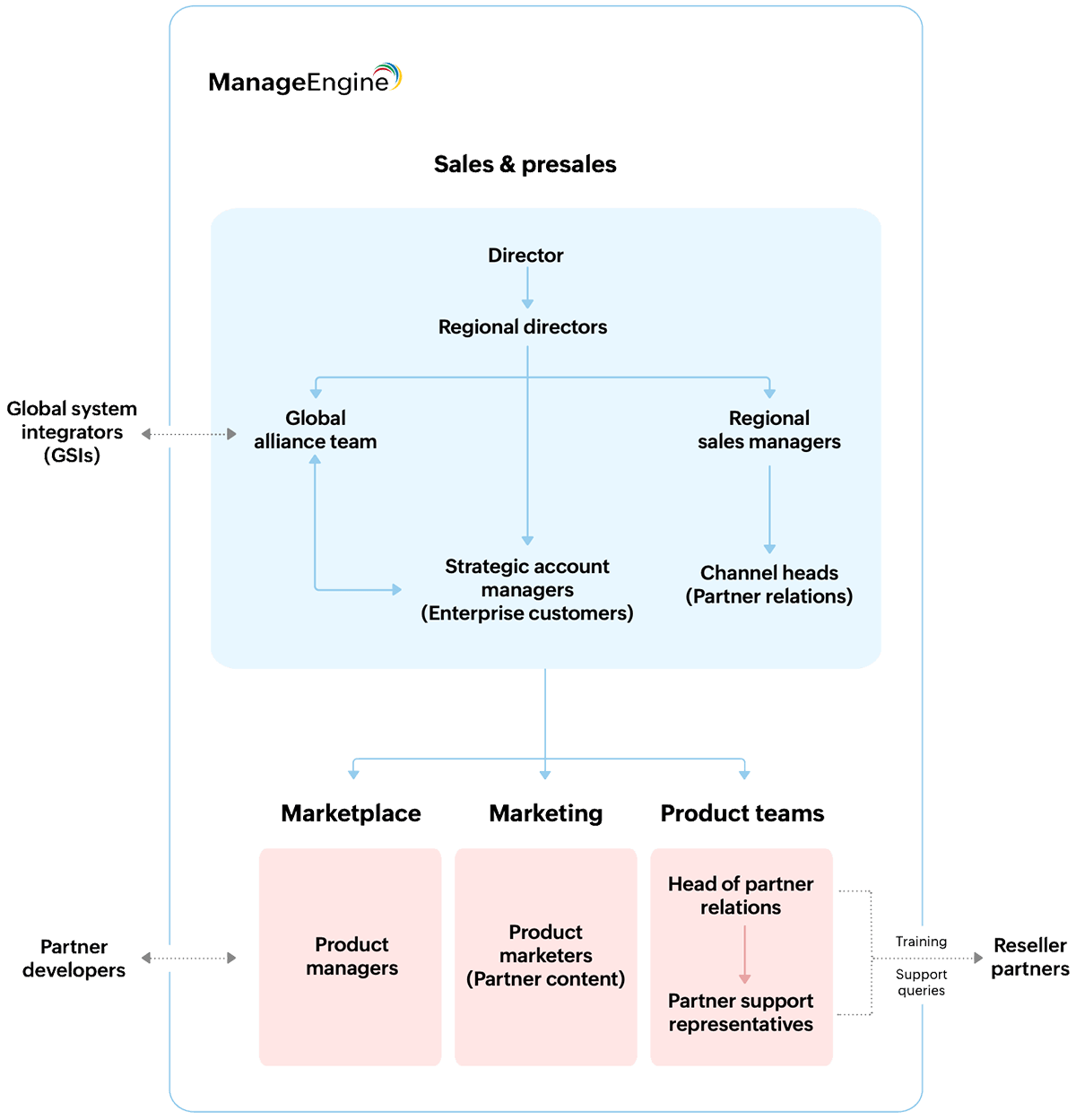
Managing partnerships requires a dedicated team, and in our case, a separate division of the sales and presales domain. Unlike customer relationships, partner ecosystems include diverse interactions, each requiring tailored support, resources, and communication.
A dedicated team ensures that these different partners are properly enabled, their performance is tracked, and they are equipped to carry out their responsibilities effectively. Let’s quickly review some of the key roles and responsibilities of the PAM team.
Sales & presales
|
Role |
Responsibilities |
|---|---|
|
Regional sales manager |
|
|
Channel head |
|
|
Global alliance manager |
|
|
Strategic account manager |
|
Product teams
|
Role |
Responsibilities |
|---|---|
|
Head of partner relations |
|
|
Partner support |
|
|
Marketers |
|
ManageEngine Marketplace
|
Role |
Responsibilities |
|---|---|
|
Product manager |
|
Building a successful partner ecosystem
- The first step is to identify potential partners, which can be done in two ways. One, through inbound approaches like networking events, online communities, referral programs, or through ManageEngine’s partner program application. Two, the company may engage in proactive efforts, such as targeted outreach, market research, partner databases and networks, or developer communities. In most cases, an inbound approach is the most common method of establishing connection.
- The sales team conducts a thorough verification process in terms of the partner’s strategic alignment, technical expertise, partnership history, and financial and operational capacity to ensure they have the capabilities to build a long-term relationship with ManageEngine.
- Once the partners have been identified, the sales team initiates the onboarding process through an email and introduces them to the partner portal, our intranet portal exclusive for each region and solution.
- Partners (particularly resellers) are given basic training on all the products or the selected products they will be taking up. Initially, they are encouraged to conduct transactions alone until they gain full product understanding and are certified by ManageEngine. As they solidify their foundation, partners build a team for other domains like support and marketing. Eventually, they are encouraged to begin implementation for customers. SIs and partner developers on the other hand, usually come up with a general understanding of the software so their training revolves around the problems they aim to solve.
Partner training program
The product-wise training program is conducted by the respective support teams. These sessions are typically aimed at helping partners understand the inner workings of the product. Partners begin as transactional resellers and are encouraged to expand their offerings to value-added or professional services like implementation and support. Once the course is concluded, partners take up an evaluation or practice session.
Take our IT service desk, for instance. The support team presents over 50 use cases that partners must implement and upload the screenshots to the session portal. These real-life scenarios help tackle problems faced by customers.
A certificate is issued to partners who are identified as value-add partners upon successful completion of the training program. The training continues annually with ad hoc sessions based on partner requests or the launch of a new feature or module.
ManageEngine’s relationship with partners is a long-standing one. Even without a formal program, we engaged in active discussions and training sessions to impart product knowledge. The partner program was formalized in 2018, with some crucial changes to our strategy. Initially, we conducted the training program with a customer-centric approach, which means our focus was on concepts like available features and modules.
We realized pretty quickly that offering the same training for partners and customers would not provide optimal results. We don’t want our customers to have to code. However, we want partners to upskill and handle value-added services like writing custom functions, doing custom integrations, and building extensions. Now, we’ve modified the agenda to highlight the fact that partners are an extension of the company. With the current training strategy, partners can provide professional services and add value for ManageEngine.
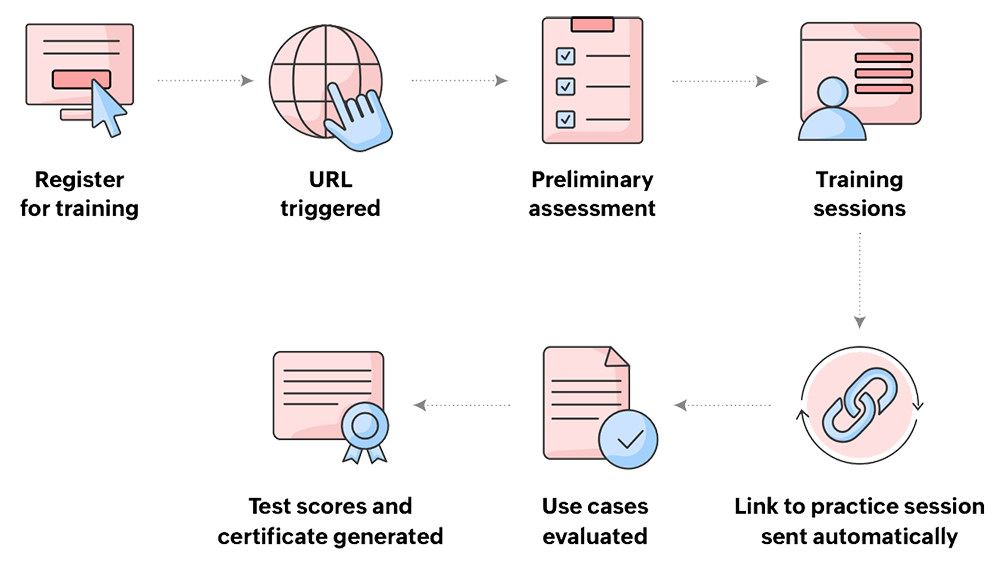
Another key change we made was to the evaluation process. Evaluation was manual previously, which was time-consuming and required additional manpower. Now, it’s automated end to end through our low-code application. So when a partner needs training, we give them a URL. Once they register, it conducts a preliminary test to gauge if the partner has basic understanding of the domain. Based on the score, the application offers materials. A week later, the application automatically sends them another link to take up the evaluation. The system evaluates the use cases, calculates the test score, and issues a certificate immediately. This is repeated annually as a refresher course as well. Making these corrections in our approach has helped us improve the quality of learning we offer and our partnership as a whole.
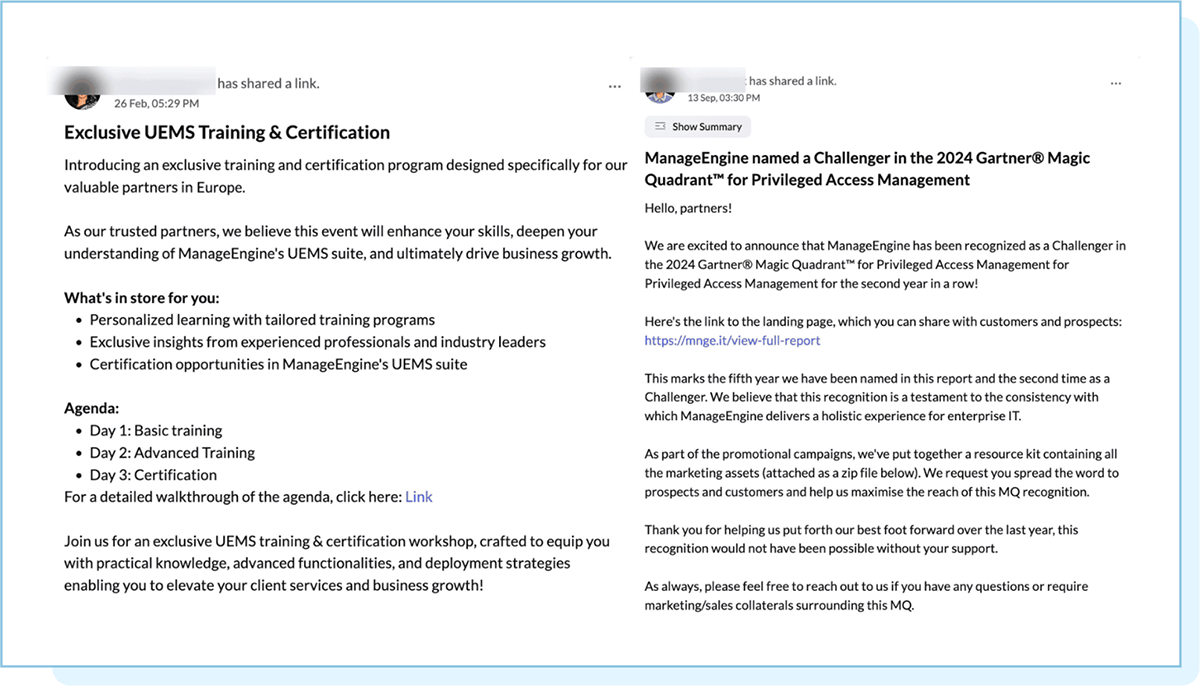
We use our in-house intranet platform to interact with partners. The partner management team conducts periodic open house or town hall sessions to resolve queries, share insights and updates, address concerns, and engage in active discussions about the program.
ManageEngine’s partner events
Partner Meet
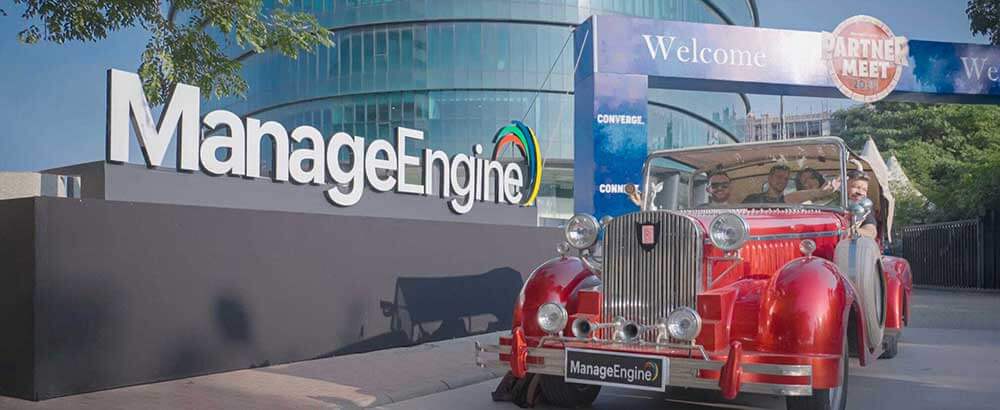
Building a strong partner ecosystem is essential for sustained growth and success, and ManageEngine’s Partner Meet serves as a pivotal platform to strengthen these relationships. The primary goal of the event is to provide a unique opportunity for face-to-face interactions. Partners can connect and share insights with ManageEngine’s product teams as well as other partners worldwide. The personal engagement with stakeholders fosters a sense of belonging and community, which is crucial for cultivating long-term, collaborative partnerships.
The partner meet also facilitates the sharing of the company’s vision, strategy, and product roadmap with the partner network. It is crucial that partners are aligned with the company’s long-term goals as they are an extension of the company’s brand and values. Conducted over a week, ManageEngine’s leadership and product team leads engage in discussions on strategic priorities, upcoming innovations, and market opportunities.
Lastly, the partner meet serves as a valuable forum for gathering feedback. Involving partners in open discussions, feedback sessions, and Q&A segments allows us to hear directly from those who are on the ground across different regions. This
feedback is invaluable for identifying areas of improvement, refining strategies, and making data-driven decisions that enhance
the partner program.
The agenda of the event revolves around:
- Regional statistics and strategies
- Customer success initiatives
- Feedback from support teams for faster resolution
- Customer feedback relayed by partners
Global Systems Integrators (GSI) Summit
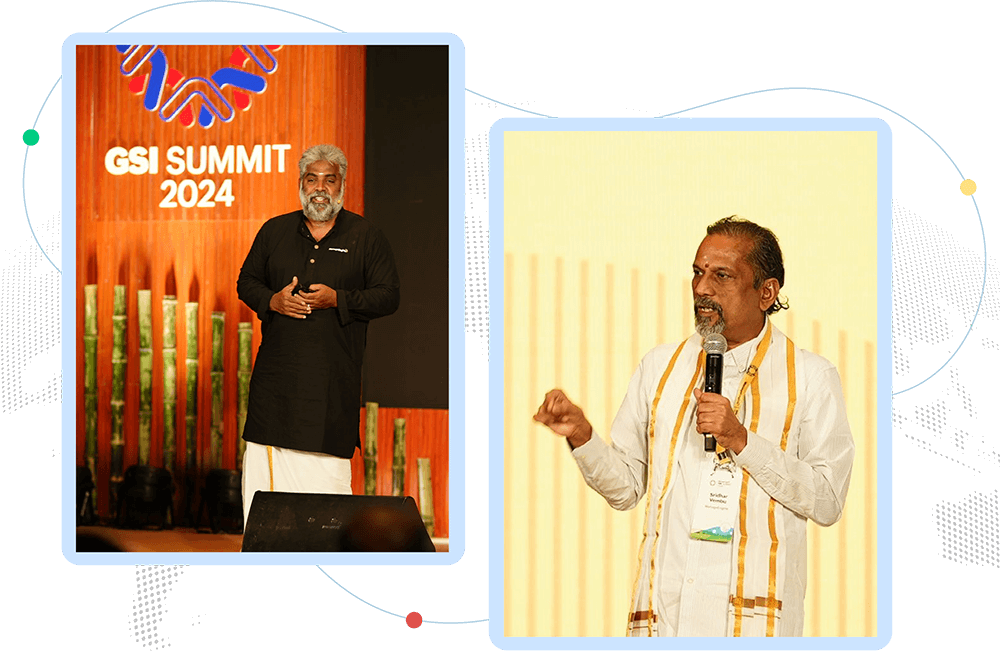
ManageEngine held its first-ever GSI Summit in April 2024 at the Indian headquarters of Zoho Corp. in Chennai. This exclusive, invite-only program had over 150 delegates from the top GSIs worldwide. The attendees were influencers and decision-makers, comprising presales heads, practice heads, solution architects, delivery heads, and bid managers. The primary objective of this summit was to emphasize our commitment to partners and help them navigate the challenges and complexities they face in the rapidly evolving tech landscape.
Establishing a strong presence in the GSI ecosystem enables us to co-create and co-innovate with partners as we foray into the enterprise market. At the event, we also bestowed the GSI awards in recognition of our partners’ contributions to our product growth. We plan to make the GSI Summit an annual event due to its success and the positive impact it has on our partners.
Partnership is a two-way street
NexGen Inc. (name changed for privacy) has been working with ManageEngine for nearly six years. As partners, it contributes both as an integration partner and reseller for ManageEngine products. They also provide customization services to ensure successful client adoption of these solutions. Here, their partner success manager shares details on their journey as a tech partner.
Q. How has this partnership benefited you?
This partnership with ManageEngine has significantly expanded our service offerings, allowing us to cater to a wider range of customer needs. These collaborative efforts have strengthened our technical expertise in the complete suite of products, which has in turn led to more business opportunities. We’ve also had several opportunities to engage with the product teams and attend events. The sessions were highly interactive, providing valuable insights into the latest product updates and roadmaps. These interactions helped us better align with customer needs and stay updated on new functionalities, which in turn improved the services we provide to our clients.
Q. What are the challenges you face when reselling or implementing products?
When the products were still in the nascent stage, we faced challenges in non-English speaking regions. The language barrier made it difficult to convey technical terms, and we weren’t fully confident in the knowledge transfer between technicians and customers. We expressed our concerns to the product teams. This has since been resolved by localizing products and product-related documentation to support multiple languages. It helps us bridge the gap between the customers and the product, facilitating seamless implementation and training.
We also see differences in perceived value. Customers may prioritize certain features that are not the core strengths of ManageEngine’s offerings, while others may expect immediate results without fully understanding the implementation process or time required to see ROI. So, setting and managing customer expectations can be a challenge sometimes. We focus on setting realistic expectations from the outset. This means highlighting any known limitations and making sure customers understand what will be required on their end for a successful implementation.
Q. What is your long-term vision for this partnership?
Our long-term vision for this partnership is to continue expanding our service offerings and deepen our expertise in ManageEngine solutions to offer holistic solutions to clients across multiple sectors.
Some of the key factors for the longevity of a tech partnership such as this are:
- Enhancing communication between us and the product teams.
- Ensuring we have the latest updates and knowledge to serve our customers better.
- Engaging in more tailored product and feature training sessions or webinars.
By working with ManageEngine on these activities, we ensure a fruitful collaboration that nurtures tandem growth and success.