Enterprise AI isn't broken; your data is broken
A friend who runs data engineering at a mid-sized logistics company once showed me something that made me laugh, and then made me a little sad. Her team spent four months building a chatbot that was supposed to answer simple questions like "how many shipments are delayed in the Chennai warehouse right now." The bot worked beautifully in the demo. Then someone asked it a real question, and it confidently returned a number that was off by almost a factor of ten. Not because the model was dumb. Because three different systems in her company called the same warehouse three different names, and nobody had ever bothered to reconcile them.
That's the whole story, really. Everyone wanted to blame the AI. Nobody wanted to blame the spreadsheet.
I've been watching this pattern repeat itself across industries for a while now, and I no longer think it's a coincidence. Enterprise AI adoption has moved fast. Every company wants an assistant, a chatbot, an agent that can "just handle it." But the more I talk to people actually building these systems, the more I notice a quiet, uncomfortable truth.
Most companies aren't failing at AI. They're failing at the thing AI was supposed to expose gently and instead exposed brutally: their data was never in good shape to begin with.
For years, this didn't matter much. Data sat in warehouses and dashboards, and humans quietly did the work of interpreting it. An analyst knew that "Chennai_WH" and "Chennai Warehouse 1" and "CHN-01" were the same place. She'd seen the mess before. She adjusted for it without even thinking. AI doesn't have that instinct. It takes what it's given and runs with it, and when what it's given is inconsistent, mislabelled, duplicated, or just old, the output looks confident and wrong at the same time. That combination, confidence plus wrongness, is what makes people say "AI hallucinates" when really the AI is just reflecting the mess it was handed.
This is worth reviewing for a moment, because it should change how you interpret every "AI project failed" headline you read. When a pilot program stalls, the easy story is that the model wasn't good enough, or the vendor over promised, or the use case was too ambitious. Sometimes that's true. But increasingly, when you dig into these post-mortems, the real problem is much less glamorous. Duplicate customer records. Inconsistent product taxonomies. Fields that mean one thing in the CRM and something slightly different in the ERP. None of this is new. It's been sitting there for a decade, quietly tolerated because humans were the buffer between bad data and bad decisions.
What AI does, is remove the buffer.
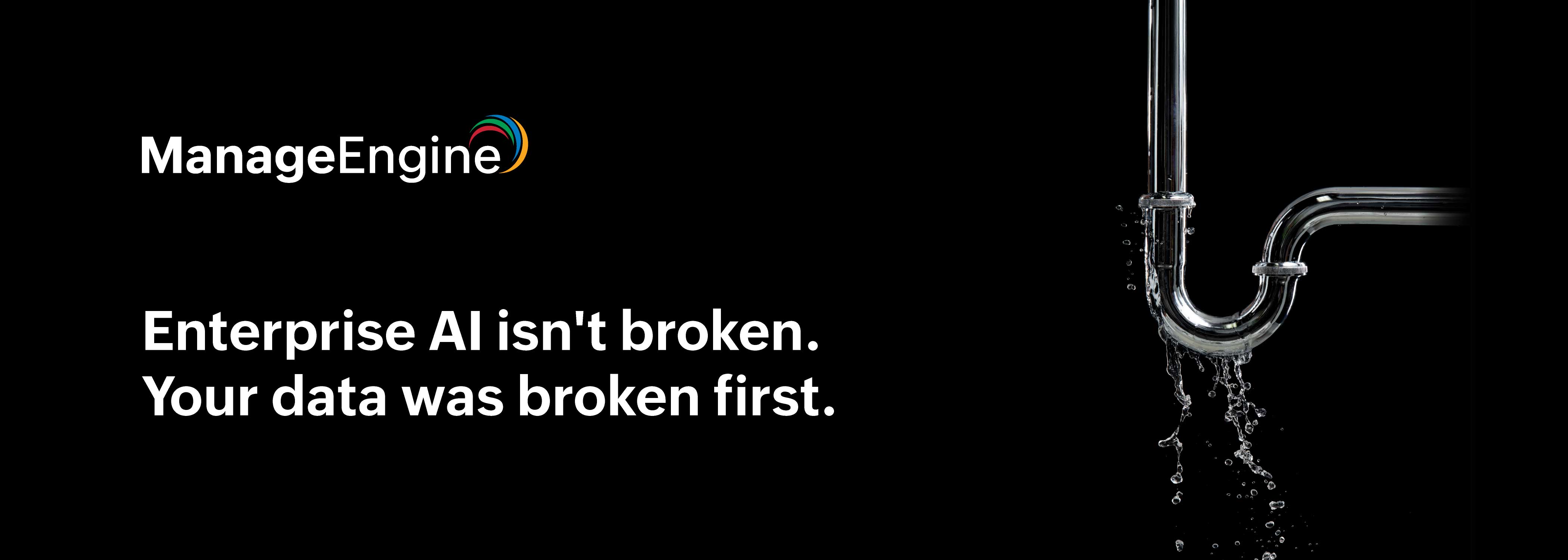
Here's the part I find genuinely interesting. This isn't really a technology problem. It's an incentive problem, and it's been one for a long time. Data cleanup has never been a project anyone gets promoted for. It's slow, unglamorous, and invisible when done well. Nobody writes a case study titled "We spent six months standardizing our address fields." Meanwhile, launching a flashy AI pilot gets you a boost in the quarterly review. So companies have spent years underinvesting in the boring plumbing while overinvesting in the shiny fixtures. AI didn't create that imbalance. It just made the plumbing leak in front of everyone.
There's a second thing people misunderstand, and it's actually the more important one. A lot of leaders assume that "our data is messy" is a temporary state, something you fix once and move past, like a renovation. It isn't. Data decays constantly. Customers change addresses. Products get renamed. Teams merge and rename their systems. Org charts shift. A dataset that was clean eighteen months ago is not clean today, and pretending otherwise is how you end up with an AI system that was accurate at launch and quietly wrong by the second quarter. The companies that are actually getting value from enterprise AI right now aren't the ones with the best models. They're the ones who treat data quality as an ongoing discipline rather than a checkbox before deployment.
I want to be fair here, because there's a genuine industry debate worth acknowledging. Some technologists argue that data quality is why the newest generation of AI tools matters, that retrieval systems and AI processes are specifically designed to work around messy, unstructured enterprise data rather than requiring it to be perfectly clean. There's real truth in that contention. Retrieval-augmented approaches have made it possible to point a model at your actual real-world internal documents instead of demanding a pristine database structure. That's progress, and it's worth noting.
But it's the full answer, and here's why. Retrieval can help a model find the right document. It can't tell the model which of your three conflicting documents is actually correct. If your contract management system says a client's payment terms are net 30, and your finance team's spreadsheet says net 45, no amount of clever retrieval fixes that. The model will just retrieve the contradiction faster and present it with more confidence. Better plumbing helps you access the mess more efficiently. It doesn't clean the mess.
This is where a lot of the AI conversation goes slightly wrong. There's an implicit assumption, almost never said out loud, that data quality is a solved problem and the interesting work now happens at the model layer. I'd argue it's the opposite. The model layer is maturing faster than most companies' internal data discipline is. We've built increasingly capable engines and bolted them onto foundations that were never designed to be load-bearing at this level.
What fascinates me is how this plays out at the human level inside organizations. I've spoken to teams where the data engineers know exactly what's wrong, have known for years, and have simply never had the budget or the authority to fix it. Then an AI initiative gets funded from the top, expectations are high, and suddenly the same data engineers are asked to make years-old problems disappear in a single sprint. It's an unfair position to put people in. And it explains something I've noticed in a lot of post-launch reviews. The people closest to the data are rarely surprised when things go wrong. They saw it coming. Nobody asked them before the deadline was set.
There's also a quieter, more uncomfortable point buried in all this. Fixing data quality properly means someone has to own it, end to end, across departments that have historically guarded their own systems jealously. Sales doesn't want IT dictating how they name their fields. Finance doesn't want to reconcile its definitions with operations. Data quality, done properly, requires organizational humility. It requires admitting that your department's version of the truth might not be the correct one. That's a harder ask than buying a new AI tool, and I suspect that's part of why so many companies keep reaching for the tool instead.
If there is just one idea I want people to walk away with, it's this: enterprise AI isn't a data quality solution; it's a data quality magnifier. It takes whatever discipline, or lack of it, that already exists in an organization and makes the consequences visible faster and more publicly than ever before. A company with tight data governance will look genuinely impressive with AI layered on top. A company with loose governance will look, often for the first time, exactly as disorganized as it actually is. Technology isn't creating new problems so much as it's finally sending out bills for old ones.
I keep thinking about my friend's warehouse naming problem. In the end, the fix wasn't a better model or a smarter prompt. It was three teams sitting in a room, agreeing on one name for one warehouse, and updating it everywhere. Unglamorous, slow, and necessary. The AI worked fine after that. It always would have.
So maybe the real question worth sitting with isn't "is our AI good enough." It's whether we've ever actually respected our own data enough to deserve a good answer from anything we ask it.
https://blogscdn.manageengine.com/sites/meblogs/images/general/toptips_laptop-after-work.jpg