Best practices for deploying out of band authentication
What analysts say regarding out of band authentication
Fortify your organization with robust out of band authentication methods using ADSelfService Plus
People also ask
What is out of band authentication?
Out of band authentication is a security verification method that uses a separate, independent communication channel to confirm a user's identity. Unlike traditional authentication that relies on a single channel (for example, a web browser or an application), OOB authentication introduces a second channel such as SMS, voice calls, mobile push notifications, or dedicated authentication apps to validate login attempts.
The term "out-of-band" refers to the use of a communication path that's separate from the primary channel being used for the transaction. This separation creates an additional security layer that makes it significantly more difficult for cybercriminals to compromise both channels simultaneously.
How does out of band authentication work?
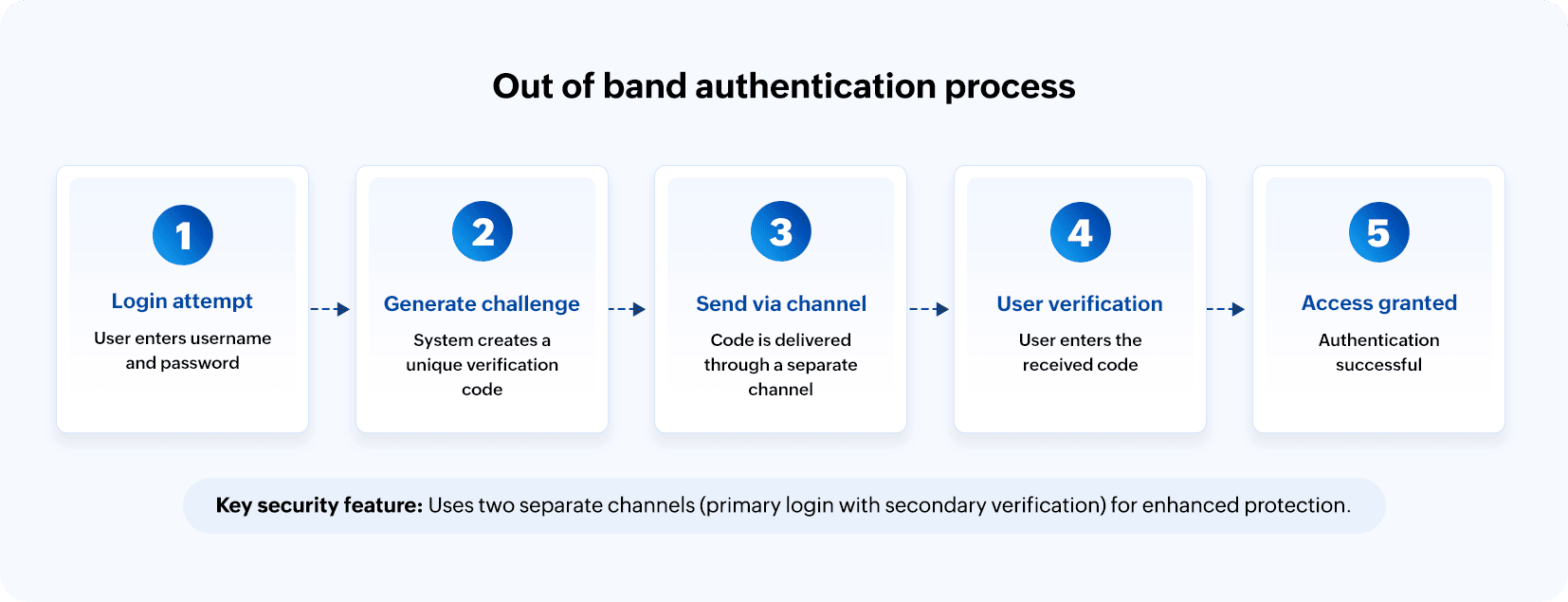
The out of band authentication process typically follows these steps:
Initial authentication request: A user attempts to log into a system using their primary credentials (username and password).
Challenge generation: The system generates a unique, time-sensitive authentication challenge.
Out of band delivery: This challenge is sent through a separate channel-most commonly to the user's registered mobile device via SMS, voice call, or push notification.
User verification: The user receives the challenge and responds through either the same out of band channel or by entering the received code into the original application.
Granting access: Only after successful verification through both channels is access granted to the requested resource.
Types of out of band authentication
SMS-based authentication
Text message verification remains one of the most widely adopted OOB authentication methods. Users receive a time-limited code via SMS that they must enter to complete authentication. While convenient and universally accessible, SMS has known vulnerabilities such as SIM swap attacks.
Voice call verification
Automated voice calls deliver authentication codes verbally, providing an alternative for users who may not receive SMS messages reliably. This method is particularly useful in areas with poor SMS service.
Push notifications
Modern smartphone apps can receive encrypted push notifications that allow users to approve or deny authentication requests with a simple tap. This method provides enhanced security through device-specific encryption and biometric verification.
Biometric authentication
Biometric verification uses unique physical characteristics like fingerprints, facial recognition, or voice patterns for authentication. Modern devices capture and transmit encrypted biometric data through secure channels, providing exceptional security since these traits are difficult to replicate or steal.
Email-based verification
Email serves as an out of band channel for lower-security scenarios, though it's generally considered less secure than mobile-based methods due to the potential for email account compromise.
Benefits of out of band authentication
Enhanced security: Out of band authentication creates a multi-layer defense by combining "something you know" (password) with "something you have" (mobile device) across separate channels. Even if attackers steal your password through data breaches or phishing, they can't access your account without also compromising your mobile device. This separation of channels makes it harder for threat actors to gain access.
Prevents credential stuffing: Credential stuffing attacks use automated bots to test millions of stolen password combinations across websites. These attacks account for over 60% of login attempts (source: Visual Capitalist) on major sites. Out of band authentication makes entire databases of stolen credentials worthless since attackers can't access the second authentication factor sent to users' devices.
Regulatory compliance: Regulatory frameworks increasingly mandate multi-factor authentication across industries. The PCI-DSS explicitly requires MFA for payment processing environments, while HIPAA strongly recommends MFA for healthcare data access. The GDPR's Article 32 requires appropriate technical measures for data protection, and SOX auditors now expect MFA for financial system access controls. Out of band authentication helps in satisfying these requirements while providing auditable evidence of robust security controls.
Best practices for deploying out of band authentication
Implement multiple channels: Deploy diverse verification options including SMS, voice calls, mobile authenticator apps, and biometric authentication. This multi-channel approach ensures accessibility regardless of user preferences or technical limitations. SMS provides universal compatibility, while mobile apps offer enhanced security through encrypted notifications and offline functionality.
Use time-limited verification codes: Set code expiration windows between 30 seconds and 10 minutes based on your security requirements. Shorter timeframes (30 to 60 seconds) maximize security, while longer windows (five to 10 minutes) improve user experience. Ensure codes become invalid after successful use to prevent replay attacks and maintain security integrity.
Establish rate limiting controls: Protect against automated attacks by limiting users to three or five authentication attempts within a 15-minute window. Implement progressive restrictions starting with small delays and escalating to temporary lockouts for persistent failures. Include IP-based restrictions alongside user-level limits to block coordinated attacks while allowing legitimate user recovery.
Provide comprehensive backup methods: Ensure business continuity with alternative verification paths when primary devices are unavailable. Establish backup methods including secondary phone numbers, email verification for less sensitive systems, and secure recovery codes. Maintain equivalent security standards across all backup channels and keep procedures simple for users to access alternatives without compromising the security.
What analysts say regarding out of band authentication
According to Credence Research Inc, the Out Of Band Authentication (OOBA) market is driven by the increasing need for secure authentication methods to combat rising cybersecurity threats, such as identity theft and data breaches. The global out of band authentication market is projected to grow from USD 3.2 billion in 2024 to USD 8.9 billion by 2032, expanding at a CAGR of 13.5% during the forecast period.
Research and Markets forecasts the global OOB authentication market to increase at a CAGR of 11.74%, reaching USD 4.66 billion by 2030, driven by the growing awareness of cybersecurity risks and increasing regulatory requirements for data protection.
Fortify your organization with robust out of band authentication methods using ADSelfService Plus
ManageEngine ADSelfService Plus is an identity security solution that provides adaptive MFA with support for a wide range of out of band authentication methods. It provides MFA for endpoints, cloud and on-premises applications, VPNs, and Outlook on the web. ADSelfService Plus also provides passwordless authentication options to bypass the need for users to enter passwords directly. The Password Policy Enforcer enables you to set stringent password rules, mitigate risks from weak or compromised passwords, and protect against various types of password attacks.
Fortify your organization with the complete arsenal of out of band authentication methods using ADSelfService Plus.
What is the difference between out of band authentication and regular two-factor authentication?
Out of band authentication is a specific type of two-factor authentication that uses a separate communication channel (like your mobile phone) from the one you're logging in with (like your computer). This separation makes it much harder for attackers to intercept both channels simultaneously.
What happens if I lose my phone or can't access my mobile device?
Most out of band authentication systems provide backup recovery methods such as backup phone numbers, email verification, or pregenerated recovery codes. It's important to set up these alternatives during initial setup to avoid being locked out of your accounts.
Is out of band authentication vulnerable to SIM swapping attacks?
SMS-based out of band authentication can be vulnerable to SIM swapping, where attackers transfer your phone number to their device. However, app-based push notifications and biometric authentication methods are much more secure alternatives that aren't affected by SIM swapping.
How does out of band authentication work with mobile apps vs SMS?
Mobile apps like authenticator apps generate codes locally on your device and don't rely on cellular networks, making them more secure and reliable than SMS. They also work offline and provide push notifications for easier authentication approval.
Can out of band authentication slow down the login process?
While it adds an extra step, modern implementations are designed for speed. Push notifications typically take just a few seconds to approve, and the added security significantly outweighs the minimal time increase.
Author details
Melvin Monachan
IAM specialist, ManageEngine
Melvin is a passionate IAM specialist at ManageEngine, always seeking to stay ahead in the fast-paced world of IAM. Outside of his professional life, he loves to research and is constantly exploring new innovations in the IAM space to sharpen his expertise.