Tencent Cloud: When systems start reacting to themselves
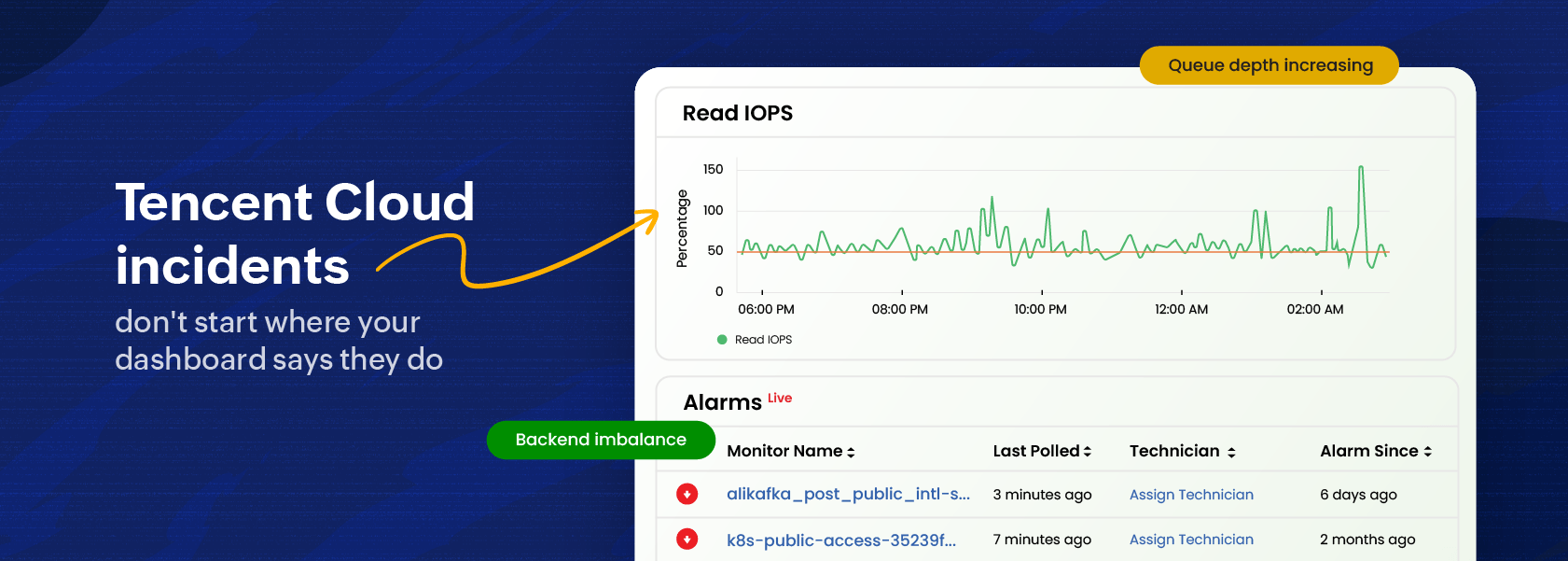
Distributed systems don't just fail. They adapt.
Services in Tencent Cloud environments are tightly interconnected. Compute, load balancing, databases, and networking layers continuously respond to each other based on changing conditions.
Under normal load, this coordination stays in the background. As pressure builds, the behavior shifts. The system does not degrade in a straight line. Instead, it starts adjusting itself. Traffic redistributes, components react, and small changes begin to cascade across layers, often before there is any visible issue.
This is where observability becomes critical. Not because something has failed, but because the system has already started adapting.
Small delays don't stay small
Most engineers have seen this before: Something slows down slightly, and suddenly everything else starts compensating. In Tencent Cloud, that compensation happens fast and across multiple layers simultaneously.
A slight delay in a cloud VM (CVM) response rarely stays isolated. It sets off a chain of small adjustments. Traffic begins to shift. Retries are triggered. Request paths change without much visibility.
Individually, these are expected behaviors. They ensure availability. But they are not aware of each other.
So they stack.
A back end that slows down slightly can end up handling more traffic as redistribution kicks in. At the same time, retries increase the number of incoming requests.
Nothing is technically broken. But the system starts working harder than it should.
What began as a minor delay turns into sustained internal pressure. And when you look at the metrics, there is no single signal that clearly explains how it got there.
The signal to watch isn't peak CPU or mean latency. It's the moment traffic distribution across cloud load balancer (CLB) back ends starts shifting without a corresponding increase in overall request volume. That shift, before any threshold is crossed, is the earliest indicator that internal amplification has begun.
Retries don't just recover, they redistribute load
Do you see retries like a safety net? Well, some do. Moreover, they're also a source of pressure that moves around the system in ways that are easy to miss.
When latency increases, retries don’t always follow the original path. They get routed across different instances or zones, and traffic starts to spread unevenly.
Healthy nodes begin taking on load they weren’t expecting. Request patterns shift, sometimes subtly at first.
Over time, parts of the system start to slow down. Not because more traffic came in, but because the system created extra pressure while trying to stay resilient.
By the time this shows up in monitoring, the retry storm has already done its work. Tracking retry rates per CVM instance alongside per-node request distribution rather than fleet averages surfaces this pattern, to an extent, before it compounds.
Load balancing stabilizes things—it also shifts pressure around
CLBs are doing their job when they redistribute traffic away from slower CVMs. The problem is that doing their job creates a new set of conditions that monitoring often doesn't account for.
When a few CVMs start slowing down, traffic doesn’t wait. It moves to the ones that look faster. For a while, that helps.
But those nodes are now doing more than they were meant to. You start to see small shifts. Response times aren’t consistent. The CLB keeps adjusting, trying to keep things balanced.
From a distance, everything looks fine. Load is being distributed. Averages hold steady.
Up close, it’s different. Some instances are carrying more than their share, while others fall behind. The pressure keeps moving, never fully settling.
That’s why fleet-level metrics don’t tell the full story. You need to look at CLB behavior alongside individual CVM performance because the imbalance shows up there first, long before it becomes an obvious problem. This is why CLB back-end distribution metrics need to be read alongside individual CVM performance, not just fleet averages. The imbalance that precedes a serious degradation rarely shows up at the aggregate level. It shows up at the instance level, in the gap between what the busiest node is handling and what the average suggests.
Asynchronous systems buy time—they also hide problems
One of the things teams appreciate most about Tencent Cloud's asynchronous architecture, including queues, event-driven processing, and background jobs, is that it absorbs upstream pressure gracefully. Services can slow down without immediately cascading into downstream failures.
What’s harder to notice in the moment is that this grace period quietly pushes the problem out of sight.
When a service slows down, messages wait. Queues start to fill up, but everything still looks stable on the surface. Dashboards stay calm, and there’s no clear reason to dig deeper.
Then, when the slowdown clears, downstream systems start catching up, and the backlog begins to move. That’s when everything spikes at once. CPU and memory on CVMs jump, TencentDB query volumes rise, and network traffic surges. It feels sudden, almost random. But by then, the original cause had already passed.
The cause existed. It was just invisible for long enough that by the time the effects surface, the connection to the original event is gone.
Queue depth is one of the most underutilized leading indicators in Tencent Cloud monitoring. A queue that is growing steadily during a period of apparently normal service performance is telling you something that no other metric is. Tracking queue depth trends alongside upstream service latency, not just downstream processing rates, is what closes the visibility gap that asynchronous architectures create.
Latency becomes uneven
When a Tencent Cloud system is under stress and adapting, latency doesn't increase uniformly. This is one of the most underappreciated aspects of how these environments behave and one of the most consequential for monitoring.
Some requests complete normally. Others slow down because they hit a node that's absorbing redistributed traffic, or because a retry added latency, or because a queue backlog pushed processing time out. A few fail entirely. The mean response time may look acceptable. The P95 and P99 tell a completely different story.
A system can appear healthy in every dashboard while a meaningful portion of users is experiencing something that doesn't match what the metrics suggest. The real signal is in the variance, not the average, and most monitoring configurations aren't built to surface it.
Cause and effect drift apart
This is the part that makes Tencent Cloud incidents genuinely difficult to investigate.
Database latency spikes after the application errors that caused it have already resolved. Load balancer anomalies appear after the CVMs that triggered the redistribution have recovered. Traffic patterns keep shifting after the original trigger has stabilized or moved to a different layer. What looks like a sequence of separate events is actually one incident playing out across multiple layers on multiple timelines.
Root cause analysis stops being about finding the failure and starts being about reconstructing the sequence. Which service moved first? What did that cause downstream? How far did the adaptation propagate before it became visible?
This is what makes Tencent Cloud environments operationally demanding in a way that capacity problems simply aren't. The system is already several steps ahead of what monitoring is showing. Every alert, every spike, and every latency increase is a lagging indicator of behavior that started earlier, in a different place, under conditions that have likely already changed. Monitoring that tracks event sequences across CVM, CLB, TencentDB, and VPC layers, rather than the current state of each service independently, is what makes it possible to reconstruct what actually happened and in what order. Without that sequence, you're not doing root cause analysis. You're doing archaeology.
What you see is adaptation
By the time a Tencent Cloud incident is visible, the system has already adapted. Traffic has shifted, retries have run, queues have cycled pressure, and local decisions across services have accumulated into global complexity.
What appears on a dashboard at that moment isn't the origin of the problem; it's the accumulated result of a system that was trying to hold itself together. And the further you get from the original event, the harder it is to work backwards to what actually started it.
This is not a failure of monitoring. It's a structural characteristic of distributed systems that are designed to adapt. But it does mean that waiting for a threshold breach to begin investigating is, in most cases, already too late to understand what happened.
The question isn't whether this behavior will occur in your Tencent Cloud environment—because it will. The question is whether your monitoring is built to read it or only to report it after the fact. Teams that answer that question well don't wait for adaptation to produce a visible symptom. They build monitoring that treats queue depth trends, instance-level CLB distribution, and tail latency divergence as first-class signals and act before the amplification cycle completes.
From signal to response: OpManager Nexus
OpManager Nexus brings unified Tencent Cloud observability across CVM performance, CLB traffic distribution, TencentDB query behavior, and asynchronous processing signals, giving teams a connected view of how Tencent Cloud services interact over time, not just how each service looks at a single point. Infrastructure-aware anomaly detection surfaces behavioral shifts before they cross alert thresholds. Automated workflows reduce the time between signal and response. And historical trend analysis gives teams the context to distinguish normal variance from early adaptation patterns, so decisions are made on evidence rather than intuition.
That connected view is what makes it possible to read adaptation signals before they compound, and to act on the right layer before the system's own adjustments become the problem.
Because in Tencent Cloud environments, the system you observe during an incident is already different from the one where the issue began.
Build your monitoring to capture how the system behaved in the minutes before the alert fired, not just what it looks like when you arrive.
FAQ
What are the early warning signs of degradation in a Tencent Cloud environment?
Watch for CLB back-end distribution shifting without a rise in overall request volume, retry rate divergence at the per-instance level, and queue depth growing during apparently normal performance. Tail latency widening at P95 and P99 while mean response time stays flat is another early signal. None of these trigger a conventional alert, which is exactly what makes them worth tracking first.
Why are fleet-level metrics insufficient for Tencent Cloud CLB monitoring?
Fleet averages smooth out the imbalances that indicate a problem is forming. When CLBs redistribute traffic, the busiest nodes absorb more than their share while others fall behind, but the aggregate holds steady. The stress is real and invisible at the fleet level. Meaningful CLB monitoring requires per-back-end distribution read alongside individual CVM performance, where early degradation actually appears.
How does queue depth indicate problems before they become visible in dashboards?
Asynchronous architectures absorb upstream pressure quietly. When a service slows down, queues fill while surface metrics stay calm. The problem only surfaces when the slowdown clears and downstream systems process the backlog at once, producing a spike that feels sudden because the original cause has already passed. Queue depth growing during normal-looking performance is one of the few signals that captures a problem while it is still forming.
What is tail latency, and why does it matter for Tencent Cloud observability?
Tail latency is response time at the high end of the distribution, typically P95 and P99. In a stressed distributed system, latency does not increase uniformly. Mean response time can look acceptable while a meaningful portion of requests experiences something far worse. Monitoring that only tracks averages misses this entirely. Tail latency is where the real behavior of a stressed Tencent Cloud system shows up first.
How does OpManager Nexus detect behavioral shifts in distributed Tencent Cloud systems?
OpManager Nexus provides unified observability across CVM, CLB, TencentDB, and asynchronous processing signals. Infrastructure-aware anomaly detection surfaces behavioral shifts before alert thresholds are crossed. Cross-layer event sequencing lets teams reconstruct the order in which services moved during an incident, and historical trend analysis distinguishes normal variance from early adaptation patterns.
What is the difference between threshold-based alerting and behavioral signal monitoring?
Threshold-based alerting fires after a condition has already developed. Behavioral signal monitoring tracks how metrics relate to each other over time, looking for patterns that indicate the system is adapting before any single metric crosses a limit. Queue depth rising alongside upstream latency, CLB distribution shifting without a volume change, retry rates diverging at the instance level: None trigger a conventional alert, but each signals that pressure is building. Behavioral monitoring gives you time to act before thresholds are reached.