

How to enable or disable Exchange ActiveSync in Office 365
Last updated on:In this page
- How to enable or disable Exchange ActiveSync using the Exchange admin center
- How to enable or disable Exchange ActiveSync using Exchange Online PowerShell
- Enable or disable Exchange ActiveSync in M365 Manager Plus
- Monitor your Exchange Online protocols and more
- Important tips
- Frequently asked questions
Exchange ActiveSync enables users to access mailbox data such as emails, contacts, and calendars on mobile devices using native mail apps. While it was once the standard protocol for mobile email access, its relevance has diminished with the adoption of modern authentication and Outlook-based clients.
However, certain environments may still rely on ActiveSync or require it to be explicitly disabled to enforce security policies, restrict unmanaged devices, or control access for temporary users.
This article explains how to enable or disable Exchange ActiveSync for users in Exchange Online using the Exchange admin center, Exchange Online PowerShell, and M365 Manager Plus, a dedicated Microsoft 365 administration tool.
- Exchange Admin Center
- Graph PowerShell
- M365 Manager Plus
Method 1: How to enable or disable Exchange ActiveSync using the Exchange admin center
Prerequisites
You need the Exchange Administrator role applied to the account you use to sign in to the Exchange admin center.
Steps
- Log in to the Exchange admin center.
- Navigate to Recipients > Mailboxes and click on a mailbox.
- Click Manage email apps settings under Email apps & mobile devices.
- Toggle the Mobile (Exchange ActiveSync) option to enable or disable Exchange ActiveSync for the selected mailbox.
- Click Save.

Limitation to consider
The Exchange admin center only allows you to enable or disable Exchange ActiveSync for one mailbox at a time. You will have to use Exchange Online PowerShell or a third-party Microsoft 365 administration tool like M365 Manager Plus to disable Exchange ActiveSync for multiple mailboxes in a single operation.
Method 2: How to enable or disable Exchange ActiveSync using Exchange Online PowerShell (Set-CASMailbox)
Prerequisites
Before using Exchange Online PowerShell, please verify that:
- The Exchange Administrator role is applied to the account you use to sign in to Exchange Online PowerShell.
- You are connected to the Exchange Online PowerShell module.
- To check if the Exchange Online PowerShell module is installed, use this script.
Get-Module -ListAvailable ExchangeOnlineManagement
- If it does not return a value, you will have to install the module. To install the Exchange Online PowerShell module, execute this script.
Install-Module ExchangeOnlineManagement -Scope CurrentUser
- To connect to Exchange Online PowerShell, run this script.
Connect-ExchangeOnline
- To check if the Exchange Online PowerShell module is installed, use this script.
Using Set-CASMailbox to enable or disable Exchange ActiveSync for Office 365 mailboxes
The Set-CASMailbox cmdlet allows you to configure client access settings for Microsoft 365 mailboxes, including enabling or disabling Exchange ActiveSync for Microsoft 365 mailboxes.
To disable Exchange ActiveSync for a single user, run the following command:
Set-CASMailbox -Identity <UserIdentity> -ActiveSyncEnabled $false
Replace $false with $true to enable Exchange ActiveSync.
Scenario: Disable ActiveSync for a specific department
An IT administrator needs to disable Exchange ActiveSync for all users in the "On-Site employees" department since they have migrated to Outlook for Android.
You can pipe the results of the GetEXO-Mailbox cmdlet to Set-CASMailbox and disable Exchange ActiveSync for the selected department using the following command:
Get-EXOMailbox -Filter "Department -eq 'On-Site employees'" |
    Set-CASMailbox -ActiveSyncEnabled $false
Supported parameters
The following table contains some parameters that can be used with the Get-CASMailbox and Get-EXOCASMailbox cmdlets.
| Parameter | Description |
|---|---|
| -Filter | Filters the results based on specific properties. For this use case, it's Department -eq 'On-Site employees' . |
| ActiveSyncEnabled | A boolean value ($true/$false) that indicates if Exchange ActiveSync is enabled for the mailbox. |
Method 3: Enable or disable Exchange ActiveSync in M365 Manager Plus
- Log in to M365 Manager Plus, navigate to Management > Mailbox Management, and select Mailbox Features Settings.
- In the ActiveSync drop-down menu, select Enable or Disable.
- Enter the display names of the mailboxes for which you want to enable or disable Exchange ActiveSync and click Find. To upload a CSV with the display names using CSV Import, click Import CSV.
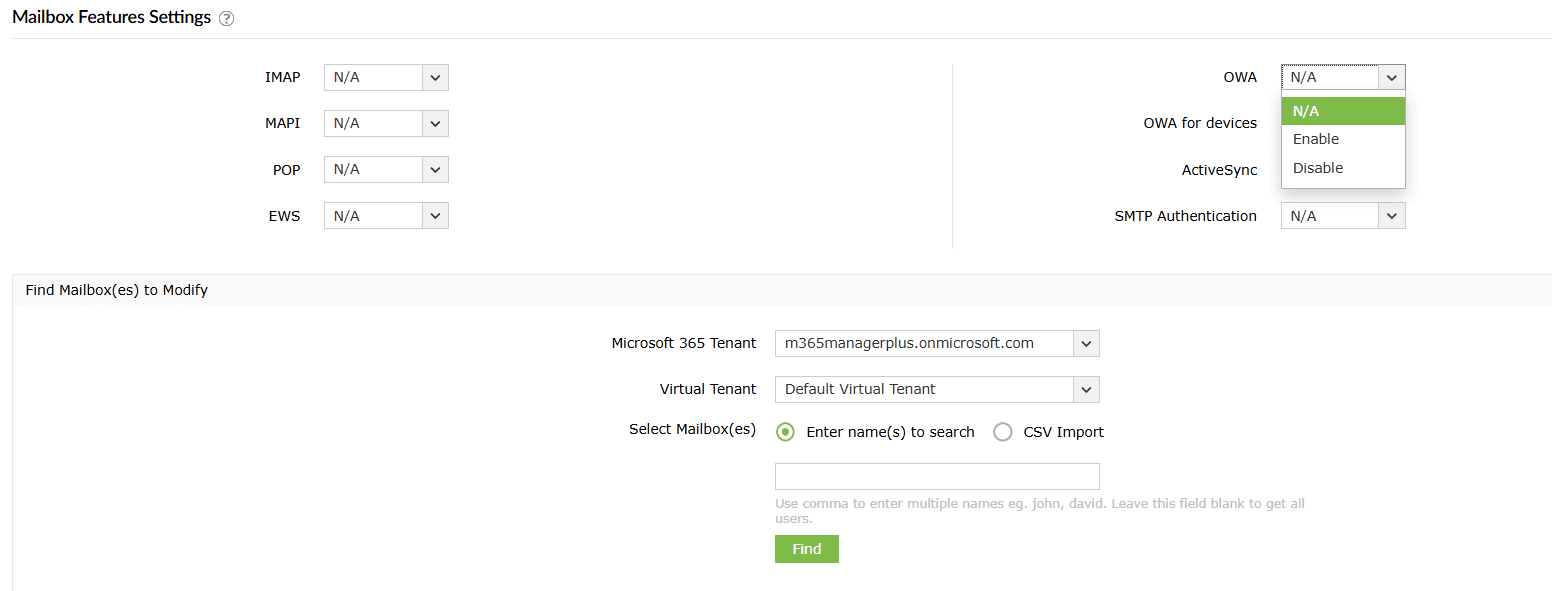
- After finalizing the list of mailboxes you want, click Apply.

Monitor your Exchange Online protocols and more
M365 Manager Plus’ mailbox management capabilities help you view, monitor, and modify not just your Exchange ActiveSync settings, but also other Exchange Online mailbox properties like mailbox quotas, archive status, and inbox rules.
Bulk mailbox management
Handle large-scale mailbox actions such as enabling features, updating settings, or modifying permissions through simple, GUI-driven operations. No manual scripts or repetitive tasks required.
Reports on Microsoft 365 mailboxes
Access ready-made reports that cover mailbox size, activity, license usage, storage trends, permission assignments, and more. Get the insights you need without digging through multiple admin centers.
Real-time alerts on mailbox changes
Set up instant alerts for critical mailbox changes, including permission updates, forwarding rule modifications, and configuration changes. Stay aware of risky and unauthorized activity as it happens.
Eliminate PowerShell complexity
Perform mailbox audits, configuration checks, and bulk updates without relying on cmdlets or scripting expertise. One-click actions reduce errors, making mailbox administration far more manageable.
Important tips
Establish a mobile policy: Only enable ActiveSync for users who have a business justification for mobile email synchronization.
Audit Exchange Online features: Regularly review which users are assigned to high-privilege Outlook on the web mailbox policies and which users have legacy protocols such as Exchange ActiveSync enabled to prevent data leakage via unmonitored features like file sharing.
Enable MFA for ActiveSync users: Ensure that MFA is enforced when accessing a mailbox with Exchange ActiveSync enabled.
Frequently asked questions
To disable ActiveSync by default for all new mailboxes, you must modify the Organization Config or create a New-CASMailboxPlan. Using PowerShell, you can run Set-CASMailboxPlan -Identity "Exchange Online" -ActiveSyncEnabled $false. This command ensures that any new user created within the tenant will have the protocol disabled from the start.
You can use the Get-CASMailbox cmdlet to verify the status of a specific user. Execute the following command:
Get-CASMailbox -Identity "user@domain.com" | Select-Object ActiveSyncEnabled
Yes, Exchange Online continues to support ActiveSync as a primary protocol for synchronizing mail, contacts, and calendars to mobile devices. However, Microsoft recommends using the Outlook for iOS and Android app, which utilizes a more modern and secure synchronization technology optimized for the cloud.
No, disabling ActiveSync only terminates the connection between the mobile device and the mailbox. It prevents further synchronization, but the actual mailbox data, like emails, attachments, and folders, remains intact within the Exchange Online environment.