Andariel's RID hijacking: When Windows trusted the wrong account
Year of occurrence: 2023 (attacks occurred; publicly reported by AhnLab in January 2025)The attack RID hijacking to turn a low-privileged account into an administrator
Andariel, a North Korean state-sponsored group under Lazarus, gained SYSTEM privileges on Windows systems using PsExec and JuicyPotato. After obtaining high-level access, the attackers created a low-privileged local account and modified the Security Account Manager (SAM) registry to replace its Relative Identifier (RID). This caused Windows to treat the unprivileged account as a full administrator.
Additional registry edits and account removal steps were used to hide the activity, enabling the attackers to operate with elevated privileges under the guise of a normal user account.
Severity High
RID hijacking is a powerful escalation technique because it abuses a core Windows trust assumption. Once the RID is altered, traditional privilege checks fail to expose the elevated rights.
State-sponsored groups like Andariel increasingly rely on this method because it bypasses common security controls, leaves minimal logs, and provides durable persistence on compromised systems.
How it impacted organizations
RID hijacking allowed attackers to:
Stealthy backdoor
Allowed attackers to create stealthy backdoor accounts that appeared legitimate but functioned as admins.
Alert evasion
Enabled privilege escalation without triggering traditional admin creation alerts.
Blended activity
Allowed attackers to perform administrative tasks while blending into normal user activity.
Lateral movement
Facilitated lateral movement and persistence using what appeared to be a harmless local user.
Forensic difficulty
Made forensic investigations significantly harder due to cleaned registry traces and removed accounts.The modified RID gave attackers silent, long-term administrative control while appearing to use a regular low-privilege user.
With ADAudit Plus in place, organizations can
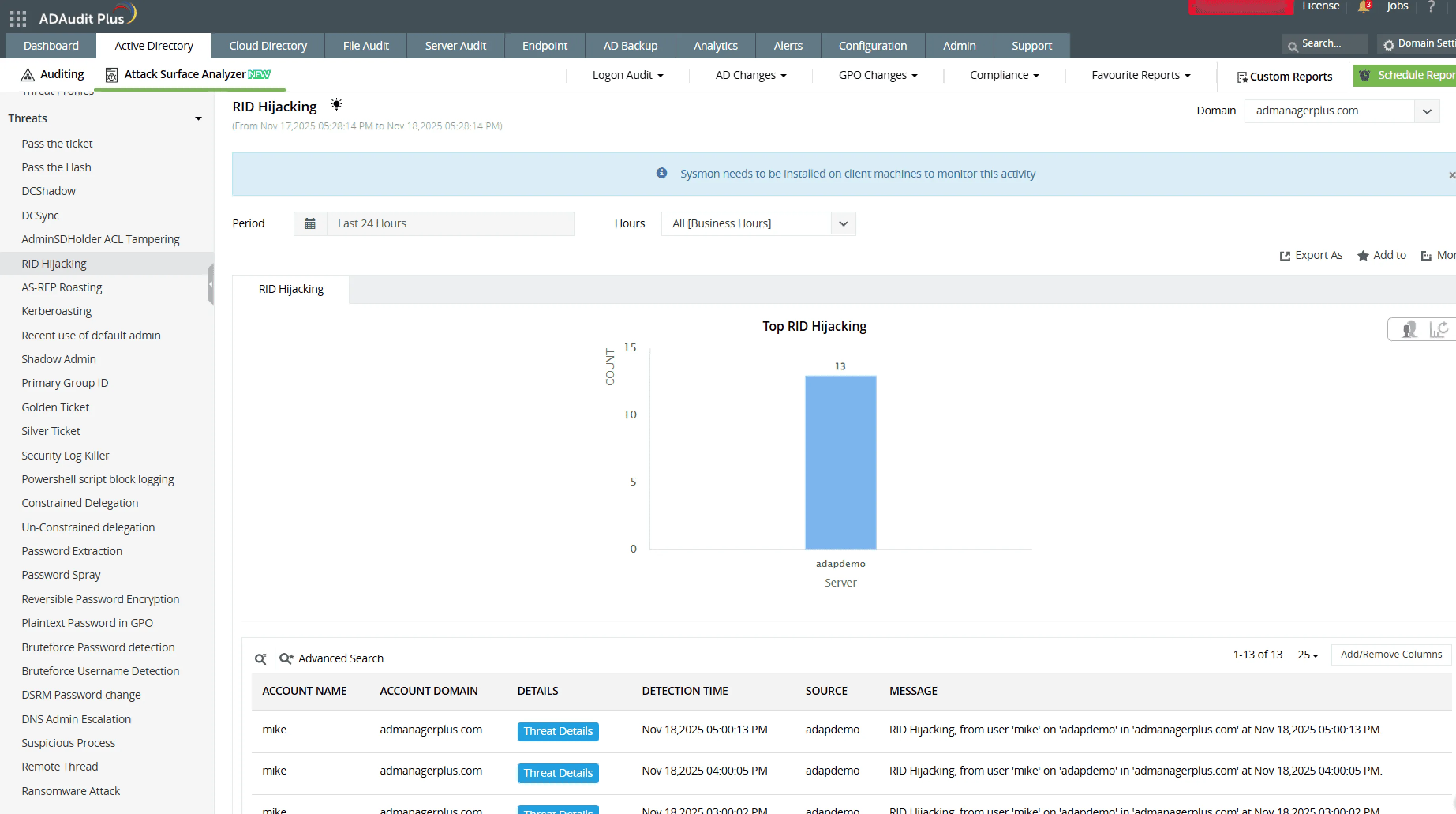
- Use the dedicated RID Hijacking report to track potential privilege escalation attempts.
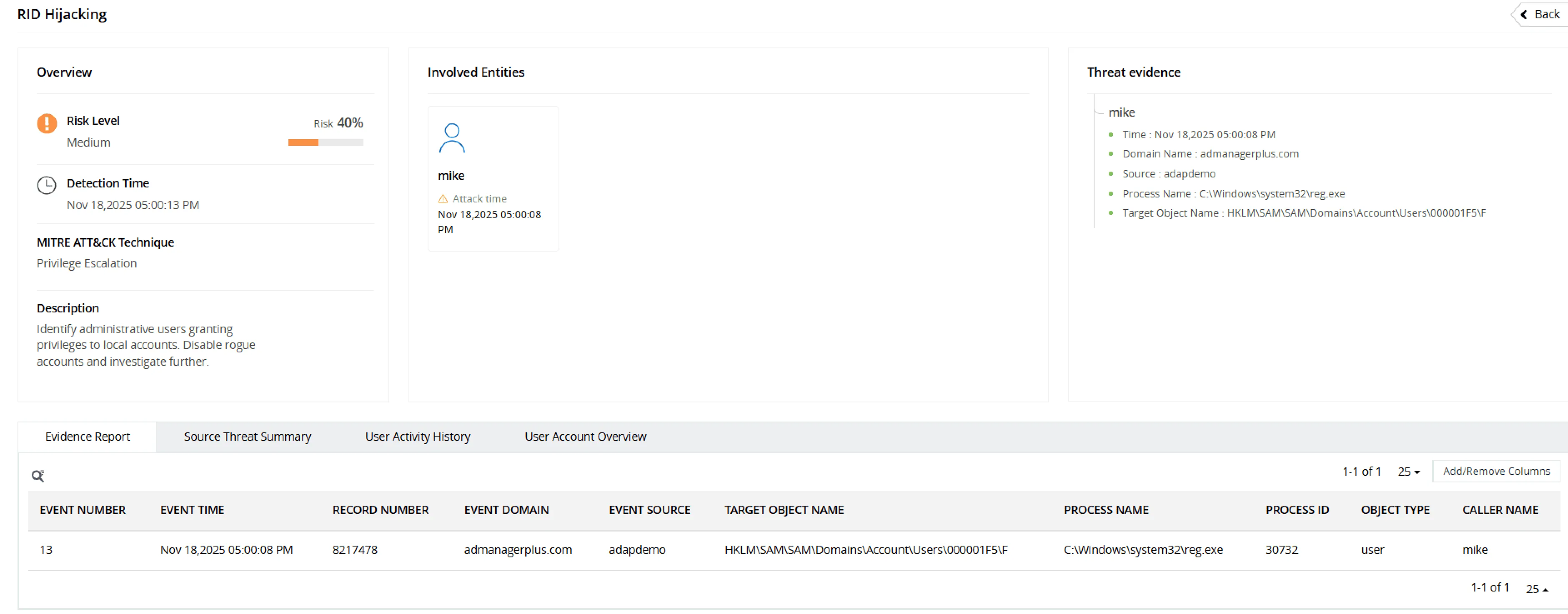
- Detect unauthorized modifications to critical binary values named F that are exploited in RID hijacking attacks.
- Send immediate alerts when patterns indicate hidden privilege escalation, allowing timely response.
- Monitor the SAM hive path SAM\SAM\Domains\Account\Users where attackers typically manipulate RIDs.
Outcome
With ADAudit Plus RID hijacking attempts and any suspicious privilege escalation would have been visible in real time, enabling organizations to respond immediately.
More security stories

BadSuccessor: The silent domain takeover hiding in plain sight

CVE-2025-59287: When the patch server becomes the attack vector

Password spraying: How five months of silence went undetected