

- Free Edition
- Quick links
- Active Directory management
- Active Directory reporting
- Active Directory delegation
- Active Directory permissions management and reporting
- Active Directory automation
- Governance, risk, and compliance
- Microsoft 365 management and reporting
- Microsoft 365 management and reporting
- Microsoft 365 management
- Microsoft 365 reports
- Microsoft 365 user management
- Microsoft 365 user provisioning
- Microsoft 365 license managementn
- Microsoft 365 license reports
- Microsoft 365 group reports
- Dynamic distribution group creation
- Dynamic distribution group reports
- Exchange management and reporting
- Active Directory integrations
- Popular products
Admins need to monitor Active Directory group membership to ensure users have access and permission to only the resources that they need. With ADManager Plus, instantly export all Active Directory groups and members, check all the AD groups, or list what AD groups a user is a member of without resorting to complex PowerShell scripting.
Why choose ADManager Plus to get group membership reports?
-
Schedule reports
Schedule group membership reports and email them to admins, technicians, or managers automatically at regular intervals.
-
Export reports
Easily export group membership reports in formats such as PDF, CSV, HTML, and XLS.
-
Fetch nested groups
Group membership gets complicated when groups are added to other groups. ADManager Plus helps you track and monitor all the groups that are added to other groups (nested groups).
-
Search and sort the results
Perform a quick search within the report and sort your results to organize the report. Check the Exclude Nested Groups box before generating the report in case you want to filter groups.
-
Customize column attributes
In the column section, you can refine the report further by selecting the attributes that have to appear in the report. By selecting +Add Custom Attributes, you can configure custom LDAP attributes to be displayed in the report.
Member-based Reports
-
Group Members
Get details of the users in the selected group.
-
Users not in Groups
Get the list of users who are not a part of the specified group.
-
Users only with Members of Domain users group
Get the list of users who are only members of the Domain Users Group.
-
Groups without Members
Find the unwanted groups in a particular domain.
-
Computers not in Groups
Get the list of computers who are not a part of the specified group.
-
Detailed Group Members
Get detailed information about specified Active Directory Distribution Groups and Security Groups along with their nested groups.
General Reports
-
All Groups
Get the details of all the groups in the specified domain.
-
Recently Modified Groups
Get the list of all the groups for which attributes were modified within a particular time period.
-
Top N Big Groups
Get the details of the large groups in the domain based on its member count.
-
Unmanaged Groups
Get the details of the groups that do not have managers.
-
Recently Created Groups
Fetch the list of all the groups that were created during the specified time frame.
-
Recently Deleted Groups
Identify all the groups that were deleted from Active Directory within a specific time span.
-
Managed Groups
Get the details of the groups that have managers.
Group Type Reports
-
Security Groups
Get the details of the security groups available in the selected domain(s).
-
Group Type and Scope
Get details of groups based on their type and scope. The group type can be either Security or Distribution and its scope can be Global, Domain Local, or Universal.
-
Distribution Group
Get the list of all distribution groups available.
How do Group Reports in ADManager Plus work?
Follow these simple steps to get reports on Active Directory group membership
-
1. Select Domain and Groups
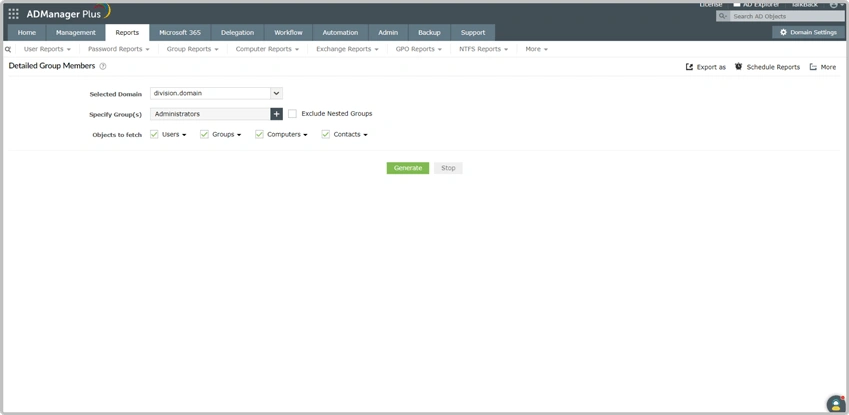 Choose which domain and groups you want to report on.
 -
2. Click Generate
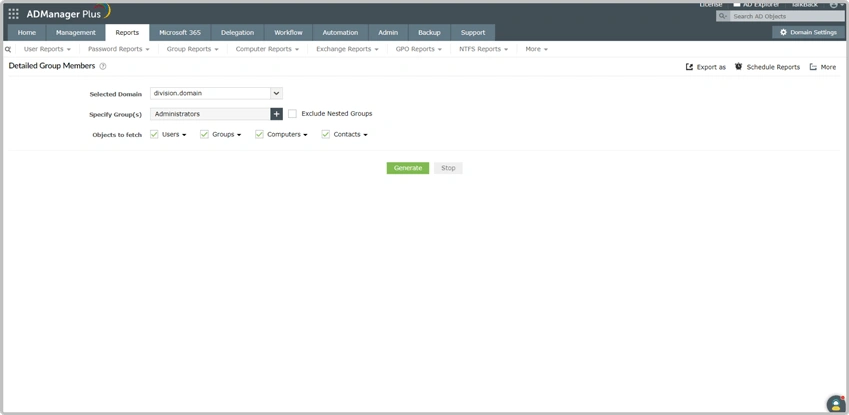 The tool fetches the membership information for the selected groups.
 -
3. Customise the columns and export the report in multiple formats
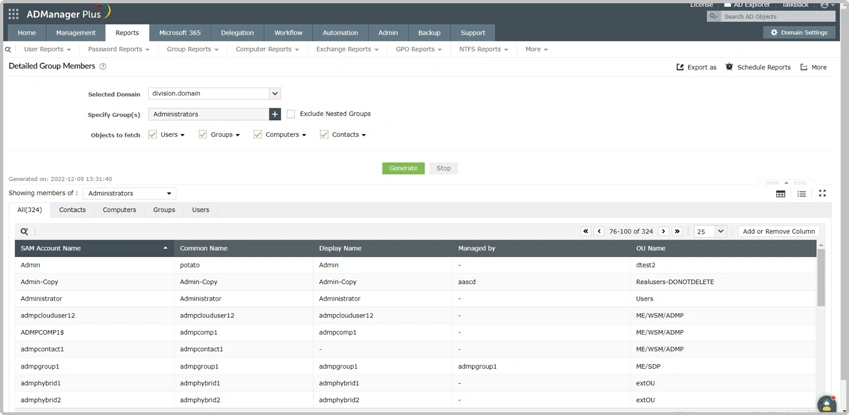 Add or remove columnExport the reports as CSV, PDF, HTML, CSVDE, and XLSX.
 -
4. Perform management action from within the report
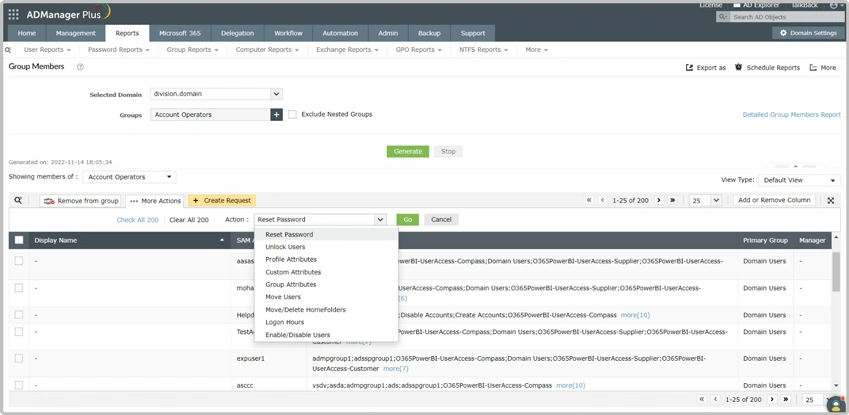 You can perform management actions from within the reports.Click on More to get a printable view of the report and to edit the export setting.
 -
5. Generate a tree view of all the group members
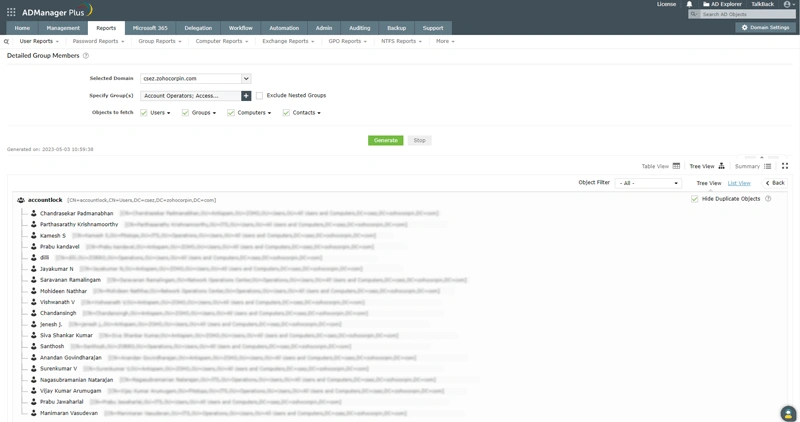 This shows the tree view of all the members of the group.
How IT admins can utilize the group membership reports in ADManager Plus
-
Scenario
Your organization wants to generate a report containing users that are part of a particular group with a specific last logon time.
Solution
With ADManager Plus' custom reports feature, you can create a custom report by filtering the group and the last logon time in just a few clicks.
-
Scenario
You need to delete all the groups without members as a part of your AD cleanup.
Solution
With ADManager Plus, you can generate a report of all the groups without users and delete those groups from within the report.
-
Scenario
You want to generate a report to view the complete list of objects from a specific group along with its nested groups.
Solution
View the nested groups and the list of objects of a specific group with the Detailed Group Members report in ADManager Plus.
Highlights of using ADManager Plus for generating reports on AD groups
- Generate reports without scripts.
- Instantly export reports.
- Perform management operations from within the reports.
- Create workflow request for group members from within the reports.
FAQs
Follow these steps to check AD group membership using ADManager Plus.
- Launch ADManager Plus and log in with appropriate credentials.
- Go to the Reports tab, navigate to Group Reports and select Group Members report.
- Select the desired domain and specify the group or search for it.
- Click Generate to view the details.
ADManager Plus provides options to filter and sort the membership list based on various attributes.You can also export the group membership for further analysis or reporting.
Follow these steps to export group members list from AD using ADManager Plus.
- Launch ADManager Plus and log in with appropriate credentials.
- Go to the Reports tab, navigate to Group Reports and select Detailed Group Members report.
- Select the desired domain, specify the group or search for it and choose the objects that are to be fetched using relevant criteria.
- Click on Generate to get the detailed group members report.
- Navigate to Export as in the top right corner of the page to export the report in your desired format such as CSV, PDF, XLSX, and HTML.
ADManager Plus allows flexibility in exporting group members, including the ability to select specific attributes, filter the membership list, and choose the desired export format.
Dynamic membership rules in groups allow automatic inclusion or exclusion of members based on specified criteria. Here are a few examples:
- Department-based dynamic group: Include all users whose department attribute is set to Sales.
- Location-based dynamic group: Include all users whose location attribute is set to New York.
- Job title-based dynamic group: Include all users with a job title containing the word Manager.
- Attribute-based dynamic group: Include all users whose employee ID is greater than a specific value.
- Membership duration-based dynamic group: Include all users who joined the organization within the last 30 days.
Other features
Active Directory User Reports
Exhaustive reporting on Active Directory Users and user-attributes. Generate reports in user-activity in your Active Directory. Perform user-management actions right from the report interface!
Active Directory Compliance Reports
Active Directory reports to assist you for compliance to Government Regulatory Acts like SOX, HIPAA, GLBA, PCI, USA PATRIOT...and much more! Make your organization compliance-perfect!
Active Directory Management
Make your everyday Active Directory management tasks easy and light with ADManager Plus's AD Management features. Create, modify and delete users in a few clicks!
Terminal Services management
Configure Active Directory Terminal Services attributes from a much simpler interface than AD native tools. Exercise complete control over technicians accessing other domain users' computers.
Active Directory Cleanup
Get rid of the inactive, obsolete and unwanted objects in your Active Directory to make it more secure and efficient...assisted by ADManager Plus's AD Cleanup capabilities.
Active Directory Automation
A complete automation of AD critical tasks such as user provisioning, inactive-user clean up etc. Also lets you sequence and execute follow-up tasks and blends with workflow to offer a brilliant controlled-automation.


