Zia Agents, CMDB data quality enhancements, and more: A half-yearly roundup of some of the major releases in 2026
15 mins read
ServiceDesk Plus is a unified service management platform that features ITIL®-compatible ITSM practices, native ESM and IT management integrations, low-code extensibility, and flexible deployment models. Yet it wasn't always. ServiceDesk Plus began as an IT help desk solution that helped IT teams streamline their ticketing. Over time, it has evolved from a system of records into a system of workflows and now into a system of autonomous intelligence.
With ManageEngine shipping a large volume of features so fast, you might have missed these important releases. Here's a roundup of the major releases from the first half of 2026.
Zia Agents: An AI task force for your service desk
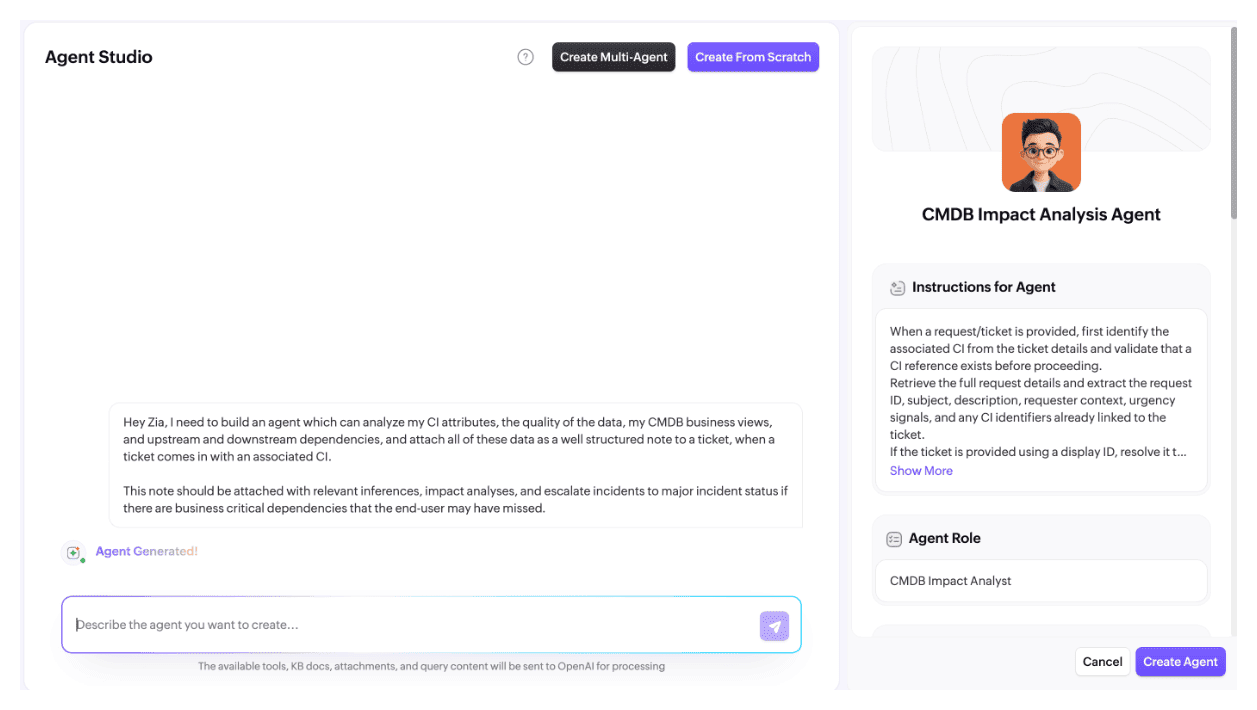
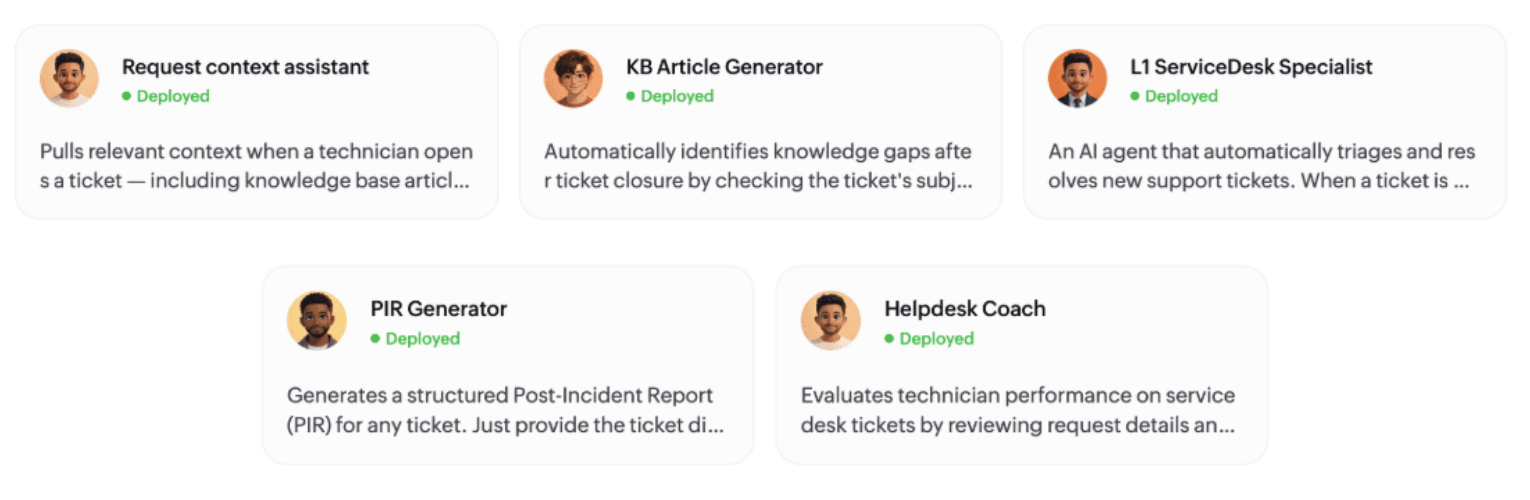
We kicked off 2026 with Zia Agents, an autonomous AI task force that works alongside your teams. This feature is available in the Enterprise edition of the cloud version of ServiceDesk Plus. You can get started in two ways: Deploy any of the five prebuilt agents straight from the Agent Store, or build your own with Zia Agent Studio (our no-code builder) and tailor custom agents to your organization's processes.
Build your own agents
Deploy prebuilt agents
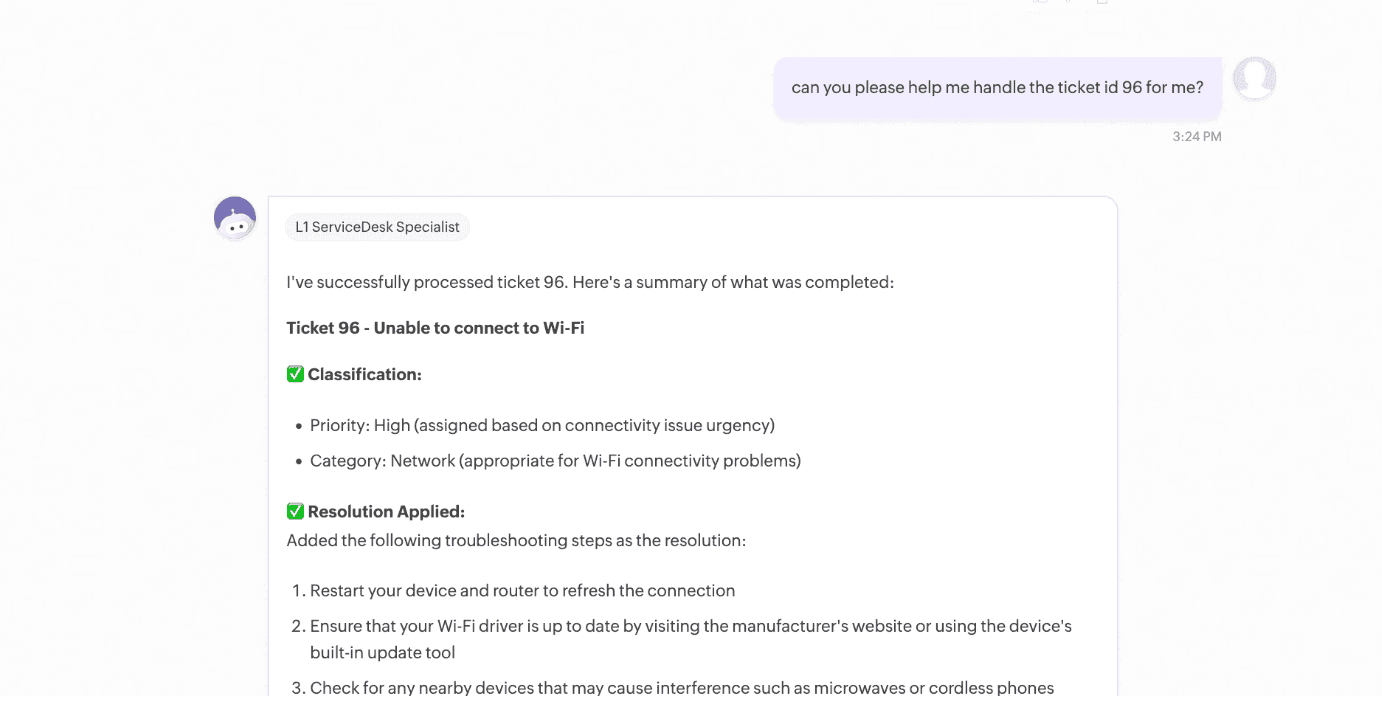
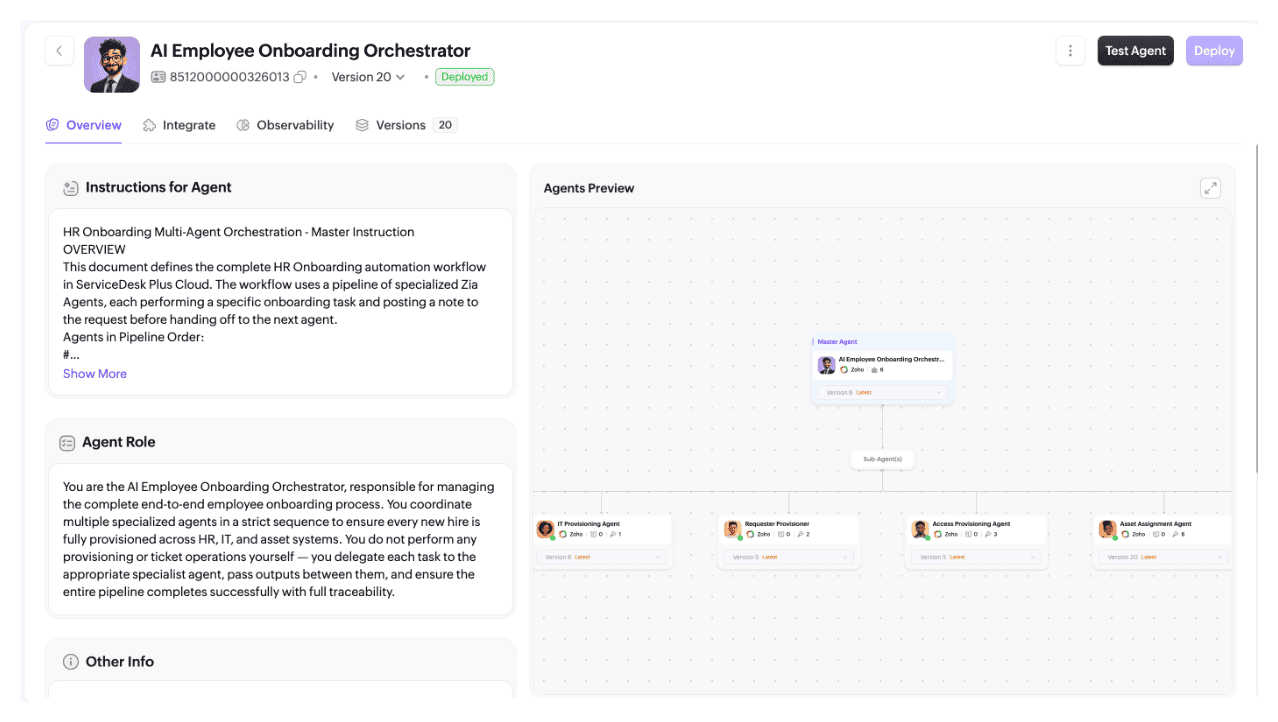
Once the agents are deployed, invoke them through Ask Zia or let them act on triggers within your workflows so routine service desk work gets handled without a technician lifting a finger. For larger goals, multi-agent orchestration lets you connect a master agent to a network of specialized subagents that each contribute toward a common outcome.
Invocation through Ask Zia
Multi-agent orchestration
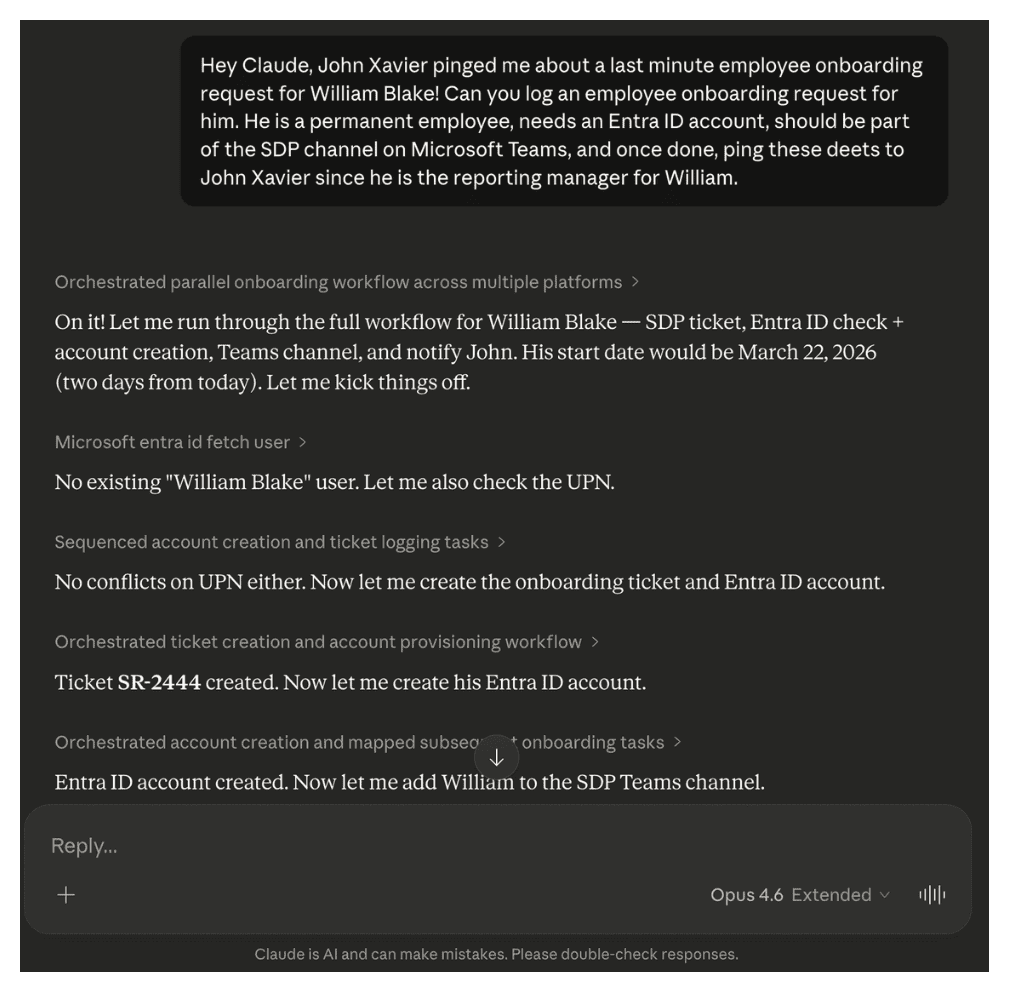
ServiceDesk Plus now also supports the Model Context Protocol (MCP) through the Zoho MCP integration. Bring your ITSM context to your own MCP-compatible AI agents and LLMs and execute IT and enterprise service workflows on the fly. Your connection to the MCP server extends across the ManageEngine and Zoho suites and to the other MCP-ready applications in your ecosystem.
A high-integrity CMDB: The foundation your AI stands on
Here's the catch with every AI initiative, agentic or otherwise: AI is only as good as the data it reasons over. In ITSM, that data lives in your CMDB. Gartner®'s Market Overview for AI Applications in IT Service Management observes that AI applications in ITSM analyze the data and metadata held within your ITSM platform to provide intelligent advice and actions. If your CMDB is riddled with orphaned, incomplete, or stale configuration items (CIs), that's the picture of your IT estate that your AI inherits, and every recommendation, prediction, and autonomous action it makes is built on shaky ground.
That's why, this year, we set out to help customers keep a high-integrity CMDB at the heart of their ITSM. A series of CMDB enhancements helps ensure your single source of truth remains truthful:
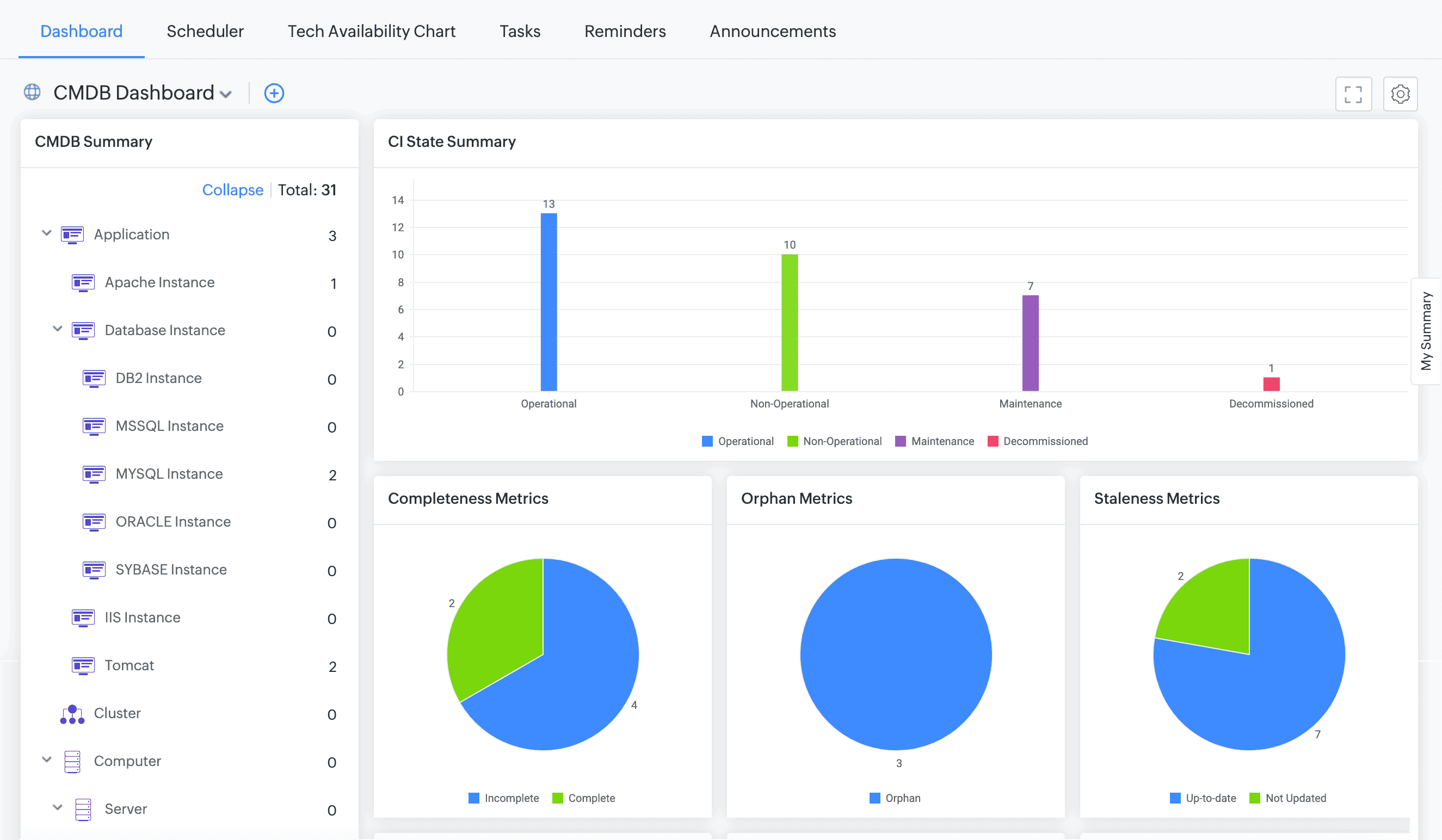
- CMDB Dashboards keep a finger on your CIs' pulse, displaying CI states, associations, and insights on your CMDB's data quality metrics.
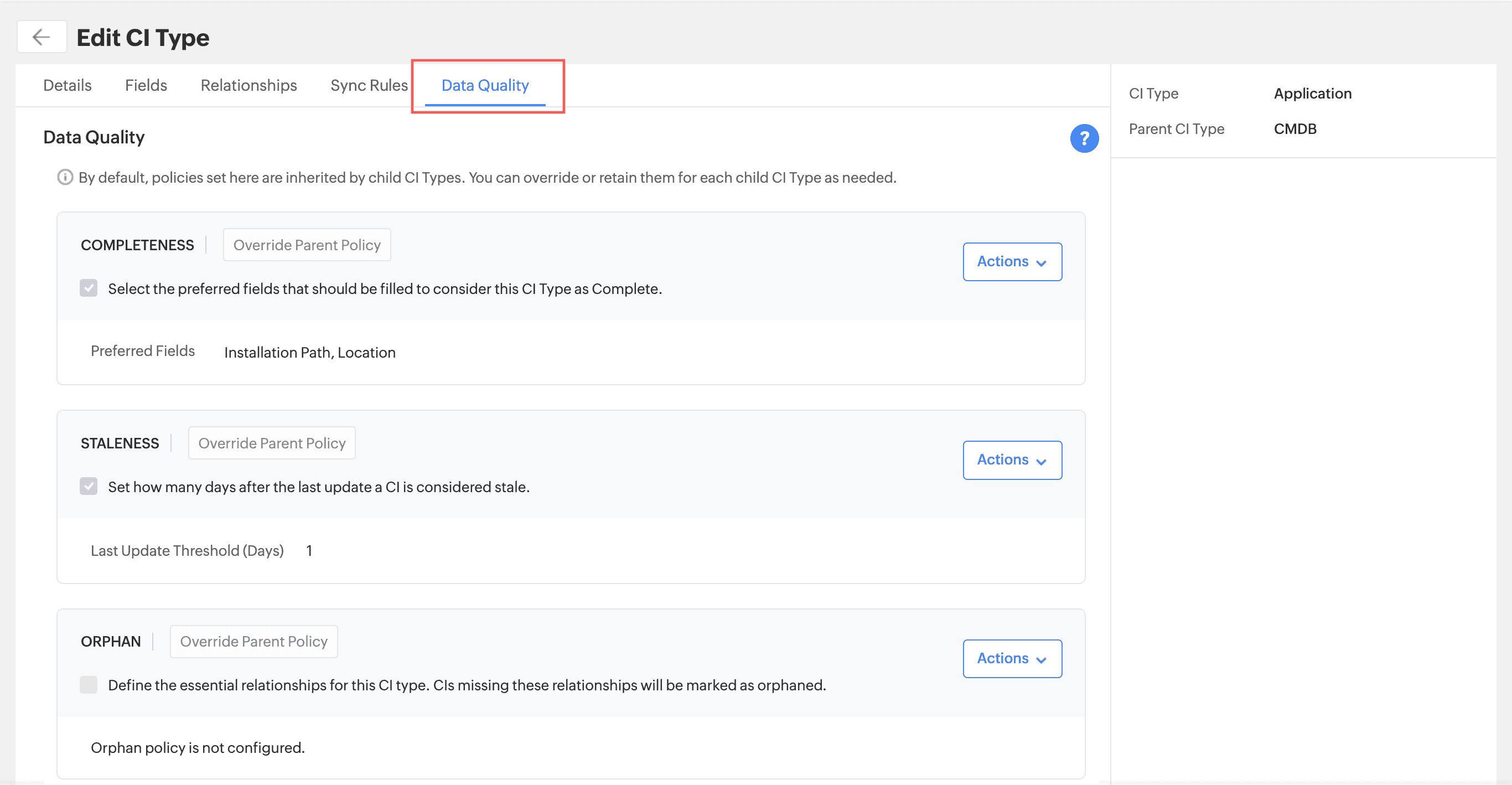
- CMDB Data Quality lets you define the essential relationships a CI needs to avoid being classified as orphaned, the fields required to mark a CI as complete, and the duration after which a CI's data gets flagged as stale.
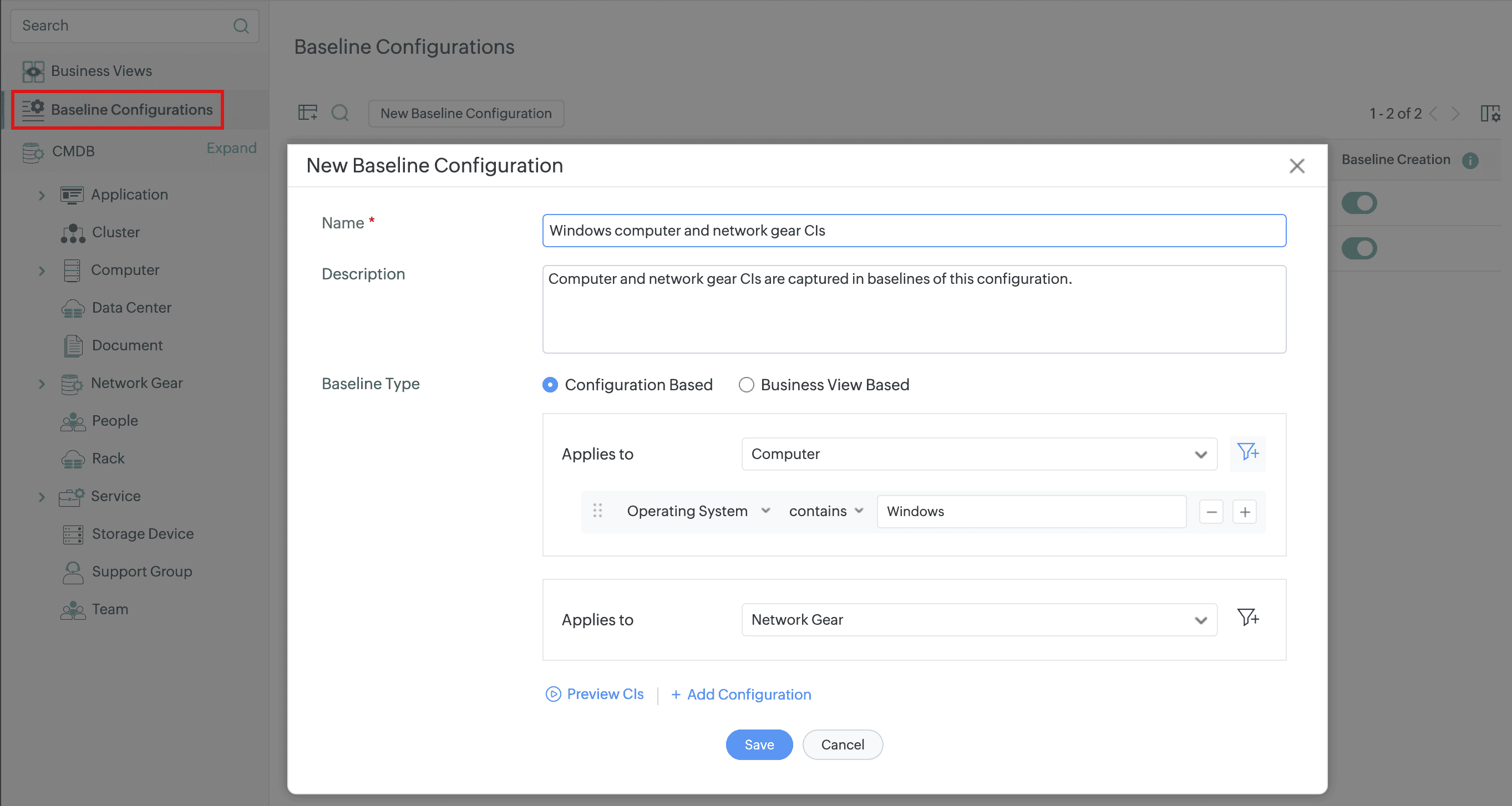
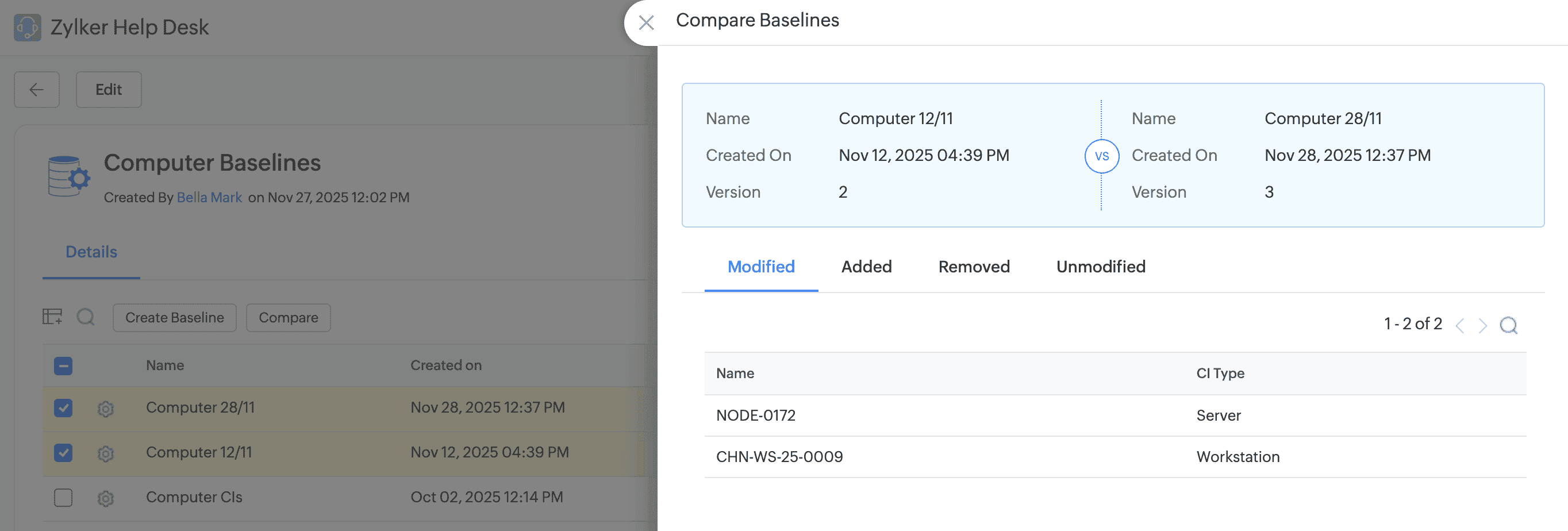
- CMDB Baselines compare CIs against timestamped snapshots of themselves, so if your CMDB is drifting, you can detect the source of the drift.
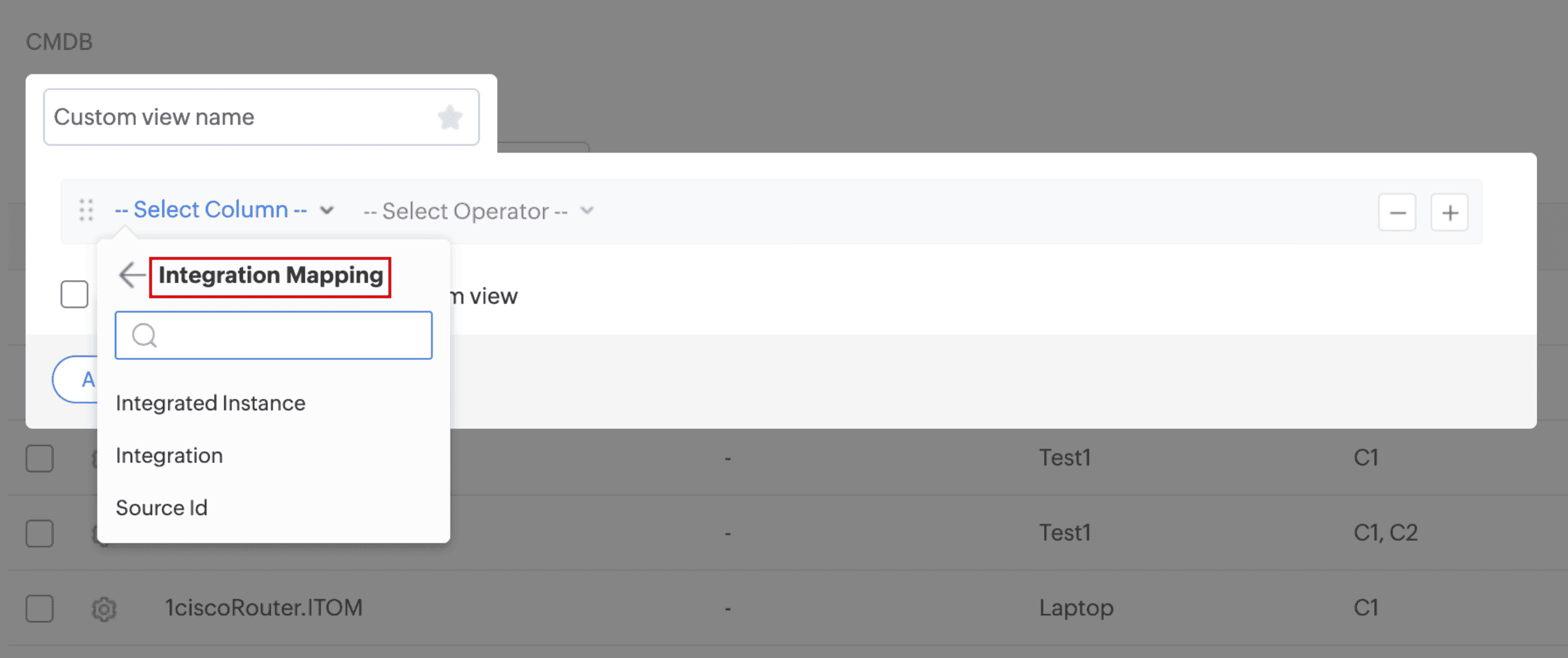
- Integration Mapping identifies which ManageEngine application and which instance each CI is imported from, giving you a clear lineage for every data source feeding your CMDB.
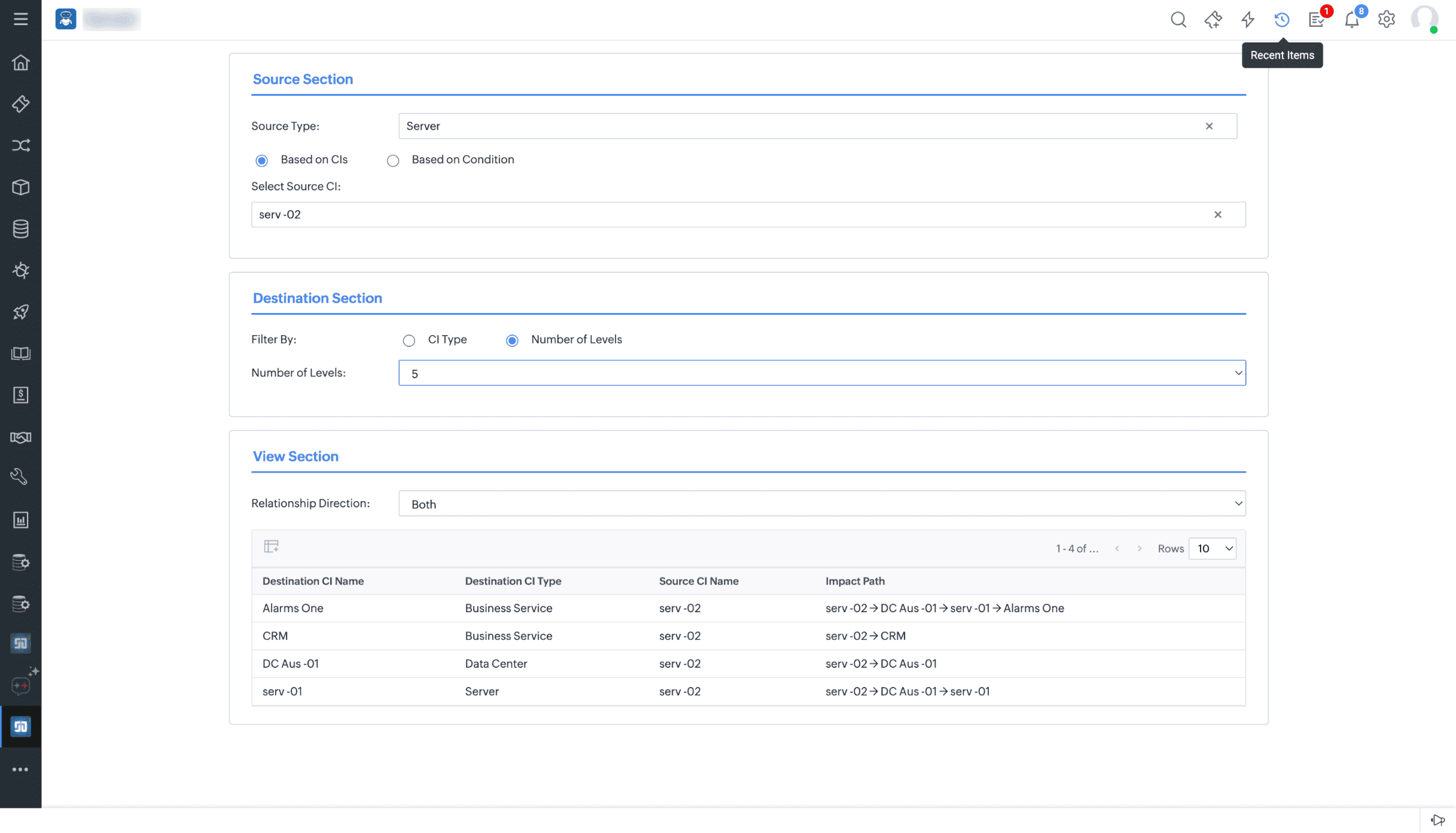
- CI Impact Analysis, an extension from the ManageEngine Marketplace, helps you set up a widget that can track upstream and downstream dependencies against a CI so you have a verified blast radius.
CMDB Dashboards
Data Quality
Baselines
Integration Mapping
CI Impact Analysis
In the on-premises version of ServiceDesk Plus, these capabilities work alongside CI sync rules that automate data precedence and reconciliation across sources. You can even auto-populate CIs based on specific attributes, making CI completeness a goal within reach—for your teams and for your AI.
Personalized self-service portals for every user group
Delivering a single version of the self-service portal for each department for your whole organization might not suffice if you are aiming for personalized service delivery. The latest enhancement to the self-service portal changes that: You can now create multiple personalized versions of the same portal, each tailored to a different user group. A manager logging in to your IT portal can see an entirely different experience than an executive logging in to the same portal—each surfacing the services, announcements, and layouts most relevant to the user.
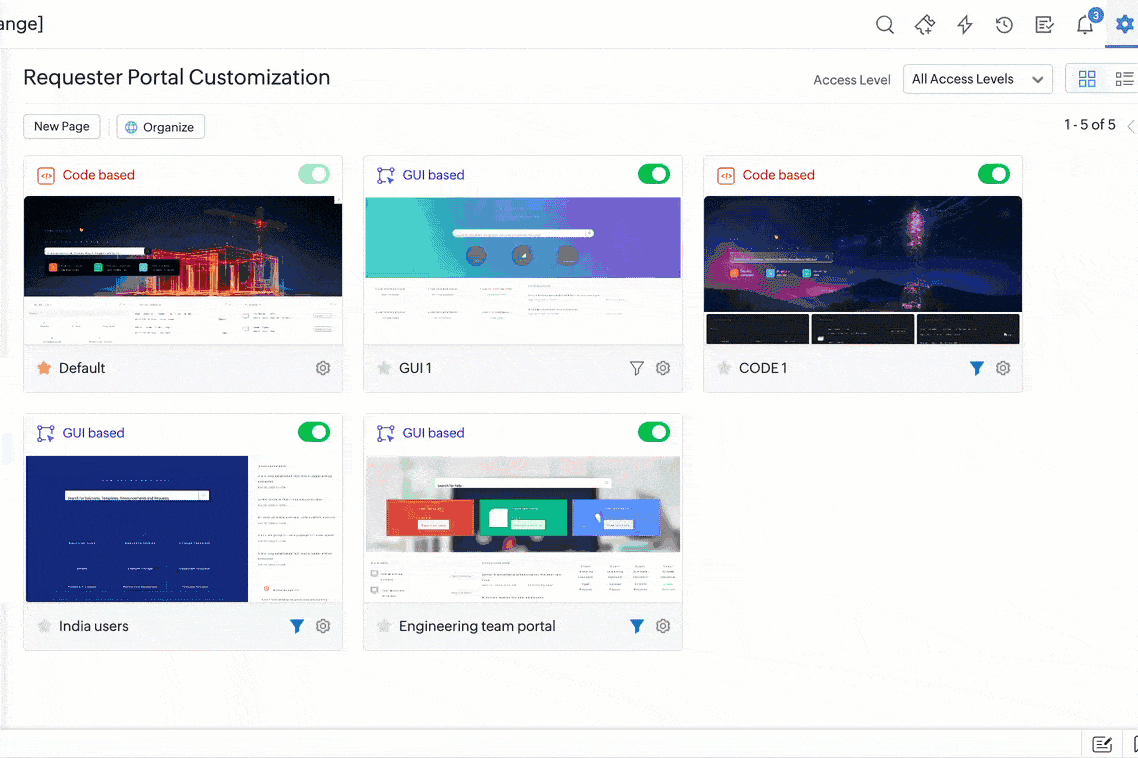
When a user belongs to multiple user groups (like Managers-IT, New-York-Office-IT, and North-America-IT), you can order the portal versions to control exactly which personalized experience that user sees first. Together, these capabilities let you deliver a self-service experience that meets each user group where it is, without maintaining separate portals from scratch.
More AI enhancements across the suite
The AI releases didn't stop with agents. We've expanded Zia's predictive intelligence and taken the GenAI suite further across editions.
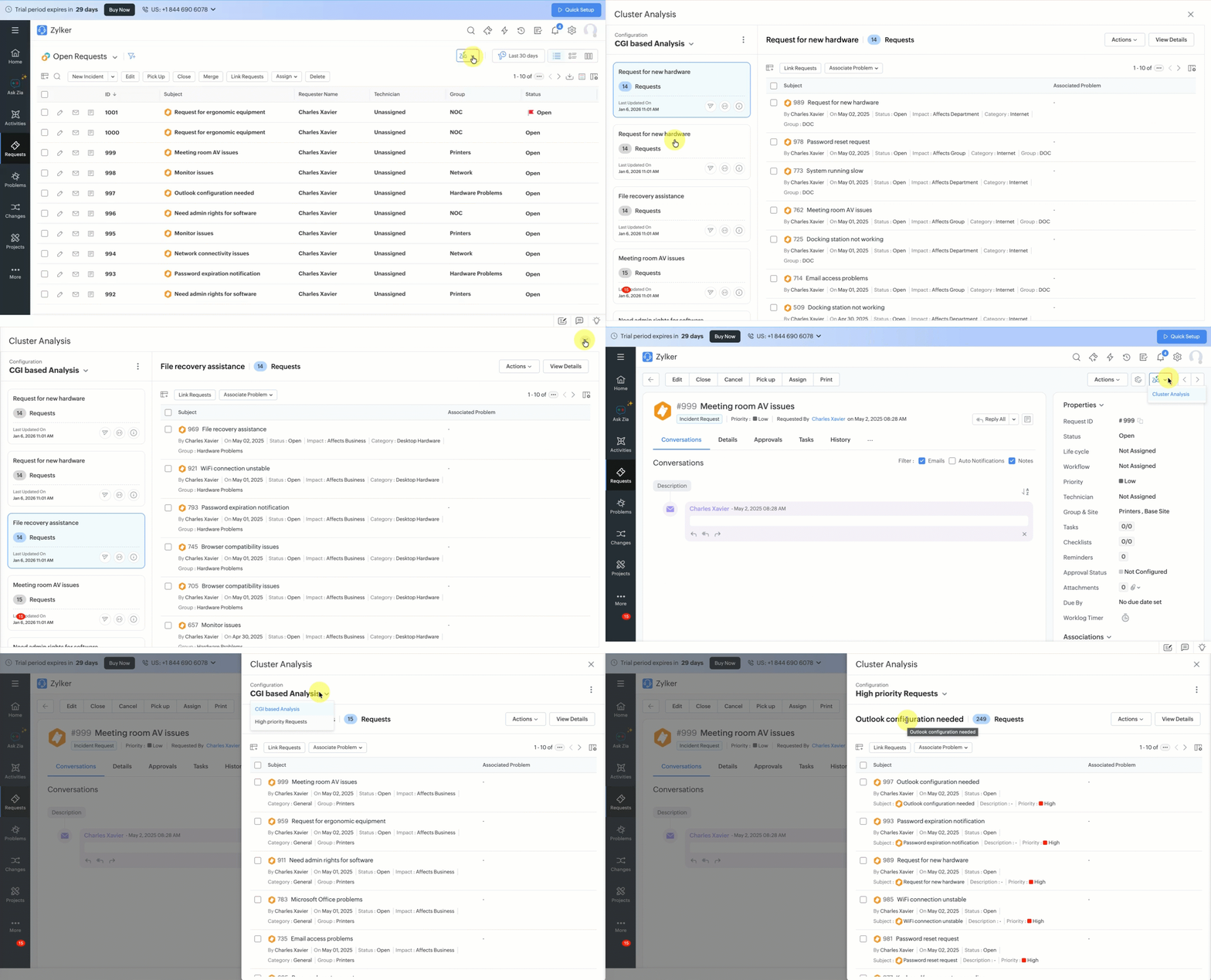
Zia Cluster Analysis now subsumes Zia Problem Prediction, helping you set up custom filters and thresholds to cluster your incidents and spot patterns worth investigating. This feature is available in the Enterprise edition.
Ask Zia, powered by the Zoho-hosted LLM, is now available beyond the Enterprise edition. Ask Zia has long been available in the Standard and Professional editions when powered by the ChatGPT or Azure OpenAI integrations. Now, the Zoho-hosted Zia LLM, built on open-source foundational models, extends to these editions as well, helping customers cut down inference costs and reduce reliance on third-party AI providers. Technicians can converse with Ask Zia to query for relevant data and pull up smart ticket views, and end users get relevant solution excerpts during ticket logging and while conversing with Ask Zia, deflecting L0 and L1 queries through self-resolution. You can even make Ask Zia the default landing page for requesters, keeping support available around the clock.
Solution Assist now analyzes and indexes the attachments in your solution articles (including PDF, DOCX, DOC, MD, TXT, HTML, and HTM file types) so the excerpts it serves draw on the full depth of your knowledge base, not just the article body. That means more contextual answers on demand and a stronger shift-left strategy that keeps your service desk focused on higher-priority work.
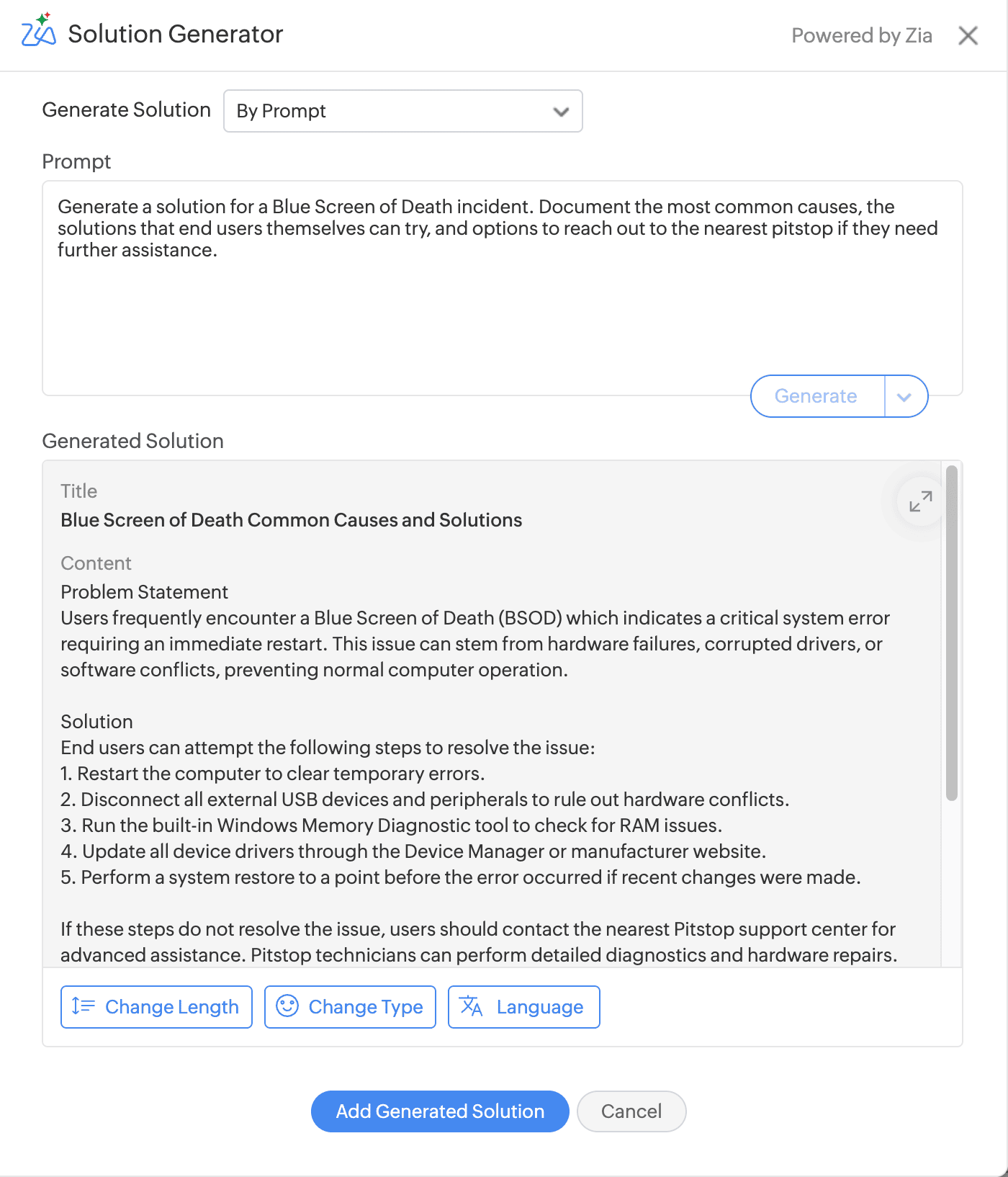
Solution Generator now generates multilingual solutions, ensuring your knowledge base is accessible to a global workforce spread across geographies. This is especially valuable for centralized IT teams responsible for knowledge management: Author a solution once and support end users across language barriers without waiting on translations.
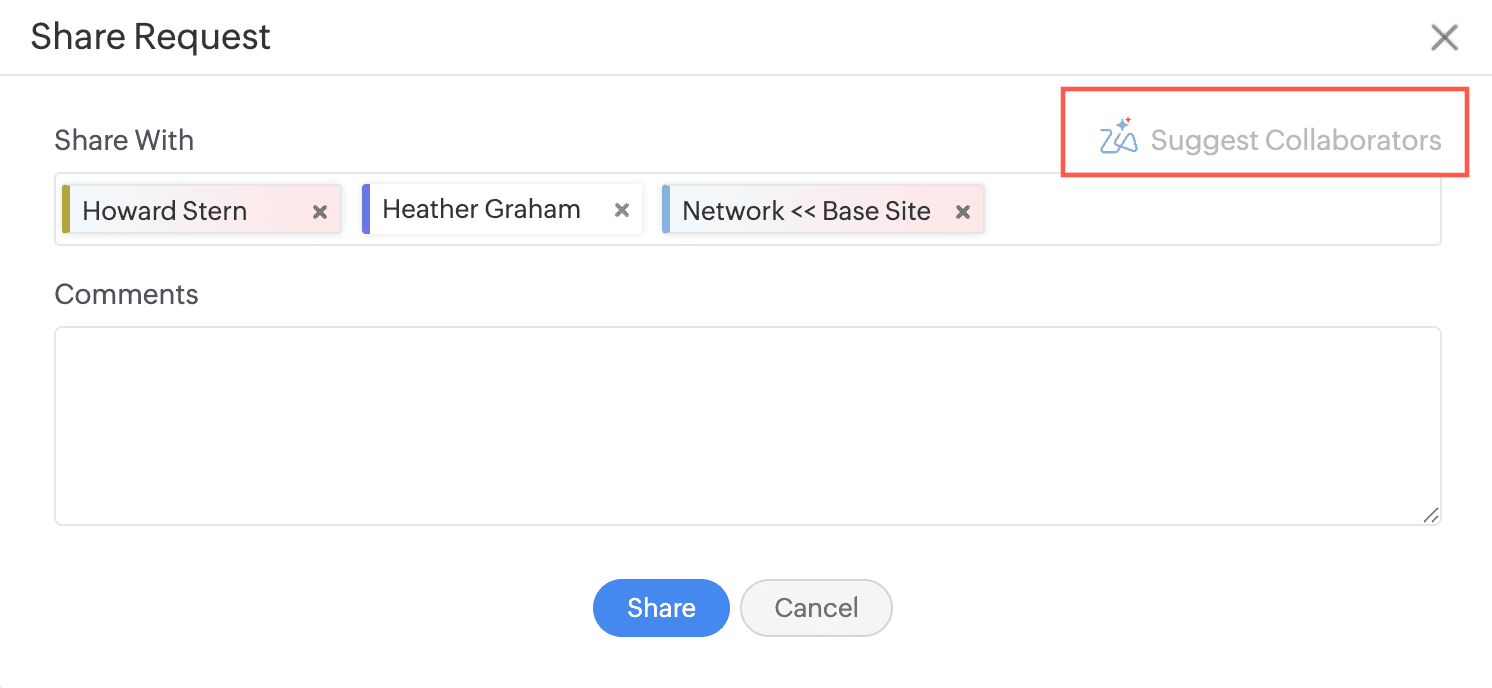
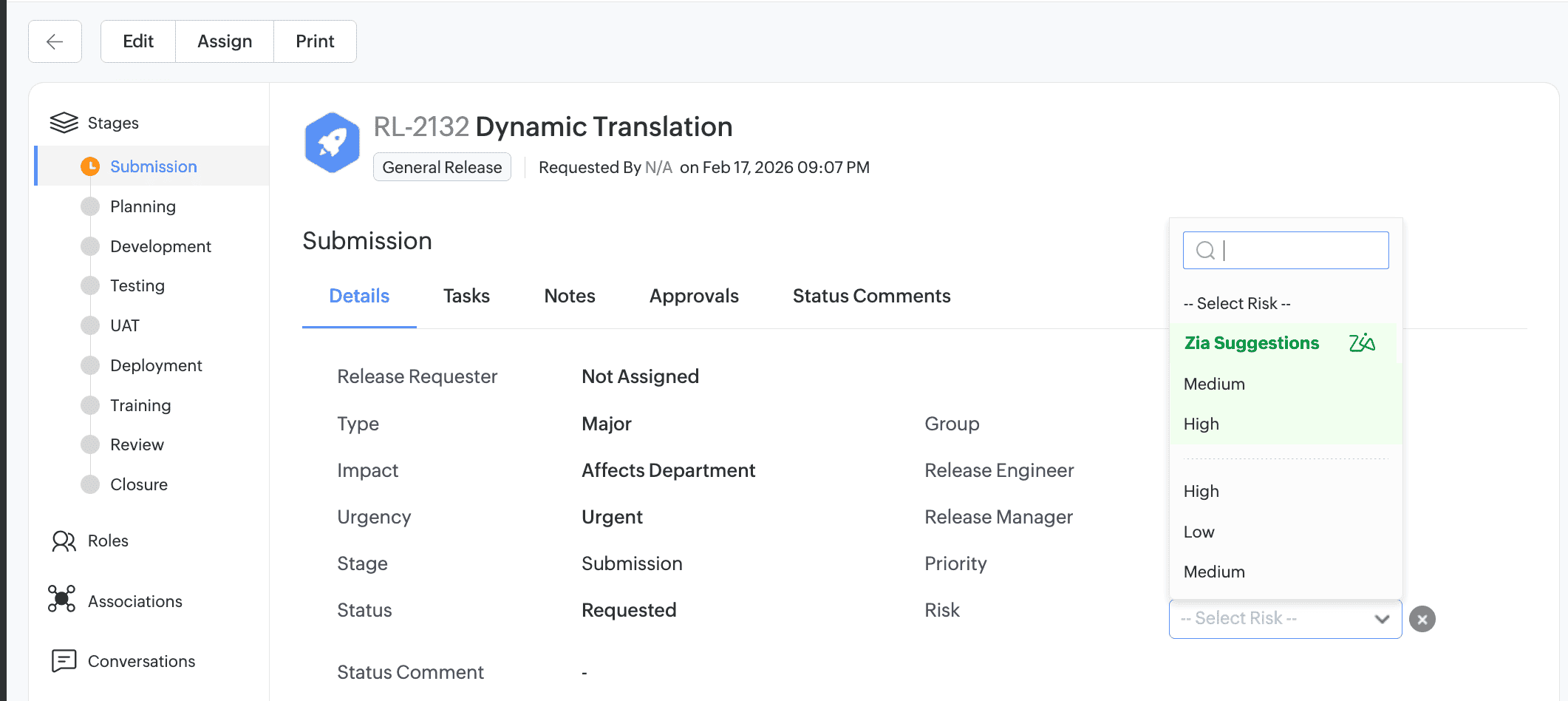
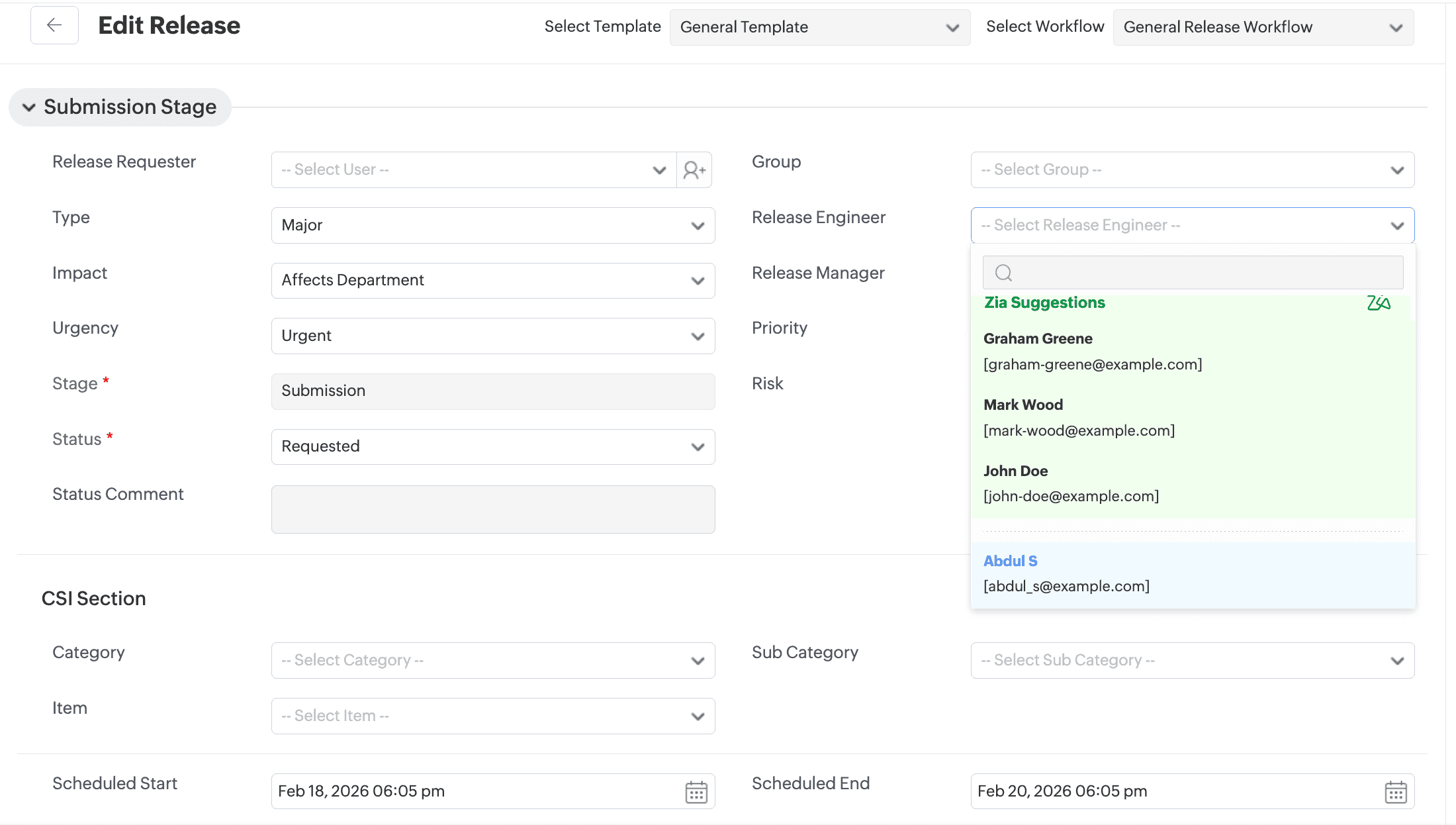
New predictive features strengthen request collaboration and release management. Collaborator Suggestion analyzes shared request data and dynamically predicts relevant users or groups to collaborate with when a request is shared, learning from historical data on how tickets are shared with requesters, technicians, and technician groups along with subject and description data. Risk Prediction helps you forecast release risks and plan accordingly, and Release Engineer Prediction indexes your release fields to suggest the most suitable release engineer. These features train locally on your existing data to help your future releases go smoothly.
Collaborator Suggestion
Risk Prediction
Release Engineer Prediction
On the integrations front, the cloud version of ServiceDesk Plus now integrates with Google AI Studio, letting you leverage Google's AI models through a bring your own key (BYOK) approach. This adds to the existing lineup of supported AI providers (Zia's Zoho-hosted LLM, ChatGPT, and Azure OpenAI) that power the GenAI suite with the model of your choice. The on-premises version of ServiceDesk Plus now integrates with Azure OpenAI, helping you power the GenAI suite with an LLM of your choice via a BYOK model.
Platform enhancements and quality of life improvements
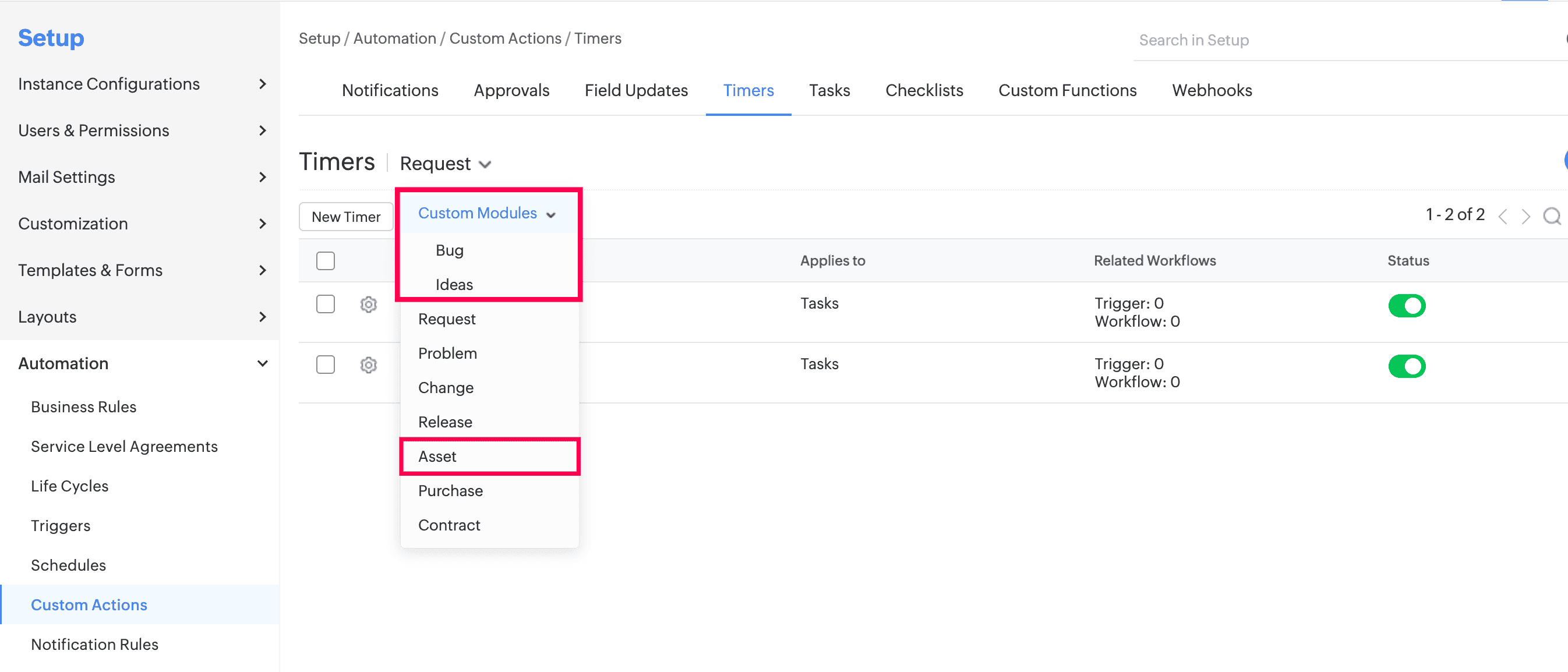
Timer Actions have been expanded in three ways. First, Timer Actions enable time-delayed automation for sub-entities like tasks and approval levels across requests, changes, problems, and releases. Examples include notifying a task owner a day before a high-priority task's scheduled completion date or sending repeated timer-based approval reminders on a high-priority request. Second, Timer Actions for assets let you send reminders before an asset audit deadline, alert users as asset loan periods end, and warn sysadmins weeks ahead of warranty expirations. Third, Timer Actions for custom modules let you take preemptive action on any bespoke practice you've built, like notifications for impending vendor risk assessments that are invoked from custom triggers.
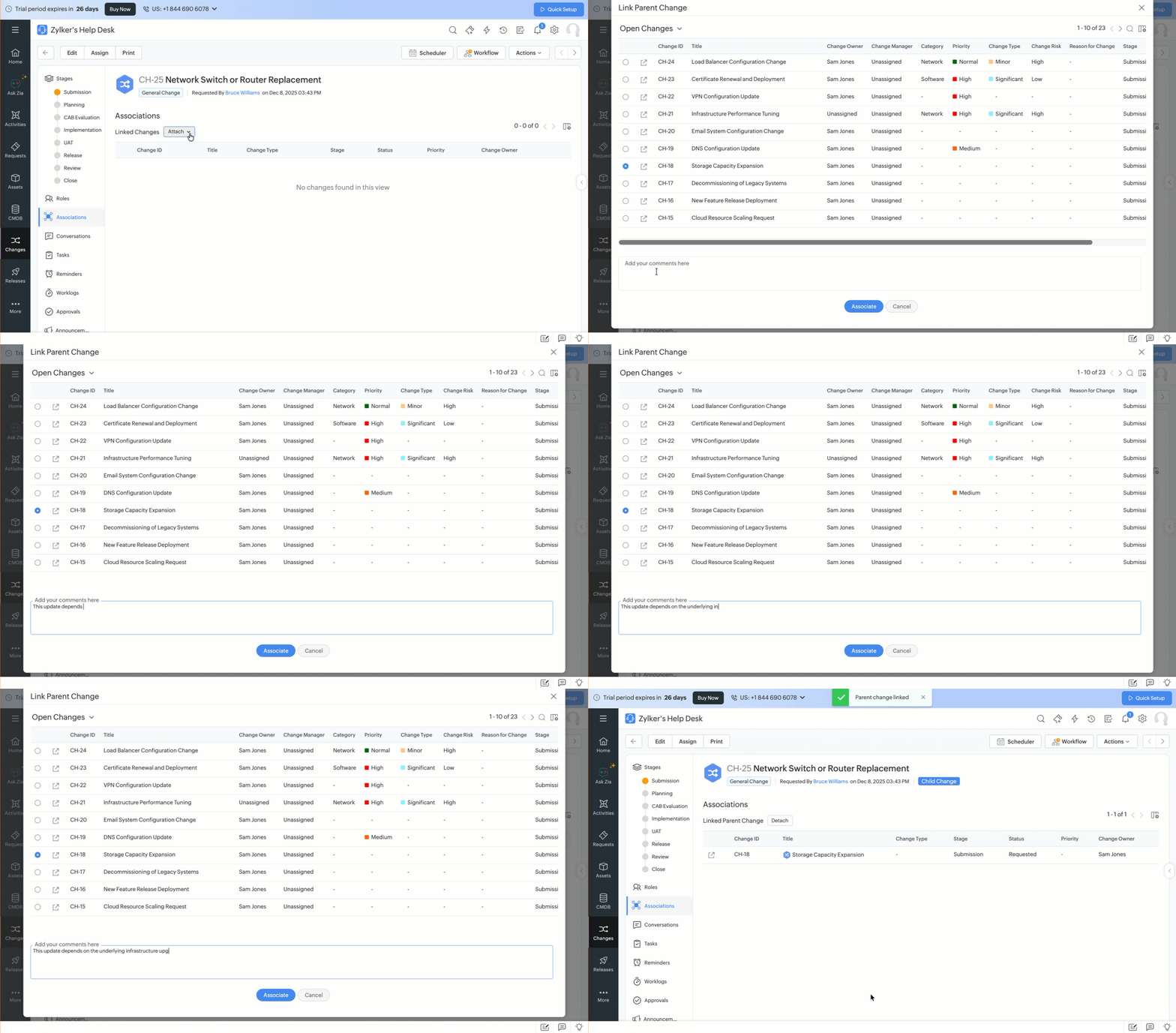
Parent-child change relationships help you manage large-scale, multi-phase changes. Break a larger change into smaller child changes, assign them to specific technician groups, and drive each with child-change-specific workflows, compartmentalizing the work so your teams can tackle changes faster.
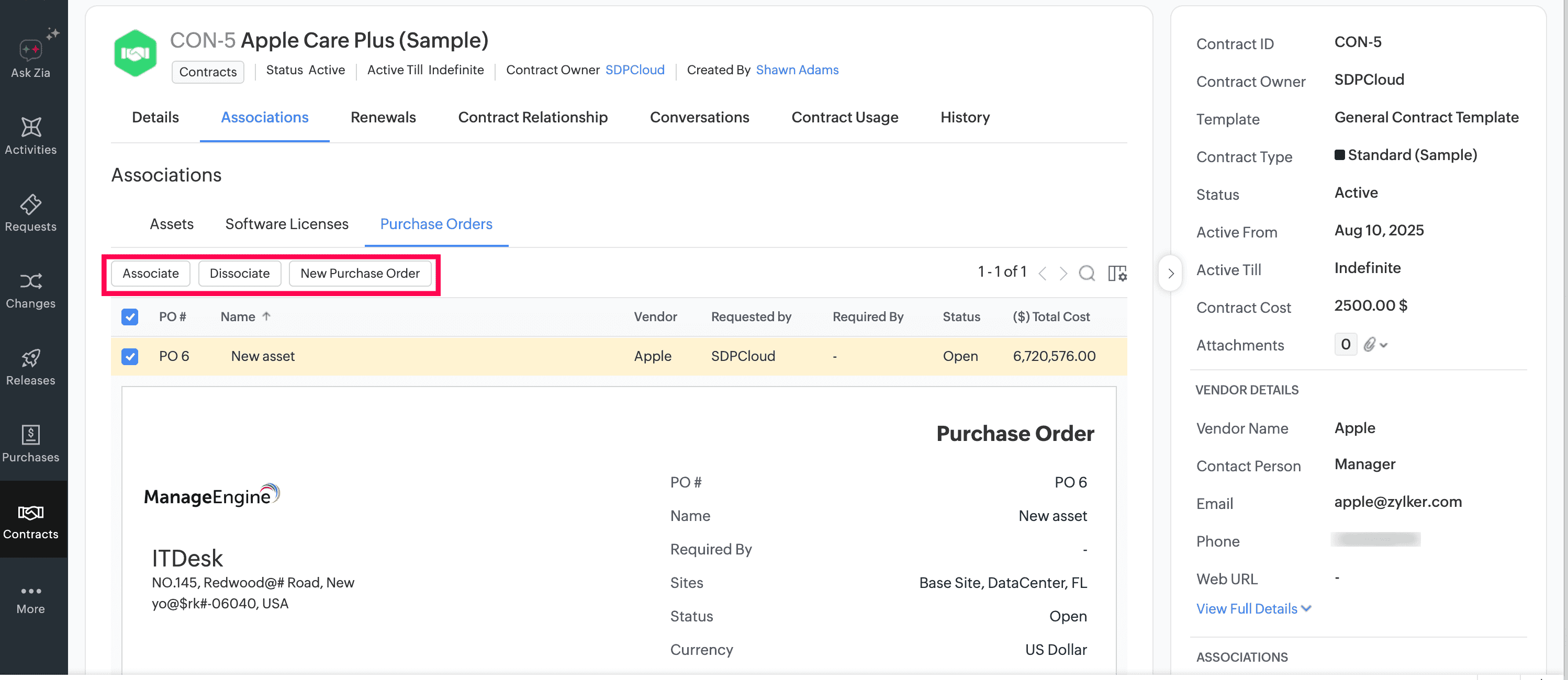
Contracts and purchase orders are now connected to your assets. You can now associate assets and licenses with contracts and associate the respective purchase orders and your vendors with those same contracts, keeping your financial documentation in one place. Technicians can invoke the relevant contracts from specific assets, letting you track invocation costs and drill down to the asset behind each usage. The outcome is a better financial posture through visibility across your assets, software licenses, and the associated contracts and purchase orders, strengthening your service finance management practice.
The path forward
2026 has already been an eventful year for ServiceDesk Plus, with major strides across the AI suite, the CMDB, and our platform and ESM capabilities. Try setting up any one of the features you read about today and let us know how it works for you.
You can access our full change log of features and enhancements for ServiceDesk Plus here:
- Release notes for the cloud version of ServiceDesk Plus
- Release notes for the on-premises version of ServiceDesk Plus
If you are a customer trying out the features, reach out to support-cloud@servicedeskplus.com for any clarifications.
If you are exploring ServiceDesk Plus, hop in for a free personalized demo by our product experts.
Get a personalized demo of ServiceDesk Plus, tailored to your requirements
Until next time! We've got an extensive roadmap to get back to so that your teams can deliver on your service excellence targets.