Glossary
Explore a comprehensive glossary of key terms and definitions commonly used in ManageEngine Applications Manager - a primary reference for understanding important terminologies and concepts related to application performance monitoring.
ActionActive DirectoryADDMAdmin ActivitiesAlarmsAlarm ConfigurationAlarm TemplateAnomalyApdexAPM InsightAttributeAvailability
A
| Terms | Definition |
|---|---|
| Action | These are tasks to be performed to notify the user, when alarms are generated by Applications Manager.For example, while monitoring WebLogic server, if the user wants to be intimated when the server response time is greater than 1000ms, then an alarm is generated when the condition is met. The users are notified of the alarms through Actions such as sending e-mail, SMS, trap, and executing a command. |
| Active Directory | Active Directory (AD) is a directory service developed by Microsoft for Windows domain networks. Applications Manager allows you to monitor your Active Directory environment to track performance metrics such as replication status, LDAP queries, and domain controller health. |
| ADDM | Application Discovery and Dependency Mapping (ADDM) enables you to automatically discover applications running in your network and map the dependencies between them, providing visibility into how different components of your infrastructure interact. |
| Admin Activities | Activities allowing IT administrators to configure any operation in Applications Manager with ease. Only the 'Admin' user can perform these activities. For more information on user access, refer to the User Administration section. |
| Alarms | Alarms are notifications generated based on Threshold / Health values .They are generated when the value of a numerical attribute exceeds the pre-defined threshold limit. Additionally, the status of health and availability of an application can also be determined through Alarms. |
| Alarm Configuration | This activity enables the user to associate a threshold profile with an attribute so that alarms are generated. It includes associating the action to be executed when an alarm is generated.Additionally, the dependencies for the ‘Health’ attribute of a Monitor can also be configured. |
| Alarm Template | Alarm templates allow you to configure alarm settings globally and apply them across multiple monitors. Instead of setting thresholds individually for each monitor, you can create a template with predefined threshold values and associate it with monitors of the same type. |
| Anomaly | Anomaly detection identifies unusual patterns or deviations from normal behavior in monitored metrics. Applications Manager uses baseline comparisons to automatically detect anomalies and generate alerts when metric values deviate significantly from expected patterns. |
| Apdex | Application Performance Index (Apdex) is an open standard that measures user satisfaction with application response times. It classifies responses as Satisfied, Tolerating, or Frustrated based on configurable thresholds, producing a score between 0 and 1 where 1 indicates complete satisfaction. |
| APM Insight | APM Insight is the code-level monitoring module in Applications Manager that provides deep visibility into application performance. It uses agents deployed in your application environment to track transactions, response times, errors, and throughput at the code level. |
| Attribute | Attributes are parameters/objects of a Monitor and they provide information about them. These are parameters whose values are set to threshold to generate alarms. |
| Availability | An attribute that determines whether a system or application is available for use (Up or Down). For example, if a Web server is running, then the availability is up.Consider a situation where the Web server may be running fine but its response time is high. This is indicated by Availability as Up  and Health as critical and Health as critical  if the response time is a dependent parameter for health. if the response time is a dependent parameter for health. |
B
| Terms | Definition |
|---|---|
| Business Hour | Business hours define the operational time windows during which monitoring and alerting are active. You can configure business hours to ensure that alarms and notifications are triggered only during specified working periods, reducing noise from non-critical off-hours alerts. |
C
| Terms | Definition |
|---|---|
| Credential | Credentials are authentication details such as usernames, passwords, SSH keys, or SNMP community strings stored in Applications Manager for connecting to and monitoring remote servers, databases, and applications. The Credential Manager provides centralized credential storage and management. |
| Custom Monitor | Custom Monitors provide a way to monitor your Java applications or other applications that expose management information through SNMP (Simple Network Management Protocol) and JMX (Java Management Extensions).Say, you have a Java application with built-in manageability using JMX and any application that has an SNMP interface, then they are managed by building Custom Monitors. |
D
| Terms | Definition |
|---|---|
| Dependencies | Dependencies determine
They consist of the dependent parameters of the Monitor based on which the severity of the health and availability is determined. For example, Health of a Tomcat Server may depend on the overall response time of the server or on the response time of each of the web applications deployed on the server etc. By configuring dependencies, you can determine the attribute, based on which the severity of health changes. |
| Discover Network | Locating all Monitors running within a network range. |
| Downtime | Downtime refers to scheduled or unscheduled periods during which a monitored resource is unavailable. Applications Manager provides a Downtime Scheduler that lets you define maintenance windows during which monitoring data collection and alarm generation are suppressed. |
E
| Terms | Definition |
|---|---|
| Enterprise OID in SNMP Trap | OID that uniquely distinguishes traps of different organizations, i.e. they vary for different vendors. This field applies only to SNMPv1 traps. |
| EUM Agent | The End User Monitoring (EUM) Agent is a lightweight component deployed in your network to simulate end-user transactions and measure application performance from the user's perspective. It monitors web applications by performing synthetic transactions from various locations. |
F
| Terms | Definition |
|---|---|
| Failover | Failover is a mechanism that ensures high availability of the Applications Manager server. If the primary server goes down, a standby (secondary) server automatically takes over monitoring operations to prevent data loss and maintain continuous monitoring coverage. |
G
| Terms | Definition |
|---|---|
| Generic Type in SNMP Trap | These are types that are mapped to specific OID to generate SNMP traps and provide additional information about the functioning of the Monitor Group. They are applicable only to SNMPv1 traps. The different types of Generic traps are coldStart, warmStart, linkDown, linkUp, authenticationFailure, and egpNeighborLoss. |
H
| Terms | Definition |
|---|---|
| Health | An attribute that indicates the quality of Monitors, based on their dependencies. For example, If a Web server takes 10 mins to respond, its response time is high but the server is still available. Hence it is indicated by Health as critical (If response time is a dependent parameter of health) and Availability as up . |
L
| Terms | Definition |
|---|---|
| LDAP | Lightweight Directory Access Protocol (LDAP) is used for accessing and managing directory services. Applications Manager supports LDAP monitoring to track directory server performance, and also uses LDAP/Active Directory authentication for user login. |
M
| Terms | Definition |
|---|---|
| Modem | In the context of Applications Manager, a modem refers to a GSM or CDMA modem connected to the server for sending SMS alert notifications. Supported modems can be configured under SMS server settings to deliver alarm notifications via text messages. |
| Monitoring | It is a continuous process that uses methodical collection and analysis of data to provide business management. |
| Monitor | Application on which monitoring is performed. Monitor is an instance of a Monitor Type that is running in a port of a host. For example, Application Servers such as WebLogic servers or Tomcat servers etc, Database servers such as Oracle or MySQL servers are some of the Monitor Types while a WebLogic server running on a particular port of a host is a Monitor. |
| Monitor Groups | Refers to the logical grouping of one or more Monitors such as application servers, network services, databases, web applications etc. This provides a holistic view of the business environment. |
| Monitor Type | Refers to application such as WebLogic server, JBoss server, System server, URL Monitor, Oracle Database server, MySQL Database server, etc. that are monitored by Applications Manager.Different instances of these applications are Monitor. |
| Mean Time To Repair (MTTR) | The average time to repair a device or a system back to acceptable operating conditions. The term can also means, the time spent to restore a machine to operating condition after failure.This must be as low as possible. MTTR thresholds can be set to trigger root cause. |
| Mean Time Between Failures (MTBF) | The average time that a device or a system worked without failure. The term also stands for the length of time a user may reasonably expect a device or system to work before an incapacitating fault occurs.This must be as high as possible. MTBF thresholds can be set to trigger root cause. |
P
| Terms | Definition |
|---|---|
| Ping | Ping is a network utility that tests the reachability of a host by sending ICMP Echo Request packets and measuring the response time. Applications Manager uses ping monitors to check server availability and network connectivity. |
| Polling Interval | The time interval to monitor the different parameters configured for a Monitor. |
| Proxy Server | A proxy server acts as an intermediary between Applications Manager and the resources it monitors. You can configure proxy settings when direct network access to monitored endpoints is restricted, enabling Applications Manager to route monitoring requests through the proxy. |
R
| Terms | Definition |
|---|---|
| RCA | Root Cause Analysis helps to point the actual cause of a problem. You can view the 'Root Cause Analysis' by clicking on the status icon of the attributes. For example, 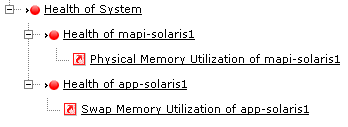 Expand the nodes to view the actual cause of the problem. Here, WebLogic Health is critical as Availability and Response Time (dependencies of Health) are also critical. Expand the nodes to view the actual cause of the problem. Here, WebLogic Health is critical as Availability and Response Time (dependencies of Health) are also critical. |
| Reports | They provide organized presentation of data that depicts the behavior of Monitor Types over a specified period of time. |
| REST API | REST (Representational State Transfer) APIs in Applications Manager provide programmatic access to perform operations such as adding monitors, retrieving performance data, managing thresholds, and configuring settings through HTTP requests. |
| Response Time | The time taken by a Monitor to react to a given input. |
S
| Terms | Definition |
|---|---|
| Secondary Server | A secondary server is a standby instance of Applications Manager configured for failover. It remains synchronized with the primary server and automatically takes over monitoring responsibilities if the primary server becomes unavailable. |
| Severity | Indicates how serious the problems are. There are three levels of severities: Critical, Warning, and Clear. These are controlled by the threshold set by the user or administrator. |
| SLA | A Service Level Agreement (SLA) defines the expected level of service for monitored resources. In Applications Manager, SLAs let you set availability and performance targets for monitors and generate compliance reports to track adherence. |
| SMTP Server | An outgoing e-mail server using Simple Mail Transfer Protocol (SMTP) that sends your outgoing messages to the appropriate recipients. Most e-mail systems that send mail over the Internet use SMTP to send messages. The messages can be retrieved using POP server. |
| SMS Gateway | An SMS Gateway is a service that enables Applications Manager to send alarm notifications via SMS messages. It can be configured to use either a connected GSM modem or a third-party SMS gateway provider to deliver text-based alerts. |
| SNMP OID | Object identifier (OID) that is used to uniquely identify each object variable of a MIB (Management Information Base). |
| Specific Type in SNMP Trap | When generic is set to Enterprise, a specific trap ID is identified. |
| Subnet Mask | The subnet mask determines the maximum number of hosts on a subnetwork. |
T
| Terms | Definition |
|---|---|
| Throughput | Throughput measures the amount of data or number of transactions processed by an application within a given time period. In APM Insight, throughput metrics help you understand the volume of requests your application handles and identify performance bottlenecks. |
| Threshold | Threshold is the value that determines the severity of the alarm based on the pre-defined conditions. For example, if the user wants to be intimated when the server response time is greater than 1000ms, then a threshold can be created based on this condition and assigned to the attribute. |
U
| Terms | Definition |
|---|---|
| Uptime | Uptime refers to the duration for which a monitored resource remains continuously available and operational. It is typically expressed as a percentage of total time and is a key indicator of service reliability and availability. |
| URL Monitors | Continuous URL monitoring service that monitors web pages. They verify the availability of specified, addressable, standard HTTP and HTTPS URLs of web pages. |