- HOME
- AI-Powered Analytics
- No-code machine learning: Building proactive IT strategies
No-code machine learning: Building proactive IT strategies
- Last Updated: December 23, 2025
- 322 Views
- 7 Min Read

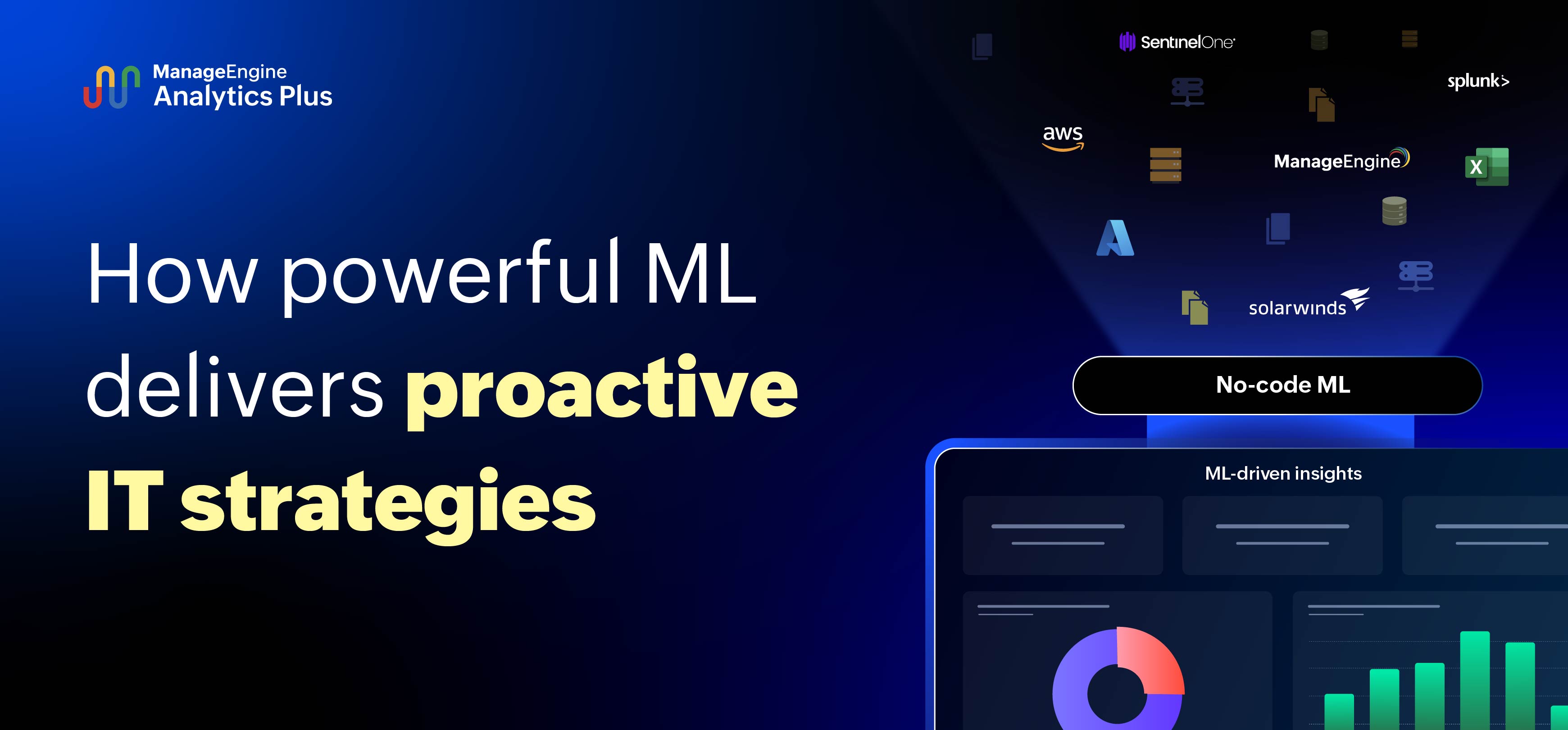
You are sitting on top of data that can predict your next system outage, ticket escalation, or patch failures. But without data science expertise, you are left reacting to these issues you could have prevented. You are firefighting, not future-proofing.
That changes now—with no-code machine learning (ML).
You don't have to rely on analysts and spend endless hours building custom analyses.
No-code ML puts predictive power directly in the hands of your IT team—the people who know your IT systems best. Let's explore how this works.
What is no-code ML?
No-code ML is an approach where you can train, test, and deploy custom ML models without writing a single line of code. This makes it possible for IT teams to predict, classify, and make prompt decisions using their own operational data.
For years, building custom ML models has been the domain of data analysts. Now, an IT technician with no ML or coding expertise can create complex custom models without writing a single line of code.
If you want to:
Predict key KPIs like resolution time, ticket escalation and more,
Implement proactive capacity planning and load balancing,
Forecast scenarios and outcomes like patch success rate,
—then, using a no-code ML-powered analytics tool is the way to go.
Your IT teams no longer have to rely on gut-feel, code-heavy models, and reactive reports. With no-code ML, they can build custom models easily, gain foresight, and resolve issues before they escalate.
4 high-impact use cases to implement with no-code ML-powered analytics
Whether you are in service delivery, endpoint management, or monitoring infrastructure health, you can use no-code ML-powered data analytics to easily solve your unique pain points.
Let's explore four real-world applications of no-code ML-powered analytics.
1. Escalation prediction with no-code prediction analytics
The earlier you can predict which incidents are at risk of escalation, the faster you can intervene by assigning senior technicians, adjusting workloads, or initiating additional technician training.
Standard forecasting frameworks assume that the future will follow the past in linear patterns. But in dynamic IT environments, escalations aren’t just about volume, they are driven by the interplay of dozens of live variables. No-code custom built ML models can capture these correlations and tailor predictions based on your unique environment conditions.
No-code ML models can understand dynamic patterns like technician availability and overdue incidents, and create predictions that adapt as conditions change.
Here's an analysis created using an incident escalation prediction ML model that uniquely unearths an organization's trends.
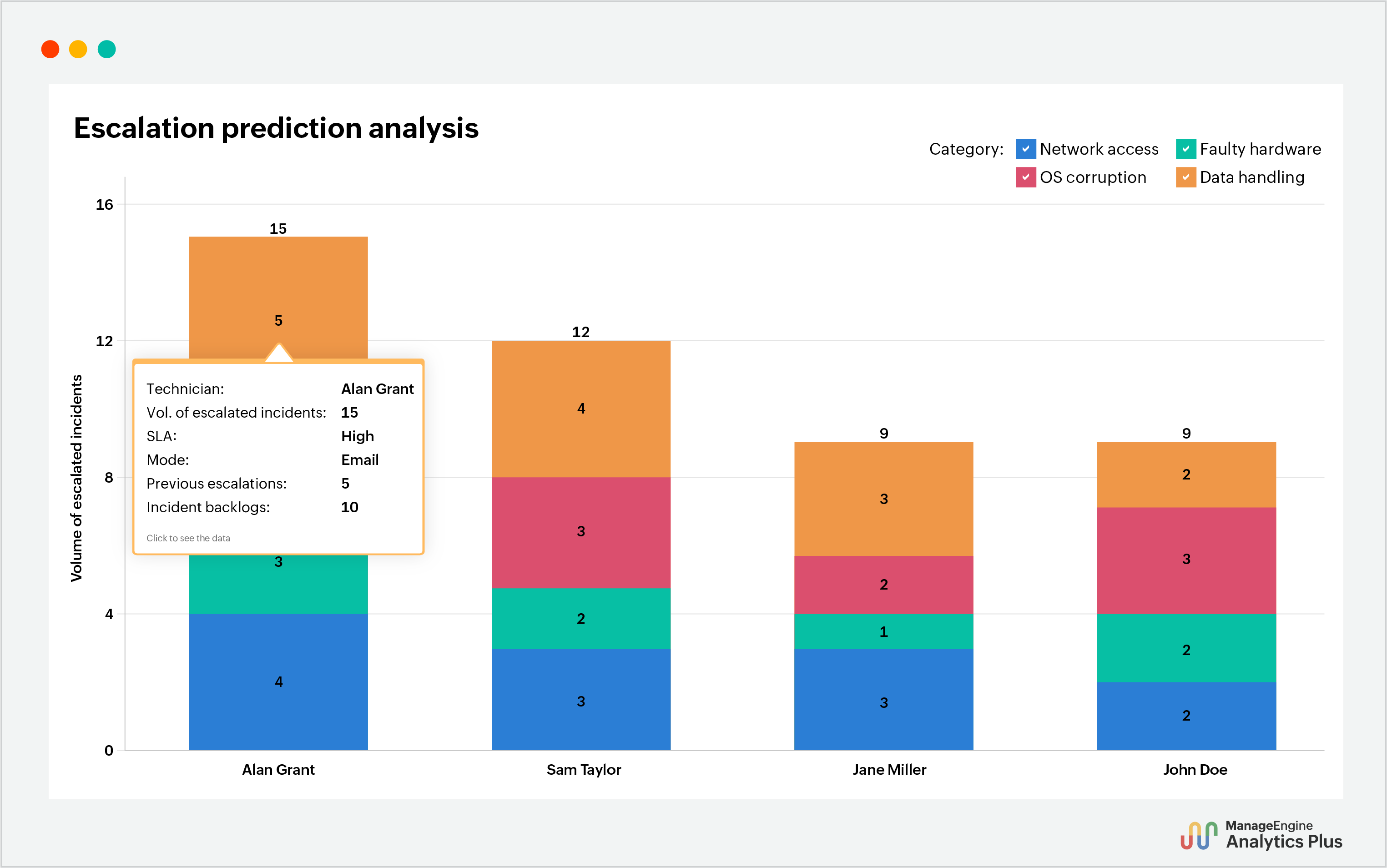
This no-code ML-powered analysis learns from historical service desk data and varying patterns to predict which incidents are likely to be escalated. Rather than relying on standard frameworks or generic rules, this model delivers predictions that are accurately tuned to an organization's unique configuration and processes.
This prediction is also incorporated with various influencing factors like: technician performance, previous escalations, category, department, site, SLA, incident entry method, impact, and more.
See how this analysis predicts that Alan Grant might face five escalations in the data handling category? With this prediction, you can promptly schedule targeted training specifically for that category.
The no-code ML builder also delivers an intuitive what-if analysis functionality that allows easy simulation of possible outcomes. By simply simulating practical scenarios such as reassigning incidents to different technicians, reducing backlog size, or adjusting the volume of incident categories, you can pinpoint which factors have the greatest impact and see how predictions shift, helping you test interventions before implementing them across your service desk.
2. Patch deployment failure prediction
Patch deployments are essential for securing and optimizing IT infrastructure, but they are also risky. Failed patch deployments can leave systems vulnerable, cause performance disruptions, and even trigger organization-wide outages.
No‑code ML-driven analytics not only captures the static relationships between your IT metrics like patch deployments, but also adapts to every new shift—agent upgrades, aging hardware, disk constraints, or new remote sites—so your patch‑failure predictions remain accurate in the face of dynamic, unforeseen changes.
Traditional analytics and forecasting will miss these complex, organization‑specific shifts. But by learning from your unique and evolving patterns, no‑code ML-driven analytics delivers accurate, actionable predictions.
Here's an analysis built using a no-code prediction model:
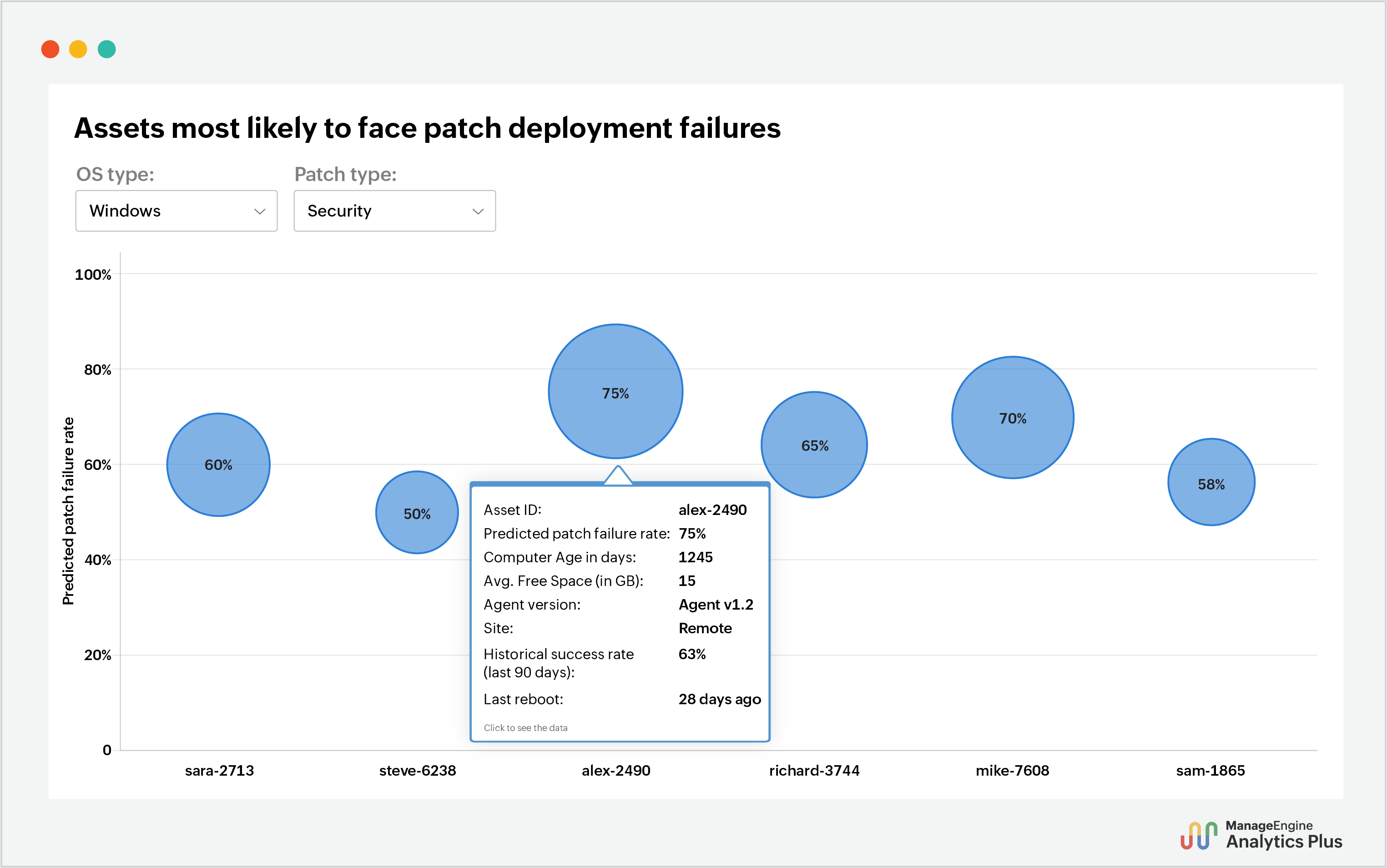
This no-code ML-powered analysis is trained on an organization's historical data. The ML model then learns which conditions preceded patch failures and which factors contributed to them. This trained ML model is then used to analyze upcoming patch schedules for precise, real-time predictions of failures.
This analysis has taken multiple factors into account like patch severity, patch type, vendor, OS family, and extensive asset details like disk space, asset age, agent version and more. This enables IT decision makers to gain insights into which factors contribute more to a patch deployment's failure.
The model intelligently combines these factors to calculate a predicted patch failure rate for each asset, showing how likely it is to encounter deployment failures in the upcoming cycle. For example, the asset alex-2490—with aging hardware, recurring patch failures, limited disk space, and more—is likely to have a 75% failure rate.
Armed with these insights, you can understand which conditions most strongly correlate with failures and proactively prioritize high-risk assets before patch cycle begins.
3. Multivariate incident volume forecasting
Traditional univariate forecasting predicts future outcomes solely based on historical trends. It assumes that past patterns will repeat, overlooking the factors and interdependencies that shape real-world shifts.
Here's an analysis that follows a univariate approach to forecasting an organization's incident volume.
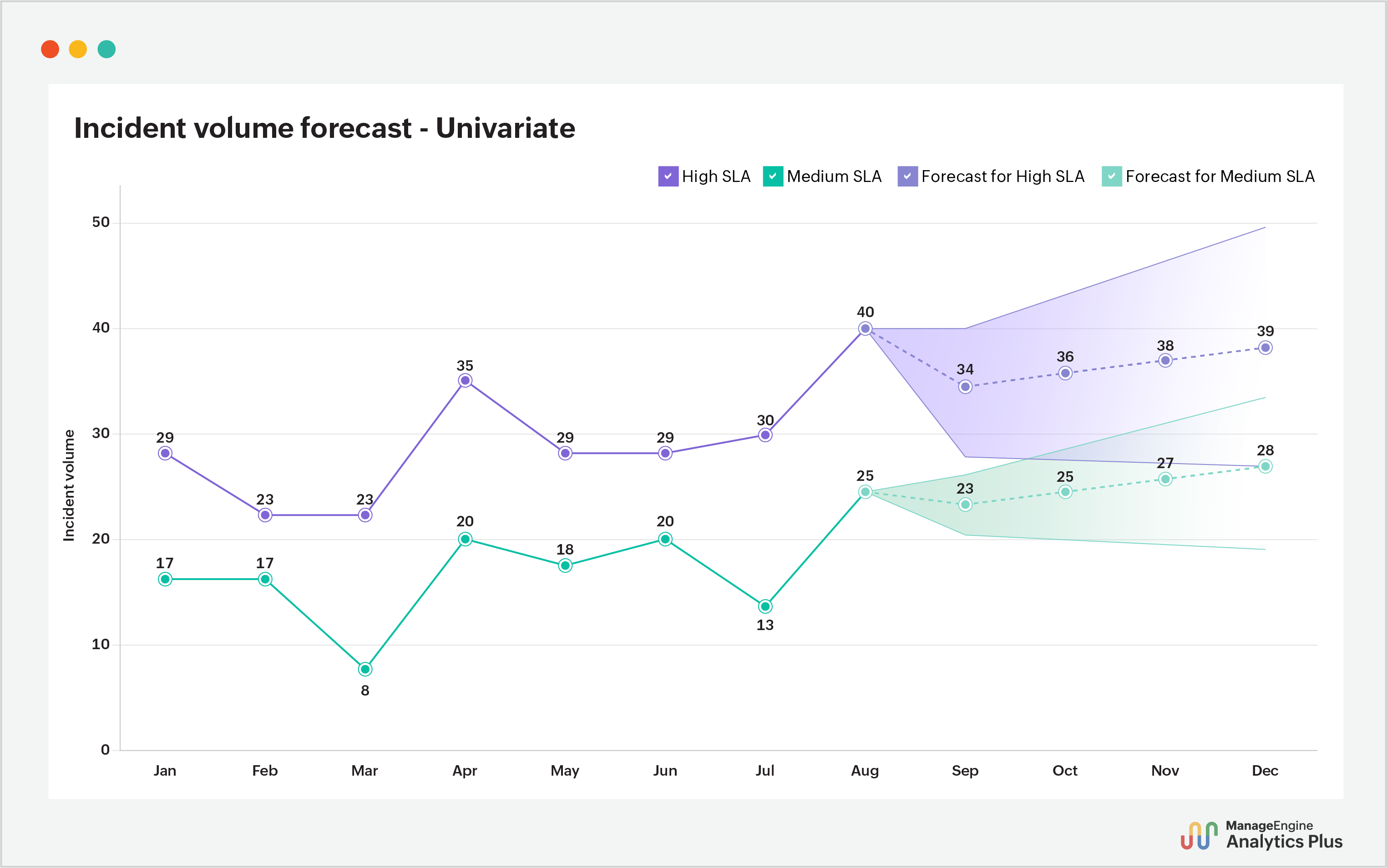
In a dynamic IT environment, anything from asset health factors like patch compliance and vulnerabilities to employee onboarding and device additions leaves a lasting impact on a service desk's incident volume. By failing to account for such influencing dynamic factors, traditional forecasting methods as used in the above analysis are inaccurate and unreliable, leaving IT teams unprepared for future events and incidents.
With ML-powered multivariate forecasting, you can incorporate influencing factors and receive accurate predictions that reflect the real-world complexity behind incident request spikes.
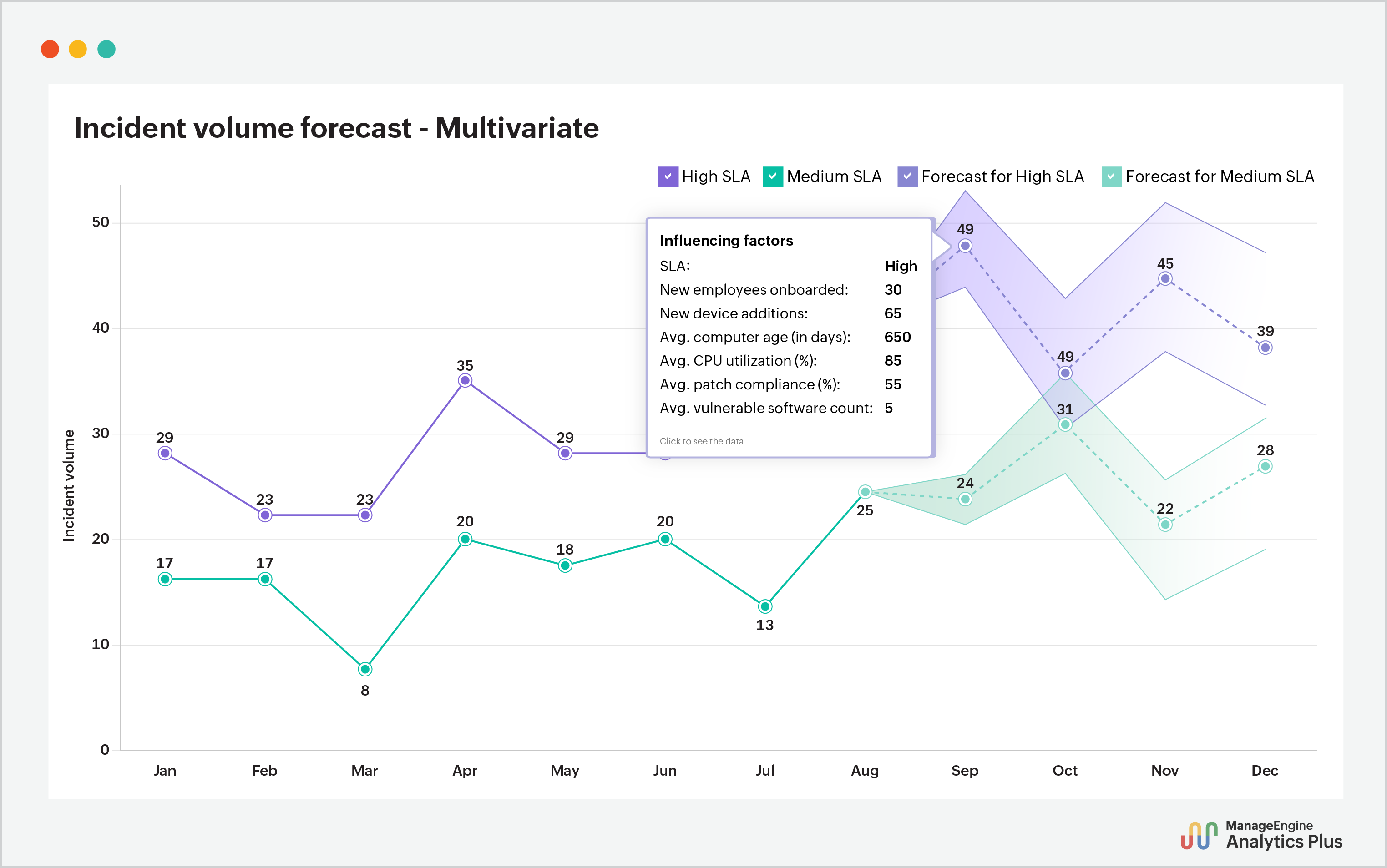
When the same incident prediction is performed using a multivariate forecasting method, it reveals that incident volume spikes in September and October. This forecast delivers reliable and actionable insights that help IT teams proactively plan resources and maintain service quality.
4. Downtime prediction score for proactive risk detection and prevention
One of the most valuable strategies in IT operations is identifying servers or applications that are at risk of downtime. Your ITOps team can then schedule timely maintenance, fix small issues before their impact cascades, and ensure operations run smoothly.
A powerful way to augment existing outage prevention practices is by incorporating ML-powered predictive analytics. This delivers precise predictions on resource downtime, calculated based on vital metrics like historic downtime trends, CPU utilization, response time, availability rate, MTBF, and more.
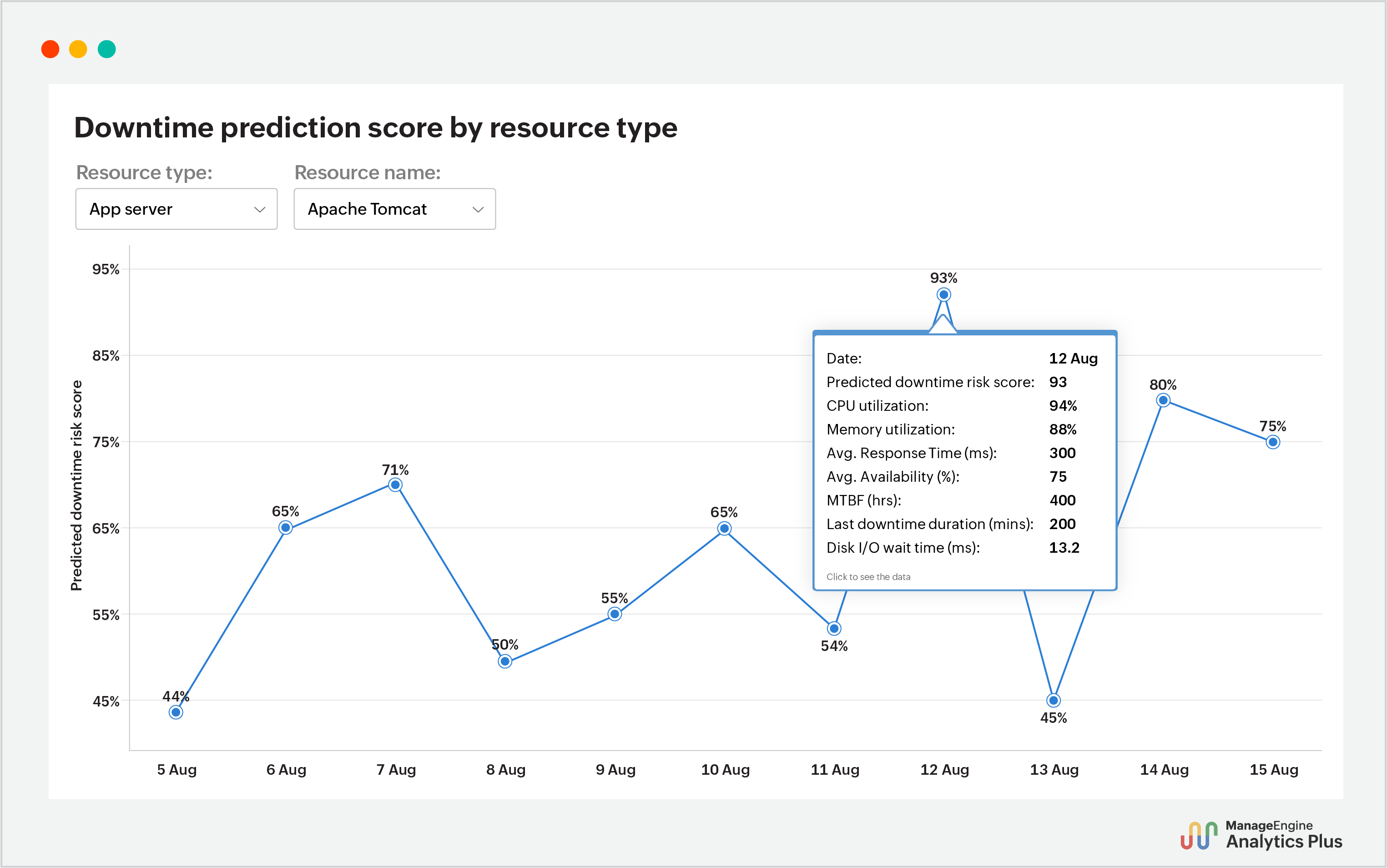
This analysis shows how a custom ML model can utilize an organization's unique downtime and usage patterns, and predict a dynamic downtime risk score with greater accuracy.
The no-code ML model can learn from fluctuating availability, prior downtime incidents, and spikes in response time to detect hidden patterns that signal rising downtime risk, for individual organizational resource. The result? A dynamic, context-aware downtime risk scores day by day, adapting to changes in resource behavior.
Apart from predicting the downtime, the custom no-code ML model also highlights all factors that contribute most to that risk, be it CPU usage, response time, availability, or error rate. This helps you fix the right issue at the right time instead of reacting blindly.
Across these use cases, you can see how traditional forecasting engines fumble to adapt to the unique IT environment conditions. No-code ML models, on the other hand, delivers accurate, context-aware predictions that enable proactive planning and democratize decision-making—from front-line technicians to CIOs.
Get started with no-code ML-powered analytics today
Wondering if no-code ML-powered analytics is truly code-free? Implementing it is more straightforward than you think.
Here is how you can create a custom no-code ML model in three simple steps:
Import your data into Analytics Plus.
Select the desired ML model and target column for training.
Deploy the model on live data and create powerful analyses in minutes.
The no-code ML-driven analyses included in this blog are built using ManageEngine Analytics Plus—an AI-powered IT analytics and decision intelligence platform.
Want to create your own custom no-code ML models and start predicting key KPIs? Start your 15-day, free trial here. Need to know what's in it first? Book a free personalized demo.
Buried in your data are answers to your biggest problems. With no-code ML-powered analytics tools like Analytics Plus, you can finally access them and act.
Frequently Asked Questions
1. How do I create no-code ML-powered analytics models?
Import your historical data.
Pick a prediction goal like "Which incidents are likely to escalate?" or "Which resources are at a high risk of downtime?"
Select key input factors such as ticket priority, asset age, CPU usage, or patch compliance.
Train and deploy a custom ML model with just a few clicks—no coding required.
2. Who in the IT team can use no-code ML-powered data analytics?
Technicians, managers, and even CIOs can use no-code analytics—thanks to its user-friendly UI and straightforward implementation.
3. What should I look for when choosing a no-code ML-powered analytics platform for IT?
When choosing a no-code analytics platform, look for IT-specific integrations, predictive analytics, AI-powered insights, and ease of use for non-technical users.
4. Can no-code ML-powered analytics handle large volumes of IT data from multiple tools and data sources?
Yes, no-code IT analytics platforms like ManageEngine Analytics Plus enable you to connect data from IT tools across service management, endpoint management, infrastructure monitoring, cloud services, and more.