[Tech comic] Network heroes: How agentic AI decides under pressure
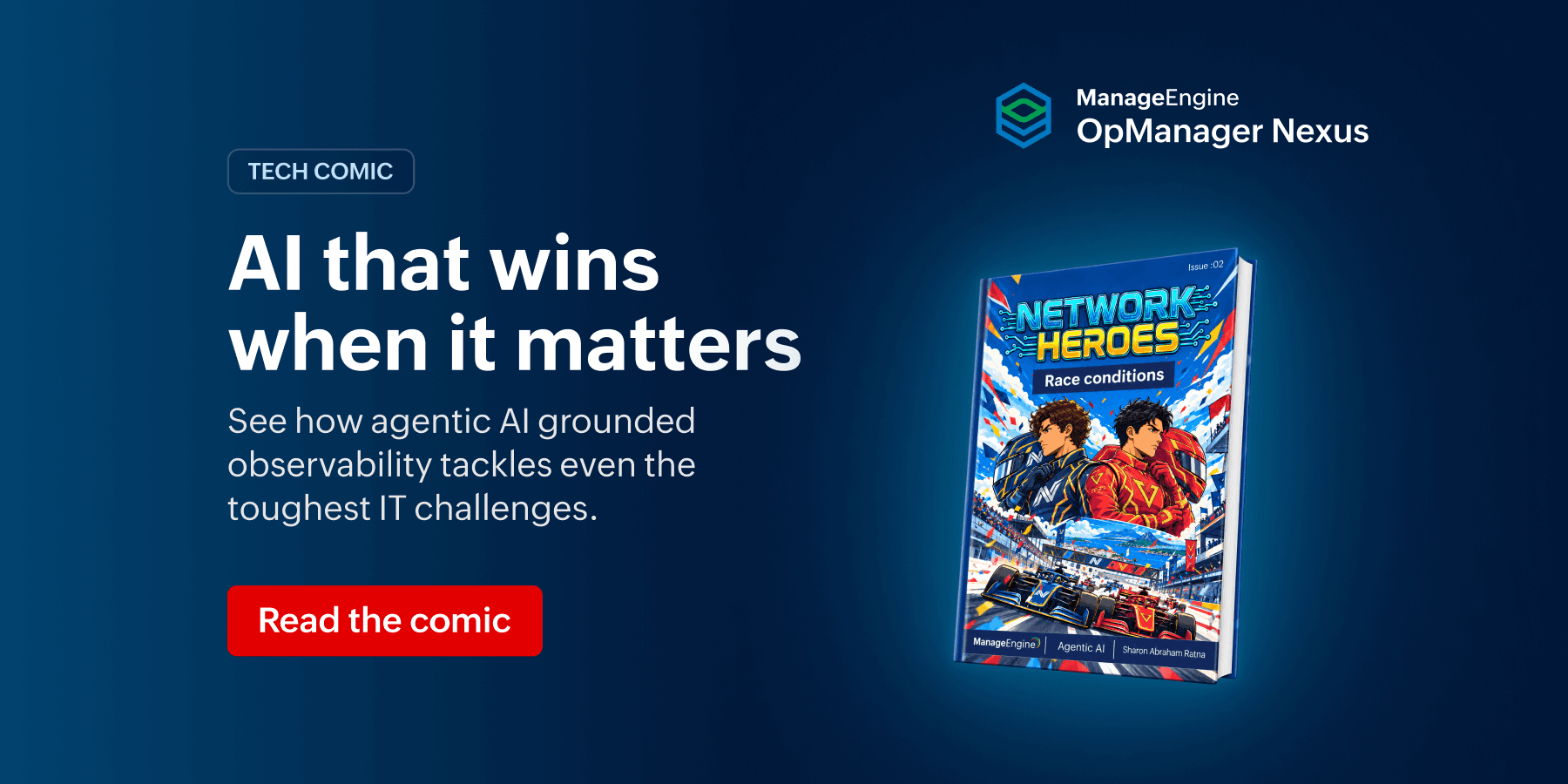
Two drivers have identical points and machinery, and the only variable left is the engineer in the pit lane. That is the premise of Network Heroes: Race Conditions, a B2B comic ManageEngine created to illustrate what production-grade Agentic AI actually looks like when the stakes are real and the clock is running.
The comic follows Nexus Racing and Vertex Racing through a high-speed competition where neither team has a hardware advantage. What separates them is how each team's AI engineer reads the situation, weighs the risk, and acts. Nexus Racing runs Zia, OpManager Nexus's Agentic AI. Vertex Racing runs Axiom. Both are AI agents. Only one is grounded, bounded, and governed well enough to win.
The Problem with a Fixed Script
Vertex Racing's Axiom runs on Cadence, a system built on predetermined playbooks. Every move is planned in advance. That sounds disciplined until the track changes and the script does not.
The comic captures the consequence directly. A grip anomaly appears four times during the session. Twice, the crew trusts the generic script, over-corrects the traffic path, and drops out of the session. The anomaly was real. The response was wrong for that specific condition, at that exact moment, with those sensor readings. A fixed script cannot tell the difference.
Most IT environments have the same problem: The runbooks were written for last quarter's topology. Alerts fire the same response regardless of context. Although the script was correct when someone wrote it, the infrastructure moved on.
How Zia Reads the Race
Zia does not work from a fixed playbook. It analyzes track, sensor, and tire metrics alongside logs and traces to forecast potential issues before they become incidents. In IT terms, that means full-stack observability: network, compute, applications, and user experience all feed the same decision loop.
The comic presents Zia with a specific dilemma: Scale now and take the cost hit immediately, or wait and risk losing the service in three laps. That is a real conversation. Every IT team running variable workloads has been through it. Zia's answer is grounded in evidence. It runs synthetic tests against the exact failure condition before committing to a path. The recommendation arrives with data behind it, not confidence alone.
That distinction matters. Zia Insights Dashboard surfaces the reasoning, not the output alone. You can see what it analyzed and tested, and what boundary it stayed within. That is what makes the decision auditable.
Guardrails Are Not a Limitation
Vertex Racing's K. Thorne picks up a five-second penalty for exceeding an SLA policy boundary. The on-screen citation reads SLA Policy boundary exceeded. Axiom pushed past the limit and nobody caught it in time.
The comic makes a point that is easy to miss in the excitement of autonomous AI: Autonomy without limits is not a feature. The quote from the comic is direct:
"Production-grade Agentic AI isn't autonomy without limits. Your agents should be grounded in quality training data, informed by real-time full-stack observability telemetry, validated through synthetic testing, constrained by guardrails, and governed by human-in-the-loop."
Zia operates inside those constraints by design. MCP-enabled orchestration governs how she coordinates actions across the stack. Human-in-the-loop governance means a person can review, override, or approve before a consequential action is executed. The guardrail is what keeps a good recommendation from becoming an unapproved change in production.
The Real Differentiator When Models Are Equal
The comic's sharpest line belongs to Grace Thomson, a reporter covering the race for Olly Networks. Asked what separates the two teams, she says, "Whoever's quickest to act." She is right, and the comic earns that line by showing what makes fast action safe rather than reckless.
The underlying argument is stated plainly in the story:
"When everyone can buy the same models, the AI isn't the differentiator. How you ground it, bound it and govern it is."
Both teams have AI engineers and capable models. The gap is in the data quality feeding the agent, the observability telemetry grounding its decisions, and the governance structure controlling its reach.
For IT teams evaluating Agentic AI tools, that framing is useful. The question is which platform gives the agent accurate, real-time, full-stack context to work from? And which platform keeps a human meaningfully in the loop when the decision carries risk?
What the Comic Is Actually About
Network Heroes: Race Conditions is a way of making a genuinely complex architectural argument readable. Agentic AI, synthetic testing, MCP-enabled orchestration, and observability telemetry are utilized as grounding data: These are not simple concepts to explain in a feature announcement.
The race format gives each concept a concrete moment. The grip anomaly is a real-time anomaly detection problem. The scale-or-wait dilemma is a cost-versus-availability trade-off under uncertainty. The five-second penalty represents the consequence of an agent acting outside its policy boundary. The comic does not simplify those problems, but puts them in a context where the consequence of each decision is visible.
If you work in IT operations, you have faced versions of all three. The comic is worth reading because it names the complex decisions accurately.
Read Network Heroes: Race Conditions
The comic is now available to view. It covers Zia's decision process, the Zia Insights Dashboard, and the guardrails that separate a trustworthy AI agent from an autonomous one. OpManager Nexus is the platform behind Zia. If you want to see how full-stack observability, synthetic testing, and human-in-the-loop governance work together in a production environment, this comic is the starting point and the product page is the next step.