Unusual logons, credential abuse, privilege escalation, and policy violations trigger intelligent anomaly detection, helping security teams identify suspicious changes in user access behavior and potential account compromise.
Signature-based detection catches known threats. It misses everything else. Attackers know this, which is why most breaches today involve compromised credentials, slow lateral movement, or insider activity that looks entirely normal until it isn't.
Log360 closes that gap with AI-based anomaly detection, powered by Zoho's Zia. By combining behavioral baselining, entity risk scoring, MITRE ATT&CK® alignment, and natural language investigation, Log360 surfaces the deviations that matter before they become incidents.
Before you can detect what’s abnormal, you need to know what’s normal. Log360’s UEBA builds individual profiles for every user, device, IP address, and application in your environment, then flags deviations that signal risk.
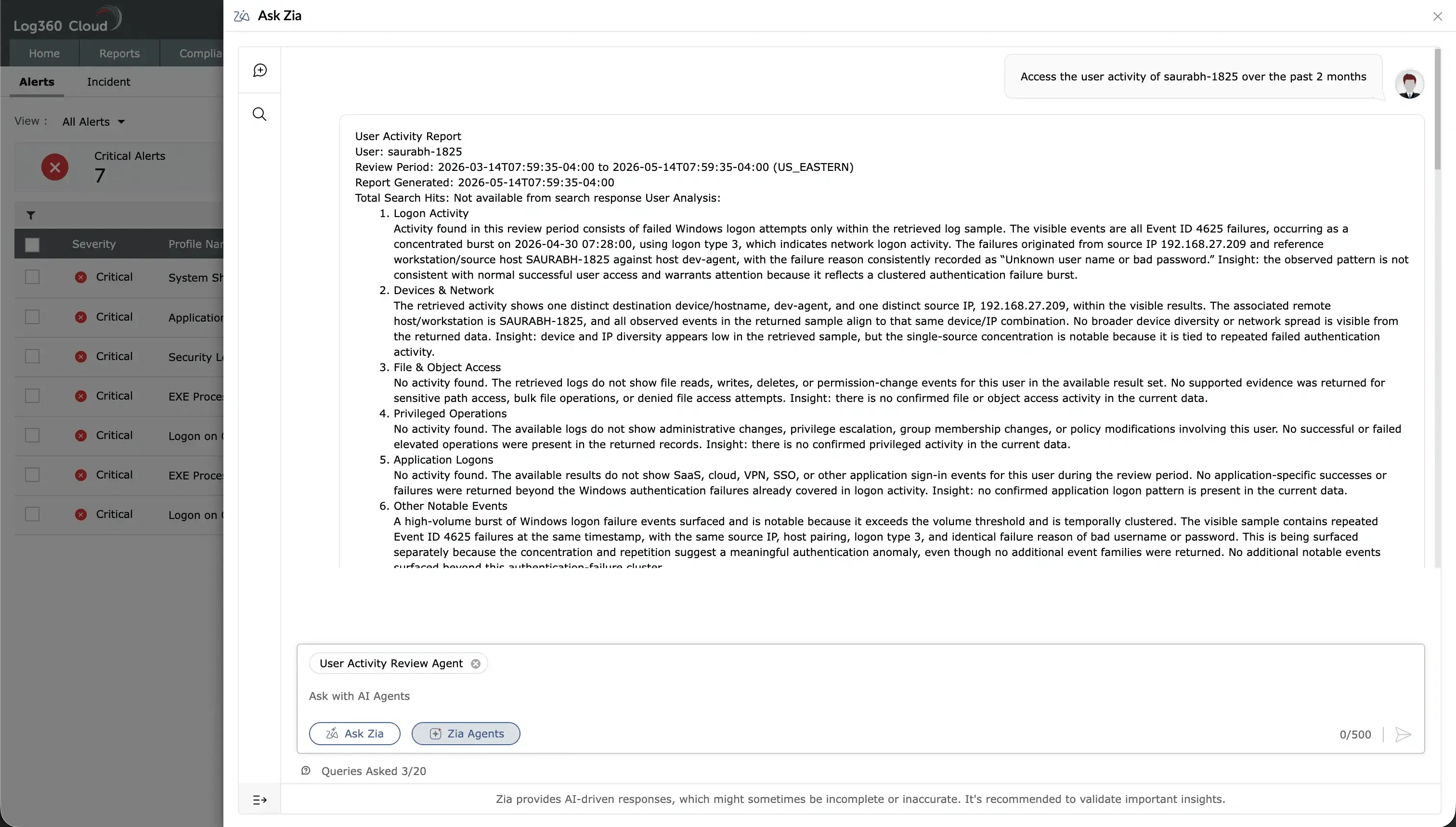
Flagging an anomaly without context creates more alert fatigue. Zia Insights automatically analyzes each detected anomaly and surfaces a structured explanation, what deviated, why it’s significant, and what to do next.
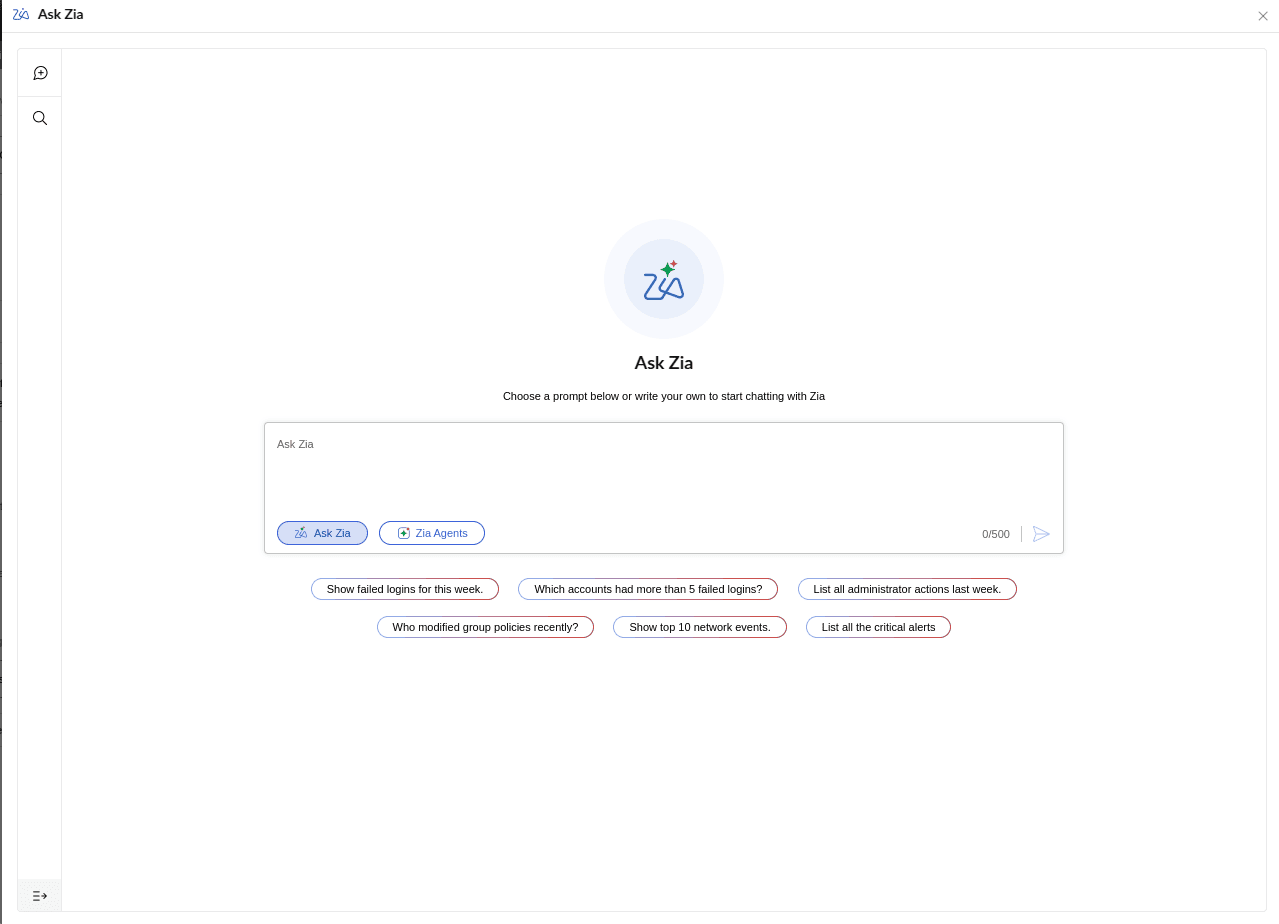
Isolated anomalies become clearer and more urgent when you see how they connect. Log360's alert correlation agent reviews anomalous alerts within a chosen time window, identifies shared entities, and sequences them into a probable attack chain.
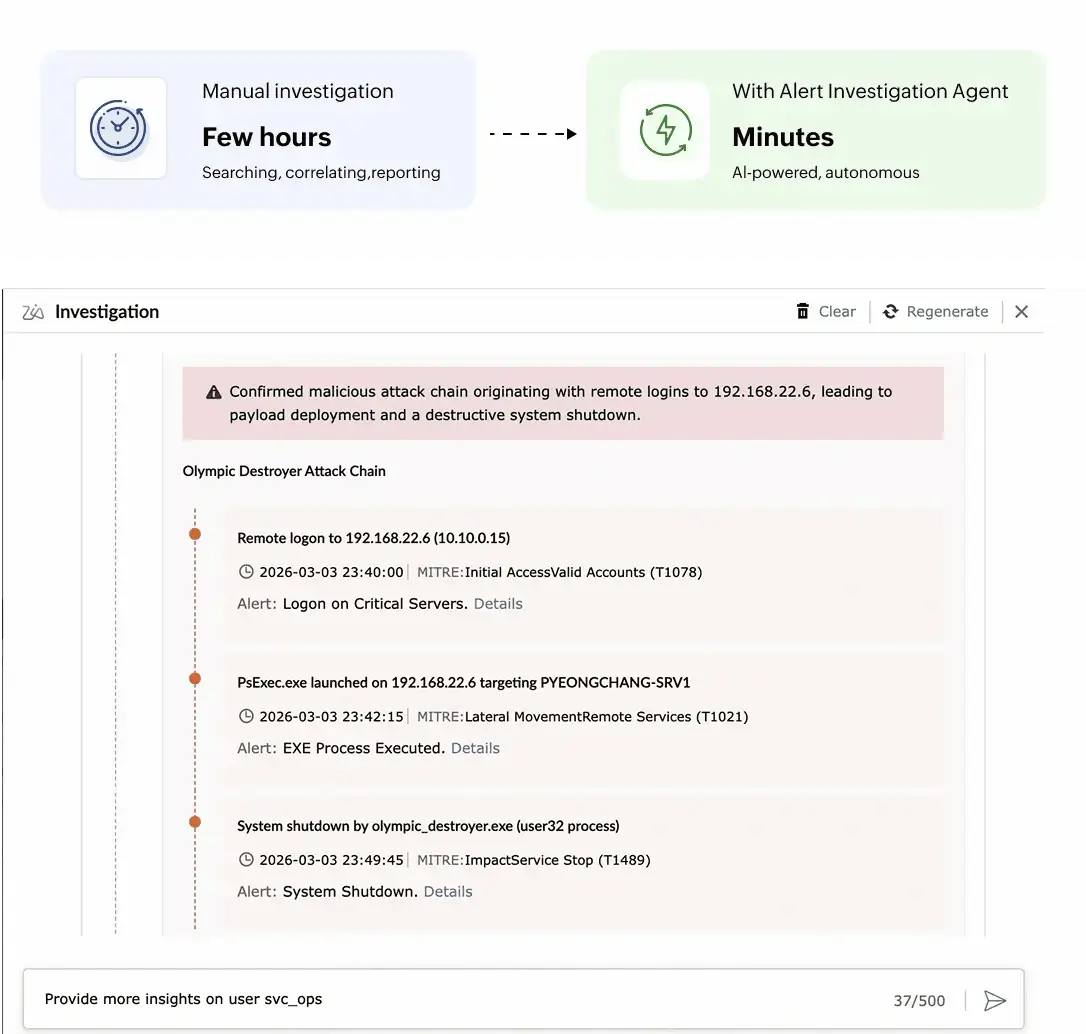
When an anomaly warrants deeper investigation, the Alert Investigation Agent takes an analyst from alert fired to a complete attack picture automatically. A process that typically spans four to six tools and more than 30 minutes compresses to one click.
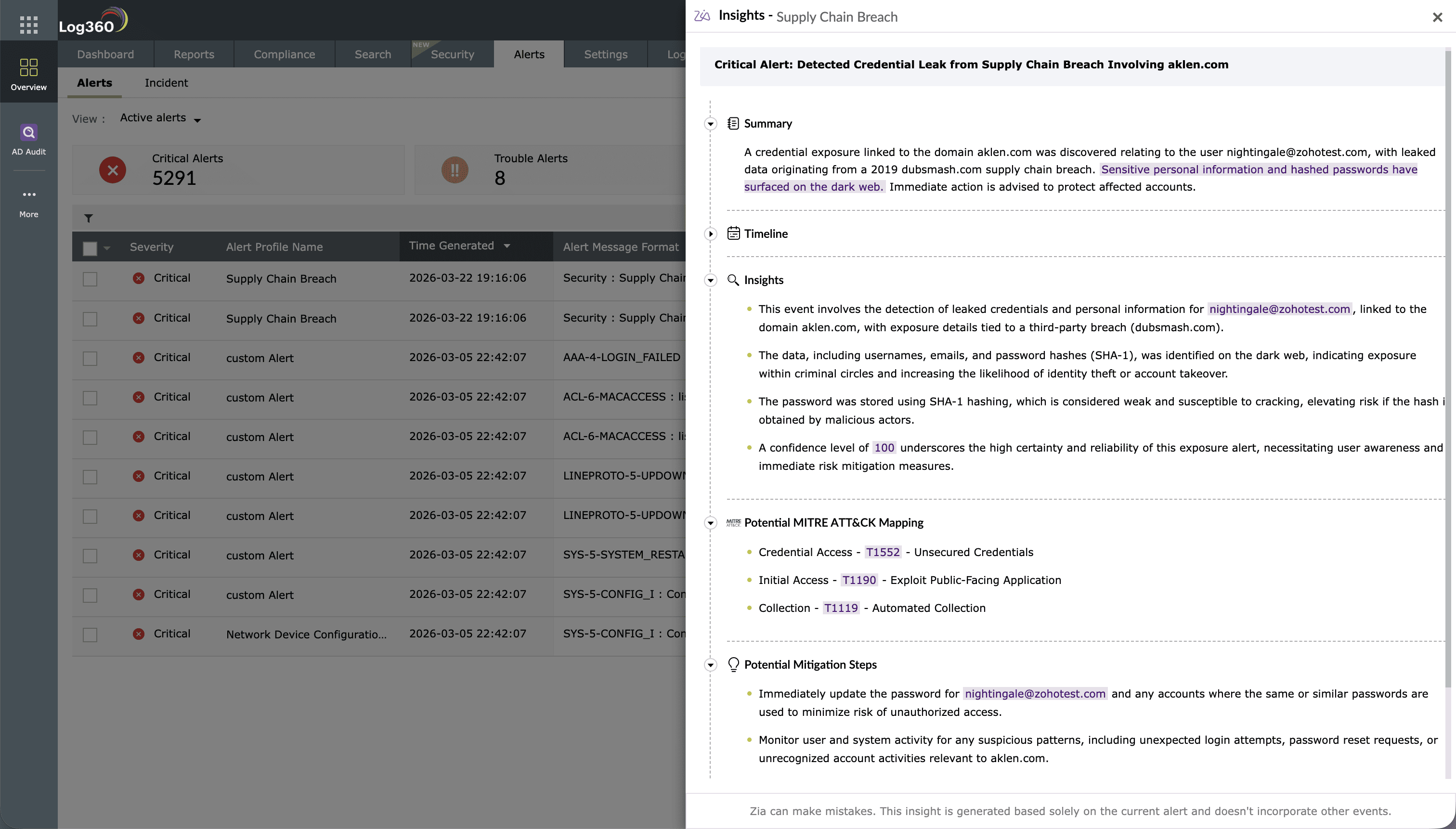
Log360's AI engine tailors its anomaly analysis to the type of deviation detected, delivering targeted,
investigation-ready context rather than generic alerts.
Unusual logons, credential abuse, privilege escalation, and policy violations trigger intelligent anomaly detection, helping security teams identify suspicious changes in user access behavior and potential account compromise.
Unusual traffic patterns, port scans, command-and-control (C2) communication indicators, and lateral movement between hosts trigger network-focused analysis.
Sudden spikes in file access, bulk downloads, or access to sensitive directories trigger data-focused analysis aligned to insider threat and exfiltration patterns.
Log360’s Zia Insights layer delivers instant context on every alert and log, summarization, entity extraction, and ATT&CK mapping in one click, without manual triage.
Learn moreLog360 provides multi-layered threat detection combining correlation rules, UEBA, and threat intelligence to detect known and unknown attacks across the full attack chain.
Learn moreAccelerate incident resolution with Log360’s SOAR capabilities, automating responses through predefined workflows triggered directly by anomaly findings.
Learn moreLog360’s UEBA engine establishes behavioral baselines for every user and entity, flagging deviations that indicate compromised accounts, insider threats, or lateral movement.
Learn moreWe wanted to make sure that one, we can check the box for different security features that our clients are looking for us to have, and two, we improve our security so that we can harden our security footprint.
Carter Ledyard
The drill-down options and visual dashboards make threat investigation much faster and easier. It’s a truly user-friendly solution.
Sundaram Business Services
Log360 helped detect insider threats, unusual login patterns, privilege escalations, and potential data exfiltration attempts in real time.
CIO, Northtown Automotive Companies
Before Log360, we were missing a centralized view of our entire infrastructure. Now, we can quickly detect potential threats and respond before they escalate.Log360 has been invaluable for improving our incident response and ensuring compliance with audit standards. It’s a game-changer for our team.
ECSO 911
Log360's AI-based anomaly detection uses UEBA and Zoho’s AI engine, Zia, to build behavioral baselines for every user and entity in your environment, then automatically flag deviations that indicate potential threats. Unlike rule-based detection, which only catches known attack patterns, Log360’s AI engine surfaces unknown threats, such as compromised credentials used at unusual times, insider activity that deviates from peer norms, or lateral movement, that looks like routine traffic. Each anomaly is enriched with ATT&CK mapping, a plain language summary, and prioritized remediation steps.
Log360 reduces noise in two ways. First, UEBA baselines are built at the individual entity level, so a deviation is evaluated against that user's or device's own normal behavior, not a generic threshold. Second, Zia Insights provides context for every flagged anomaly, letting analysts quickly validate or dismiss findings without opening multiple consoles. The Alert Correlation Agent further reduces noise by grouping related anomalies into a single attack chain rather than generating separate alerts for each event.
Log360 detects identity and access anomalies (off-hours logons, privilege abuse, and policy violations), network anomalies (unusual traffic, lateral movement, and C2 indicators), data access anomalies (bulk downloads and access to sensitive directories), and endpoint anomalies (suspicious process execution and registry modifications). Each category receives tailored analysis and remediation guidance from Zia Insights.
Log360’s AI anomaly detection features use a Bring Your Own Key model. Organizations configure their own Azure OpenAI key to enable Zia Insights and the AI agent capabilities. This ensures log data stays within the customer’s own configured environment—no data is shared with third-party AI services outside the customer’s tenant. UEBA and behavioral baselining operate on-premises or in the cloud without requiring an external API key.
Standard anomaly alerts surface a deviation with context. The Alert Investigation Agent goes further: It autonomously collects related logs and alerts for all involved entities, correlates them across sources, runs threat intelligence and UEBA scoring, and builds a full attack timeline. The output is a structured investigation trail with impacted entities, ATT&CK-mapped timeline entries, and an exportable PDF report. Analysts can redirect the investigation at any point using natural language queries within the same interface.
See how Log360 surfaces behavioral anomalies, correlates attack chains, and delivers investigation-ready context automatically.