

AI cyberattacks: How attackers weaponize artificial intelligence
Attackers are using the same AI that powers your security tools. LLMs generate phishing, machine learning accelerates reconnaissance, and AI-assisted code produces novel malware. What is actually happening, what is still hype, and how to detect AI-powered threats.
On this page
- What are AI cyberattacks?
- How attackers use AI today
- What AI does not change
- Detecting with behavioral analytics
- Building defenses
- How Log360 detects AI threats
- FAQ
What are AI cyberattacks?
AI cyberattacks are attacks where threat actors use artificial intelligence (primarily large language models and machine learning) to automate, scale, or improve some phase of the attack lifecycle. This is already happening. The CrowdStrike 2025 Global Threat Report documented LLM usage by both nation-state actors and criminal organizations for reconnaissance, social engineering, and code development. The Microsoft Digital Defense Report 2025 identified AI-assisted attack campaigns across multiple threat actor groups, noting that the barrier to entry for sophisticated attacks is dropping as AI tools become more accessible.
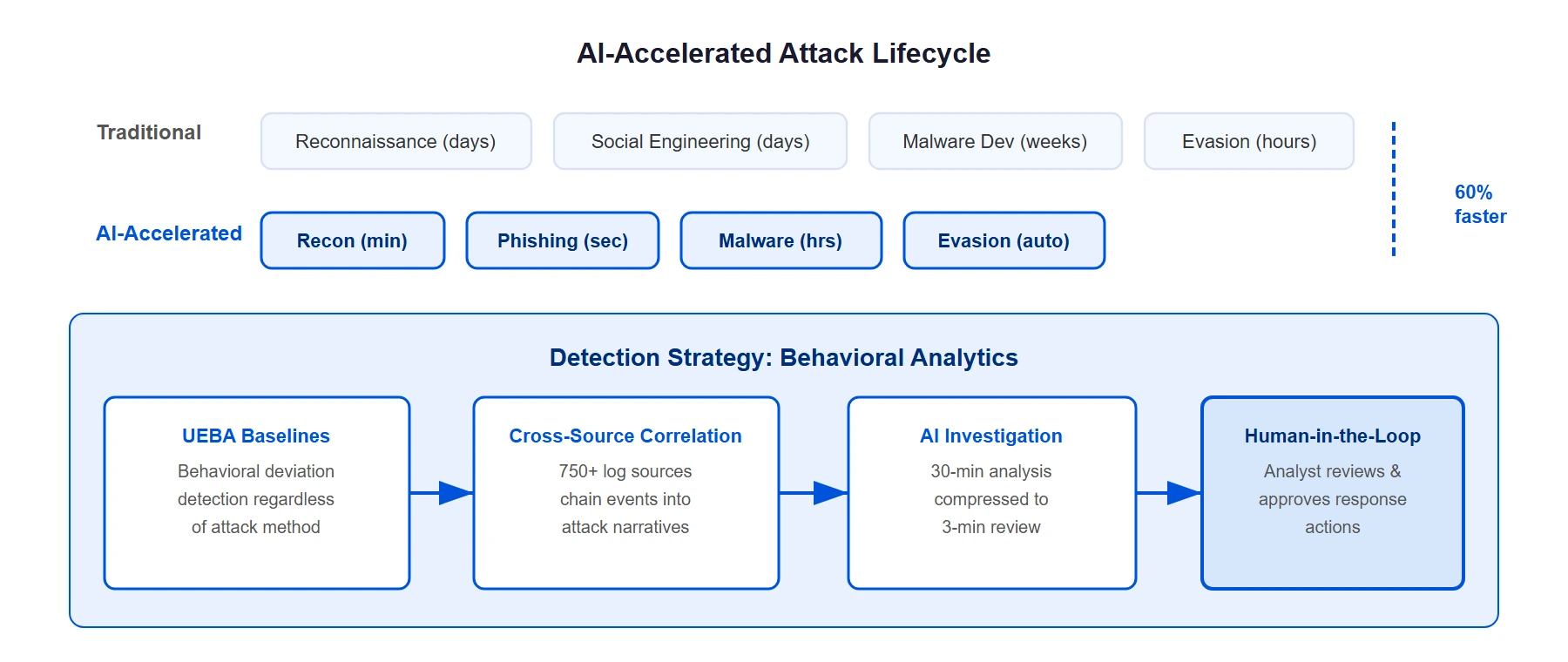
Security teams need to understand which phases of the attack lifecycle AI genuinely accelerates and where the threat is overstated. AI isn't creating entirely new attack categories; the MITRE ATT&CK framework techniques remain the same. What AI changes is the speed, scale, and cost of executing existing techniques. A spear-phishing campaign that once required hours of manual research per target now takes seconds. Malware that once required an experienced developer to customize can be generated by an attacker with basic prompting skills. Reconnaissance that required manual OSINT analysis is automated to run across thousands of targets simultaneously.
This acceleration directly affects detection strategy: if attacks execute faster, investigation and response must accelerate proportionally. A SIEM that requires 30 minutes of manual investigation per alert loses ground against attackers who compress their entire attack chain into the same timeframe. AI-powered detection and AI-guided investigation are not optional. They are how defenders keep pace with an AI-accelerated threat landscape.
Key highlights
- AI augments existing techniques: Attackers use the same MITRE ATT&CK TTPs, but faster, cheaper, and at scale
- 4 primary attack uses: Reconnaissance, social engineering, malware development, and detection evasion
- 60% faster credential theft: AI-assisted attacks compress the reconnaissance-to-access timeline (IBM X-Force 2025)
- 48-min breakout time: Median time from compromise to lateral movement, down from 62 minutes (CrowdStrike 2025)
- Behavioral detection catches AI-powered attacks; techniques change faster than signatures, but behavior patterns persist
How attackers use AI today
Detection investments should track documented attacker behavior, not vendor-driven fear. The following categories represent AI usage confirmed by threat intelligence research, not theoretical scenarios.
AI-powered reconnaissance
Attackers use LLMs and ML tools to automate the reconnaissance phase of the attack lifecycle. AI processes publicly available data (corporate websites, LinkedIn profiles, SEC filings, GitHub repositories, job postings, conference presentations) and synthesizes it into target profiles that identify likely attack vectors. A job posting for a "Palo Alto Networks firewall engineer" tells the attacker what firewall the company uses. A GitHub commit history reveals the technology stack and potentially exposes credentials or API keys. AI processes this information at a scale and speed that manual OSINT cannot match.
The Mandiant M-Trends 2025 report documented multiple cases where threat actors used AI tools to process leaked credential databases, cross-referencing stolen credentials against corporate email domains and identifying active accounts across multiple platforms in hours rather than weeks. This compressed reconnaissance directly feeds into targeted phishing campaigns and credential-based initial access.
AI-generated social engineering
This is the most widely documented use of AI in attacks. LLMs generate phishing emails, business email compromise messages, and vishing (voice phishing) scripts that are personalized per target, grammatically flawless, and contextually appropriate. The Verizon 2025 DBIR noted that social engineering remains the leading initial access vector, and AI is making it more effective by eliminating the linguistic tells that security awareness training taught users to recognize.
Beyond email, attackers use AI for deepfake voice and video in targeted social engineering. Voice cloning requires as little as 3 seconds of sample audio to produce convincing impersonations. Documented cases include attackers impersonating executives in voice calls to authorize wire transfers and impersonating IT help desk staff to trick employees into approving MFA prompts for attacker-initiated logins.
AI-assisted malware development
LLMs with code generation capabilities help attackers develop and modify malware faster. This doesn't mean AI writes complete exploit chains from scratch; current models have limitations and most commercial LLMs include guardrails against overtly malicious requests. But it does significantly accelerate several specific malware tasks:
- Polymorphic code generation: AI generates unique variants of existing malware for each target, changing function names, variable names, code structure, and execution flow while maintaining the same malicious functionality. Each variant produces a unique hash, defeating signature-based detection.
- Obfuscation and evasion: AI rewrites malicious code to bypass specific antivirus engines and EDR solutions. Attackers describe the detection they want to evade, and the model suggests code modifications. This is the AI equivalent of testing payloads against VirusTotal, but faster and more systematic.
- Exploit adaptation: When a proof-of-concept exploit is published for a known vulnerability, AI helps attackers adapt it for specific target environments, modify it to work against different versions, or combine it with other techniques to create a multi-stage payload.
- Script and tool generation: AI generates one-off tools for lateral movement, Active Directory enumeration, data collection, and exfiltration. This is custom code that has never been seen before and has no signature to match against.
AI-driven detection evasion
Attackers are beginning to use AI to specifically evade security detection. This goes beyond polymorphic malware into behavioral evasion, where the attacker uses AI to model how their activity would appear to a SIEM or UEBA system and adjusts their approach accordingly. AI can help an attacker time their activities to match normal business patterns, mimic legitimate user behavior patterns, and distribute actions across time windows to stay below anomaly detection thresholds.
The IBM X-Force 2025 Threat Intelligence Index noted early examples of this: threat actors using AI to generate network traffic patterns that mimicked legitimate CDN traffic during data exfiltration, and AI-assisted timing of Active Directory queries to match the cadence of legitimate admin activity.
< From the field: A penetration testing firm I collaborate with integrated LLM assistance into their red team workflow in mid-2025. Their internal metrics showed that AI-assisted engagements achieved initial foothold 40 percent faster than unassisted engagements, primarily due to AI accelerating the reconnaissance-to-phishing pipeline. The phishing emails were more convincing, but the post-compromise behavior was identical. That last point matters for defenders: the path from compromise to lateral movement follows the same behavioral patterns no matter how the attacker got in. UEBA catches the behavior, not the delivery mechanism.
What AI does not change about attacks
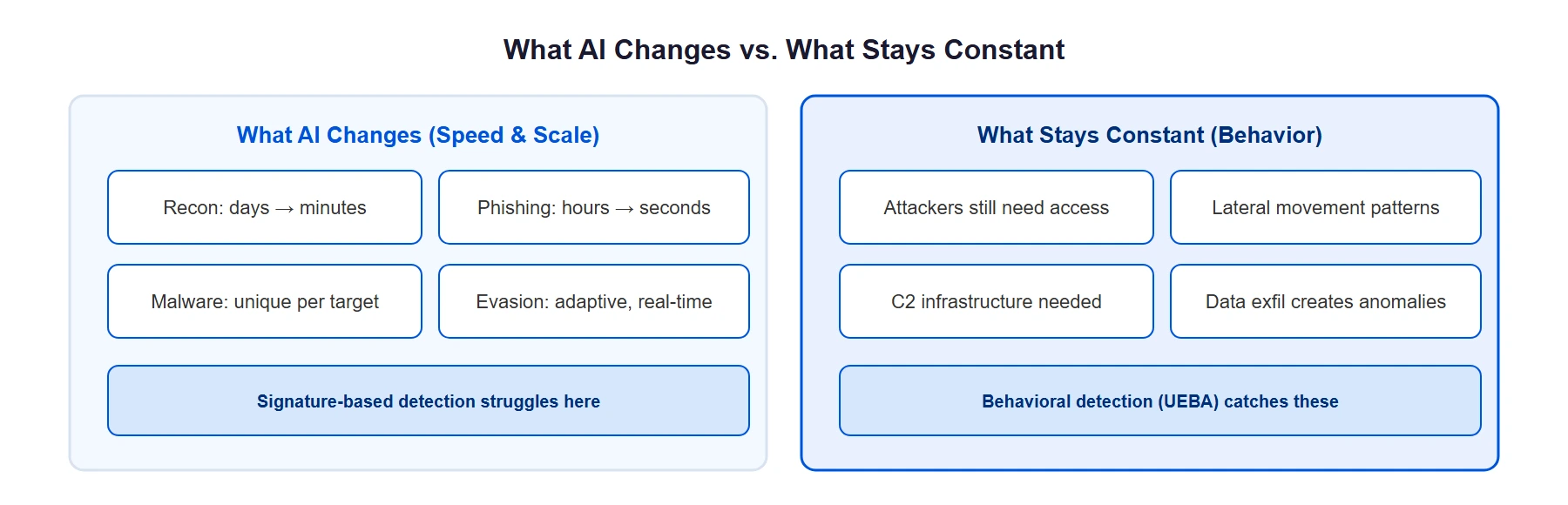
The hype around AI cyberattacks obscures a practical reality: AI accelerates attacks, but it doesn't fundamentally change their detectable footprint. Knowing what stays constant helps security teams focus investment.
Attackers still need access
AI doesn't teleport attackers into your network. They still need initial access: compromised credentials, exploited vulnerabilities, or social engineering. AI makes obtaining access faster and cheaper, but the access event itself produces the same telemetry: an authentication log, a network connection, a process execution. Correlation rules that detect anomalous initial access work whether or not AI was involved in obtaining the credentials.
Post-compromise behavior follows the same playbook
After initial access, attackers still perform the same actions: internal reconnaissance, privilege escalation, lateral movement, data staging, and exfiltration. These actions map to the same MITRE ATT&CK techniques and produce the same behavioral indicators in logs. An attacker using AI to write a custom enumeration tool still generates Active Directory query logs. AI-generated lateral movement still creates authentication events on target hosts. The tools are novel; the behavior is consistent.
Infrastructure requirements persist
AI-powered attackers still need command-and-control infrastructure, exfiltration channels, and staging environments. These produce network telemetry (DNS queries, outbound connections, data transfer patterns) that SIEM correlation and behavioral analytics can detect. AI doesn't make C2 infrastructure invisible; it just makes the C2 communication patterns harder to distinguish from legitimate traffic, which is why behavioral baselines matter more than static signatures.
| Attack phase | What AI changes | What stays the same | Detection approach |
|---|---|---|---|
| Reconnaissance | Speed and scale of target profiling | Public data sources remain the same; no new information created | Monitor for data exposure (leaked credentials, public repos) via log analysis |
| Initial access | Better phishing; faster vulnerability exploitation | Authentication events, network connections, process creation still logged | UEBA + correlation rules on auth anomalies |
| Execution | Polymorphic malware; novel code per target | Process creation, script execution, command-line activity still visible in EDR/endpoint logs | Behavioral detection on process chains; MITRE ATT&CK technique mapping |
| Lateral movement | AI-crafted tools avoid signature detection | Authentication events on target hosts; network connections between internal systems | UEBA peer group analysis; first-time access detection |
| Exfiltration | Traffic mimicry; AI-blended data transfer patterns | Data volume leaving the network; unusual destination connections; off-hours transfers | Network behavioral baselines; data volume anomaly detection |
Detecting AI-powered attacks with behavioral analytics
Signature-based detection struggles against AI-generated, polymorphic, and novel threats. Behavioral detection (analyzing patterns of activity rather than known indicators) is the primary defense against AI-accelerated attacks because behavior persists even when tools and content change.
UEBA as the foundational detection layer
User and entity behavior analytics establishes baselines for every user and device: what they normally access, when they log in, which applications they use, how much data they transfer. When a compromised account deviates from these baselines (logging in from a new location, accessing systems they have never touched, transferring unusual data volumes), UEBA surfaces the anomaly no matter how the compromise happened. AI-generated phishing, exploited zero-days, and insider threats all produce behavioral deviations that UEBA catches.
Correlation across data sources
Individual signals from AI-powered attacks may be subtle enough to avoid triggering single-source alerts. A login from an unusual location alone might be a business trip. An Active Directory query alone might be routine administration. But "unusual location login" + "AD enumeration within 30 minutes" + "access to finance file share for the first time" + "large file download" creates a correlated chain with high confidence for compromise, regardless of whether the initial access was AI-assisted phishing or a brute-forced password.
Log360 correlates signals across 750+ log sources (endpoints, network devices, Active Directory, cloud platforms, email systems, and applications). The correlation engine chains individual events into attack narratives that surface in the Incident Workbench, where AI-guided investigation via Zia Insights maps the chain to MITRE ATT&CK techniques and recommends response.
AI-guided investigation to match attacker speed
When AI compresses the attack timeline from days to hours, investigation that takes 30 minutes per alert creates an operational gap the attacker exploits. Log360's Zia Insights performs entity-deep investigation on triggered alerts, analyzing all associated users, hosts, IP addresses, and processes across the full log corpus in seconds. The AI produces a structured investigation narrative with MITRE ATT&CK mapping, timeline reconstruction, and response recommendations. The analyst reviews and approves - compressing a 30-minute investigation into a 3-minute review.
The defensive asymmetry: Attackers use AI to move faster. Defenders use AI to detect and investigate faster. The difference comes down to trust architecture. Attacker AI operates autonomously because the attacker accepts all risk. Defensive AI in Log360 operates with human-in-the-loop oversight because incorrect automated response carries its own operational risk. This is not a limitation - it is a deliberate design choice that keeps the speed advantage of AI investigation without the blast radius of autonomous response.
Building defenses for the AI threat era
Preparing for AI-powered attacks does not mean discarding your existing security stack. It means strengthening behavioral detection, accelerating investigation, and ensuring log coverage is comprehensive enough to support AI-powered analysis.
- Maximize log source coverage: AI investigation quality (whether by your tools or the attacker's) is proportional to available data. Collect logs from endpoints, network devices, identity systems, cloud platforms, email, and applications. Gaps in log coverage are gaps in detection capability that AI-powered attackers will exploit and your AI investigation tools cannot compensate for.
- Deploy behavioral analytics as the primary detection layer: UEBA detects the consequences of attacks regardless of the attack technique. Polymorphic malware, AI-generated phishing, and novel tools all produce behavioral deviations from user and entity baselines. Make behavioral detection your first line, with signature-based detection as a supplementary layer.
- Build correlation rules for compressed timelines: AI-powered attacks execute faster. Adjust your correlation rule time windows accordingly. If your current rules look for "reconnaissance + lateral movement within 24 hours," consider adding rules for "reconnaissance + lateral movement within 2 hours" to match the compressed timelines that AI-assisted attacks produce.
- Deploy AI-guided investigation: Match attacker speed with investigation speed. AI-guided investigation tools compress analysis time from 30 minutes to under 5 minutes per alert. When the attacker's breakout time is 48 minutes, every minute of investigation speed matters.
- Test against AI-generated threats: Run AI-powered phishing simulations, use AI-generated payloads in red team exercises, and test whether your detection rules catch AI-polymorphic malware variants. Identify gaps before attackers find them.
- Monitor your own AI systems: If you deploy AI security tools, those tools themselves become attack surfaces. Prompt injection, training data manipulation, and adversarial evasion targeting your defensive AI are emerging threat vectors. Log AI interactions, monitor AI outputs for anomalies, and maintain human oversight of AI-driven decisions.
How Log360 detects AI-powered threats
ManageEngine Log360 combines multiple detection layers that work together against AI-accelerated attacks: behavioral analytics that catch novel techniques, correlation that reconstructs attack chains, and AI-guided investigation that matches attacker speed.
<ML-based UEBA for behavioral detection
Log360's UEBA engine builds behavioral baselines for every user and entity across your environment. Machine learning models detect deviations from these baselines (anomalous logins, unusual application access, data transfer spikes, privilege escalation patterns) that indicate compromise. Because UEBA detects behavior rather than signatures, it catches AI-generated and polymorphic attacks that bypass traditional detection.
<Real-time correlation across 750+ log sources
The correlation engine chains events across endpoints, network, identity, cloud, and application logs into attack narratives. Individual signals that fall below single-source alert thresholds combine into high-confidence detections. Pre-built correlation rules map to MITRE ATT&CK techniques, and custom rules let you target specific attack patterns relevant to your environment.
<AI-guided investigation via Zia Insights
When alerts fire, Zia Insights performs entity-deep investigation: analyzing all associated entities across the full log corpus, mapping to MITRE ATT&CK, building the attack timeline, and recommending containment actions through the Incident Workbench. The analyst reviews and decides. Investigation that took 30 minutes manually happens in seconds, matching the compressed timelines of AI-powered attacks.
<SOAR for codified response
Log360's SOAR module codifies response playbooks that standardize containment actions for common attack patterns. When AI-guided investigation identifies a compromised account, the SOAR workflow presents pre-approved containment steps (account lockout, session termination, host isolation) for the analyst to approve with a single click. The response is fast without being autonomous.
Defend at the speed of AI-powered attacks
Log360 combines ML-based behavioral detection, real-time correlation, and AI-guided investigation to detect and respond to AI-accelerated threats.
Frequently asked questions
1. What are AI cyberattacks?
AI cyberattacks are attacks that use artificial intelligence (primarily large language models and machine learning) to automate, scale, or improve some phase of the attack lifecycle. This includes AI-generated phishing content, automated vulnerability discovery, polymorphic malware that mutates to evade signatures, and AI-assisted reconnaissance. The CrowdStrike 2025 Global Threat Report documented increasing use of generative AI by both nation-state and criminal threat actors.
2. Are attackers actually using AI in cyberattacks today?
Yes, but the usage is concentrated in specific phases. AI is most widely used for social engineering content generation, automated reconnaissance, and code assistance for malware development. Fully autonomous AI-driven attack chains remain rare; most AI usage augments human attackers rather than replacing them. AI-powered detection in tools like Log360 helps defenders keep pace.
3. How does AI make cyberattacks more dangerous?
AI changes three variables: speed (attacks execute faster), scale (personalized attacks that were once expensive are now cheap), and sophistication (AI-generated content bypasses human-targeted filters). The IBM X-Force 2025 report found that AI-assisted attacks reduced the time from initial reconnaissance to credential theft by approximately 60 percent. Behavioral detection becomes essential because signature-based approaches struggle against AI-generated, polymorphic threats.
4. Can AI-powered detection keep up with AI-powered attacks?
AI-powered detection has structural advantages: it can analyze behavioral patterns across millions of events simultaneously, establish baselines that detect novel techniques, and correlate signals across data sources beyond what any human analyst could process manually. Log360 combines ML-based UEBA, real-time correlation, and AI-guided investigation to detect attacker behavior whether or not AI was used to generate the attack.
5. How should organizations prepare for AI-powered threats?
Three priorities: first, shift detection from signatures to behavioral analytics (UEBA catches AI-generated attacks that bypass static rules). Second, improve log coverage. AI investigation quality depends on having comprehensive data across endpoints, network, identity, and cloud. Third, deploy AI-guided investigation tools that compress analyst response time to match the increased speed of AI-powered attacks.