
- What is the purpose of compliance audits?
- Internal audit vs. compliance audit: What's the difference?
- What are the types of compliance audits and regulations?
- 6 steps of the compliance audit process
- Industry-wise compliance audits
- Region-wise compliance mandates
- Tips for a successful compliance audit
- Use Log360 to ease your compliance audit process
A compliance audit is a systematic review process that assesses an organization’s adherence to regulatory requirements, internal policies, and industry standards.
Regulatory bodies across the world establish requirements and standards to ensure secured and legal business operations. Organizations conduct compliance audits through independent auditors or third-party professionals to ensure their adherence to various regulations, such as environmental laws, financial reporting standards, and IT security protocols. For instance, an IT compliance audit focuses specifically on evaluating an organization's IT systems against standards like ISO 27001 or data protection regulations.
What is the purpose of compliance audits?
Compliance audits serve several critical functions, including:
- Risk management: By conducting compliance audits, organizations can identify security vulnerabilities and mitigate risks that cause legal fines, operational disruptions, or reputational damage.
- Regulatory adherence: Compliance audits verify that the organization's operations conform to local, national, and international regulations, which is essential for avoiding legal repercussions.
- Improved business practices: Through compliance audits, companies can identify inefficiencies, outdated procedures, or areas where processes do not meet regulatory standards, driving continuous improvement.
- Stakeholder confidence: Regular compliance audits enhance transparency and accountability, building trust among customers, partners, regulators, and investors.
- Identifying areas of non-compliance: A crucial aspect of conducting compliance audits is identifying policies, processes, controls, and documentation that don't adhere to regulatory requirements. Once these areas are identified, corrective actions must be implemented to address gaps. This approach helps the organization avoid potential damages, such as legal penalties or operational setbacks, and fosters a culture of continuous compliance and improvement.
Internal audit vs. compliance audit: What's the difference?
While internal audits help identify areas where compliance might be at risk, compliance audits ensure that an organization meets its legal and regulatory obligations.
| Internal audit | Compliance audit | |
|---|---|---|
| Purpose | Assesses internal controls, risk management, and governance processes. | Specifically examines whether the organization complies with external laws, regulations, and standards such as the PCI DSS, HIPAA, the GDPR, and more. |
| Scope | Focuses on enhancing operational efficiency and ensuring that internal policies are followed. | Often required by regulatory authorities, industry standards, or contractual obligations. |
| Auditor | Conducted by internal staff and usually not mandated by external bodies. | Conducted by internal or external auditors who assess adherence to compliance requirements, such as IT compliance audit standards or environmental regulations. |
What are the types of compliance audits and regulations?
Organizations are liable to comply with various standards across different business functions. Here are some of the most common compliance audits:
- IT compliance audit: This type of audit evaluates an organization's information technulogy environment, including data security, privacy controls, and software usage against IT compliance standards such as ISO 27001, the GDPR, HIPAA, and the PCI DSS. IT compliance audits help ensure that sensitive data is protected and that IT practices align with regulatory requirements.
- Financial compliance audit: This type of audit focuses on verifying that financial statements and processes comply with accounting and reporting standards, such as the Sarbanes-Oxley Act (SOX) or International Financial Reporting Standards (IFRS). These audits help prevent fraud, ensure accurate financial reporting, and maintain investor confidence.
- Health and safety compliance audit: This audit type ensures that workplaces adhere to health and safety regulations, such as the Occupational Safety and Health Administration (OSHA) standards. These audits are critical for protecting employee safety and reducing the risk of workplace accidents.
- Operational compliance audit: This type of audit evaluates the day-to-day operations against internal policies and external regulations, focusing on areas such as procurement, production, and supply chain management.
6 steps of the compliance audit process
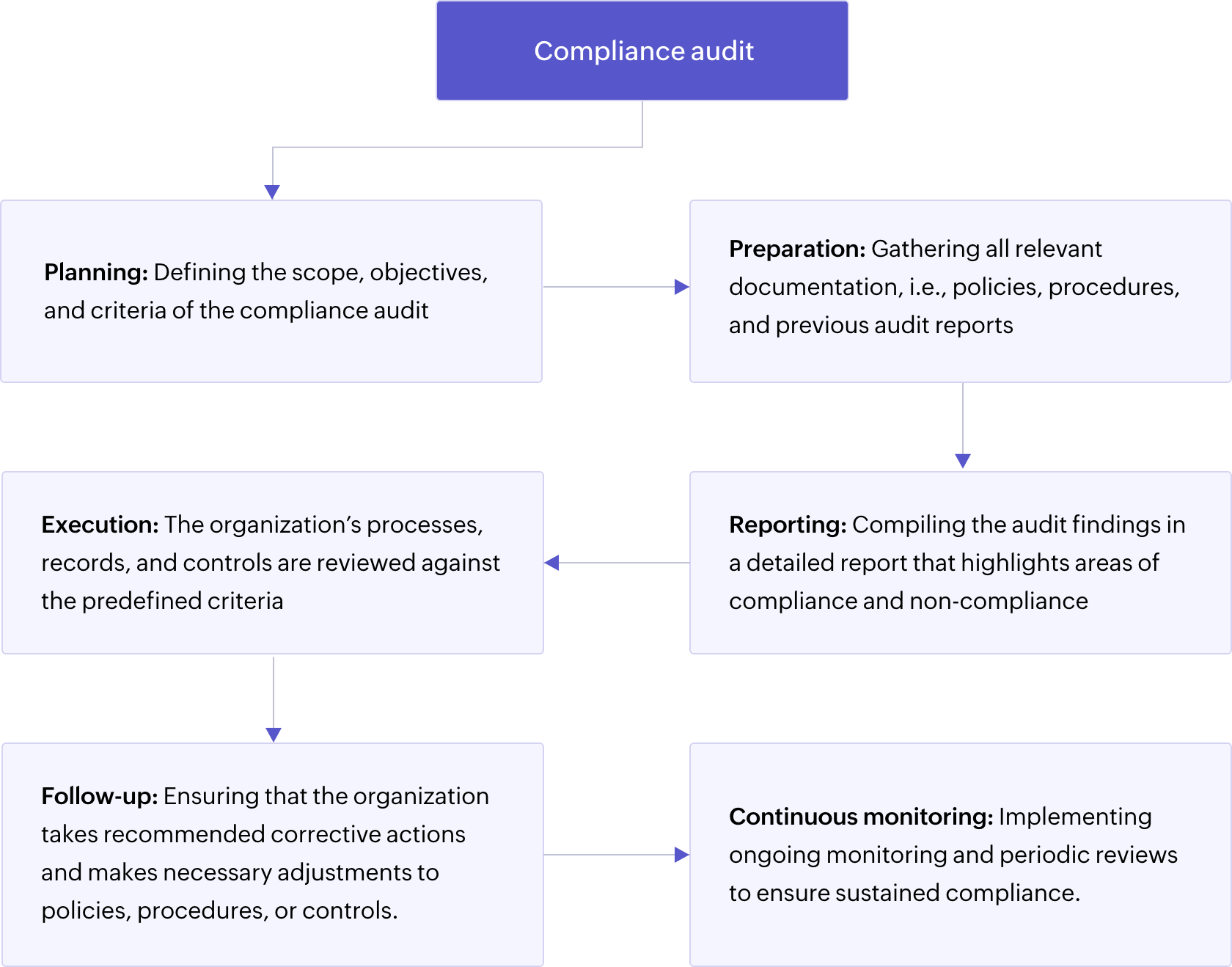
Conducting a compliance audit involves a structured approach that ensures comprehensive evaluation and actionable insights. Here are the six key steps in the compliance audit process:
-
Planning:
Define the scope, objectives, and criteria of the compliance audit. This step involves identifying which laws, regulations, and standards are applicable and determining the audit's goals, such as an IT compliance audit focusing on data security. Example: A healthcare organization planning a compliance audit for HIPAA standards will outline the audit scope to include patient data security, privacy practices, and training staff to handle data with HIPAA requirements. -
Preparation:
Gather all relevant documentation, including policies, procedures, and previous audit reports. Prepare audit checklists and set up interviews with key personnel involved in compliance-related activities. Example: The preparation phase in a financial institution may involve collecting documents like anti-money laundering (AML) policies, transaction records, and staff training logs, and scheduling interviews with compliance officers to understand their roles. -
Execution:
Depending on the type of compliance audit, either the internal team, external auditor, or third-party professionals conduct the actual audit. At this stage, the organization’s processes, records, and controls are reviewed against the predefined criteria or the regulatory compliance's requirements. This involves testing compliance controls, inspecting documentation, and evaluating operational practices.Example: During an ISO 27001 compliance audit in an IT company, auditors will examine the company's information security management system, test data protection controls, and review security incident logs to ensure compliance with the standard. -
Reporting:
Compile the audit findings in a detailed report that highlights areas of compliance and non-compliance. The report should include recommendations for corrective actions to address any deficiencies discovered during the audit. Example: An IT compliance audit for a financial services company may identify issues such as inadequate data encryption practices and outdated access controls. The report would recommend corrective actions such as implementing stronger encryption protocols, updating access control policies, and conducting regular employee training on data security and compliance with regulations like the GDPR and the PCI DSS. -
Follow-up:
Ensure that the organization takes the recommended corrective actions and makes necessary adjustments to policies, procedures, or controls. Follow-up reviews are conducted to confirm the effectiveness of these actions. Example: After a compliance audit in a retail business highlights non-compliance with PCI DSS standards, a follow-up review ensures that corrective measures, like improved encryption for payment data, have been successfully implemented. -
Continuous monitoring:
Implement ongoing monitoring and periodic reviews to ensure sustained compliance. Continuous monitoring helps organizations stay ahead of regulatory changes and maintain a proactive compliance posture. Example: A bank implements continuous monitoring of transactions and regular compliance checks to maintain adherence to AML regulations, adjusting practices in response to evolving regulatory updates.
Check out the compliance audit checklist from ManageEngine.
Industry-wise compliance audits
Below are some key industries where compliance audits play a pivotal role:
Healthcare
In the healthcare industry, compliance audits are essential for ensuring patient data security and privacy, adhering to regulations such as HIPAA. These audits verify that healthcare providers comply with data protection laws, safeguarding sensitive patient information.
Education
Educational institutions are subject to compliance audits to ensure adherence to privacy regulations like FERPA and the GLBA, which mandates financial institutions, including universities offering loans, to protect consumer data. These audits help protect student data and maintain compliance with federal funding requirements.
IT industry
In the IT sector, compliance audits focus on data security, software licensing, and adherence to international standards like ISO 27001. IT compliance audits are vital for protecting digital assets, maintaining customer trust, and meeting legal obligations related to data privacy.
Finance and banking
For the finance and banking sector, compliance audits are critical in maintaining transparency, preventing financial fraud, and ensuring accurate reporting. IT compliance audits specifically focus on assessing data security controls, transaction monitoring, and cybersecurity measures. Financial institutions also conduct audits to ensure compliance with the PCI DSS, which sets the benchmark for protecting cardholder data and reducing payment fraud. These audits help institutions comply with laws such as the Dodd-Frank Act, Basel III, and AML regulations, thereby protecting financial stability.
Government
Government agencies conduct compliance audits to ensure procurement processes, financial management, and operational practices comply with statutory and regulatory requirements while maintaining accountability and transparency. Specific frameworks like FISMA and the FBI's security standards are critical to maintaining cybersecurity and protecting sensitive government data.
Region-wise compliance mandates
EU
Compliance mandates vary significantly across regions, reflecting local laws, industry requirements, and international standards. Here’s a breakdown of key compliance mandates across different regions, including the European Union, the United States, Asia-Pacific (APAC), and Europe, Middle East, and Africa (EMEA):
General Data Protection Regulation (GDPR)
The GDPR is a comprehensive data protection law that governs how companies collect, store, and manage personal data. It applies to any organization handling the data of EU residents, regardless of where the organization is located. GDPR audits focus on data privacy, user consent, and stringent security controls to prevent data breaches.
US
Health Insurance Portability and Accountability Act (HIPAA)
HIPAA mandates compliance for healthcare providers, health plans, and other entities handling patient data, focusing on the protection of medical information. Compliance audits evaluate how organizations manage patient data privacy, security, and breach notification protocols.
Gramm-Leach-Bliley Act (GLBA)
The GLBA requires financial institutions, including banks, insurance companies, and investment firms, to protect consumer data. Compliance audits ensure these entities maintain robust data protection policies and share information responsibly.
California Consumer Privacy Act (CCPA)
The CCPA focuses on protecting the privacy rights of California residents, similar to the GDPR but specifically targeting consumer data rights within California. Audits examine data handling practices, privacy notices, and opt-out processes.
Sarbanes-Oxley Act (SOX)
SOX sets regulations for financial reporting and corporate governance for public companies, focusing on the accuracy of financial disclosures. SOX audits assess internal controls over financial reporting and safeguard against fraud.
Federal Information Security Management Act (FISMA)
FISMA mandates federal agencies and contractors to secure sensitive government data through stringent cybersecurity measures. Audits evaluate compliance with information security frameworks to protect government systems against cyberthreats.
APAC
Personal Data Protection Act (PDPA) – Singapore
The PDPA governs data protection laws in Singapore, focusing on personal data security and privacy. Compliance audits help organizations meet consent requirements, ensure data integrity, and secure personal information.
Cybersecurity Law of the People's Republic of China
This law governs data localization, personal information protection, and cybersecurity measures in China. Compliance audits assess how organizations manage data within China, maintain network security, and comply with stringent data protection requirements.
Digital Personal Data Protection Act (DPDP) – India
The DPDP Act of India is a recent legislation designed to protect the personal data of individuals and enforce data privacy principles across organizations operating in India. The Act mandates organizations to ensure data security, obtain explicit consent before processing personal data, and report data breaches promptly. Compliance audits under the DPDP evaluate how organizations adhere to these requirements, focusing on data collection practices, security measures, and the management of sensitive personal information.
EMEA
General Data Protection Regulation (GDPR) – Europe
Similar to mandates in the EU, the GDPR also impacts EMEA companies that handle European citizens' data, making compliance audits essential for cross-border data protection and privacy.
National Electronic Security Authority (NESA) and Saudi Arabian Monetary Authority (SAMA) – Middle East
In regions like the UAE and Saudi Arabia, frameworks such as NESA and SAMA guide cybersecurity standards. Compliance audits ensure organizations align with these regional cybersecurity mandates to protect critical infrastructure.
AML directives
EMEA countries enforce strict AML regulations to combat financial crime. Compliance audits assess financial institutions’ controls on identifying, reporting, and preventing money laundering activities.
Protection of Personal Information Act (POPIA) – South Africa
POPIA governs data protection laws in South Africa, aligning closely with GDPR principles. Compliance audits help organizations safeguard personal information and ensure responsible data management.
Tips for a successful compliance audit
- Prepare thoroughly: Collect all necessary documents, policies, and records well before the compliance audit begins. Engaging relevant stakeholders early can streamline the process.
- Stay updated on regulations: Compliance requirements are constantly evolving. Regularly reviewing updates in laws, standards, and industry best practices is essential for staying compliant.
- Leverage technology:Utilize tools specifically designed for easing compliance audits such as governance, risk, and compliance (GRC) platforms, security information and event management (SIEM) systems. While GRC tools help manage risks, track compliance requirements, and streamline policy management across the organization, SIEM solutions monitor and log security events, providing real-time insights into potential compliance issues, particularly with respect to cybersecurity. Implementing these audit tools automate data collection, monitor compliance status, identify and address compliance gaps, and generate detailed reports, significantly reducing manual efforts and errors.
- Communicate effectively: Clear communication with staff about the compliance audit process and its objectives helps minimize resistance and encourages cooperation.
- Implement corrective actions promptly: Address any non-compliance issues identified during the audit swiftly to avoid repeated errors and ensure that compliance standards are met.
Use Log360 to ease your compliance audit process
ManageEngine Log360, a unified SIEM and IT compliance management solution, is designed to streamline the compliance audit process, particularly for IT environments. Log360’s integrated compliance management capability helps minimize security risks and ease the compliance audit process for enterprises. The solution comes with more than 150 out-of-the-box audit reports for regulatory mandates such as the GDPR, the CCPA, HIPAA, the PCI DSS, and more.
Here’s how Log360 can help ease your compliance audit process:
Unified compliance monitoring
Log360 provides a centralized platform that consolidates data from various sources, including logs from servers, applications, network devices, and endpoints. This unified approach makes it easy to monitor the compliance status across your IT environment, ensuring that all components meet relevant regulatory standards.
Automated compliance reporting
Compliance audits often require extensive reporting to demonstrate adherence to specific standards. Log360 simplifies this by offering prebuilt compliance report templates that cater to major regulatory mandates. These reports highlight areas of compliance and non-compliance, providing clear insights into your organization's compliance status.
Log management
Maintaining secure and accurate audit logs is a key requirement for many compliance standards. Log360 facilitates comprehensive log management, including collection, archiving, and analysis of logs, ensuring that you can easily track user activities, changes, and access patterns across your network. This audit trail is crucial during compliance audits, providing evidence of regulatory adherence.
Compliance dashboard
The interactive compliance dashboard in Log360 offers a visual representation of your compliance status, highlighting critical metrics such as policy changes, firewall auditing, logon trends, and more. The dashboard simplifies complex data, making it easy to track your progress, identify areas needing improvement, and prepare for audits.
Forensic analysis and investigation
Log360’s advanced forensic capabilities allow you to conduct in-depth investigations into compliance breaches. The software provides detailed insights into who did what and when, helping you identify the root cause of any non-compliance issues and take prompt corrective actions.