
Advanced incident management in Log360

Detect, analyze, and respond to incidents with rule-based detections, contextual analysis, and SOAR response playbooks—all under a single pane of glass.

Here's how Log360 helps manage the entire incident life cycle from initial triage to final remediation

Log360 provides advanced incident management capabilities that elevate your organization's defense against cyberattacks. By combining prebuilt detection logic, ML-based alerting, and natively integrated playbooks, Log360 helps detect and neutralize threats within minutes, significantly enhancing the incident management life cycle.

  • High-fidelity detection
  • Automated triage
  • Multi-tool orchestration
  • Playbook automation
  • Forensic investigation

High-fidelity detections and alerts that reduce incident noise

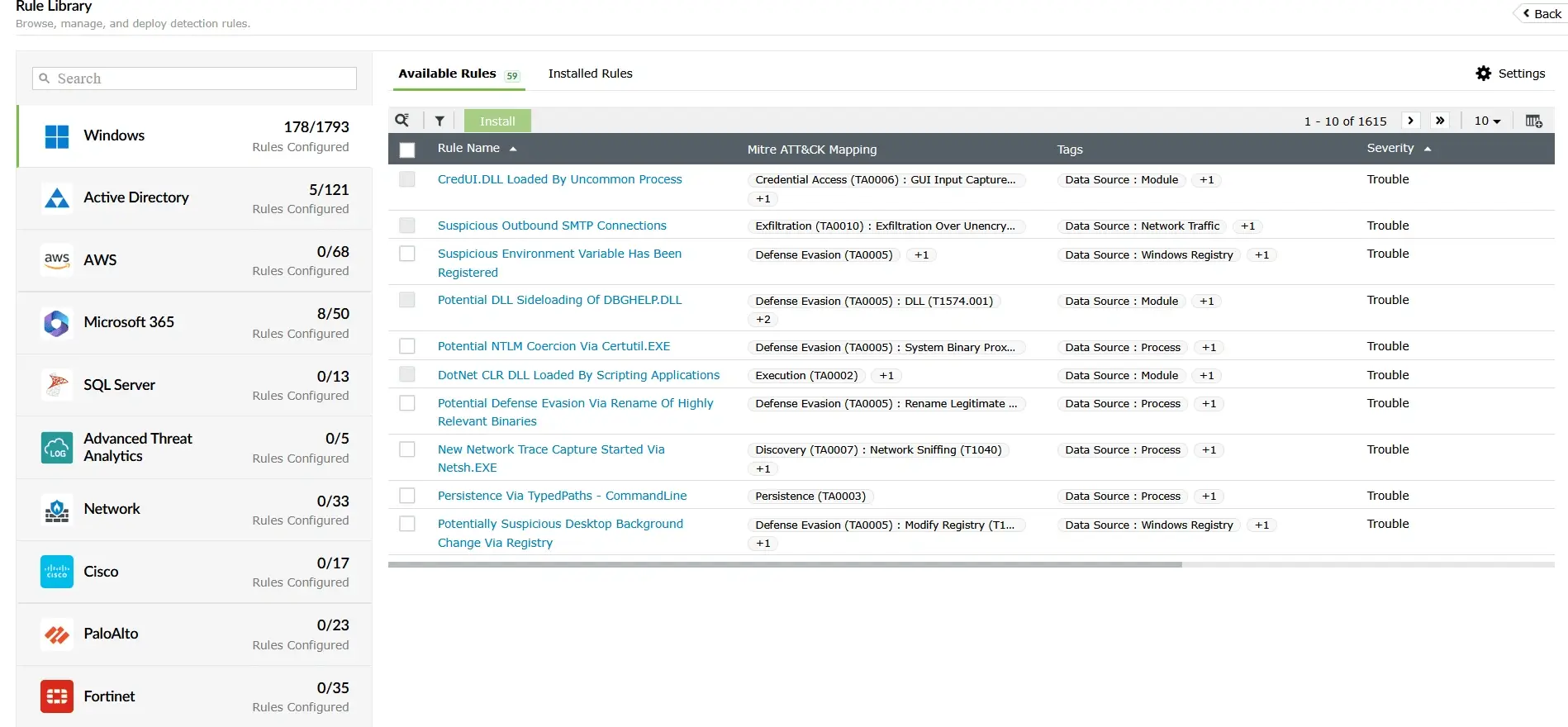
Log360 offers out-of-the-box detection rules and alert profiles that flag known signature-based incidents with surgical precision. The predefined alert profiles are tuned with smart threshold capabilities to flag potential suspicious activities. This helps reduce alert noise and the escalation of low-priority incidents that overwhelm the SOC.

  • High-precision incident detection: Log360 offers 2000+ preconfigured, MITRE ATT&CK®-mapped rules that correlate multiple events across the network to identify potential IoCs and IoAs. Since these detections are based on high-precision logic, it eliminates the escalation of low-priority events as incidents.
  • High-fidelity incident alerting: The solution also offers predefined alert profiles that correlate disparate detections into prioritized notifications. This combined with UEBA-driven dynamic baselines act as a high-fidelity filter to validate critical security alerts before they reach the incident management console.

Benefit: Log360 transforms overwhelming alert noise into streamlined, actionable incidents. This unified approach diligently handles high-priority incidents while slashing incident noise that burdens SOC teams.

High-fidelity detections and alerts that reduce incident noise

Automated triage and data enrichment that combats alert fatigue

Log360's SOAR capabilities automate incident triage to distinguish high-volume, low-severity alerts and false positives from high-fidelity incidents. Furthermore, it leverages contextual data driven by advanced threat intelligence to significantly enrich incident evidence for fast-tracked triage and investigation. This combination of automated data enrichment and context-aware investigation effectively neutralizes alert fatigue in SOC teams.

  • ML-based triaging: By leveraging ML-based behavior analysis, Log360 assigns risk scores to users and entities based on the severity of their activities. The UEBA risk scores provide the behavioral context needed to instantly distinguish between a routine event and a high-risk incident, eliminating false positives.
  • Contextual data enrichment: Log360 enriches detection and alerts by matching system telemetry against real-time threat intelligence feeds. This adds crucial context to investigations with known malicious IPs, domains, or URLs to enhance triage accuracy and discard benign alerts with confidence.

Benefit: Log360 drastically reduces noise-to-signal ratios by automating the initial stages of the investigative life cycle. By offloading data enrichment and triage to ML-driven engines, SOC teams are spared the cognitive load of manual verification. This transition allows analysts to bypass low-priority distractions and focus on high-fidelity threats, significantly reducing alert fatigue and preventing burnout within the SOC.

Automated triage and data enrichment that combats alert fatigue

Multi-tool orchestration that eliminates tool sprawl

Log360 bridges the gap between disparate systems such as identity, cloud, firewalls email gateways, and network layers with cross-layer correlation and incident management. By orchestrating SIEM, EDR, and SOAR capabilities within a single platform, Log360 harmonizes security workflows and eliminates the need for analysts to pivot between multiple disconnected consoles.

  • Cross-layer detection and response: Log360’s native integration with leading EDR platforms, such as CrowdStrike Falcon, Microsoft Defender, and Bitdefender, enables seamless cross-platform incident management. This integration closes the gap between detection and remediation by allowing analysts to trigger immediate, automated responses directly from the SIEM console without switching between multiple tools.
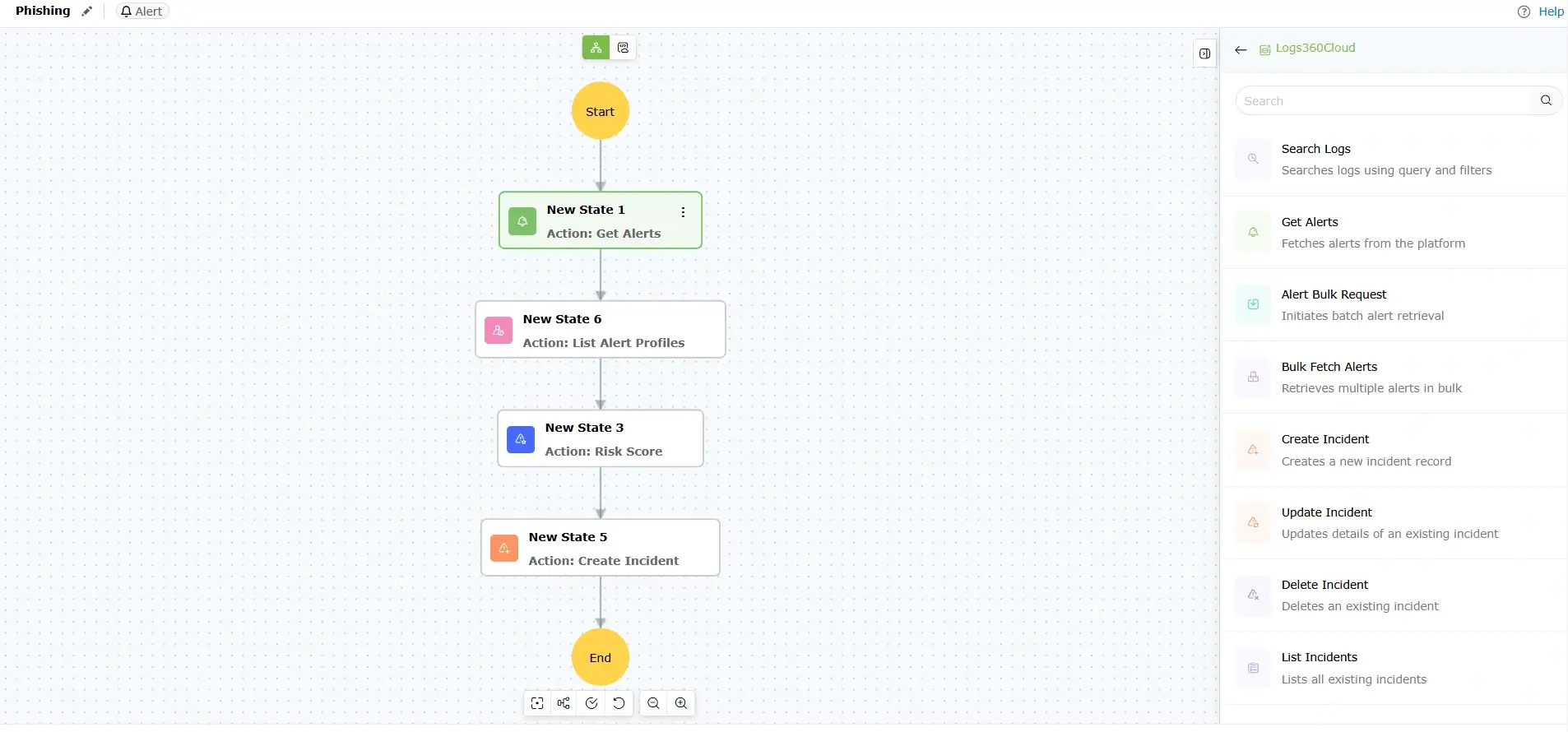
  • Workflow orchestration: Utilizing an extensible playbook builder, analysts can create harmonized workflows that connect Log360 with ITSM tools like Jira and ServiceNow for streamlined incident handling and life cycle management.

Benefit: Log360 effectively eliminates tool sprawl by bringing together fragmented security and IT systems into a single, consolidated interface. This orchestration-first approach replaces manual, multi-console operations with unified, automated workflows that enhance SOC efficiency while managing incidents.

Multi-tool orchestration that eliminates tool sprawl

Playbook automation that decreases MTTR

Log360 offers prebuilt incident response playbooks that orchestrate security data and threat feeds from multiple sources to detect and respond to incidents in real time. The platform leverages automation to execute investigation and containment actions across multiple security tools simultaneously and instantly. This reduces overall mean time to repair (MTTR), thereby minimizing the impact of breaches.

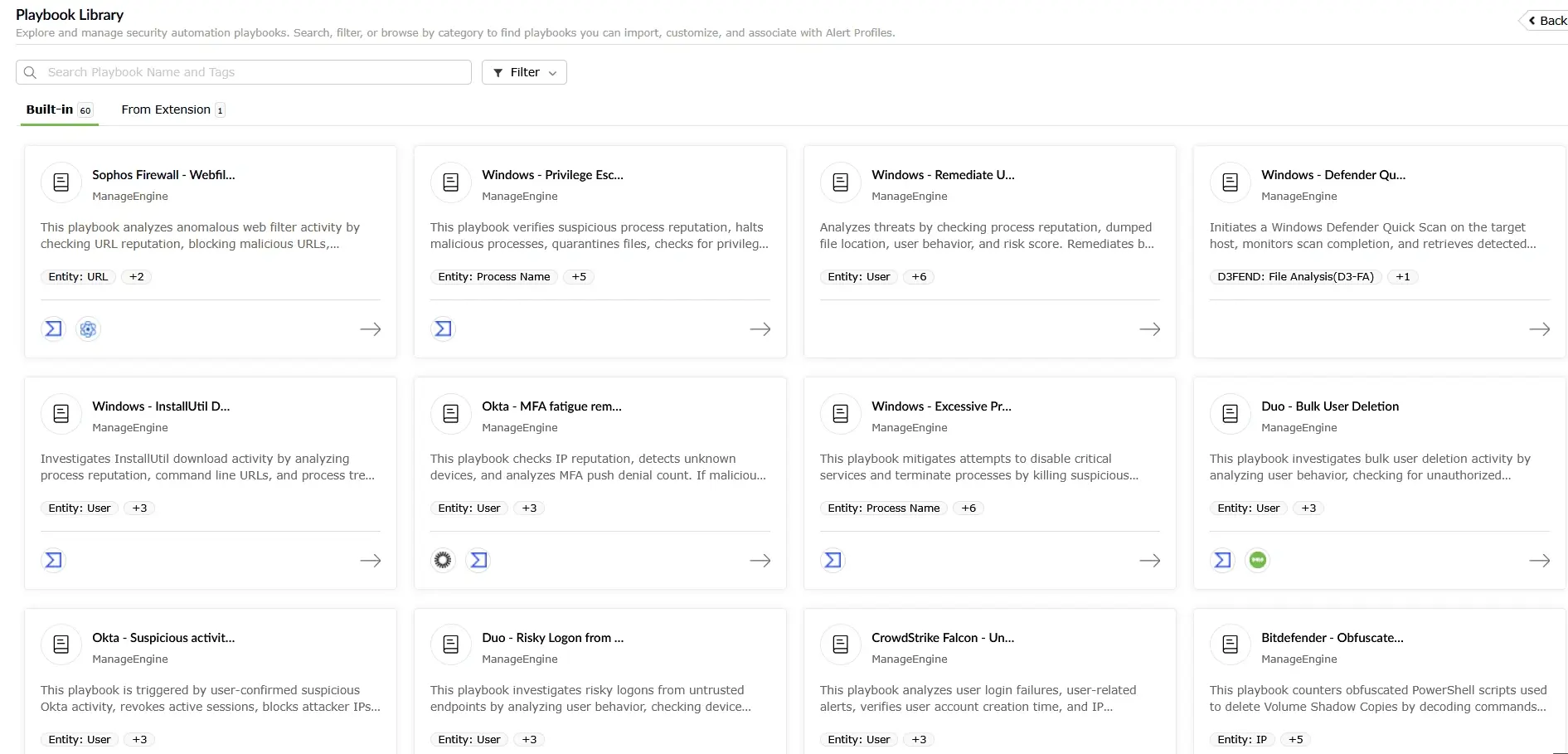
  • Comprehensive playbook library: Log360 helps accelerate incident response with over 40+ prebuilt playbook templates designed for critical scenarios like ransomware and brute-force attacks. These templates allow SOC teams to deploy standardized, cross-platform response strategies instantly, drastically reducing the MTTR for incidents.
  • Rapid automated remediation: By correlating real-time detections with automated actions, such as isolating an infected host or revoking compromised credentials, Log360 removes manual bottlenecks and tool switching delays, ensuring that threats are neutralized at machine speed.

Benefit: Log360 transforms the incident response life cycle by replacing manual, fragmented processes with high-velocity automation. By providing ready-to-use templates and context-aware orchestration, the platform ensures that the path from initial detection to final containment is measured in seconds rather than hours.

Playbook automation that decreases MTTR

Forensic investigation and analysis of incidents for compliance

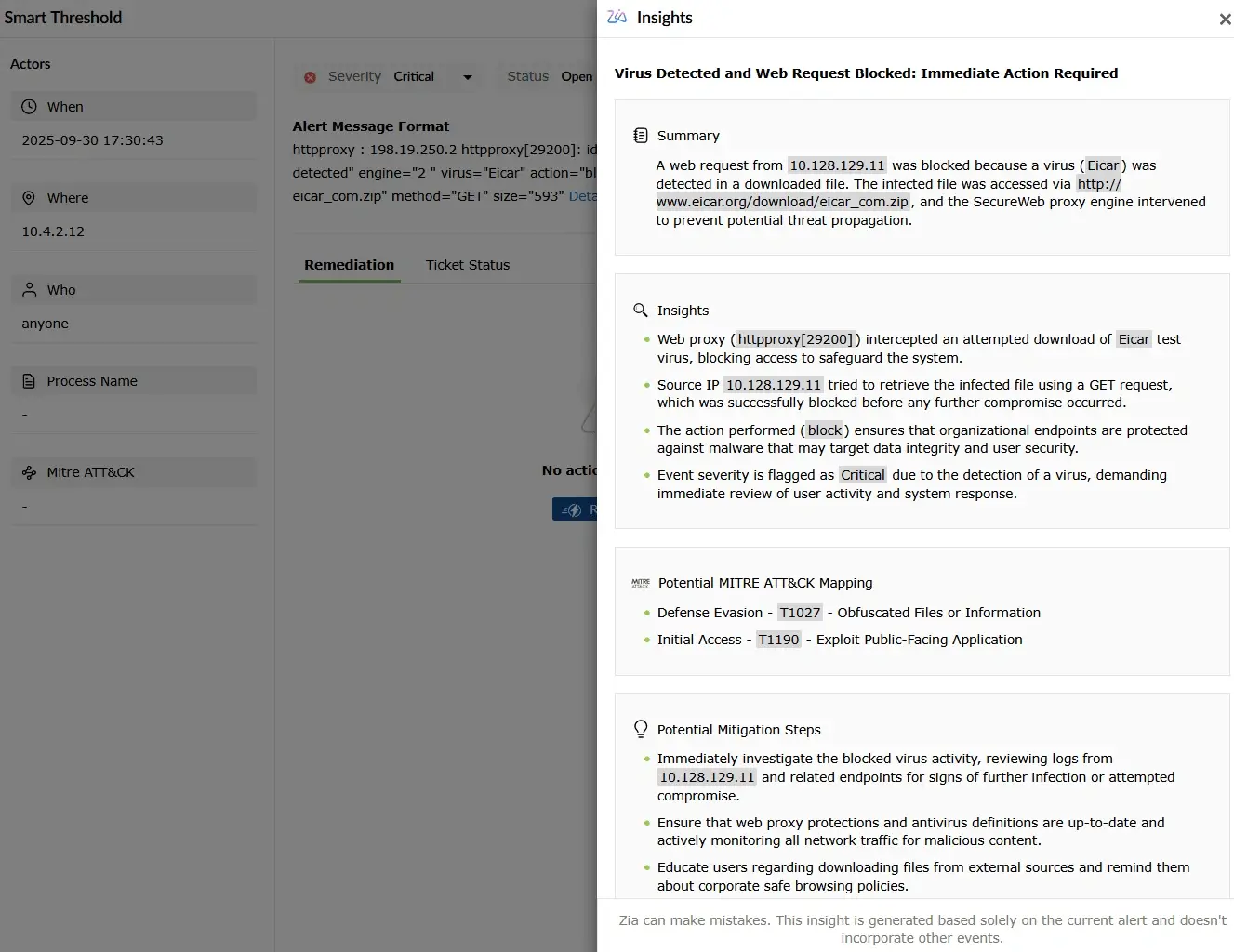
By combining Zia Insights and the incident workbench, Log360 transforms fragmented log data into a cohesive story, ensuring that organizations can meet strict compliance mandates like the GDPR, HIPAA, and PCI DSS through evidence-based reporting.

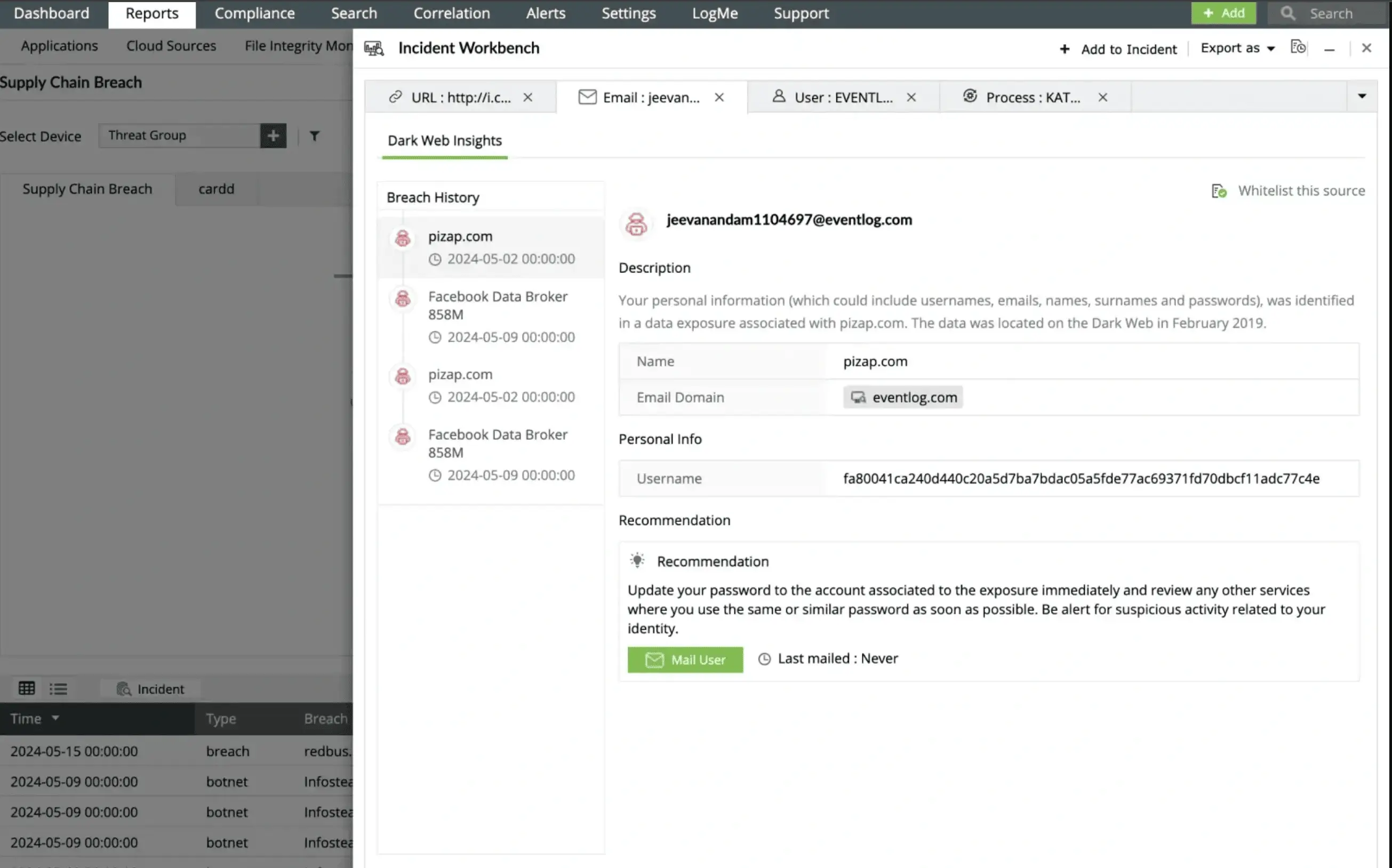
  • Evidence investigation using Zia: Log360's Zia Insights leverage generative AI to transform complex log data into human-readable evidence. It provides contextual summaries of alerts, reconstructs incident timelines, and suggests remediation steps to validate the security posture of the network and document forensic evidence for regulatory reporting.
  • Forensic investigation with incident workbench: Log360's incident workbench provides a centralized analytical tab for deep-dive forensics and compliance audits. It correlates behavioral analytics and threat intelligence feed that serve as evidence of an incident. It also provides visual process hunting trees that help in root cause analysis.

Benefit: By combining Zia’s AI narratives with the incident workbench’s visual forensics, organizations can accelerate investigations and eliminate manual data silos. This provides a clear, verifiable chain of evidence, enabling security teams to meet compliance requirements.

Forensic investigation and analysis of incidents for compliance

Responding to real-time incidents with Log360's advanced playbooks

Log360 offers 40+ playbook templates that help security teams manage the incident life cycle from triage to remediation. Here are some real-time use cases that explain Log360's incident management capabilities.

  • Account lockout incident

    An account lockout occurs when a user is disabled from logging into their profile after multiple failed attempts. This is usually triggered by forgotten passwords, synced devices with old credentials, or brute-force attacks by malicious actors. Log360's account lockout analyzer helps probe the root cause of the lockout and identify legitimate lockouts caused by unauthorized logins

  • Privilege escalation incident

    Privilege escalation occurs when an attacker gains higher-level permissions like admin rights to access restricted data. It is typically caused by exploited software vulnerabilities, misconfigurations, or stolen credentials. Log360 traces privilege escalations with advanced Active Directory auditing that tracks GPO changes. It also flags attempts to abuse privileges with predefined detection rules.

How Log360 responds

  • Identification and verification: Log360 checks failed login counts, processes, and the reputation of source IPs. It leverages UEBA risk scores to confirm if the activity is a malicious threat or simple user error.
  • Immediate containment: It automatically blocks malicious IPs and terminates compromised sessions. If the target is a non-admin, Log360 disables the account and expires associated passwords to prevent further access.
  • Deep remediation: For persistent threats, the system quarantines malicious processes, runs Defender scans, and isolates infected hosts. High-privilege escalations are instantly flagged to security teams for urgent investigation and final resolution.

How Log360 responds

  • Verification and triage: Log360 determines if the account is local or Active Directory-based. It then analyzes logon alert details and user risk scores to distinguish between a simple typo and a genuine security threat.
  • Deep investigation: It checks for successful logons and audits the reputation of associated IP addresses. It specifically scans for unauthorized processes, suspicious scheduled tasks, or persistent services linked to the lockout event.
  • Automated remediation: If confirmed malicious, Log360 automatically blocks the IP, disables the user, and blocks remote access. It finishes by enforcing a credential update to restore a secure state.

How Log360 responds

  • Detection and verification: Log360 inspects process reputations, command lines, and privilege attempts to confirm malicious intent while filtering out false positives.
  • Immediate containment: It halts the attack by killing malicious process trees, quarantining files, and terminating compromised user sessions to stop further movement.
  • Remediation and notification: Log360 then secures the network by disabling accounts, removing persistence mechanisms, and alerting the security team for final investigation.

Discover more with Log360


AI-powered security insights

Empower your SOC to outpace attackers with contextual, AI-driven intelligence. Log360’s Zia Insights uses generative AI to transform complex logs into plain-text summaries, instantly mapping threats to MITRE ATT&CK and providing tailored remediation steps.

Learn more  

MITRE ATT&CK-mapped defense

Log360 transforms the extensive MITRE ATT&CK framework into an actionable defense strategy. With real-time mapping of tactics and techniques, an intuitive global dashboard, and over 2,000 prebuilt rules, Log360 helps identify security gaps and neutralize sophisticated attacks before they escalate.

Learn more  

ML-based anomaly detection

Log360 uses ML-powered UEBA to expose hidden threats like data exfiltration and lateral movement that traditional rules miss. By baselining normal behavior and scoring risks in real time, it ensures that you stay ahead of zero-day exploits and insider attacks.

Learn more  
  •  

    We wanted to make sure that one, we can check the box for different security features that our clients are looking for us to have, and two, we improve our security so that we can harden our security footprint.

    Carter Ledyard

  •  

    The drill-down options and visual dashboards make threat investigation much faster and easier. It’s a truly user-friendly solution.

    Sundaram Business Services

  •  

    Log360 helped detect insider threats, unusual login patterns, privilege escalations, and potential data exfiltration attempts in real time.

    CIO, Northtown Automotive Companies

  •  

    Before Log360, we were missing a centralized view of our entire infrastructure. Now, we can quickly detect potential threats and respond before they escalate.Log360 has been invaluable for improving our incident response and ensuring compliance with audit standards. It’s a game-changer for our team.

    ECSO 911

Fill this form to schedule a
personalized web demo

  • By clicking " Submit", you agree to processing of personal data according to the Privacy Policy.

Your request for a demo has been submitted successfully. Our support technicians will get backto you at the earliest.

Frequently Asked Questions

Security orchestration, automation, and response (SOAR) is a security tool that enables organizations to orchestrate multiple tools that automate incident response against security threats and incidents. It allows teams to automate low-level responses to security events, streamline incident response, and improve overall operational efficiency—thereby reducing MTTR.

The incident management life cycle comprises several stages from the instant an incident is detected until it is completely remediated. It includes stages such as preparation (readiness), identification (detection), containment (limiting damage), eradication (removing the threat), recovery (restoring systems), and lessons learned (post-incident analysis). This structured approach ensures a consistent and thorough handling of every security threat.

Log360 reduces mean time to respond (MTTR) by providing centralized visibility and real-time alerts. Its automated incident response playbooks trigger immediate actions. Rather than waiting for manual intervention, threats are neutralized the moment they are detected.

Log360 utilizes ML-based UEBA to distinguish between genuine threats and normal activity. By correlating events and grouping related alerts into a single incident, it filters out false positives, ensuring that analysts focus only on critical tasks.

Stop alert fatigue and slash MTTR

Leverage Log360’s 2000+ detection rules, ML-driven insights, and 40+ SOAR playbooks to orchestrate your security stack, automate threat detection, and neutralize attacks in seconds.