Chapter 5:
Modernize through intelligence automation
Building intelligence into security operations
When we talk about security modernization, there are five core principles to adhere to:
-
1. Integration over addition:
High school flashback? Those with math anxiety can relax. Focus on capabilities that integrate with and enhance existing investments instead of adding complexity through additional point solutions. The goal is operational simplification, not tool proliferation.
-
2. Automation with human oversight:
Implement automation that augments human capabilities. The key to effective security operations is to combine machine speed and consistency with human creativity, judgment, and strategic thinking.
-
3. Business alignment first:
Prioritize investments that directly support business objectives and demonstrate measurable value. Technical proficiency without business value rarely receives sustained organizational support.
-
4. Incremental implementation:
Implement modernization incrementally with clear milestones and success metrics. This approach reduces risk while building organizational confidence and competence with new capabilities.
-
5. Continuous evolution:
Design modernization efforts to be ongoing. Technology and threats evolve continuously, requiring security capabilities that can adapt and improve over time.
Cloud-native security transformation
Cloud environments require fundamentally different security approaches than traditional data center architectures. Cloud-native security capabilities provide better protection with lower operational overhead than traditional security tools adapted for cloud use.
Cloud security posture management
CSPM tools provide continuous monitoring of cloud configurations against security best practices and compliance requirements. These platforms automatically identify misconfigurations, policy violations, and security risks while providing automated remediation for common issues, thereby reducing the need for manual assessments.
Let’s take a scenario where a developer of a regional healthcare network accidentally creates an S3 bucket with public read access while testing a new patient portal feature. Traditionally, the misconfiguration might go undetected for weeks until the next manual audit, potentially exposing thousands of patient records and violating HIPAA requirements. However, this can be handled through a log management tool.
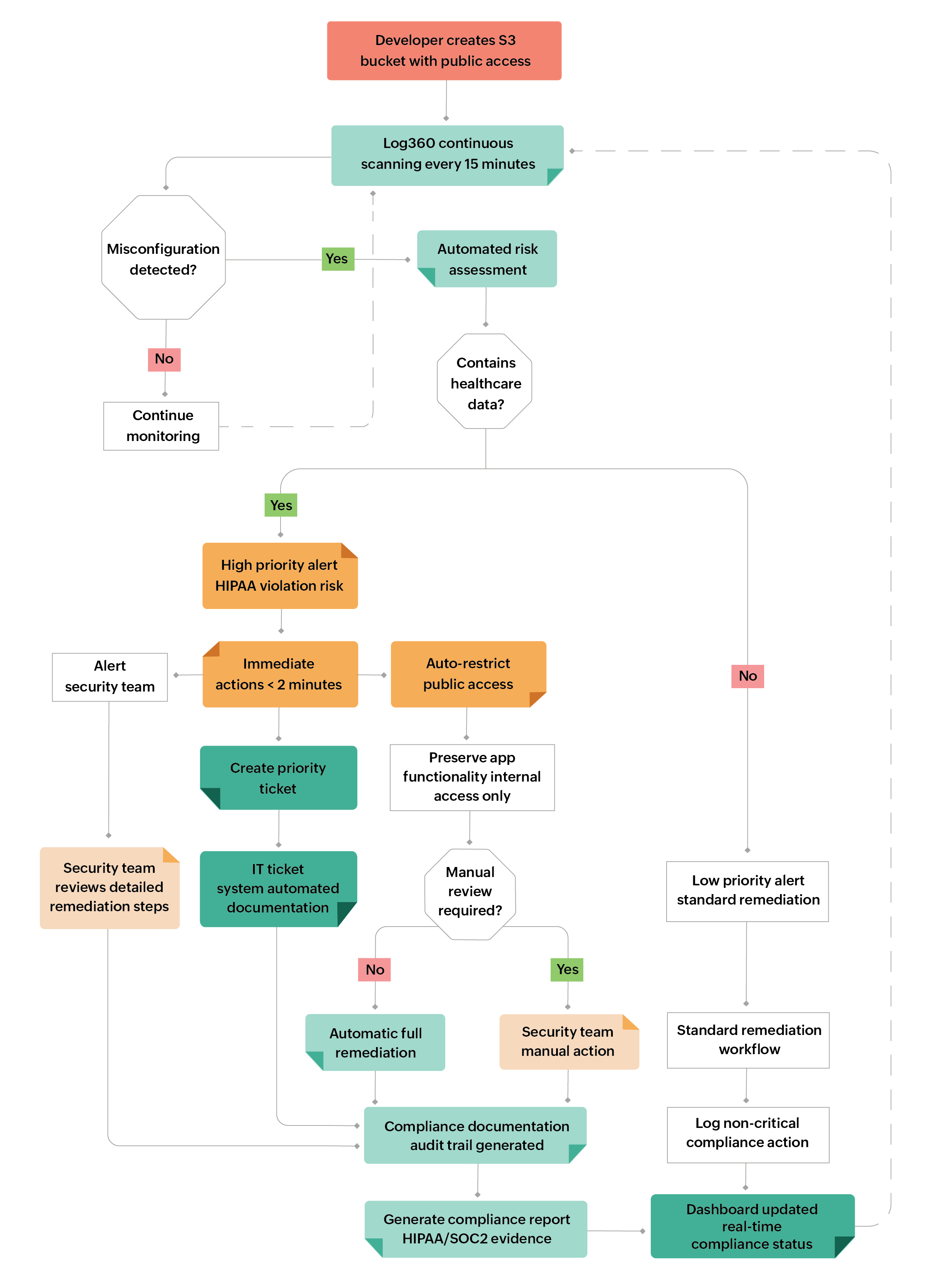
Through continuous scanning and content analysis, the system determines the bucket contains healthcare data. The security team immediately receives a high-priority alert with detailed remediation steps while the tool automatically restricts public access without affecting other functionalities. All these actions are automatically logged for audit trail and regulatory reporting. This capability becomes essential as organizations adopt multi-cloud strategies and increase their cloud footprint.
Cloud infrastructure entitlement management
In a cloud-native ecosystem, the network isn't permanent, but identity is. The biggest blind spot for many organizations is non-human identity. With thousands of microservices talking to each other, service accounts often accumulate excessive permissions. Modernization requires implementing cloud infrastructure entitlement management (CIEM) to automatically detect and strip unused privileges from machine identities, ensuring a compromised container doesn't become a vulnerable entry point.
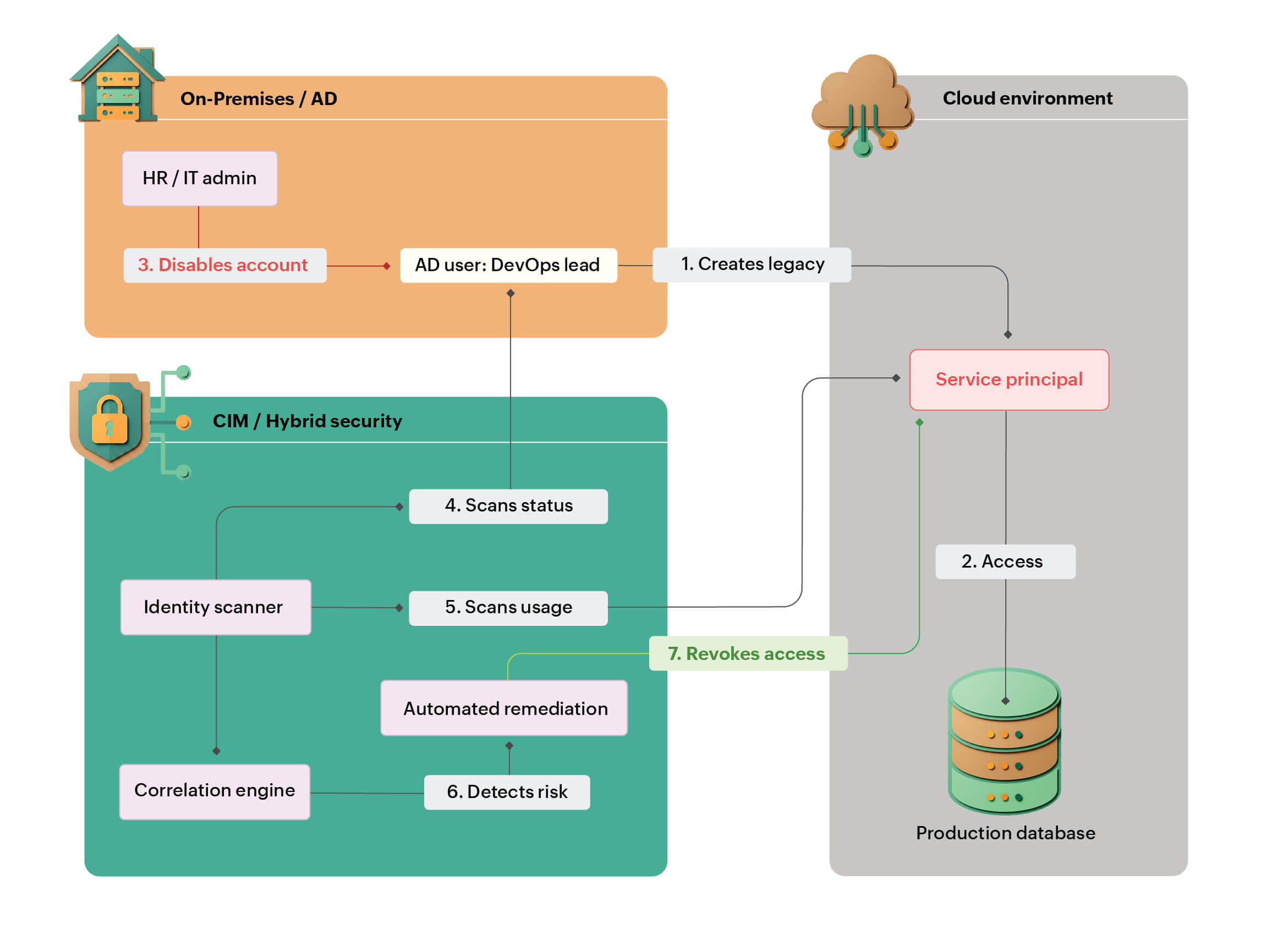
Most enterprises are hybrid, so it's crucial to look for an ecosystem that can trace an identity's lineage from the on-premises domain controller all the way to the cloud container. Let's say a DevOps lead is troubleshooting a critical database failure in Azure. To fix it quickly, they create a temporary service principal with contributor access to the production environment. The bug is fixed, the ticket is closed, and everyone moves on.
Six months later, the DevOps lead leaves the company and HR disables their AD account on-premise. The on-premises account is dead, but the cloud service principal is still active, unmonitored, and holds high-level permissions. It is now a zombie identity, a perfect backdoor for attackers.
With a CIEM tool, the cloud environment can be scanned and a service account that hasn't been used in 90 days can be identified. This tool can map that account back to the DevOps lead's disabled on-premises identity, flagging it as an orphaned asset. The system then triggers an automated workflow to revoke the cloud permissions or alert the SOC, closing the loop that a human admin likely missed.
Infrastructure as code and DevSecOps
IaC is an impactful modernization opportunity for security, but only if it is wrapped in a DevSecOps workflow. Think of it as two sides of the same coin. IaC is the "What" (the asset), and DevSecOps is the "How" (the process). By treating infrastructure configuration as version-controlled code, organizations can move from reactive "detect and fix" cycles to proactive "prevent and deploy" models.
One way to secure IaC is to enforce a single path to production: the golden pipeline. In this model, developers cannot manually change cloud settings in the console. Instead, all changes should be committed as code and pass through an automated CI/CD pipeline. This gives the security team a single choke point to enforce standards without slowing down velocity.
CISOs can also implement Policy as code as automated guardrails that scan IaC templates during the build process. If a developer tries to commit code that creates an unencrypted database or an oversized instance, the pipeline automatically rejects the build and provides immediate feedback.
Governing the AI frontier
The challenge for the CISO is that AI adoption is often bottom-up. Engineers are using genAI to write code, and marketing teams are using it to draft emails. All this happens long before a policy is in place, so the goal is to wrap it in a seat belt.
By simply blocking these tools, we create Shadow AI, driving usage to personal devices where we have zero visibility. Instead, the modern CISO must architect a safe harbor. Call it the AI traffic light protocol. Not all AI usage carries the same risk. Establish a clear acceptable use policy based on data sensitivity:

Public: Safe for brainstorming and public marketing copy.
Internal: Safe for process optimization, provided PII is redacted.
Restricted: Strictly prohibited for customer data, source code, and financial projections unless used within a walled, enterprise-contracted environment.
Implementation strategy
Successful modernization requires careful sequencing and change management. Start with initiatives that provide immediate, visible value while building toward more complex capabilities.
-
Phase one Foundation (months 1-6)
Focus on initiatives that provide immediate relief for current operational challenges. Implement SOAR for high-volume use cases, deploy basic AI-powered alert enrichment, and establish cloud security baselines. These improvements demonstrate value while building organizational confidence in modernization efforts.
-
Phase two Integration (months 6-18)
Expand automation and integration capabilities. Implement extended detection and response (XDR) for comprehensive threat detection, deploy zero trust capabilities for critical assets, and establish advanced behavioral analytics. These capabilities provide significant security improvement while reducing operational complexity.
-
Phase three Optimization (months 18+)
Focus on advanced capabilities and optimization. Implement predictive analytics, establish autonomous response capabilities, and create innovation capabilities for emerging technologies. These investments position the organization for future success while maximizing the efficiency of current capabilities.
Remember to keep redefining success. Don't mark a project complete when the new tool goes live. In phase one, include a hard "decommission date" for the legacy asset. This forces the team to fully migrate rather than relying on the old tool as a crutch, preventing the organization from paying for both simultaneously and freeing up budget for phase two.