Chapter 1:
The new face of security leadership
What does an IT leader's workstation look like?
Forty-seven browser tabs left open for weeks, laptop fan screaming for help, sticky note reminders everywhere and an ungodly number of coffee mugs that should've been washed yesterday. Let's not forget the mystery tab playing audio in the background. Technically, the system works. Operationally, however, it's hanging by a thread.
Now, apply that same chaotic logic to an entire enterprise architecture.
Every tool is running, every dashboard is active, and on the surface everything seems fine. Yet, the system is slow, the team is overwhelmed, and no one knows what half of these tools actually do.
yet only 29% of CISOs say their board includes at least one member with cybersecurity expertise.
Why the gap?
The answer lies in an outdated perception. For years, CISOs operated largely in the background, focusing on technical implementations and reporting to IT leadership. Their primary concerns were keeping systems running and ensuring basic security hygiene. Fortunately, they are now increasingly recognized as C-suite executives, with many earning board seats and playing crucial roles in strategic decision-making. The catalyst for this evolution is increasing digitization and the corresponding expansion of cyberthreats. High-profile breaches, stringent regulatory requirements like the GDPR, and growing customer expectations around data protection, have made cybersecurity a boardroom priority.
As the role matured, distinct types of CISOs have emerged, each suited to different organizational needs and business contexts. The transformational CISO drives enterprise-wide digital transformation while ensuring security enables business innovation. The compliance-oriented CISO specializes in regulatory adherence for security, a necessity in heavily regulated industries. The tactical CISO focuses on building and optimizing security operations and implementing new technologies. Understanding which type of CISO an organization needs is crucial for its cybersecurity posture.
| Feature | Transformational CISO | Compliance CISO | Tactical CISO |
|---|---|---|---|
| Core focus | Business strategy and culture | Regulation and governance | Operations and firefighting |
| Primary goal | Align security strategy to drive business growth | Ensure strict adherence to laws and audit requirements | Maximize operational efficiency and tool performance |
| Best for | Enterprises driving rapid change or entering new markets | Heavily regulated industries | Organizations with immature security programs or active crises |
For readers like you
Let's play a game, shall we?
| THE CISO BINGO | ||
|---|---|---|
| "Can we disable MFA just for the CEO?" | "We launch tomorrow, can you sign off?" | "But we've always done it this way" |
| Budget denied, but scope increased | Marketing buys AI tool on personal credit card | Audit finding from 2019 still open |
| Password found on sticky note | Employee clicks phishing link during the training | Spreadsheet named "Passwords.xlsx" found with org-wide share access |
If you hit three in a row before your morning coffee is finished, go home. You've done enough for today.
If that bingo card felt a little too real, you are in the right place. This e-book is for leaders who recognize that cybersecurity requires strategy and business alignment beyond technical implementation. CISOs managing mature security environments will find practical frameworks to reinvent "good enough" programs without disrupting existing operations. For the C-suite, this acts as a translation guide to understand how security contributes to business success, competitive advantage, and organizational resilience. The business-focused frameworks we dive into today will help evaluate, support, and leverage security leadership for maximum organizational benefit.
Core competencies of the CISO office
At the executive level, we know that technical skills take a back seat when it comes to desirable traits. Navigating a C-suite landscape can often be political, and requires intense strategy, empathy, and communication. Here's how we define successful CISOs:
Business alignment
While a strong technical foundation is essential, being a CISO today is just as much about understanding the business as it is about cybersecurity. Unlike an IT admin or technician who primarily executes and maintains systems, a CISO should zoom out and align security priorities with business strategy. For example, if a company is entering the healthcare market, the thought process isn't "We need HIPAA compliance." They ask, "How do we enable fast and efficient delivery while prioritizing patient data protection at every layer?" CISOs participate in high-level planning discussions and ensure risk decisions support business growth.
Cross-functional communication
Security cannot live in isolation and a good CISO knows how to translate security priorities into the language of every team they interact with. When rolling out endpoint detection and response (EDR) agents across all employee laptops, a CISO might say to engineers, "This won't interfere with your dev tools, it only monitors for unusual activity like unauthorized script execution." To HR and legal, they might say, "This helps us detect and respond to insider threats or compromised devices without collecting personal data." And to the executive team, they'd frame it as, "This strengthens our ability to detect ransomware early, reducing potential downtime or regulatory exposure." The core message is the same, but it's tailored to what each team values: performance, privacy, and business continuity, respectively. Being able to communicate with different teams "in their language" is a crucial aspect of the job.
Ethical governance
Trust is central to the CISO's role. They must uphold strong ethical standards and follow best practices for information security. They also understand the importance of data privacy, including protecting the privacy of their employees as well as customers. Let's go back to the EDR example. When deploying monitoring tools to detect insider threats, an ethical CISO considers privacy boundaries and ensures transparent communication with employees. Following due process and balancing surveillance with respect for individual rights is non-negotiable.
Proactive by design
A firefighting approach leads to burnout and missed threats. Successful CISOs shift toward a proactive strategy. Instead of waiting for a third-party audit to reveal gaps in access control, they initiate internal reviews across critical systems and work with team leads to implement role-based access and auto-expiry policies. This forward-thinking approach is paired with a continuous learning mindset built by actively listening to ground-level teams who see risks firsthand. The best CISOs keep learning, asking questions, and refining their approach.
Cultural leadership and advocacy
Part of being a good CISO involves building a security-first culture within the organization. They support awareness campaigns, build champions in business units, and advocate for org-wide practices. They should also secure executive buy-in by showing how security investments protect business goals. Influence here is about credibility, persistence, and leading by example.
Adaptive resilience
CISOs operate in volatile conditions, from zero-day exploits to reputational crises. The ability to remain composed, reframe strategies, and make informed decisions under high pressure is critical. Successful CISOs develop multiple contingency plans (we're talking Plan B to Plan Z) and rehearse them regularly. Their responses are meticulously calculated, not based on guesswork.
The CISO Framework
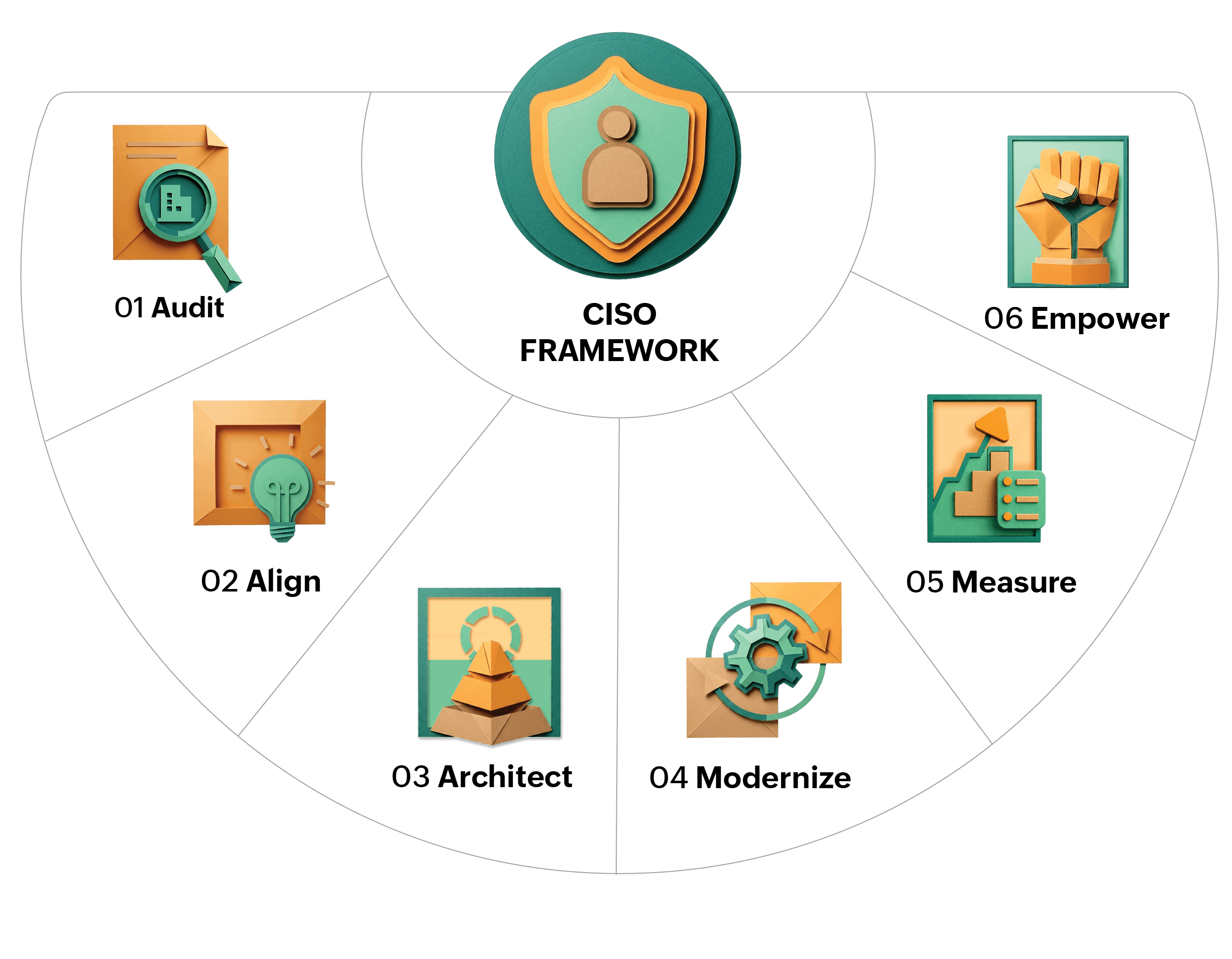
| Pillar | What it is | How CISOs achieve it |
|---|---|---|
| 1. Audit | Understand the current state of the security environment. | Conduct infrastructure reviews, evaluate tool integration, assess team skills, analyze process efficiency, and document business impact of security gaps. |
| 2. Align | Map security efforts to business goals. | Map security initiatives to business goals, engage executives to understand priorities, develop business-focused metrics, and integrate with planning cycles. |
| 3. Architect | Improve processes and tools for agility and efficiency. | Select appropriate frameworks (NIST, ISO), design technical/process/organizational architecture, create governance structures, and plan integration strategies. |
| 4. Modernize | Future-proof the stack and reduce manual burden. | Implement security orchestration, deploy behavioral analytics, automate workflows, integrate with business systems, and eliminate manual processes. |
| 5. Measure | Define and track KPIs while influencing leadership. | Track business impact metrics, risk reduction outcomes, operational efficiency gains, and stakeholder satisfaction levels. |
| 6. Empower | Build capabilities and culture that sustain security excellence. | Develop skills through training, prevent burnout, and create internal champions across departments. |