- HOME
- More
- Industry Solutions
- Healthcare cost optimization: Eliminating hidden cost drivers and inefficiencies
Healthcare cost optimization: Eliminating hidden cost drivers and inefficiencies
- Last Updated: July 14, 2026
- 1.2K Views
- 6 Min Read

Cost optimization in healthcare carries a weight that few other industries share. Every financial decision is a constant balancing act with care quality. What makes it even harder is that significant cost drain accumulates through avoidable inefficiencies such as underpaid claims, idle operating rooms, and under-utilized medical equipment.
Traditional strategies built on siloed data, periodic reporting, and manual analysis fall short of tracing these hidden drivers to their root causes and quantifying their true impact.
The shift from this static cost reporting to cost intelligence requires a different approach—one that AI-powered healthcare analytics provides by unifying financial, operational, and infrastructure data, accelerating the path from insight to remediation.
This blog explores three areas where AI-powered analytics can uncover key cost drivers in healthcare enterprises and enable tangible efficiency gains.
3 ways healthcare enterprises can reduce cost drain using AI-powered analytics
1. Building a unified insurance claims and reimbursement dashboard
Cost optimization in healthcare is directly anchored to revenue cycle performance. Claim denials, rework costs, and underpayments often accumulate quietly, eroding margins before they are fully recognized.
Traditional approaches to healthcare revenue cycle management operate with a fundamental blind spot. Teams track KPIs across siloed tools, but lack end-to-end visibility across the claims life cycle and where inefficiencies originate.
AI-powered healthcare analytics delivers the intelligence to bridge these gaps. By consolidating claims, payer and operational insights into a unified claims and reimbursement dashboard, it enables revenue cycle leaders to trace how operational inefficiencies translate into financial leakage across the claims life cycle.
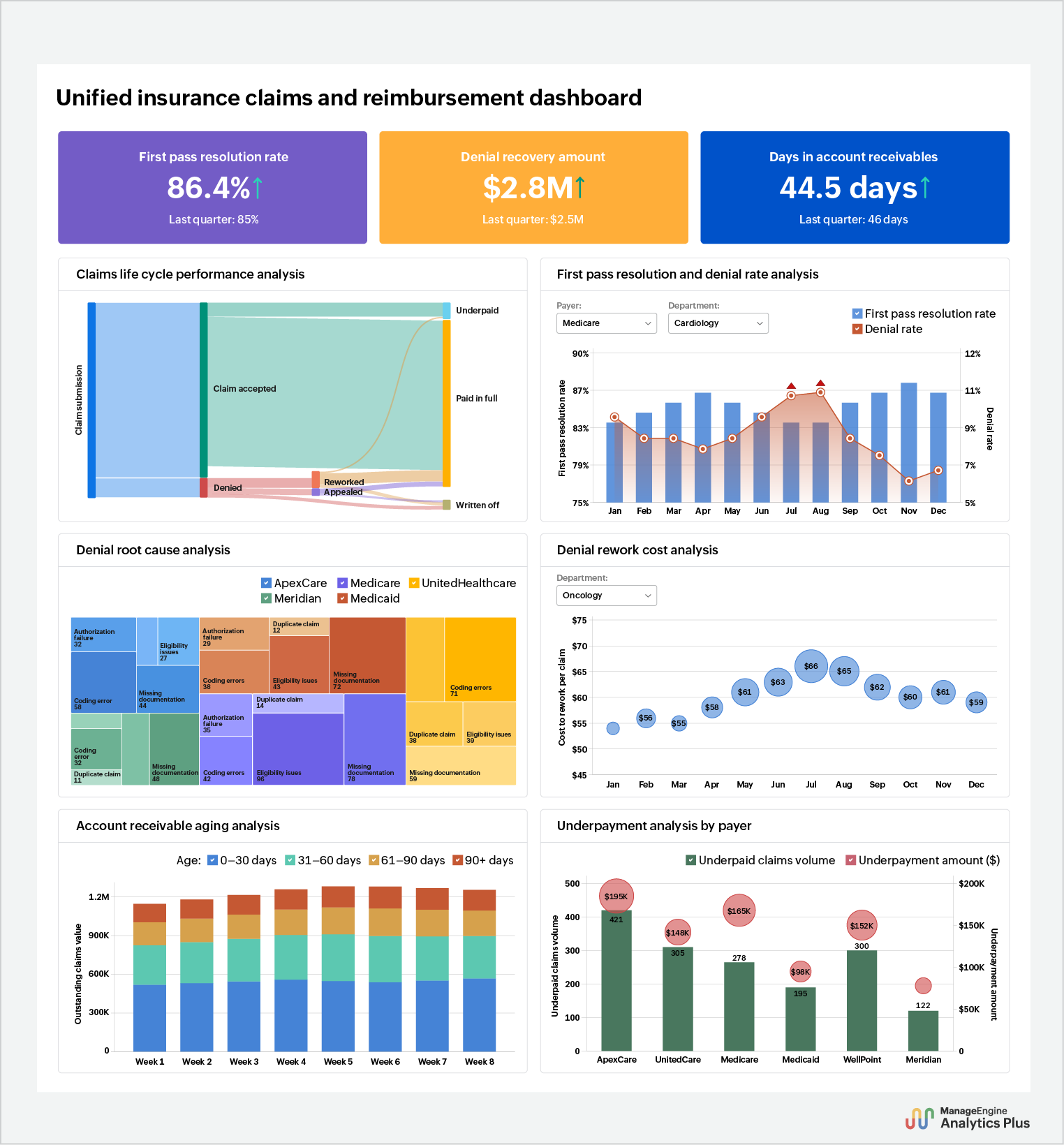
With this unified claims and reimbursement analysis at their disposal, revenue cycle teams can:
Map the full claims life cycle from submission to resolution, pinpointing where denials cluster, rework accumulates, and revenue is written off without recovery.
Spot the primary drivers behind denial spikes, whether they stem from coding errors, missing documentation, or payer authorization rules.
Detect departments with high rework denial costs and prioritize process improvements where administrative effort is highest.
Track how outstanding AR moves across aging buckets week over week, spotting claims migrating toward the 90+ day threshold before they become write-off risks.
By identifying the operational bottlenecks and payer behaviors driving claim inefficiencies, healthcare enterprises can improve first-pass resolution rates, reduce denial rework costs, and accelerate reimbursement timelines.
2. Uncovering healthcare capacity utilization gaps and their financial impact
Hospitals operate in a constant balancing act between maximizing clinical throughput and managing limited resources. From operating rooms (ORs) to high-value medical equipment, capacity must be utilized efficiently to meet patient demand without inflating costs.
In reality, identifying these inefficiencies is rarely straightforward. Teams have to sift through multiple reports and connect the dots manually to understand where capacity is underused. Even when gaps are identified, mapping them to their financial impact requires additional effort. This fragmented, time-consuming analysis makes it difficult to act on inefficiencies before they compound into increased operational costs.
This is where GenAI-powered analytics assistants like Ask Zia prove to be valuable. By asking simple, natural language questions, teams can go from uncovering hospital capacity utilization gaps to quantifying their financial impact in a single conversational thread.
i) Mapping OR utilization and idle time cost
ORs are among the most expensive and critical assets in a hospital, and even small inefficiencies in scheduling and turnover can lead to significant idle time. Delays between procedures, underutilized block hours, and last-minute cancellations often complicate OR capacity.
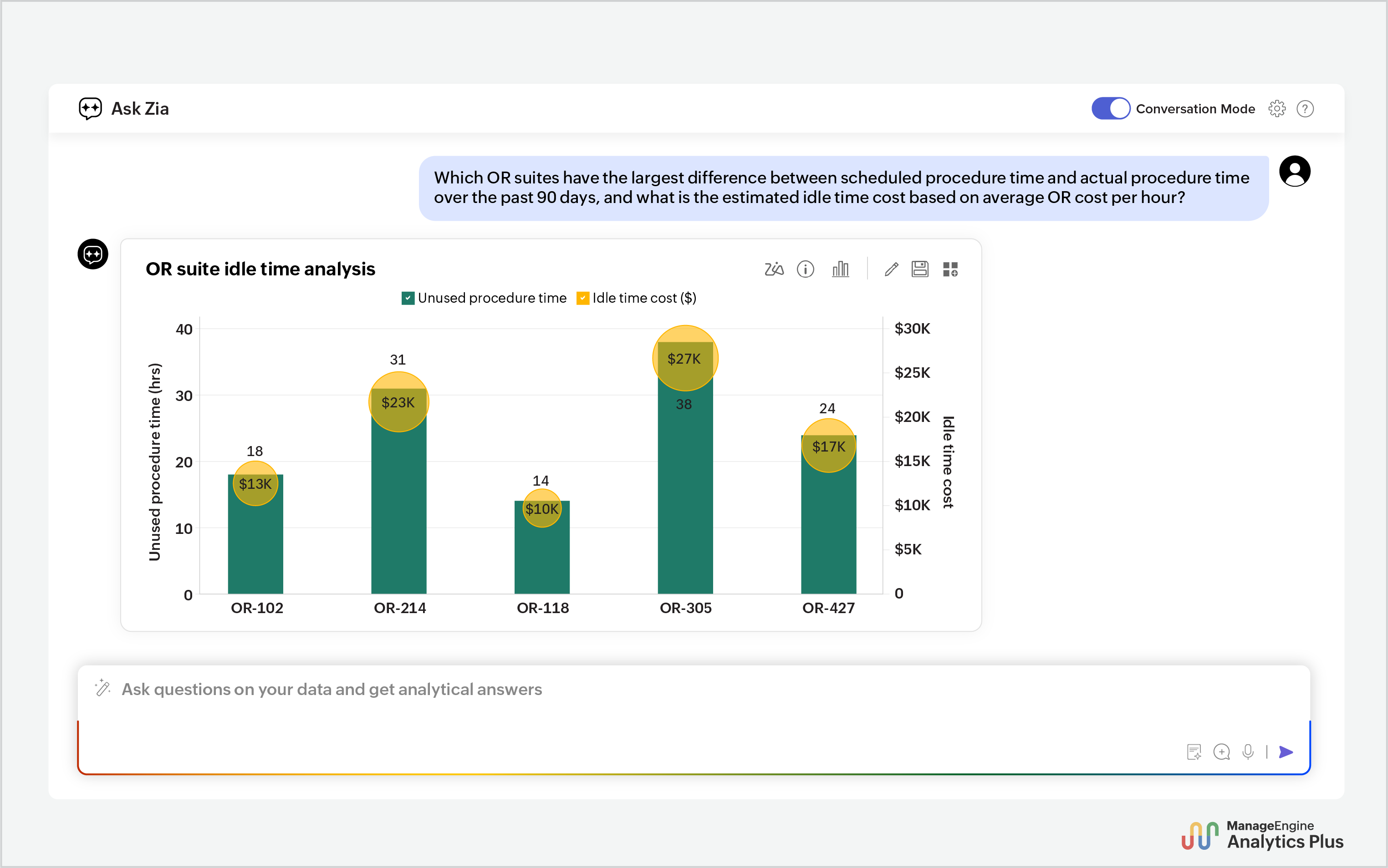
With Ask Zia, teams can uncover inefficiencies across these three dimensions, assess OR utilization patterns across suites, and identify the procedure categories and departments contributing to idle time and inevitable cost drains.
Teams can begin by comparing scheduled versus actual procedure time across operating rooms to highlight where allocated capacity is not fully utilized. Quantifying the associated idle cost brings clarity to which OR suites contribute most to avoidable financial loss.
From there, they can shift the focus to departmental block allocation, revealing which departments leave the most scheduled OR time unused and pinpointing where scheduling practices drive avoidable idle time.
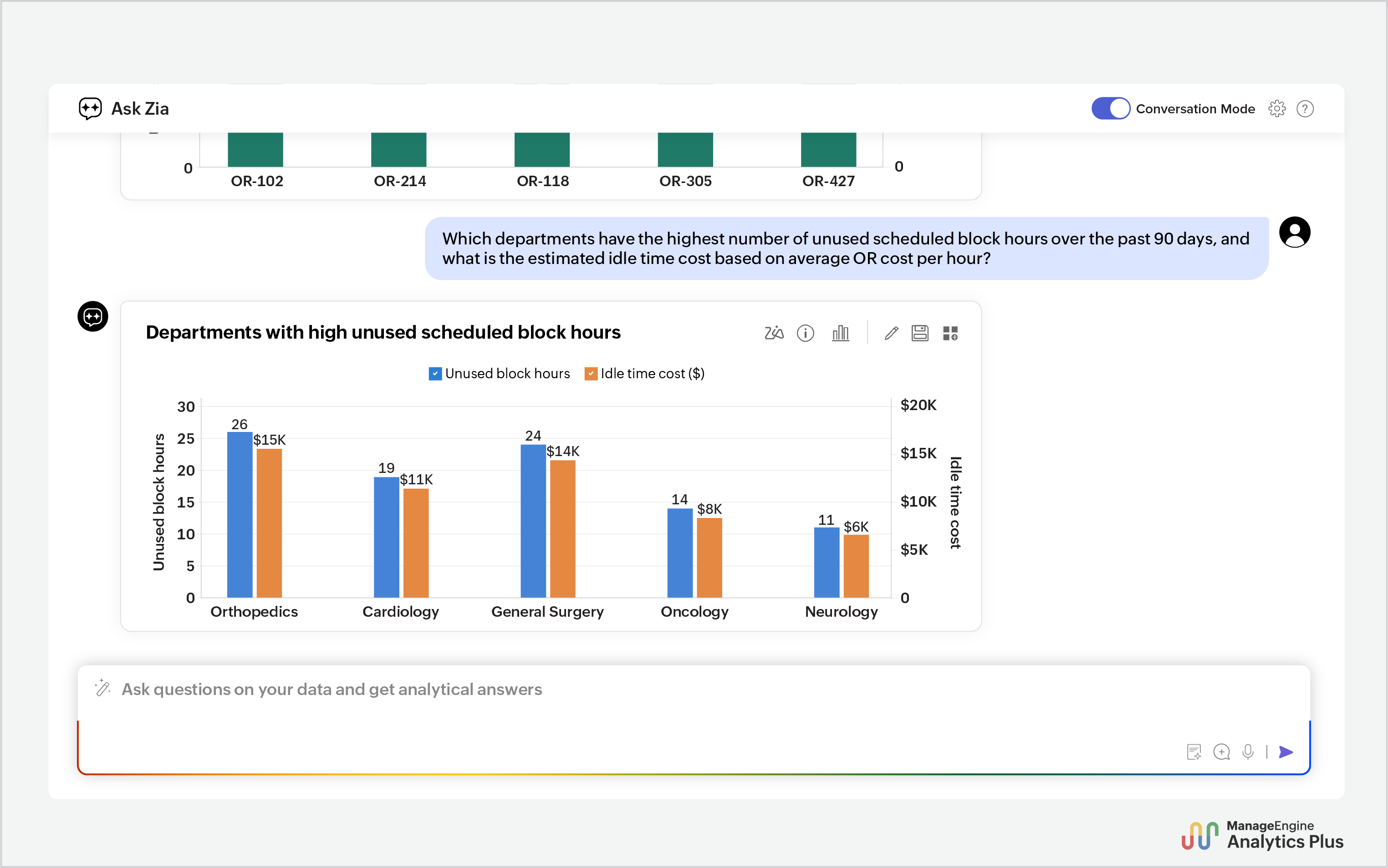
Finally, examining procedure categories with high cancellation frequency provides additional context on disruptions that affect planned utilization and contribute to idle capacity.
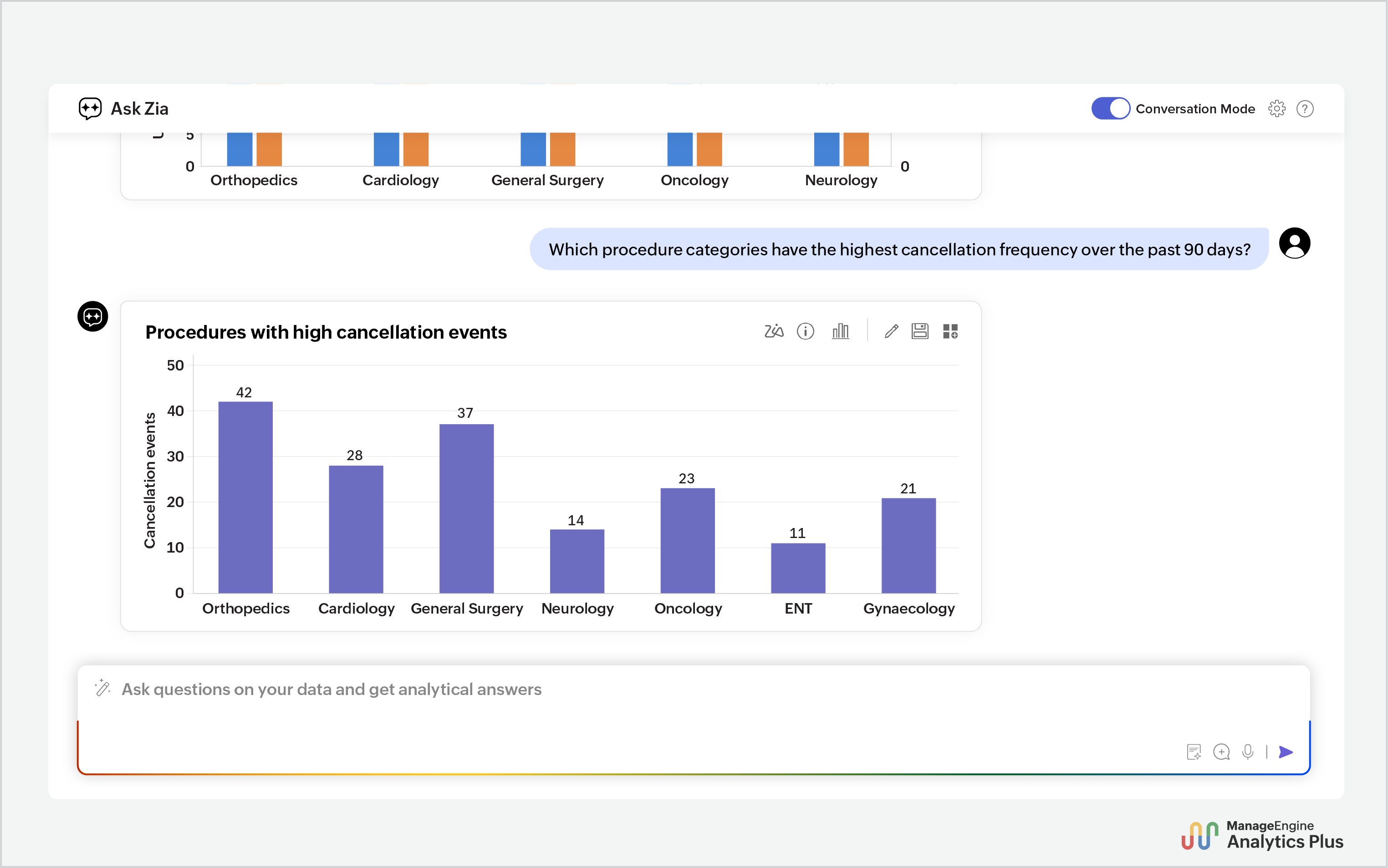
This line of analysis goes beyond visibility. By correlating idle time with average OR cost per hour, it quantifies the financial impact of under-utilization, turning abstract inefficiencies into measurable revenue loss.
With these insights at hand, teams can make timely, data-driven decisions around block scheduling, turnover optimization, and resource allocation to maximize OR throughput and minimize idle capacity.
ii) Improving medical equipment utilization
Expensive medical equipment—such as MRI scanners, CT machines, and surgical systems—represents significant capital investments for hospitals. Variations in usage patterns, demand, and scheduling inefficiencies across departments often result in these assets being underutilized.
In practice, identifying underutilization requires consolidating equipment usage logs, data from scheduling platforms, and operational reports, often spread across systems. This makes it difficult to accurately determine which assets are consistently underused and whether the issue stems from demand gaps, allocation inefficiencies, or operational constraints.
With Ask Zia, teams can analyze medical equipment utilization patterns across facilities and identify equipment with consistently low usage, along with the associated procedures and departments contributing to underutilization.
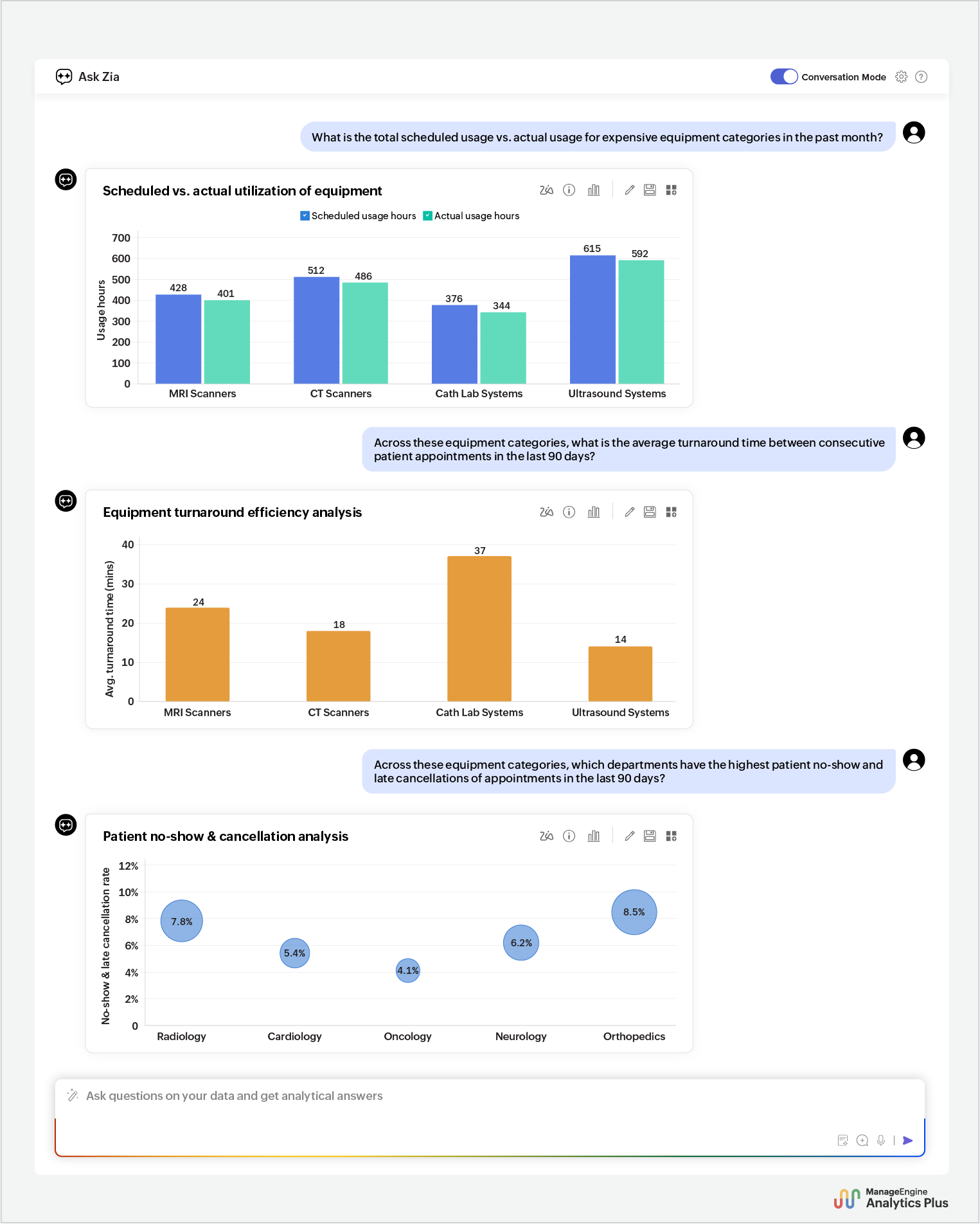
This sequence of analysis surfaces where and why expensive equipment is underutilized—whether due to gaps between scheduled and actual usage, extended turnaround times between appointments, or missed opportunities from no-shows and late cancellations. Correlating these factors, provides a clear view of operational inefficiencies impacting equipment throughput.
As a result, teams gain the clarity needed to refine scheduling practices, reduce idle intervals between appointments, and address avoidable inefficiencies in utilization.
3. Maximizing ROI from digital infrastructure investments
Healthcare enterprises continue to invest heavily in digital infrastructure, from clinical applications and EHR systems to cloud hosting. The real question is whether this spend is driving measurable gains in throughput, system performance, and cost efficiency. Without a clear link between investment and outcomes, ROI remains largely opaque.
Teams in most healthcare enterprises rely on manually correlating spending, usage, and performance signals—an approach that fails to scale with the volume of data modern infrastructure generates. While it can surface insights, the process is inherently iterative and time-consuming, delaying timely actions on emerging inefficiencies.
With LLMs powered by MCP-enabled platforms like Analytics Plus, teams can move beyond manual infrastructure investment evaluation to a conversational ROI analysis across the entire digital investment portfolio. Through simple, natural language queries in their preferred LLMs, they can analyze how investments across digital applications and infrastructure translate into measurable outcomes and pinpoint areas where returns fall short of spend.
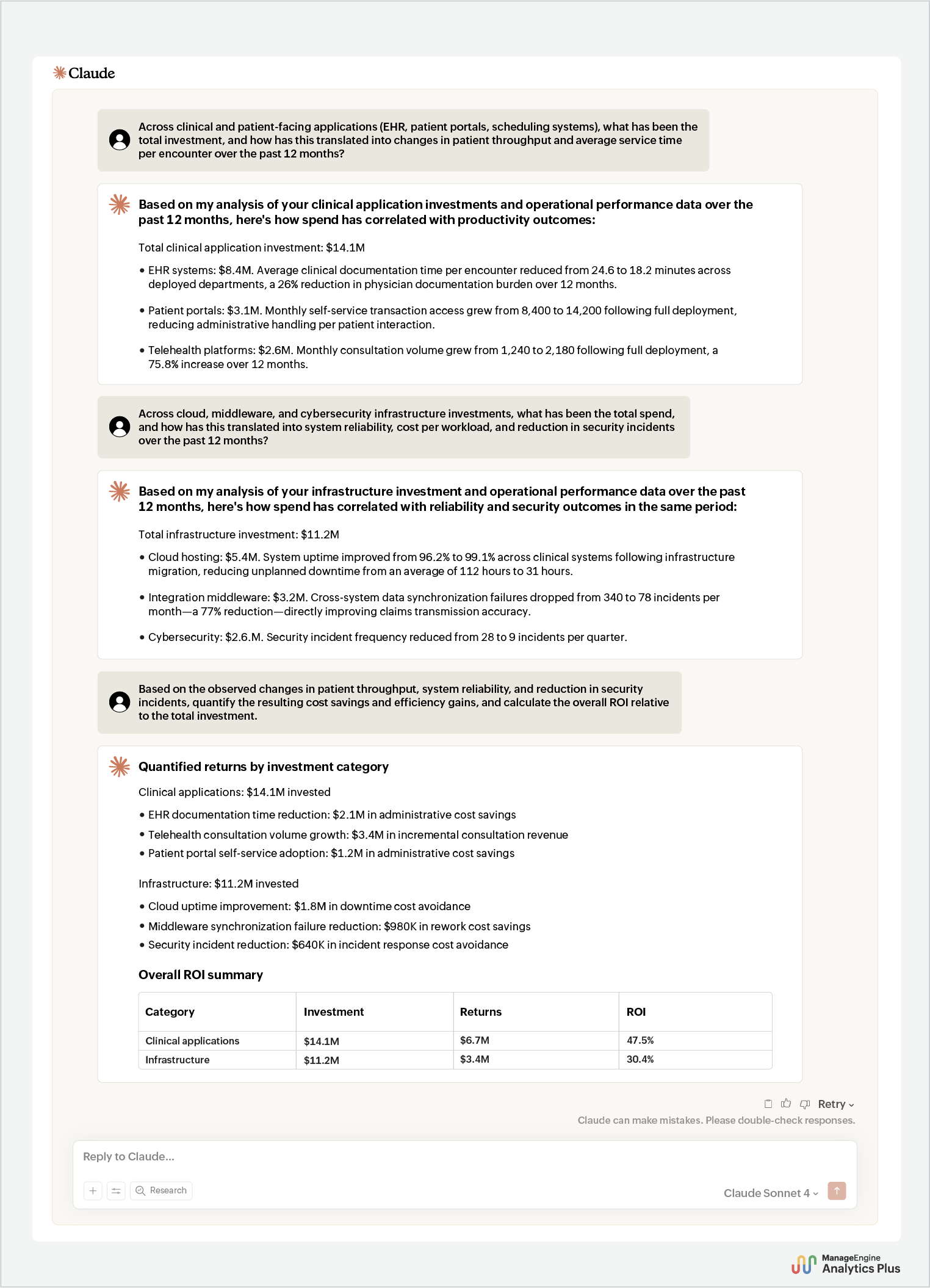
Drawing on the unified insights from Analytics Plus, the LLM surfaces how investments across applications and infrastructure correlates with improvements in outcomes like patient throughput and system reliability. Then, it intelligently quantifies the ROI by translating operational improvements into financial outcomes like administrative cost savings, incremental consultation revenue, and downtime cost avoidance.
Start eliminating hidden healthcare cost drivers with AI-powered analytics
Optimizing healthcare costs today requires more than tracking metrics. It demands the ability to unify data, uncover hidden inefficiencies, and act before they escalate. AI-powered healthcare analytics makes this possible by turning fragmented signals into actionable insights. This shift from static reporting to unified healthcare cost intelligence is an operational imperative for enterprises aiming to move from reactive cost management to proactive control.
The analyses included in this blog were created using ManageEngine Analytics Plus—a powerful AI-powered IT analytics and decision intelligence platform. Try these AI capabilities today with a free, 15-day trial. Want to see more first? Book a personalized demo.
Want more strategies to build resilient healthcare operations?
Learn to elevate patient experience, address workforce burnout, and prevent infrastructure downtime in our e-book.