- HOME
- More
- Industry Solutions
- The blueprint for building proactive, always-on healthcare IT operations
The blueprint for building proactive, always-on healthcare IT operations
- Last Updated: July 14, 2026
- 362 Views
- 5 Min Read

Healthcare IT resilience has become the backbone of consistent, high-quality care delivery. As hospitals transition from legacy infrastructure to digital environments, including EHR platforms, connected medical devices, and telehealth systems, the reliability of their IT systems will directly shape clinical outcomes.
Yet many IT teams still rely on fragmented monitoring tools and manual root cause analysis to manage these systems. The result is a healthcare IT environment that's perpetually reactive.
AI-powered healthcare analytics changes this operating model at its foundation. It unifies data across disparate systems and delivers the decision intelligence required to anticipate emerging disruptions, uncover root causes, and guide proactive, more informed remediation actions.
Let's see how to wield AI-powered analytics to tackle four persistent challenges in healthcare IT operations (ITOps).
4 ways to build proactive healthcare ITOps with decision intelligence
1. Building a unified healthcare digital experience dashboard
Clinical applications sit at the heart of modern digital healthcare infrastructure. Systems such as EHR platforms, imaging viewers, lab systems, and pharmacy applications have become critical access points for both patients and clinicians. When these systems slow down or fail, the impact is immediate: missed appointments, delayed documentation, and frustrated users on both sides of the care journey.
With siloed monitoring, these issues often surface as user complaints rather than early warning signs. Without a unified view of application performance across digital touchpoints, IT teams struggle to detect and resolve emerging performance issues before they affect digital experience.
AI-powered analytics platforms like ManageEngine Analytics Plus bridge this visibility gap. They consolidate data from across the healthcare enterprise's digital ecosystem into a unified dashboard and surface performance trends, reliability signals, and usage patterns across key applications.
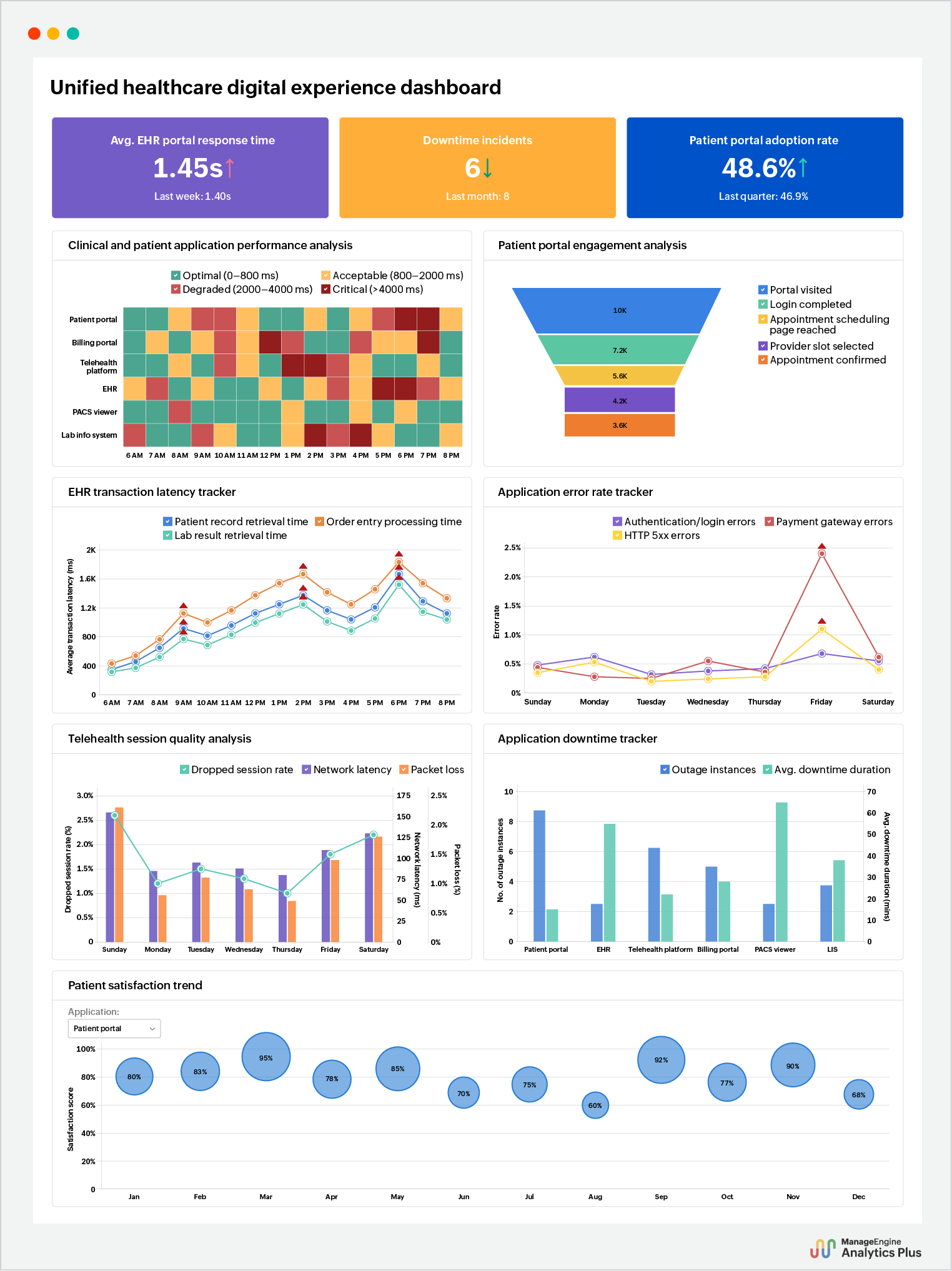
With this cross-system intelligence at their disposal, healthcare IT leaders can:
Correlate operational signals with real-world digital interactions to uncover friction points.
Spot performance bottlenecks early during peak clinical hours before they cascade into application slowdowns.
Pinpoint exactly where patients drop off across their appointment journey.
Identify applications experiencing higher outage frequency and longer recovery times.
Instead of piecing together insights from multiple tools, teams managing an expanding portfolio of clinical and patient-facing applications can proactively spot performance degradation and deliver an uninterrupted digital healthcare experience.
2. Automating root cause analysis and remediation of clinical application outages
While a digital experience dashboard excels at surfacing the symptoms of underlying infrastructure bottlenecks, ITOps teams constantly face the harder problem of decoding their cause. In most healthcare IT environments, this investigation is still manual.
When a clinical application outage occurs, teams sift through a flood of alarms and performance logs across disconnected systems to isolate the root cause while clinical workflow and patient outcome disruptions persist.
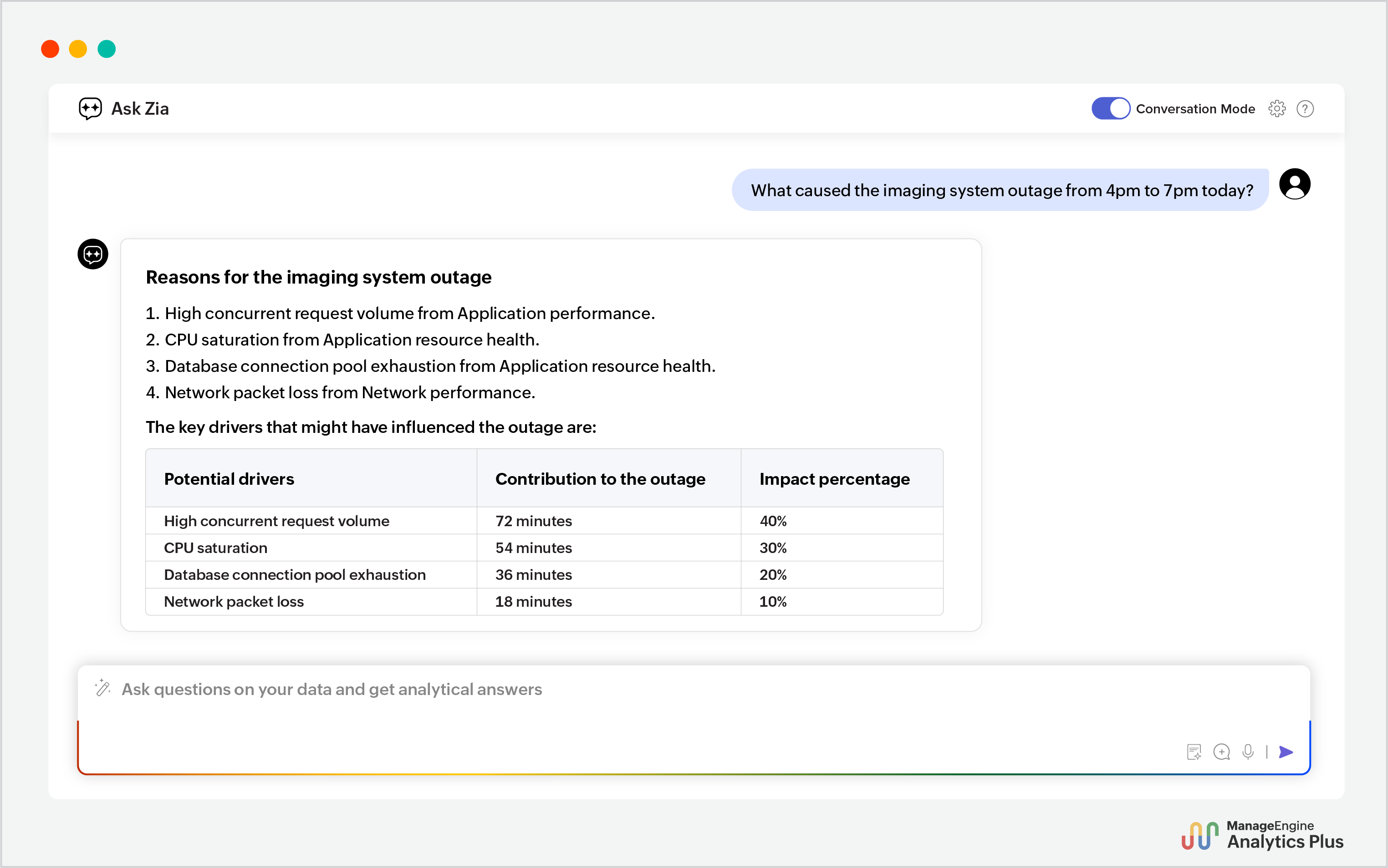
GenAI-powered analytics assistants like Ask Zia replace this manual investigation with conversational analysis, enabling faster remediation. With its advanced analytical and reasoning engine, it analyzes infrastructure telemetry data from application monitoring and observability platforms, correlates relevant metrics, and surfaces potential root causes of an outage in minutes.
For example, when an imaging system outage is detected, a technician can simply ask, What caused the imaging system outage? and Ask Zia will list the key drivers and rank them by impact in seconds.
But faster root cause diagnosis is only half the equation. The team still needs to strategize their next move, translating these insights into remediation actions. Ask Zia addresses this by recommending targeted, actionable remediation steps for each identified root cause.
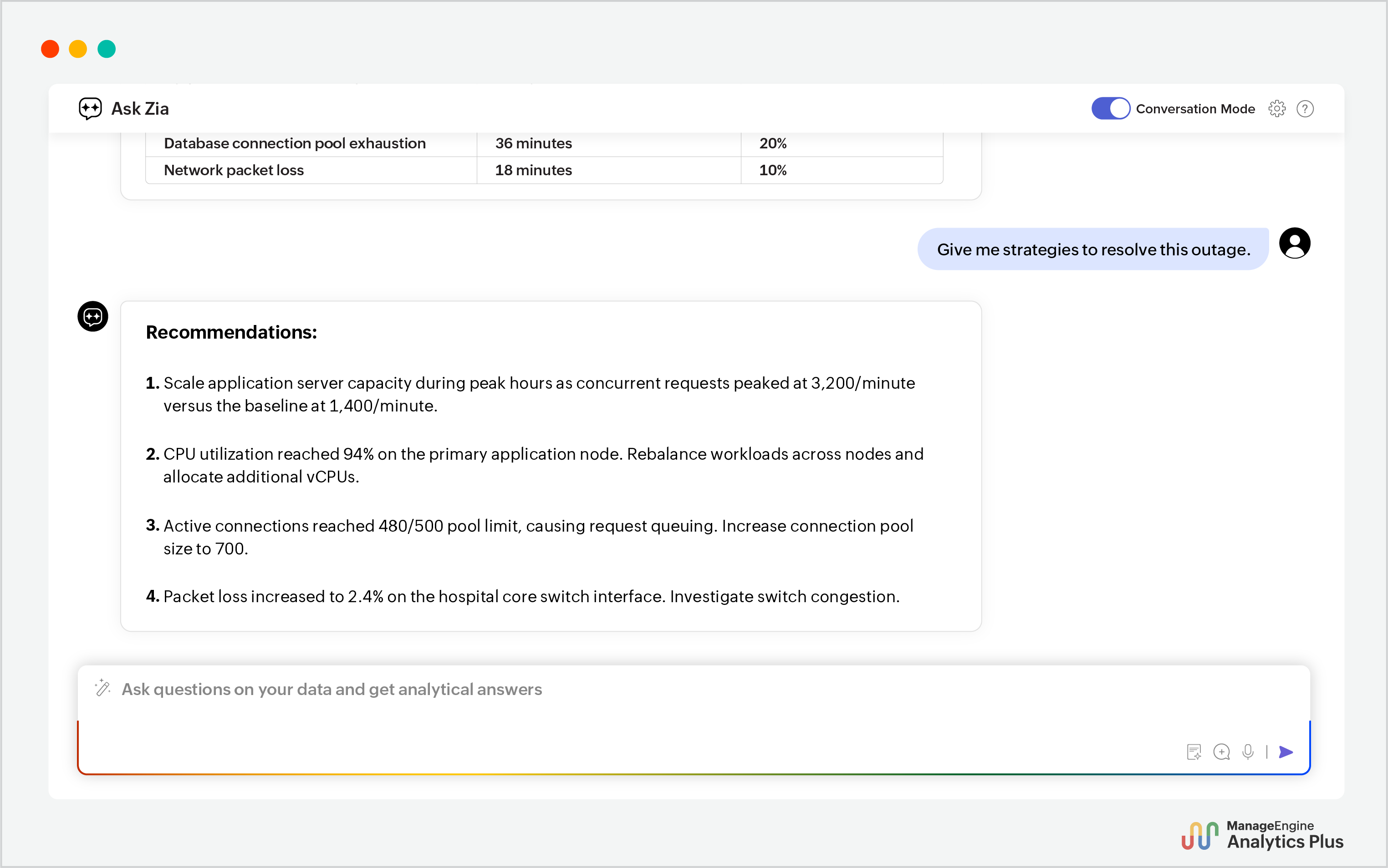
By accelerating both diagnosis and remediation with conversational analysis, healthcare ITOps teams can cut down incident response time and restore clinical systems with minimal disruption.
3. Isolating vulnerable IoMT devices
Healthcare enterprises today run thousands of connected Internet of Medical Things (IoMT) devices—from infusion pumps and patient monitors to imaging systems and ventilators. While these assist care delivery, each device can also become an attack vector for the exfiltration of sensitive patient data.
The traditional approach to secure IoMT devices is reactive and siloed. With thousands of devices across multiple floors and facilities, rule-based alerts and periodic reviews don't scale. Critical vulnerabilities can go undetected until a device fails or a security incident surfaces.
ML-powered cluster analysis offers a faster way to spot subtle but high-risk patterns across these devices. Unlike threshold-based tools that evaluate each device against a fixed rule, this analysis examines multiple operational signals and groups devices into dynamic clusters based on shared risk profiles.
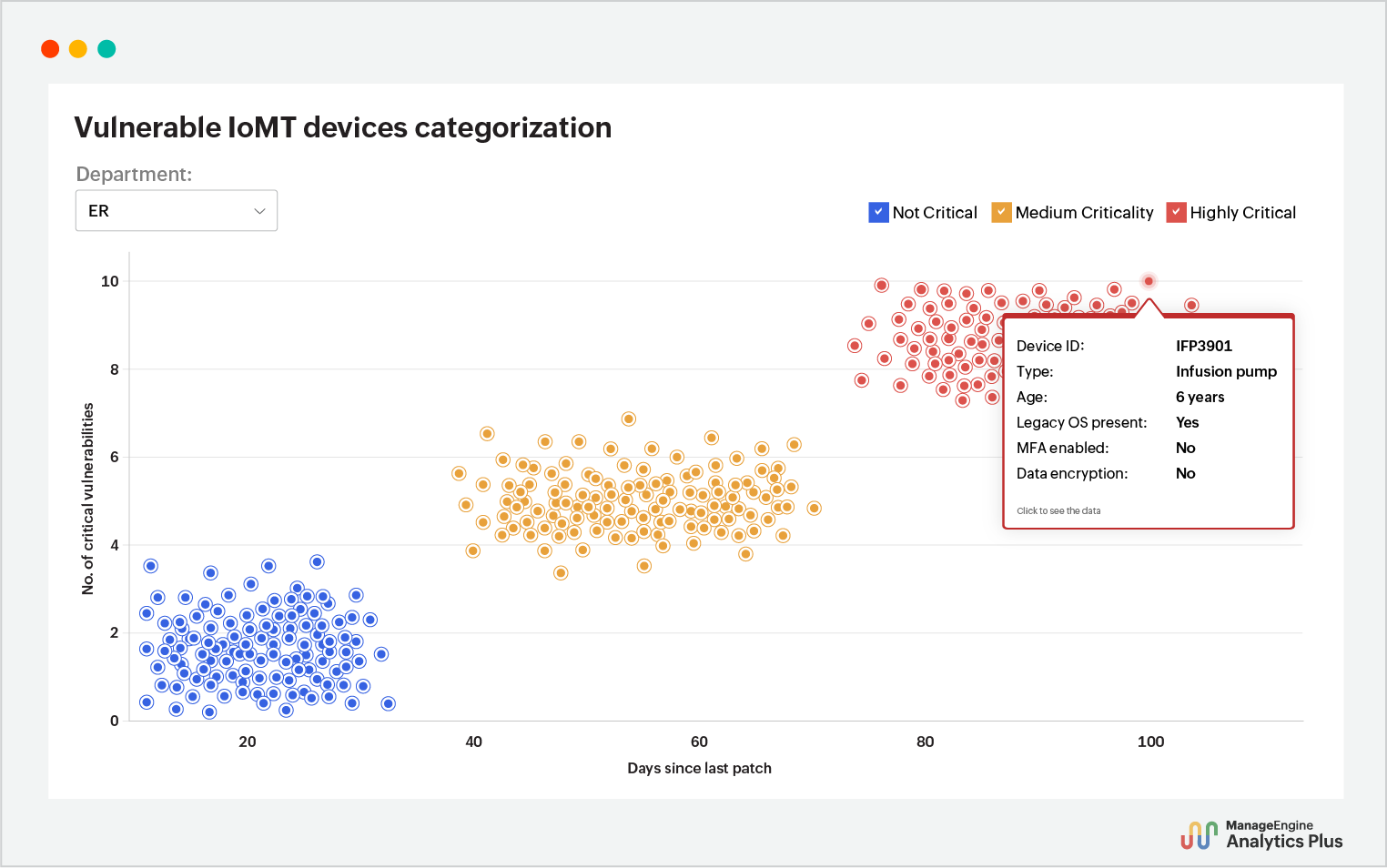
Instead of combing through countless reports, IT teams can ensure IoMT device security across the enterprise by easily surfacing devices carrying disproportionate risk and prioritizing intervention before a vulnerability becomes a breach.
4. Addressing network congestion across critical healthcare systems
Hospital networks often experience sudden congestion during peak clinical hours, when multiple systems compete for bandwidth. Large imaging transfers, telehealth sessions, EHR access, and continuous telemetry from thousands of connected IoMT devices can quickly saturate network segments.
Traditionally, IT teams detect congestion only after performance begins to degrade. Hospital network monitoring tools may show rising bandwidth utilization, but they offer little insight into how traffic demand will evolve over time.
Multivariate forecasting delivers this foresight. By analyzing historical bandwidth usage alongside influencing factors such as active device count, firmware update activity, device onboarding events, and telemetry transmission rates, NOC teams can forecast how network demand is likely to evolve across specific segments.
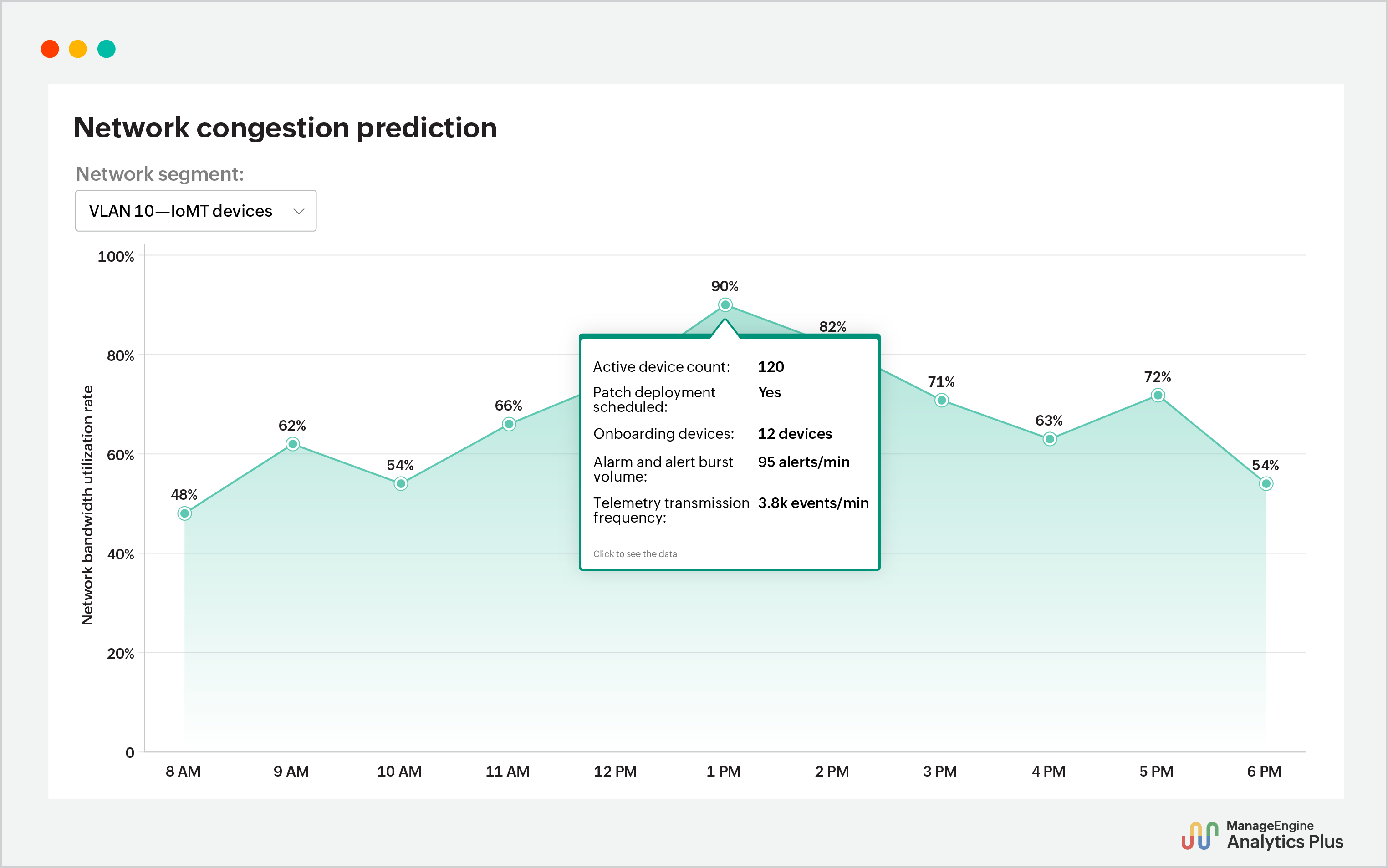
For instance, the above analysis detects that when the volume of active IoMT devices exceeds a certain threshold and patch deployments occur simultaneously, bandwidth utilization on the VLAN approaches critical levels.
By forecasting network demand across critical segments, healthcare IT teams can schedule device updates more strategically, balance network workloads, and prevent congestion from cascading into application slowdowns.
Conclusion
Healthcare organizations can't afford reactive IT operations in an environment where clinical applications, IoMT devices, and digital patient services must run continuously. The future of healthcare IT lies in anticipating disruption before it impacts care delivery. By combining unified insights, automated root cause analysis, and predictive intelligence, AI-powered healthcare analytics helps IT teams detect emerging risks, target interventions, and maintain system reliability across complex digital ecosystems.
The analyses included in this blog were created using ManageEngine Analytics Plus—a unified AI-powered IT analytics and decision intelligence platform. Try these AI capabilities today with a free, 14-day trial. Need to see what's in it first? Book a personalized demo.
Want more strategies to build resilient healthcare operations?
Learn to prevent downtime, address workforce burnout, and uncover hidden cost drivers in our e-book.