- HOME
- AI-Powered Analytics
- Agentic AI for ITSM: Building proactive enterprise service desks
Agentic AI for ITSM: Building proactive enterprise service desks
- Last Updated: April 1, 2026
- 3 Views
- 5 Min Read

Enterprise service desks are under mounting pressure to manage growing service complexity without increasing operational overhead, deliver frictionless employee experiences, and be a strategic enabler of rapid digital transformation.
Achieving these mandates requires moving beyond reactive support. Service desk teams need to anticipate issues, proactively find inefficiencies, and implement remediation before service quality drops.
Generative AI (GenAI) and agentic AI power this transition, delivering the conversational intelligence and closed-loop automation required to build proactive, self-optimizing service desks.
To see how this shift takes shape, let's first understand where traditional service desk practices fall short and how AI fills those gaps.
Limitations of traditional ITSM practices
As modern service desks increase in complexity and scale, proactively identifying what to fix and where to intervene is rarely straightforward. This challenge is amplified by these traditional ITSM practices:
Reactive and siloed monitoring: Issues like SLA breaches, asset failures, and workload imbalances are identified only after their impact is visible.
Slow and manual investigation: As traditional reporting only shows what happened, service desk managers spend hours correlating data across disconnected systems to find root causes while mean time to resolve climbs and more incidents pile up.
Fragmented remediation workflows: Remediation depends on human intervention and tool switching, delaying incident response.
GenAI-powered analytics and agentic AI eliminate these bottlenecks by turning ITSM data into instant, actionable insights—predicting failures, automating RCA, and orchestrating remediation workflows across systems.
Let's explore how these capabilities solve persistent service desk challenges.
3 ways to build proactive ITSM with generative and agentic AI
Building proactive ITSM requires changing how issues are detected, investigated, and acted upon across service desk operations. The sections below illustrate how generative and agentic AI enable this shift in practice.
1. Addressing technician workload imbalance with agentic AI
Service desk performance hinges on dynamic and balanced workload distribution, yet static assignment rules fail to adapt to real-time capacity and incident volume fluctuations. Workloads concentrate unevenly as tickets pile up in certain queues while underutilized technicians sit idle, affecting resolution times and SLA compliance—not from a lack of capacity but from misaligned distribution.
Identifying workload imbalances traditionally requires service desk managers to manually correlate metrics across assignment queues, ticket complexity, resolution velocity, and skill-based capacity across technicians to pinpoint where imbalances lie—an analysis that often takes hours.
Agentic AI transforms this manual process into automated intelligence. A unified IT analytics platform like Analytics Plus, augmented with MCP support, enables service desk managers to instantly surface workload imbalances and make remediation decisions through conversational queries in the LLM interface.
Within minutes, service desk teams can:
Automatically correlate relevant metrics and factors.
Plan multi-step remediation strategies.
Execute actions across disparate systems.
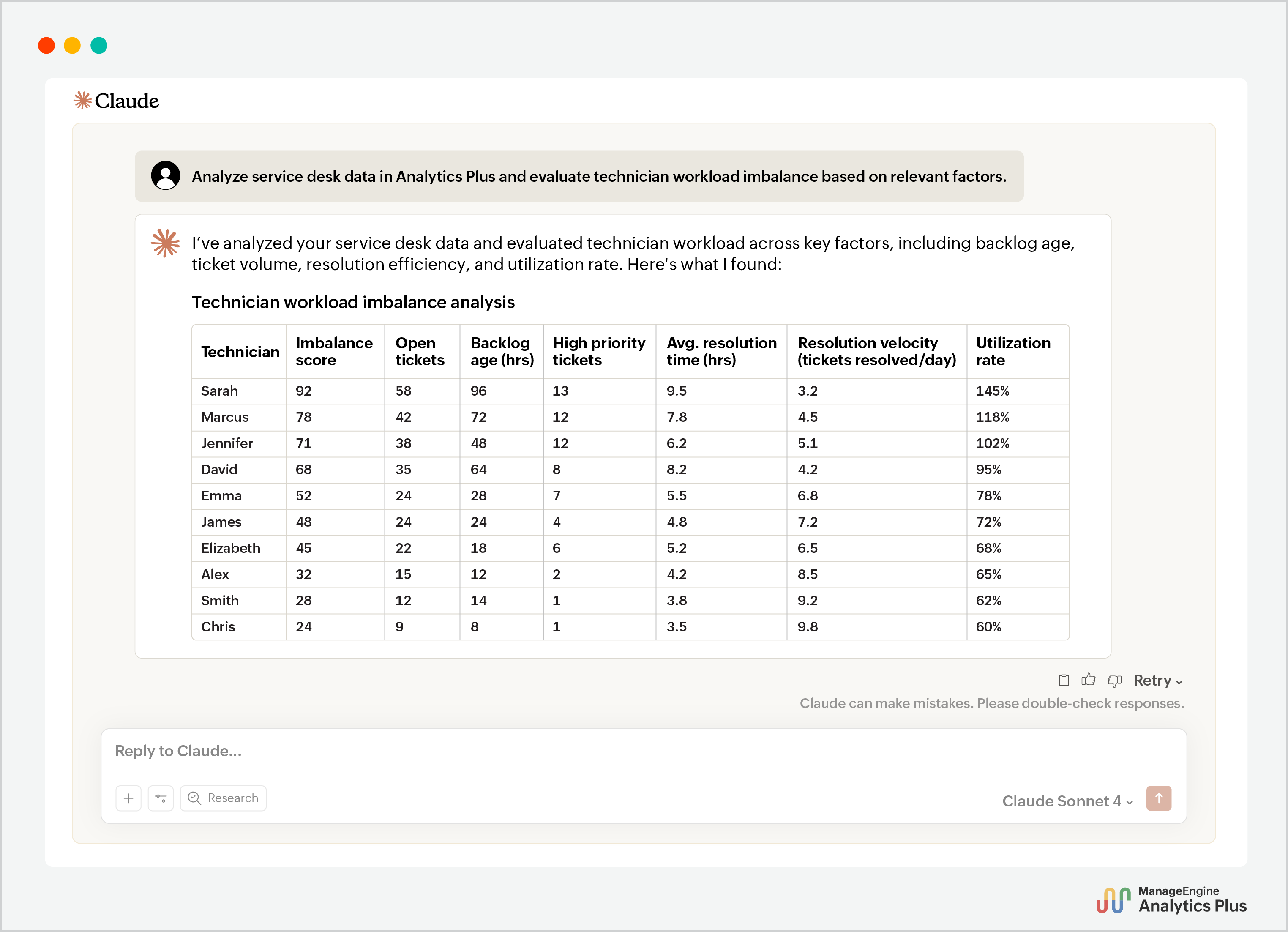
The LLM assigns a tailored workload imbalance score, with higher scores indicating a heavier workload. This is calculated for each technician by correlating seven key factors, revealing the true extent of imbalance beyond simple ticket counts. For instance, even though Emma and James have the same volume of open tickets, Emma's higher score accounts for her heavier high-priority ticket load.
Service desk managers can also leverage the LLM to get recommendations for actionable and data-backed remediation strategies.
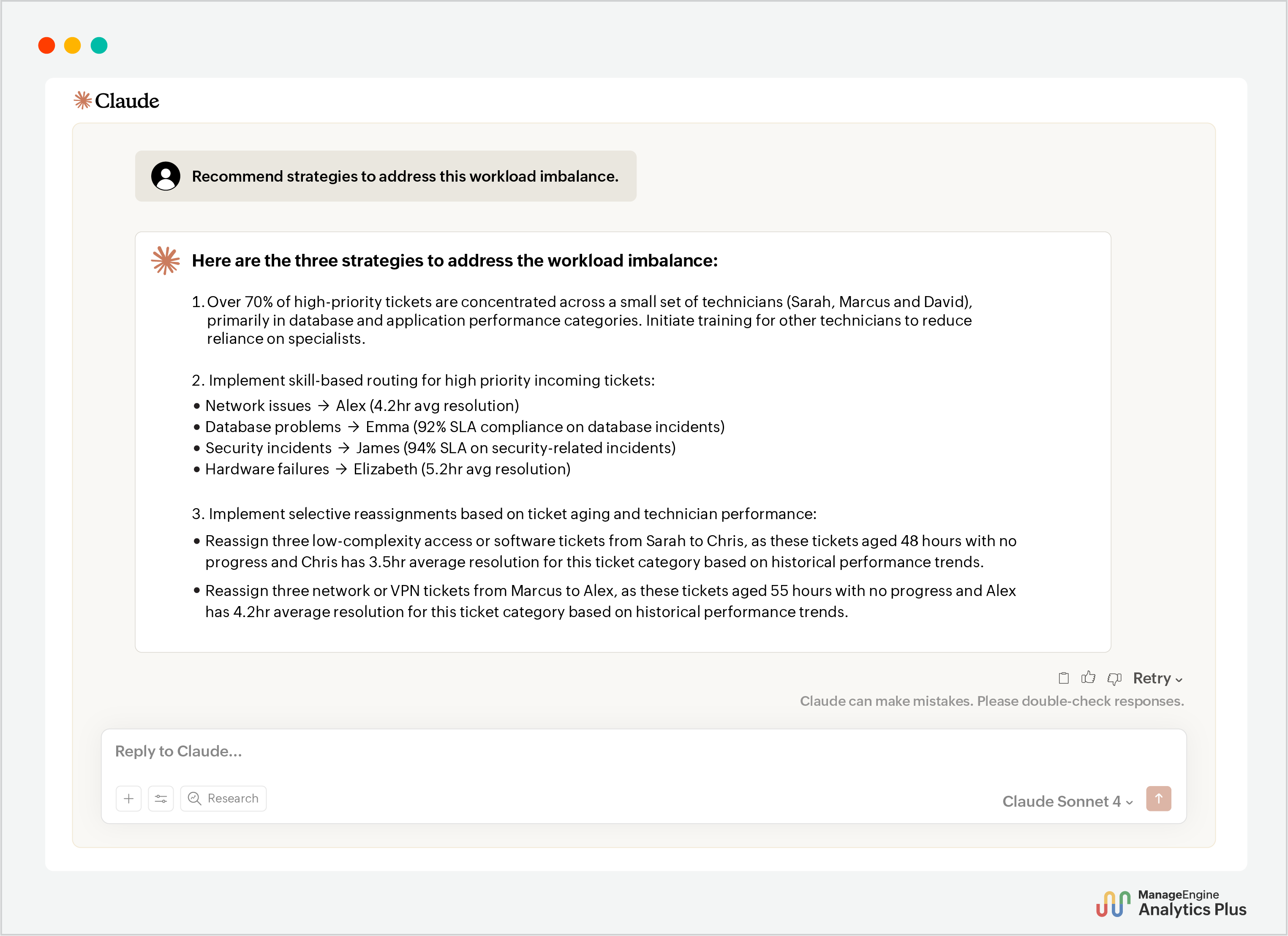
The LLM delivers actionable, data-driven remediation strategies grounded in workload optimization best practices—targeting aging tickets with minimal progress for reassignments based on technician performance and matching ticket categories to technician skills.
If the ITSM platform is MCP-enabled, service desk managers can orchestrate the entire remediation workflow from the LLM interface—implementing reassignments and routing rules without tool hopping. This transforms hours of manual coordination into seconds of conversational commands.
2. Automating root cause analysis of recurring incidents
Recurring incidents drain service desk capacity—the same issues resurfacing again, consuming technician time without permanent fixes. Manually uncovering root causes behind these issues requires correlating incident history with change records, asset health, and past resolution patterns—an investigation that takes hours while incidents continue accumulating.
This is where conversational root cause analysis using GenAI-powered analytics assistants like Ask Zia changes the approach. Service desk managers can simply ask the AI assistant, What is causing recurring incidents? and get a consolidated view of the contributing factors. By correlating patterns across the ITSM landscape, conversational AI helps service desks move from reactive firefighting to addressing the systemic causes driving recurring incidents.
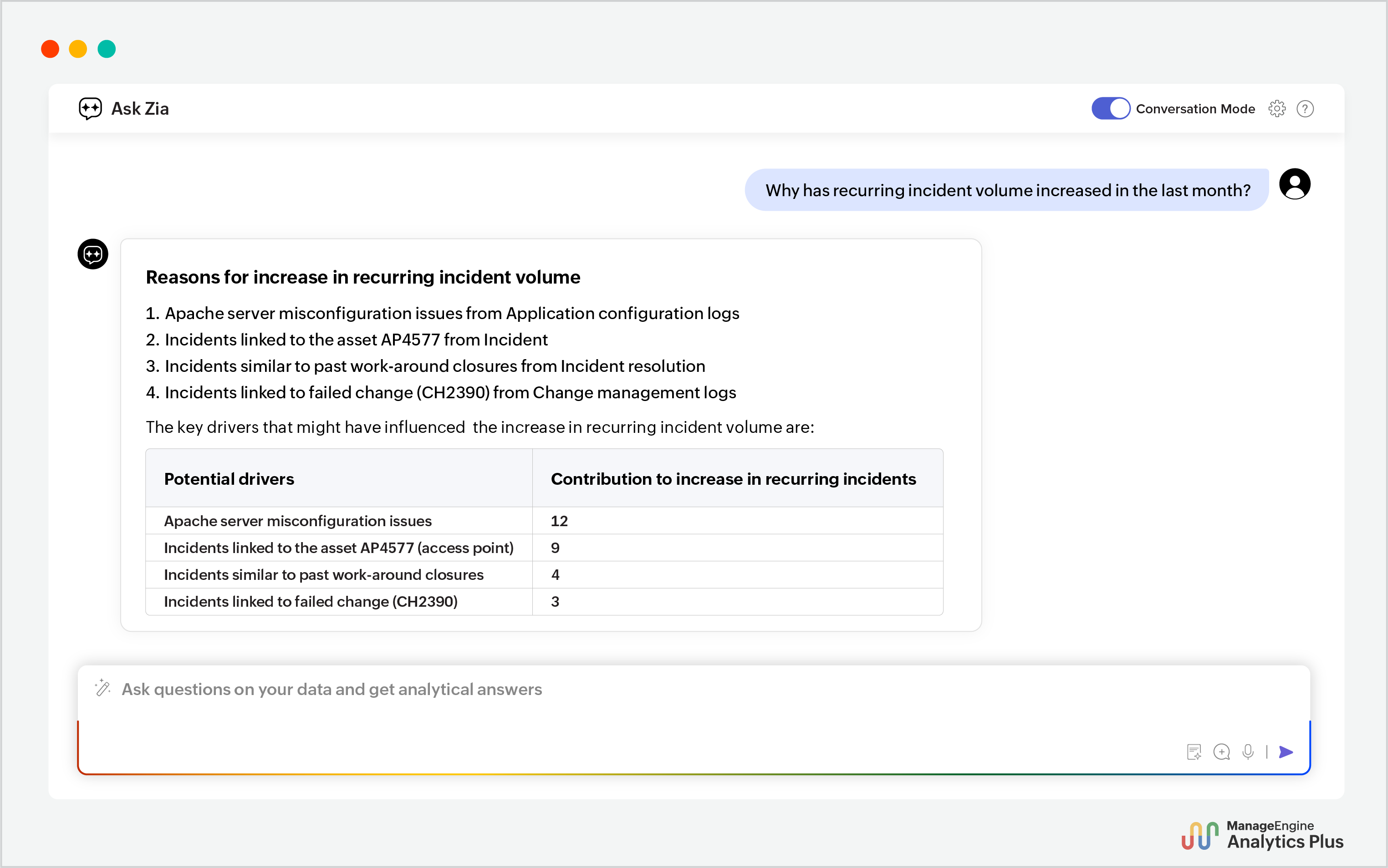
Ask Zia doesn't just surface root causes. It also recommends actionable, data-backed remediation strategies to address each factor, eliminating the need to translate root causes into next-best actions.
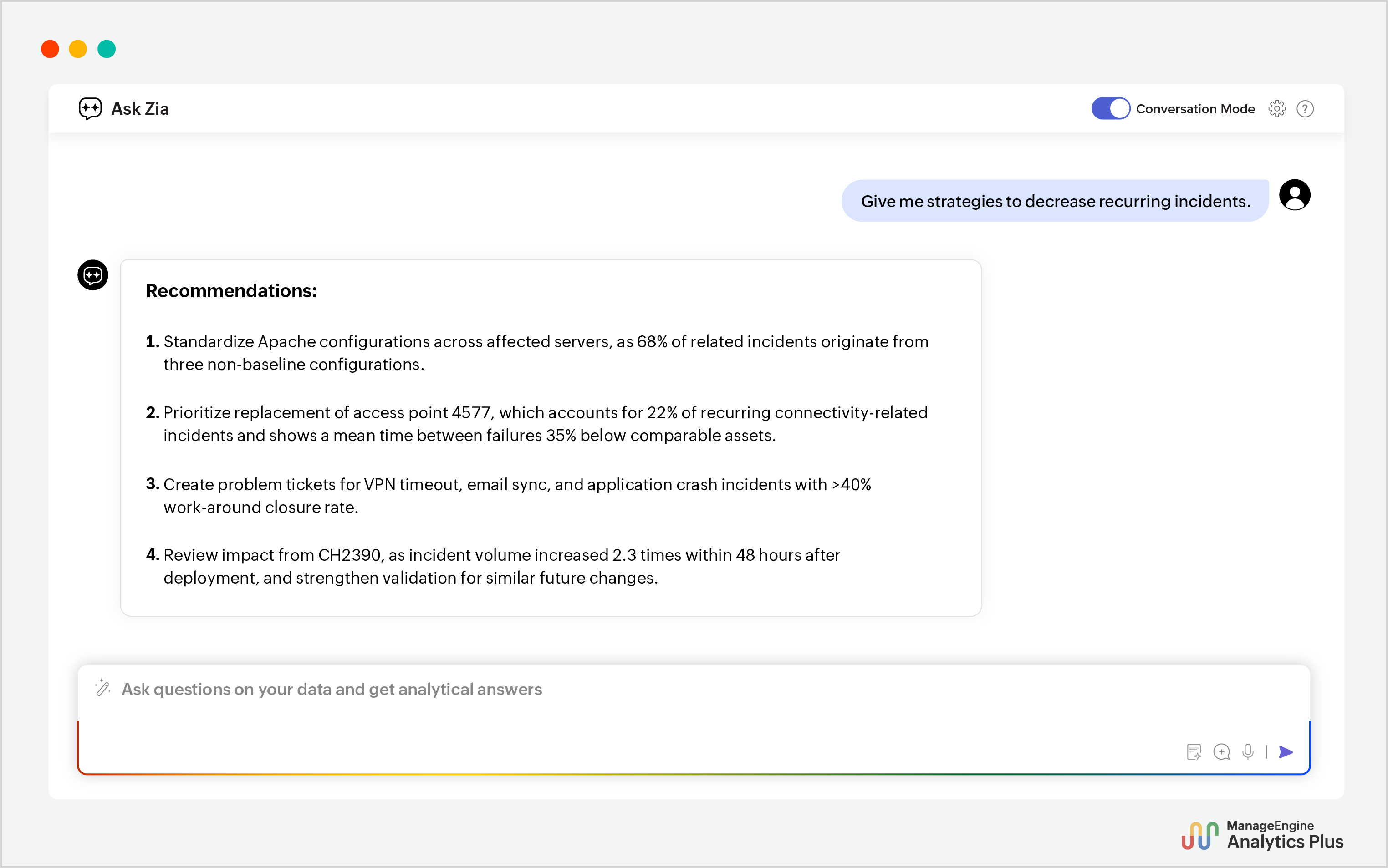
Rather than offering generic guidance, it highlights targeted fixes tied to specific assets, configurations, and incident closure practices. This context helps teams act with confidence and focus remediation efforts where they will have the greatest impact.
3. Proactive asset life cycle optimization with conversational AI
Service desks sit at the intersection of asset upkeep and service reliability. Without accurate understanding of how maintenance influences service stability, teams struggle to distinguish assets that can be retained from those quietly becoming a recurring burden. As a result, life cycle optimization decisions are often delayed until service impact is unavoidable.
Conversational AI like Ask Zia breaks this reactive cycle with instant, decision-ready insights. Instead of manually analyzing reports and correlating metrics across dashboards, teams can ask simple, natural language questions and get immediate visual insights that highlight relevant metrics and trends.
By analyzing incident, downtime, and maintenance data through a single line of reasoning, teams gain clarity on:
Assets that stabilize after maintenance
Assets that show diminishing returns and generate recurring tickets despite intervention
Assets that have reached the inflection point where replacement costs less than ongoing repairs
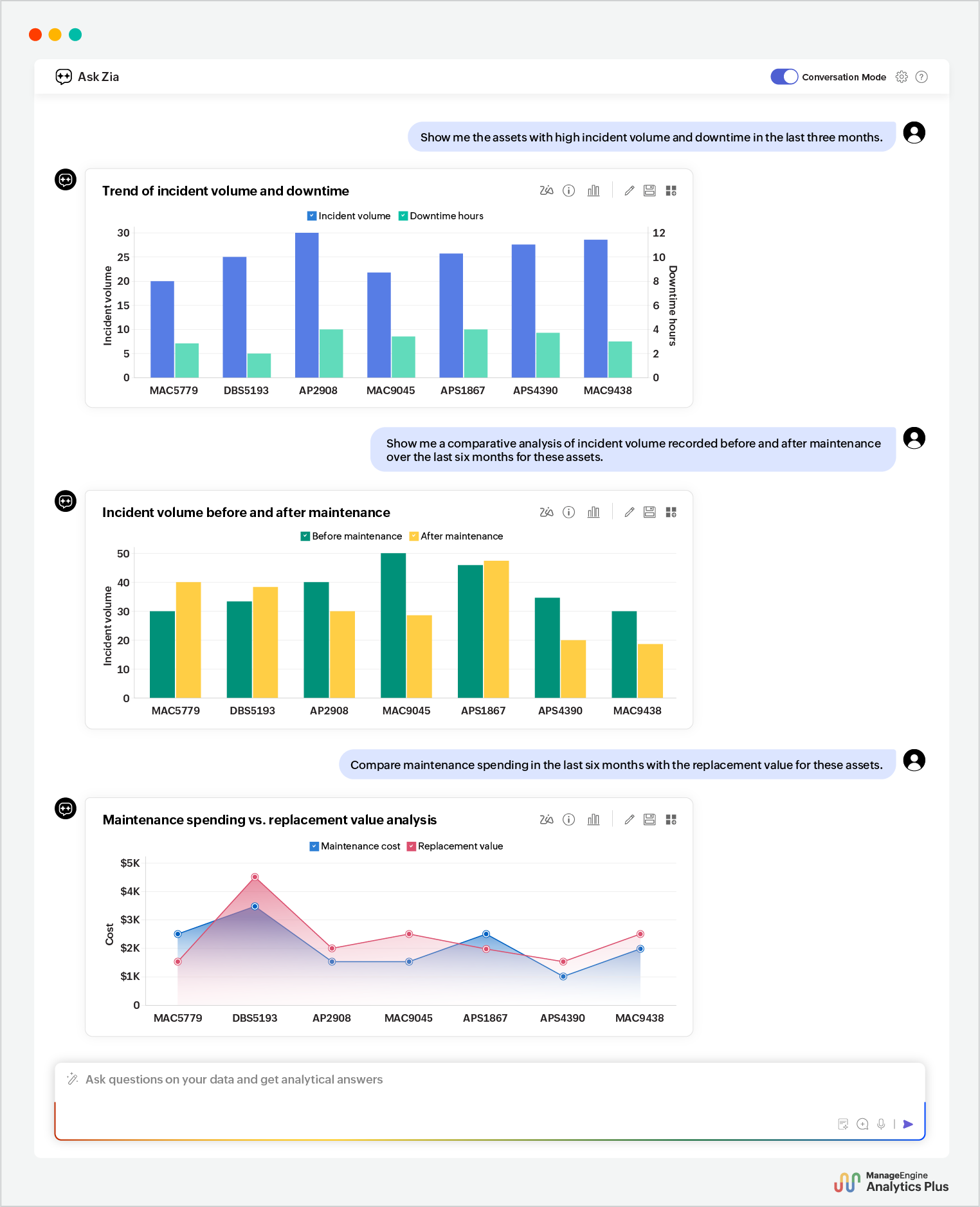
This GenAI-powered analysis transforms asset life cycle optimization from complex, manual analysis into continuous, proactive governance.
Equipped with these insights, ITAM leaders can move beyond reactive maintenance by identifying which assets are driving repeat incidents, validating whether maintenance is actually reducing disruption, and projecting the operational impact of inaction. Instead of guessing when assets need life cycle attention, they can proactively intervene before facing high break-fix incidents.
Start building intelligent and self-optimizing service desks with agentic AI
GenAI and agentic AI enable service desk teams to uncover insights and get remediation strategies effortlessly, facilitating precise, data-backed decisions without tedious analysis. What traditionally required manual correlation, report building, and context switching now happens in seconds. The result: balanced teams, optimized spend, and service desks that operate as strategic enablers rather than reactive cost centers.
The analyses included in this blog are created using ManageEngine Analytics Plus—an AI-powered IT analytics and decision intelligence platform. Try these AI capabilities today with a 15-day, free trial. Need to see what's in it first? Book a personalized demo.
Want strategies to build AI-powered, proactive service desks?
Learn to prevent SLA breaches, and forecast asset failures and incident spikes in our e-book.