- HOME
- Compliance analytics
- How to get a Cyber Essentials certificate
How to get a Cyber Essentials certificate
- Last Updated: September 22, 2026
- 106 Views
- 7 Min Read

Have you ever been in stressful situations because the stakes are too high? You make a to-do list of all that needs to be done, work meticulously, cross them off one by one, check and recheck everything only to find out you missed the simplest details. The easiest, most routine tasks you do everyday become the most poorly executed. Something identical happens with organizations' compliance analytics when trying to earn a Cyber Essentials certificate.
What is a Cyber Essentials certificate?
A Cyber Essentials certificate is an official state-sponsored credential in the United Kingdom that states that an organization has implemented basic defenses against the most common cyber threats. Supervised by the NCSC and IASME, this credential enforces five core controls to defend operations from online threats and qualifies organizations for government tenders.
Cyber Essentials certification requires annual renewal, so your security controls must remain effective year-round. As your environment changes, continuous compliance monitoring helps you detect and address gaps before they become assessment blockers.
Why Cyber Essentials certification gets complicated, fast
In theory, getting Cyber Essentials certified can seem straightforward. But in practice, its five controls span across almost everything in your environment at the same time—your network boundaries, devices, and user accounts. The re-certification process happens every year, which means you're not proving these controls exist just once; you're proving they've held up continuously since your last Cyber Essentials audit.
Add cloud services, remote endpoints, and BYOD devices to the mix, and the scope of what falls under those five controls keeps expanding. The Cyber Essentials audit process becomes more complex as your organization grows.
What's stopping you from getting your Cyber Essentials certificate?
The Cyber Essentials certification doesn't grade on a curve. One unmanaged firewall rule, one unpatched laptop, or one account with more access than necessary can sink an otherwise clean assessment—even when other four controls are in good shape.
What makes this risk difficult to catch is where the evidence lives. Firewall configurations sit in the network management tool. Patch status sits in the endpoint management tool. User access sits in the identity manager and malware protection status is in the antivirus console. This makes your compliance data unmanaged and messy. Painting one Cyber Essentials certification-ready picture means logging into a multitude of disconnected consoles every single cycle.
In addition to this, most teams only piece evidence together right before the Cyber Essentials audit. Drift goes unnoticed until then: a firewall rule quietly loosened, a new admin account created and forgotten, or a patch missed three months ago. None of these get flagged until it's too late. The Cyber Essentials assessment is notorious for its strict timelines—for example, any critical, high, or CVSS 7+ vulnerability must be patched within 14 days of release. This is a deadline that's nearly impossible to hit with manual validation once you're managing more than a few hundred endpoints.
Such last minute scrambles is exactly what continuous compliance monitoring prevents, powered by compliance analytics.
Succeed in your next Cyber Essentials certification through continuous compliance monitoring
The fix isn't a bigger spreadsheet or a more disciplined pre-audit fire drill. It's a unified compliance dashboard built around the five controls a Cyber Essentials audit evaluates, pulling real-time compliance data from your network, endpoint, and identity tools into one powerful view. It also helps you contextually understand why a control slipped, not just that it did.
With a unified compliance analytics solution, like ManageEngine Analytics Plus, that dashboard comes pre-structured and ready to use around the five controls—no manual mapping or report-building from scratch to refer hours before a Cyber Essentials certification assessment. Every control is monitored continuously, so audit readiness stops being annual scramble and becomes something you can check on any random Tuesday.
AI-driven analysis further correlates patch activity, access logs, and configuration changes to surface insights on what changed and where to act first.
Real-time monitoring that continuously validates your compliance posture beats evidence you have to go hunting for once an year.
Your Cyber Essentials certificate awaits behind five checkpoints
The pre-built Cyber Essentials compliance dashboard is categorized into five tabs, with each one dedicated to a Cyber Essentials control. This gives security teams a magnifying glass to monitor compliance data specific to each control.
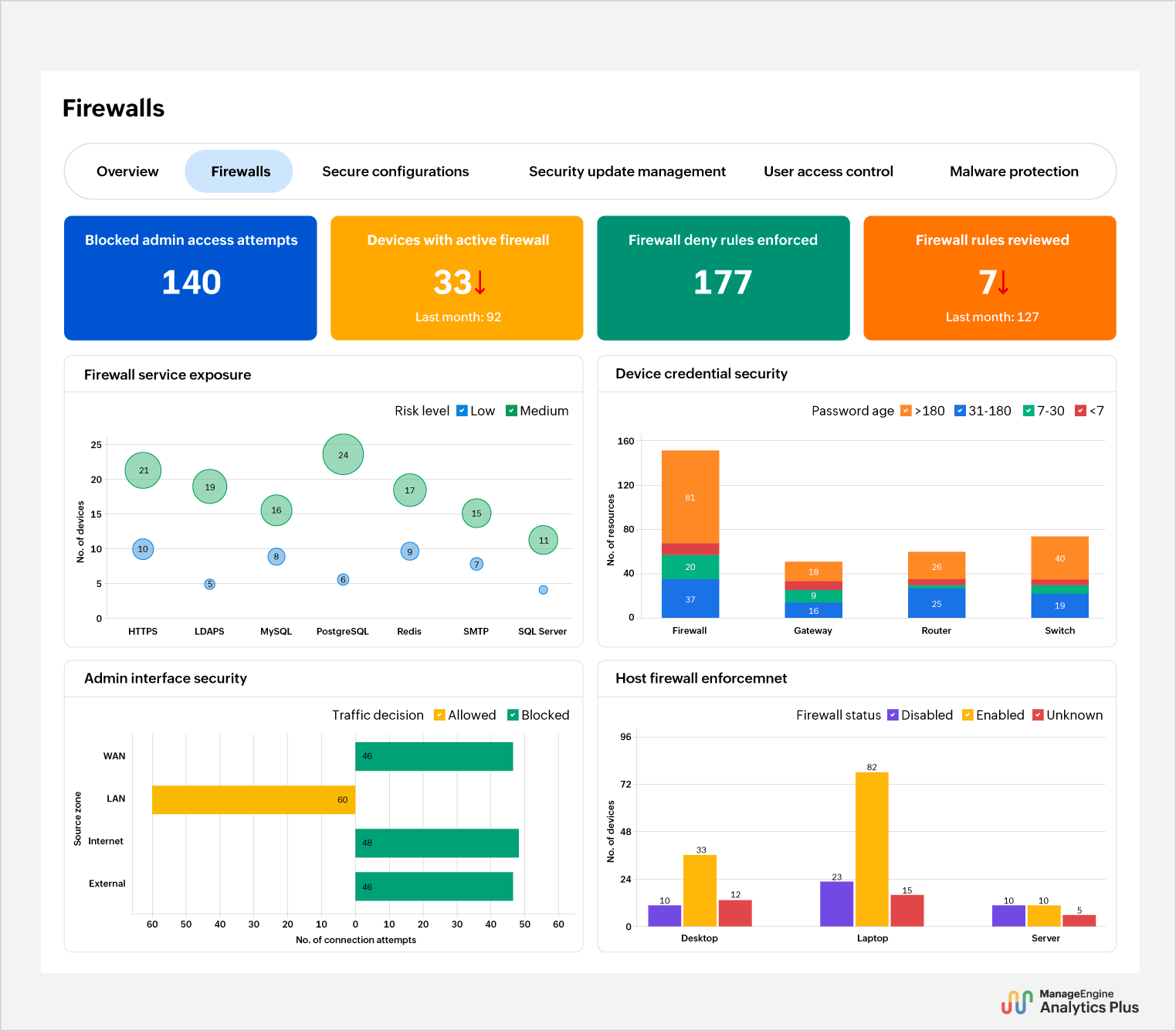
Firewalls
Firewall rules and network events usually live inside your network monitoring tools, making it hard to tell whether a misconfigured rule is a minor cleanup item or the one obstacle standing between your organization and a passed audit.
In the Firewall tab, Analytics Plus unifies firewall rule status, network traffic, and boundary configuration insights into one single view. Any compliance gap shows up in context next to your patch status and your access data instead of buried in a separate console that nobody checks until audit time.
Secure Configuration
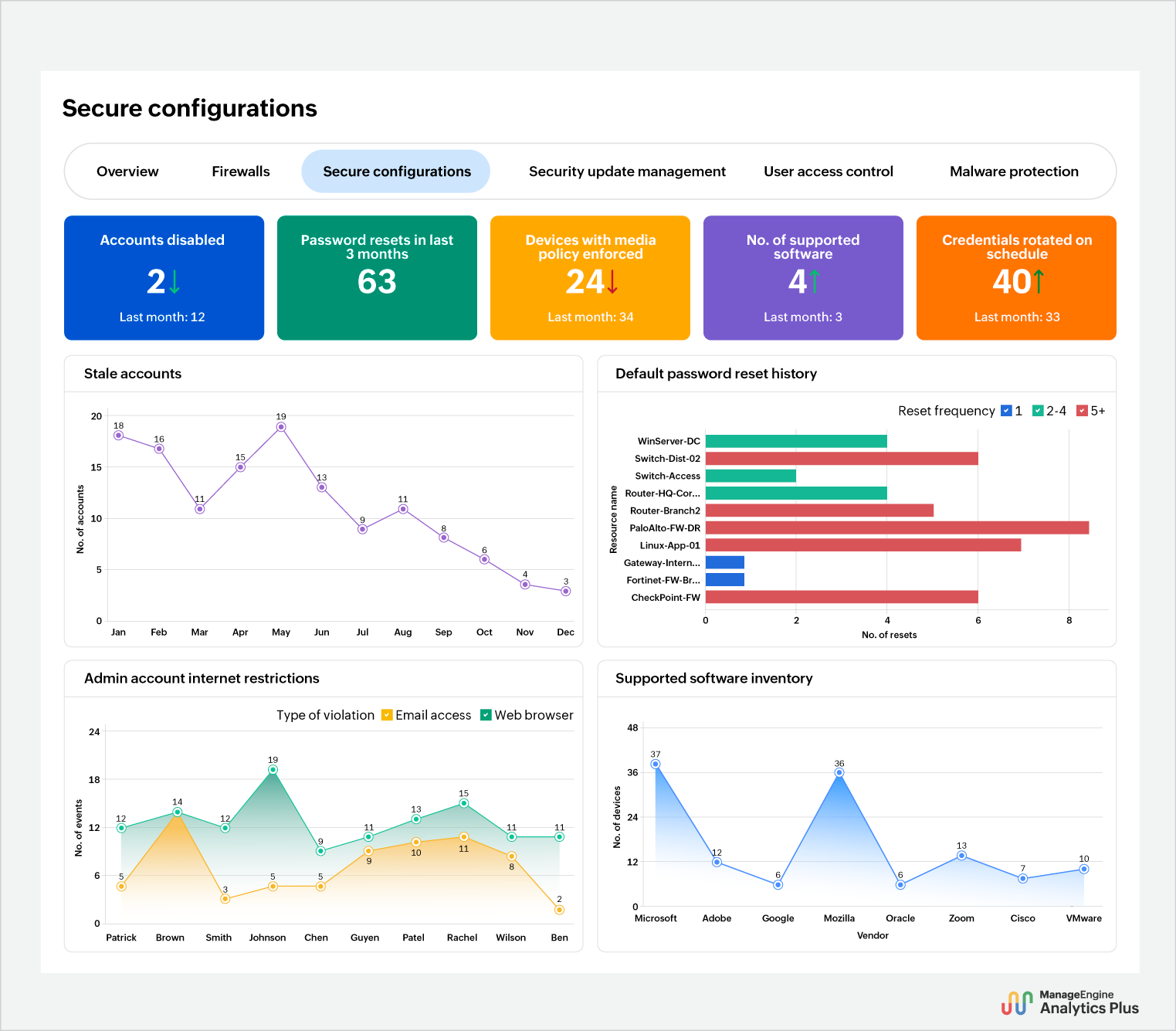
Hardening standards drift the moment a new device gets provisioned or new software gets installed. Manually auditing every endpoint against a baseline doesn't scale past a handful of machines, let alone a few thousand.
The Secure Configurations tab tracks the security hardening efficiency of your organization's network in real-time, flagging deviations as they happen instead of a few hours before your Cyber Essentials audit. For larger environments running CIS-benchmarked gold images across fleets of endpoints, this proactive approach is the difference between an impromptu compliance check and actually maintaining compliance and security.
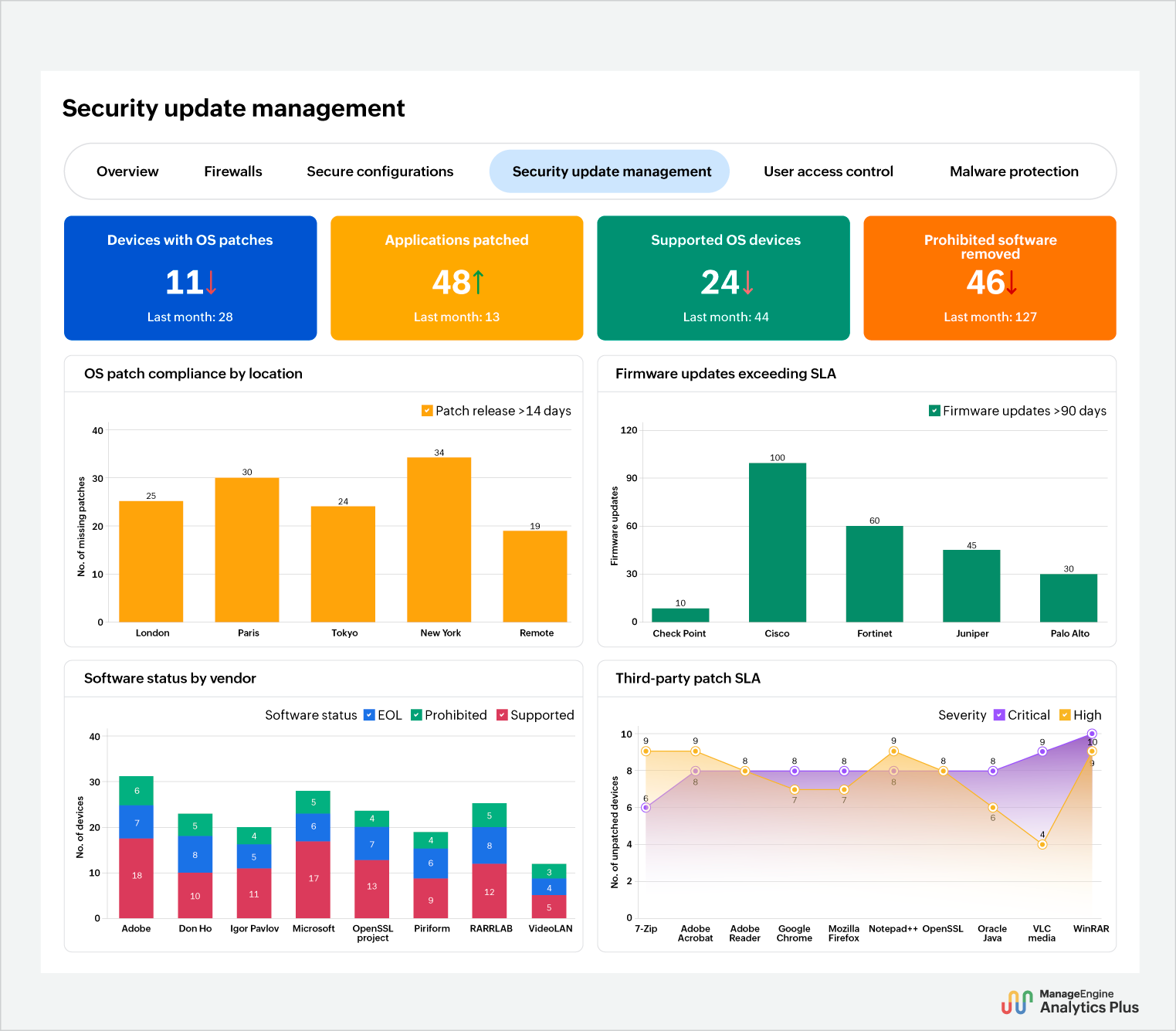
Security Update Management
The 14-day patching rule to qualify for the Cyber Essentials certificate is where most enterprises are eliminated. Sure, they can deploy patches—but they often fail to prove if every critical vulnerability was closed within the mandated window.
Analytics Plus tracks this insight directly in the Patch Management tab: Any vulnerability rated seven or higher on the CVSS scale, or marked critical or high and has been public for more than 14 days, shows up as an active gap.
Correlate this with a deployment pipeline running test, pilot, and production rings and teams get a unified, auditable record of what shipped on time and what's still outstanding.
User Access Control
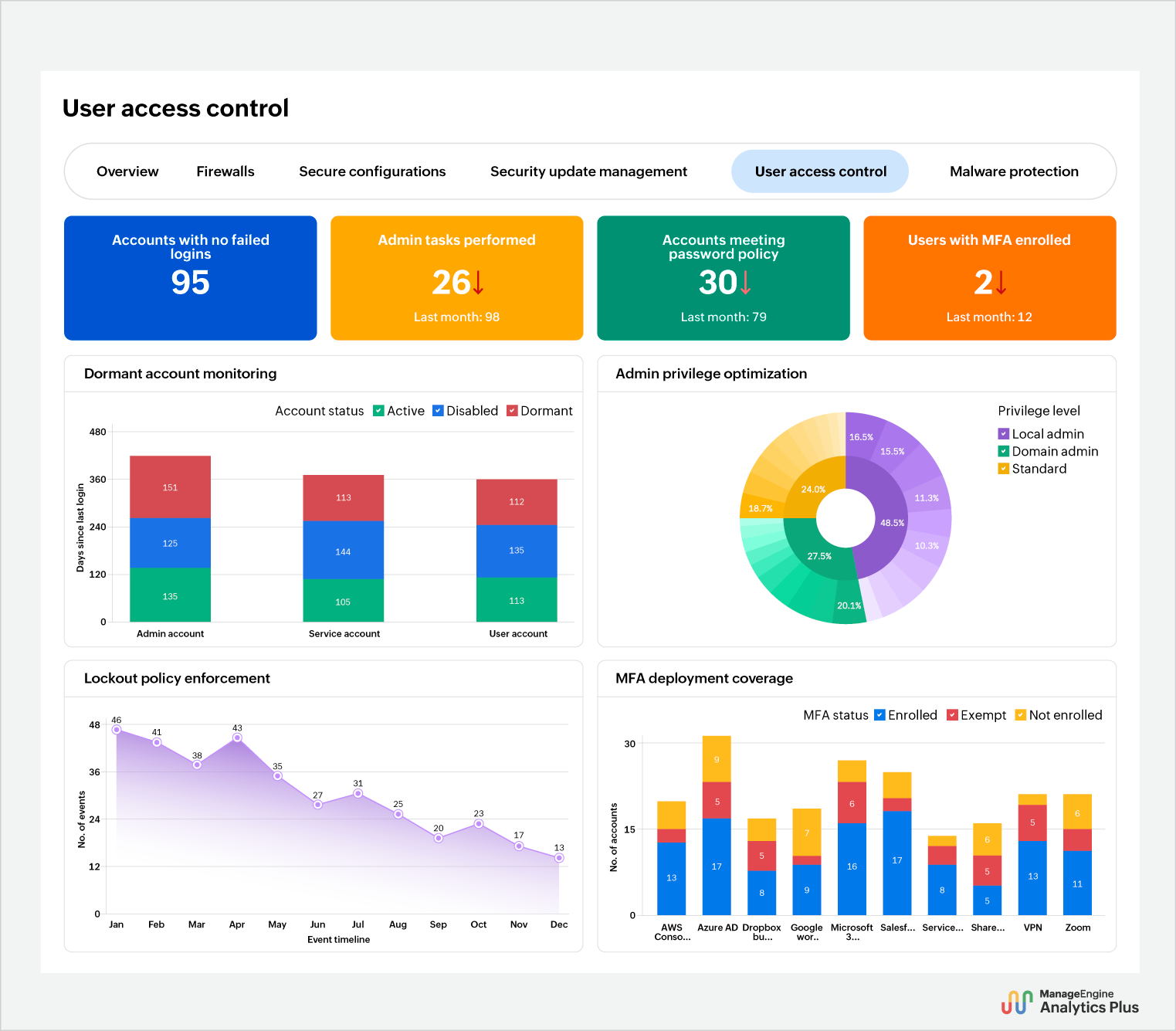
Standing admin rights is one of the most commonly missed reasons why a Cyber Essentials certificate stalls. Standard users quietly accumulate local admin access over time, and permanent domain admin accounts sit collecting dust long after their project requirements have ended.
The User Access Control tab flags local administrator leaks and tracks MFA coverage across user accounts, cloud admin roles, and third-party extensions in one place. For teams moving toward just-in-time access instead of permanent privilege, this continuous visibility is what changes we think our access controls are fine into a fact you can actually rely on during a Cyber Essentials audit.
Malware protection
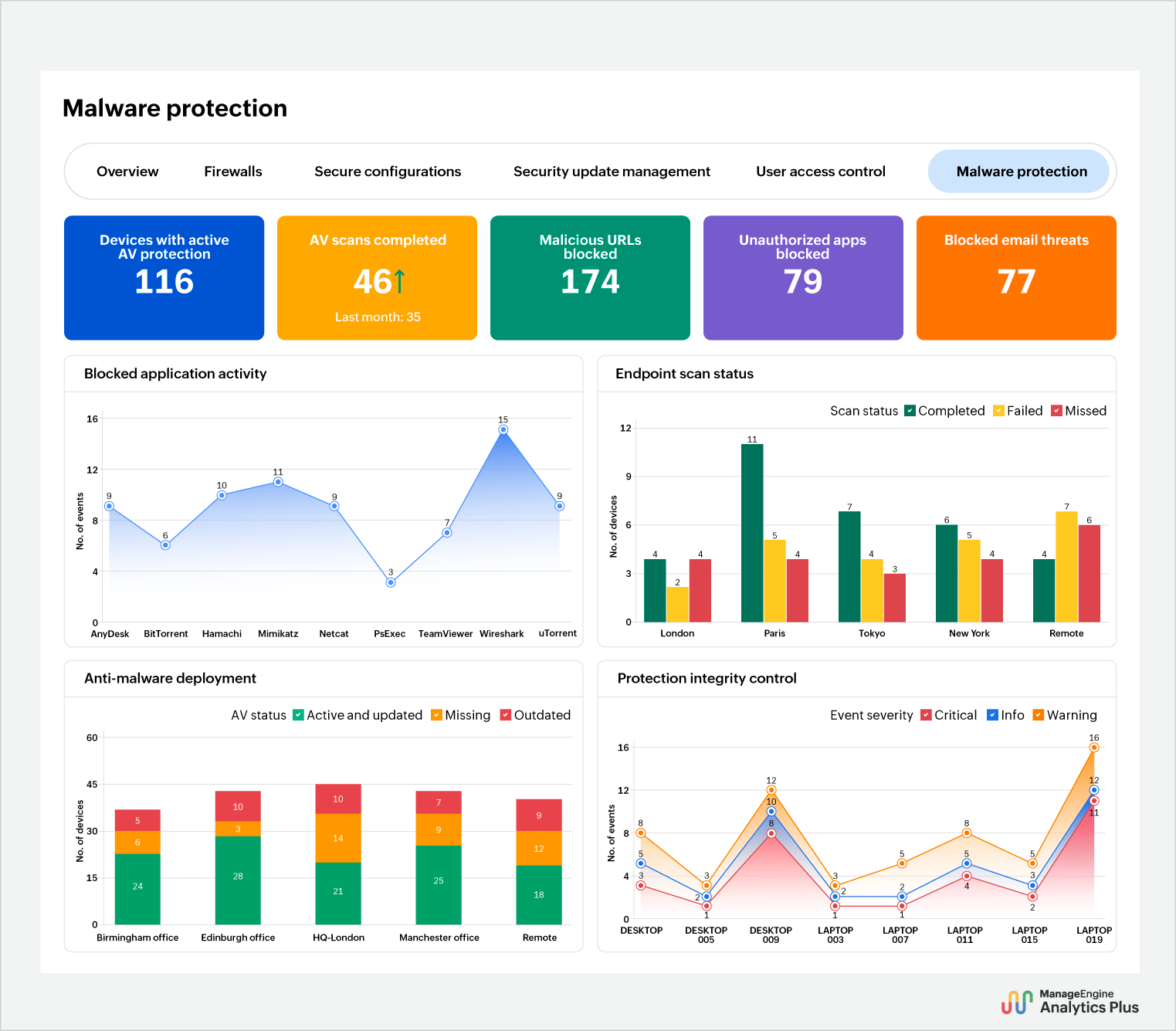
Antivirus and antimalware solutions are commonly neglected aspects of an organization's security strategy, often isolated to their own consoles. This often means a lapsed agent or an outdated definition file can go unnoticed for weeks.
Analytics Plus unifies malware and endpoint protection statuses into a continuously monitored view in the Malware Protection tab, so a device falling out of coverage is instantly identified and addressed.
Have what it takes to be Cyber Essentials certified
Zoom out from a single control, and the pattern is the same across all five: Compliance data that lives in disconnected tools can't tell you anything until someone manually stitches it together, and by the time they do, it's already stale. Compliance analytics that pull from every monitoring tool continuously can deliver powerful compliance insights, without any manual scramble.
The transition from assembling proof once a year to always having it continuously accessible is what separates organizations that breeze through their Cyber Essentials certification from those that face a mad rush each year.
Cyber Essentials Certification shouldn't be an annual scramble.
Cyber Essentials audit anxiety fades when you start treating it like a habit and cross all five controls off your to-do list at once. But this is much harder to prove when your compliance evidence is scattered across separate tools.
Consolidate that evidence into one continuously updated, certification-aligned unified dashboard, and the scramble disappears. Instead of searching for compliance data every renewal cycle, your team stays stress-free in a constant state of readiness, and detects compliance gaps the moment they appear.
More compliance dashboards on the way!
We’re continuously expanding our library of prebuilt compliance dashboards to help organizations simplify reporting across more frameworks. If you’re searching for a specific compliance dashboard, reach out to us at analyticsplus-eval@manageengine.com.
FAQs
1. What is Cyber Essentials?
Cyber Essentials is a government-backed cybersecurity certification in the United Kingdom that confirms an organization has implemented basic defenses against common cyber threats. The Cyber Essentials certification covers five essential controls: firewalls, secure configuration, security update management, user access control, and malware protection.
2. Who needs a Cyber Essentials certification?
Cyber Essentials certification is relevant to organizations that need to demonstrate that their environment is well equipped to protect their operations from common online threats. It is also required for organizations seeking to qualify for certain UK government tenders.
3. How long does Cyber Essentials certification last?
A Cyber Essentials certificate is valid for 12 months and requires annual renewal. Organizations must complete a fresh assessment each year; otherwise, the certificate expires and they are removed from the NCSC certified list. This means organizations must ensure their five core security controls remain effective throughout the certification period. The unified Cyber Essentials compliance dashboard proves crucial here, helping teams identify configuration changes, missed patches, access issues, and other compliance gaps as they occur, keeping the organization Cyber Essentials certified and assessment-ready.
4. What happens if you fail Cyber Essentials certification?
Failing a Cyber Essentials assessment implies the organization has not met one or more of the required security controls and so, a review process follows with a remediation window. This window allows you to address the flagged issues. The assessor then retests the fixes, and once verified, that part of the assessment is marked as passed. It is worth remembering that even a single issue can prevent successful certification. Continuous compliance monitoring helps organizations proactively identify and address compliance gaps, making it easier to maintain the controls required for Cyber Essentials certification.