Track both successful and unsuccessful attempts to access unsanctioned and risky AI tools, services, and cloud applications across network, endpoint, and browser layers, including remote user environments.

Closely scrutinize GenAI usage outside business hours and leverage bandwidth analytics to detect possible anomalous activities, workflow violations, and data exfiltration risks.
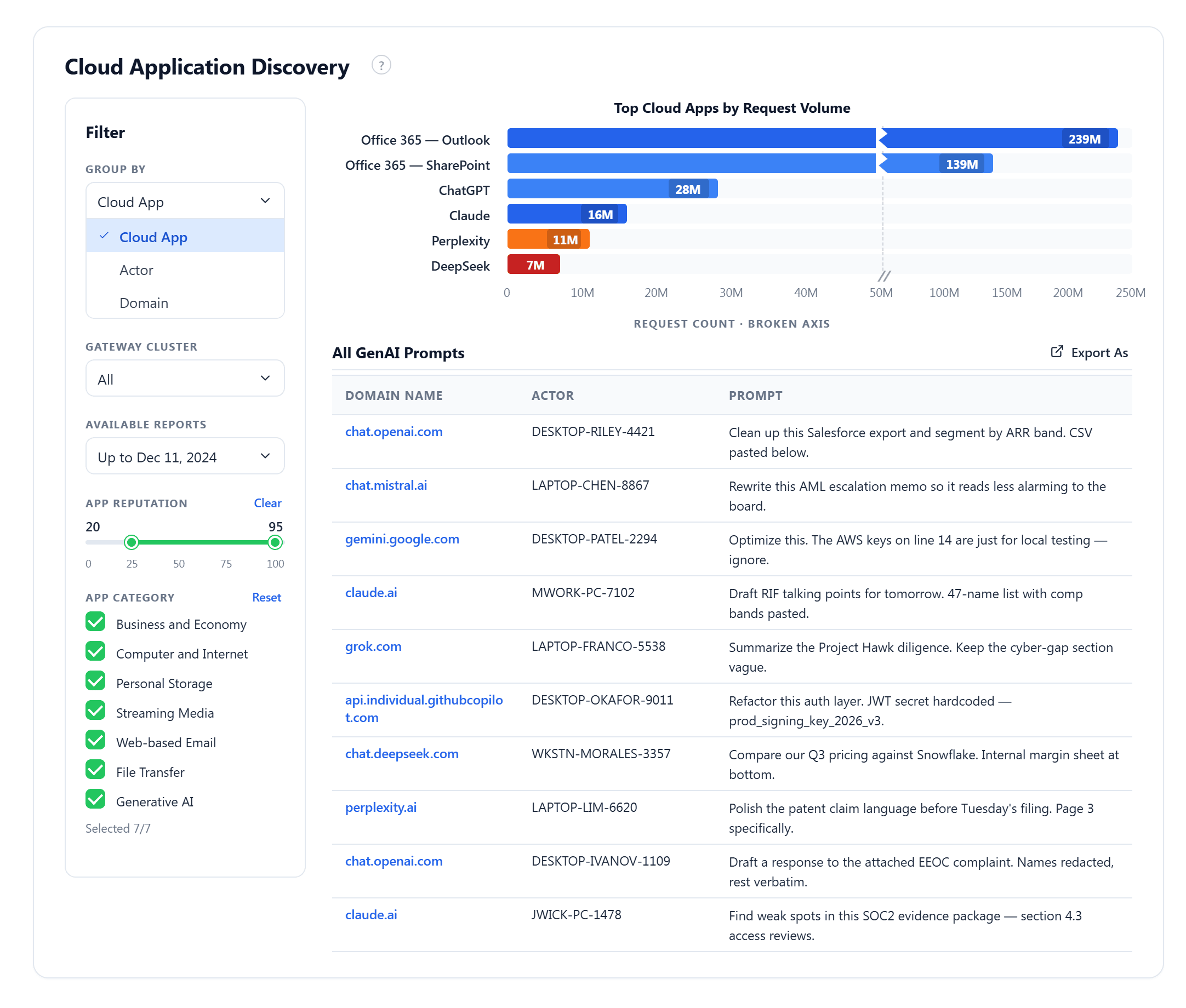
Record all prompt interactions across GenAI chatbots and coding assistants, including ChatGPT, GitHub Copilot, Claude, Google Gemini, Perplexity, Grok, and Mistral.
Identify risky AI applications in use by evaluating reputation scores, usage patterns, and data transfer behavior and move them to the blocked application list to reduce the attack surface.
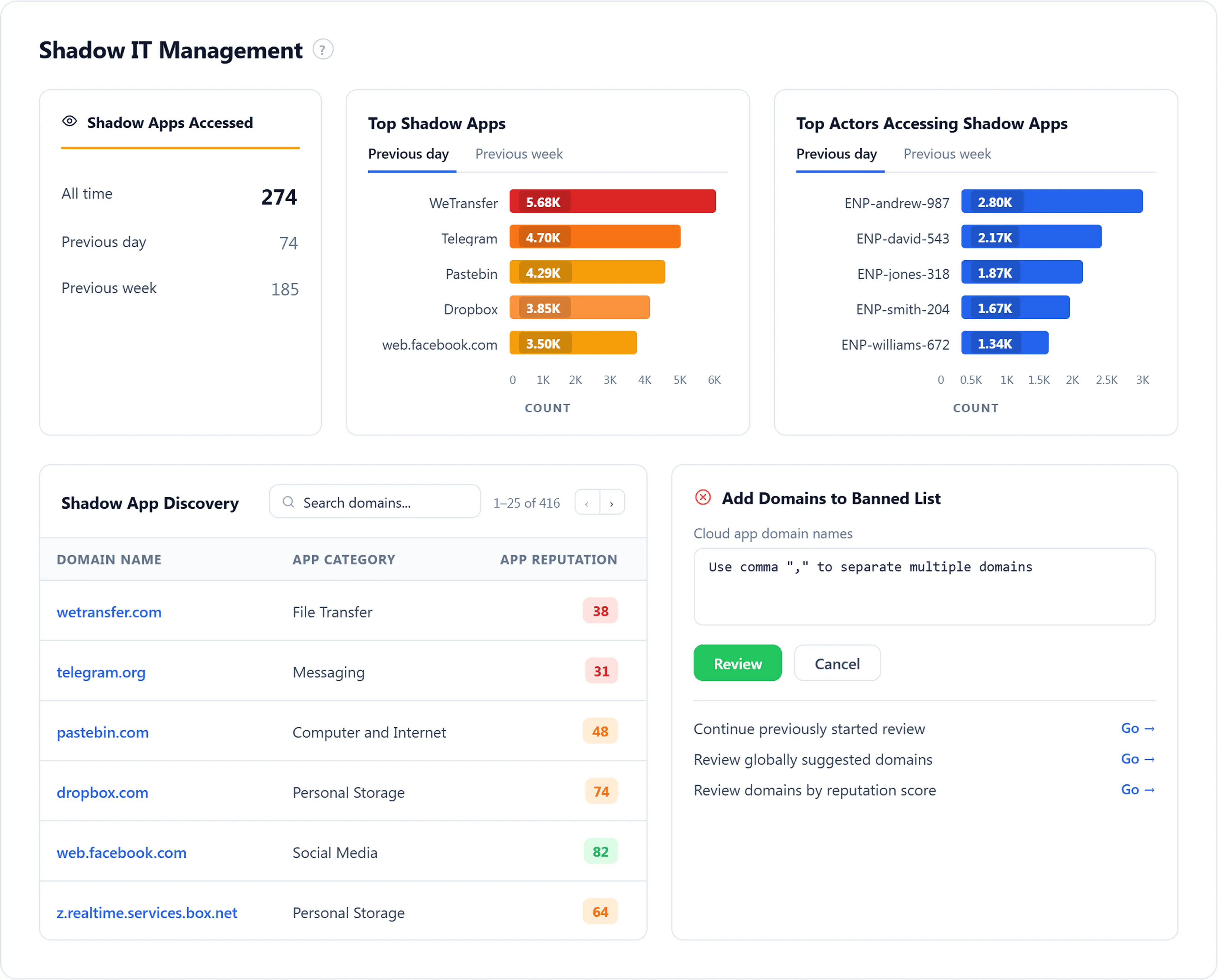
Highlight the top shadow apps in use (including GenAI), identify the main actors based on their usage, and analyze usage patterns across various timeframes.
Categorize shadow AI apps as sanctioned or banned to strengthen cloud app security by dictating which web services can remain in use and which are banned.
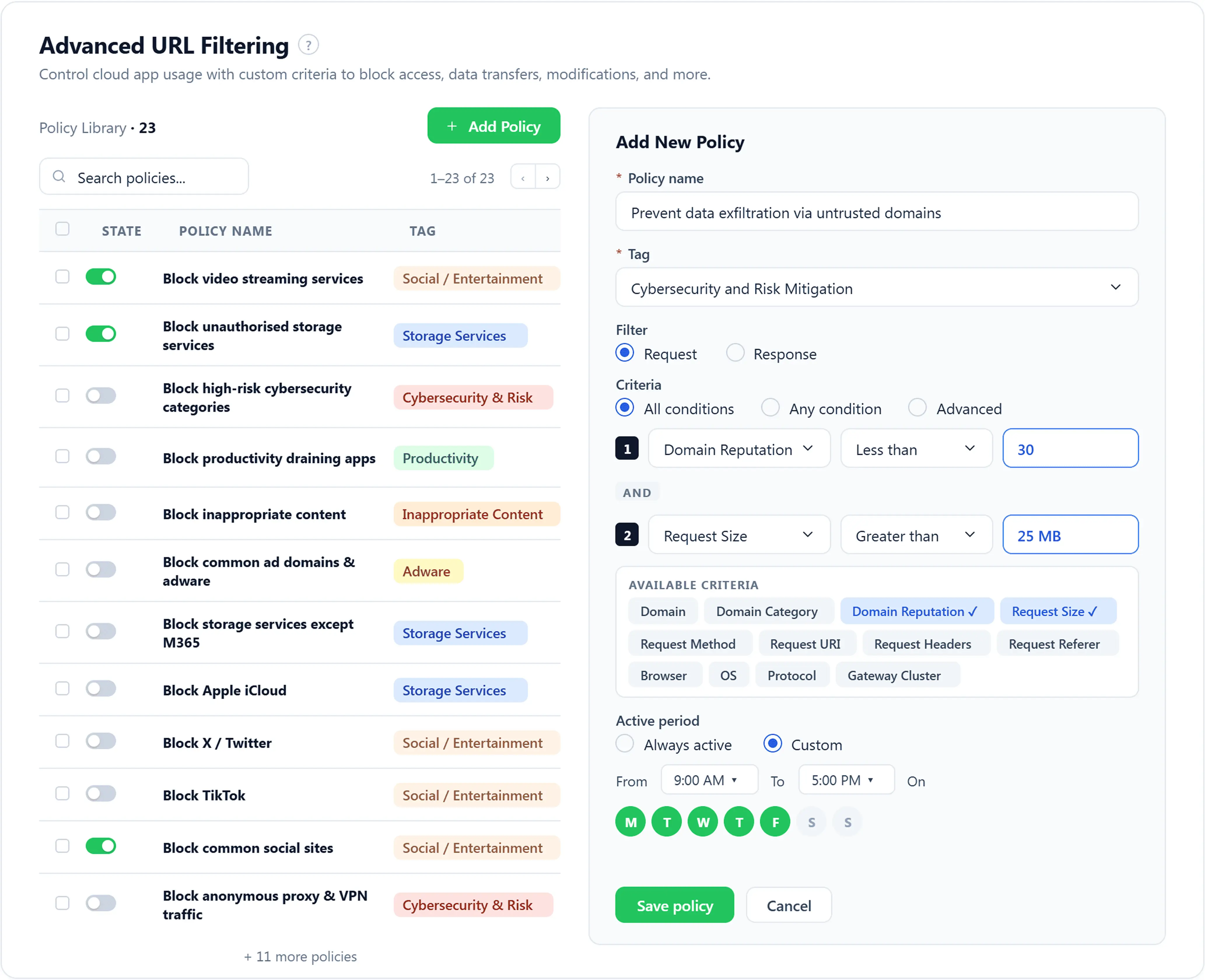
Manage your organization's risk exposure by blocking unsafe AI domains, suspicious referrers, malicious payload types, and abnormal request patterns using granular filtering criteria tuned to field modern security threats.
Leverage the prebuilt profiles to block common video streaming services, social media sites, VPN websites, messaging services, advertisement domains, personal storage services, and more.
Drill into prompts shared by employees across GenAI apps such as ChatGPT, Github Copilot, Claude, Perplexity, and Grok and maintain a detailed audit trail to ensure compliance and effective GenAI governance.
Use our intuitive dashboard to adjust the app reputation slider to spotlight low-trust, risky services and analyze usage patterns across any time frame.
Track the use of both permitted and denied AI cloud applications, including chatbots, coding assistants, and command-line AI tools, across your workforce for complete visibility and control.
Track outbound HTTP and HTTPS traffic from configured endpoints. Use the captured URL access logs to cross-reference this traffic with both sanctioned and banned app lists to split known AI cloud platforms from the unknown.
Analyze the usage patterns of shadow AI domains over time, identify key actors driving adoption, and evaluate risks based on the reputation score, access frequency, bandwidth consumption, and other factors.
Designate applications as sanctioned or banned using risk insights and create custom policies to restrict unauthorized data transfers to select AI tools.
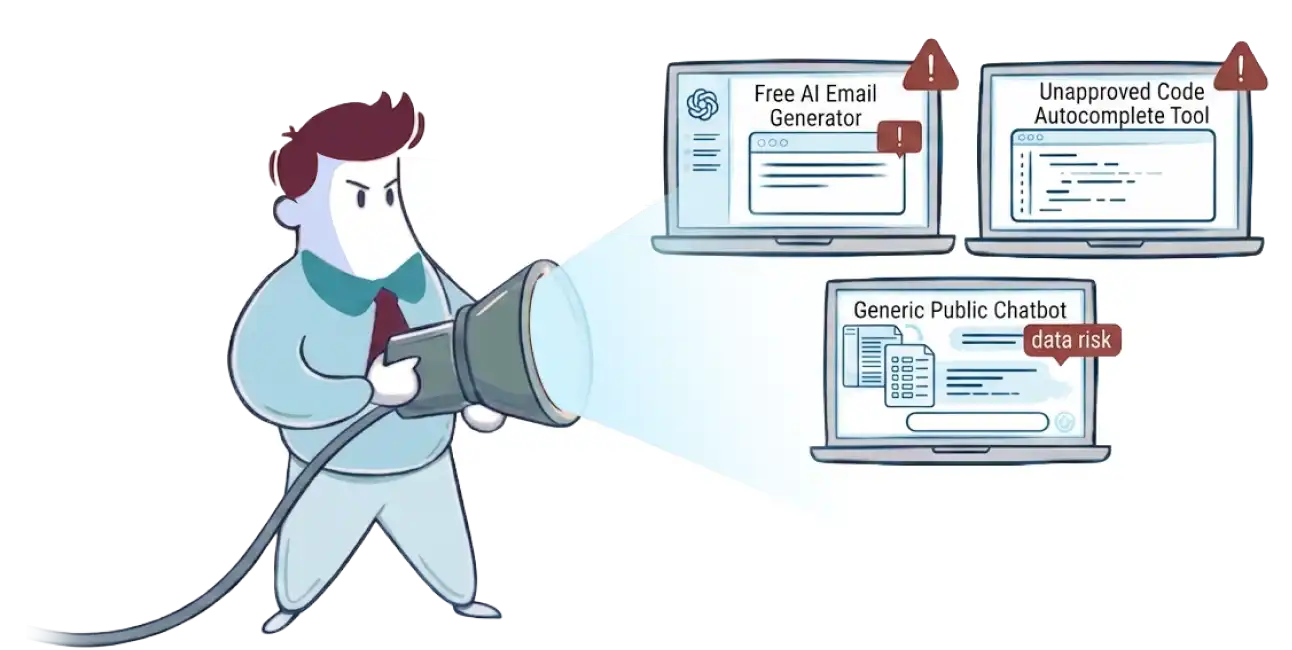
Shadow AI refers to the unauthorized use of AI cloud platforms, including GenAI tools, AI-powered design applications, and coding assistants, by employees without prior approval from IT, security, or asset management teams. Common examples include pasting confidential code into ChatGPT, uploading client data to a free summarization tool, or using a personal Copilot subscription for work tasks.
Shadow IT is broader and covers the use of unsanctioned hardware, software, and cloud services across the organization. Shadow AI is a subset of shadow IT. The risks overlap, but shadow AI is fast becoming a serious concern due to the rate of adoption.
Several new regulations are emerging around AI use, including the EU AI Act, NIST AI Risk Management Framework, and Colorado AI Act, with more expected to follow. These mandates increasingly require organizations to demonstrate a combination of discovery (which AI tools are in use), control (what data can flow to them), and auditing (evidence that controls are working). Shadow AI management solutions address a critical part of this by detecting which AI apps are in use and providing the means to control which ones employees can access and share data with.
The steps listed below provide a comprehensive framework for managing risks associated with shadow AI:
Yes. DataSecurity Plus extends shadow AI discovery and monitoring to endpoints, whether they are in the corporate network, remote, or connected through a hybrid setup. The endpoint agent continues to enforce policies and capture activity logs even when devices are outside the corporate network, and findings sync back to the central console once connectivity is restored.
Yes, DataSecurity Plus supports the creation of customized URL filtering profiles that can be used to specify the types of access control measures, such as for file uploads, downloads, and posting messages, exerted on select GenAI applications. With these controls, organizations can regulate how employees interact with GenAI, preventing sensitive data exposure while still allowing the productive use of approved services.
If you need assistance creating personalized access control profiles tailored to your environment, get in touch with our product experts.

