Beyond IP addresses: How DDI solutions power telco data center operations
There is a moment, somewhere between the third ring of a phone call connecting and the first frame of a video buffering, where an entire telco data center has already done its job. A device asked a question, Where do I belong, and what is my name here? And somewhere in a rack of servers, in less time than it takes to blink, the system gave the answer.
Most people never think about that moment, and they shouldn't have to. But for the engineers, architects, and operators who build the infrastructure underneath modern telecommunications, that moment is the entire job. And increasingly, the system responsible for making it happen—instantly, correctly, securely, and at a scale that would overwhelm any team of humans—is DNS, DHCP, and IP address management working together as a single control plane known as DDI.
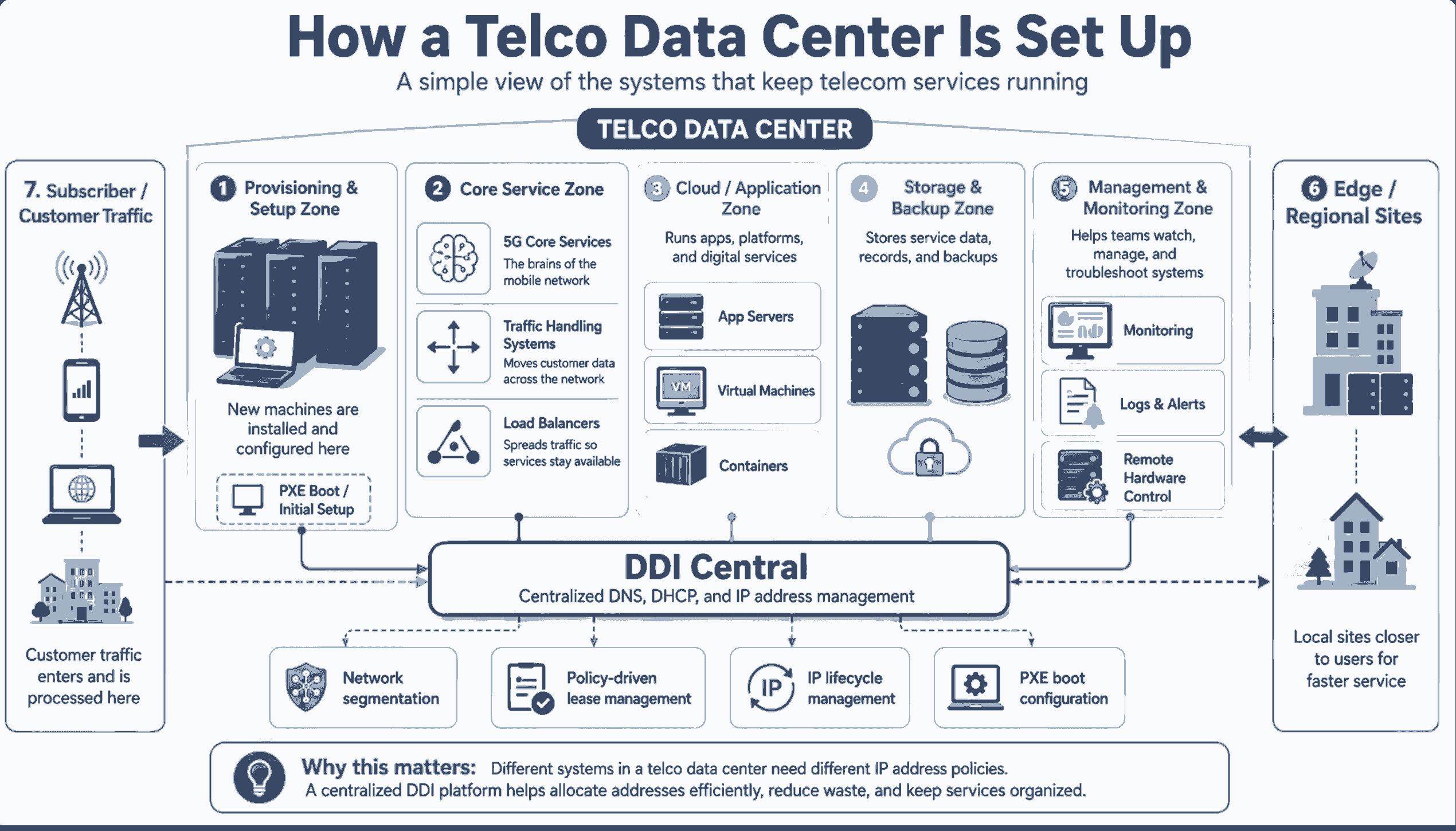
This is the story of what DDI actually does inside a telco data center and why it has quietly become one of the most important systems in the building.
The network everything depends on
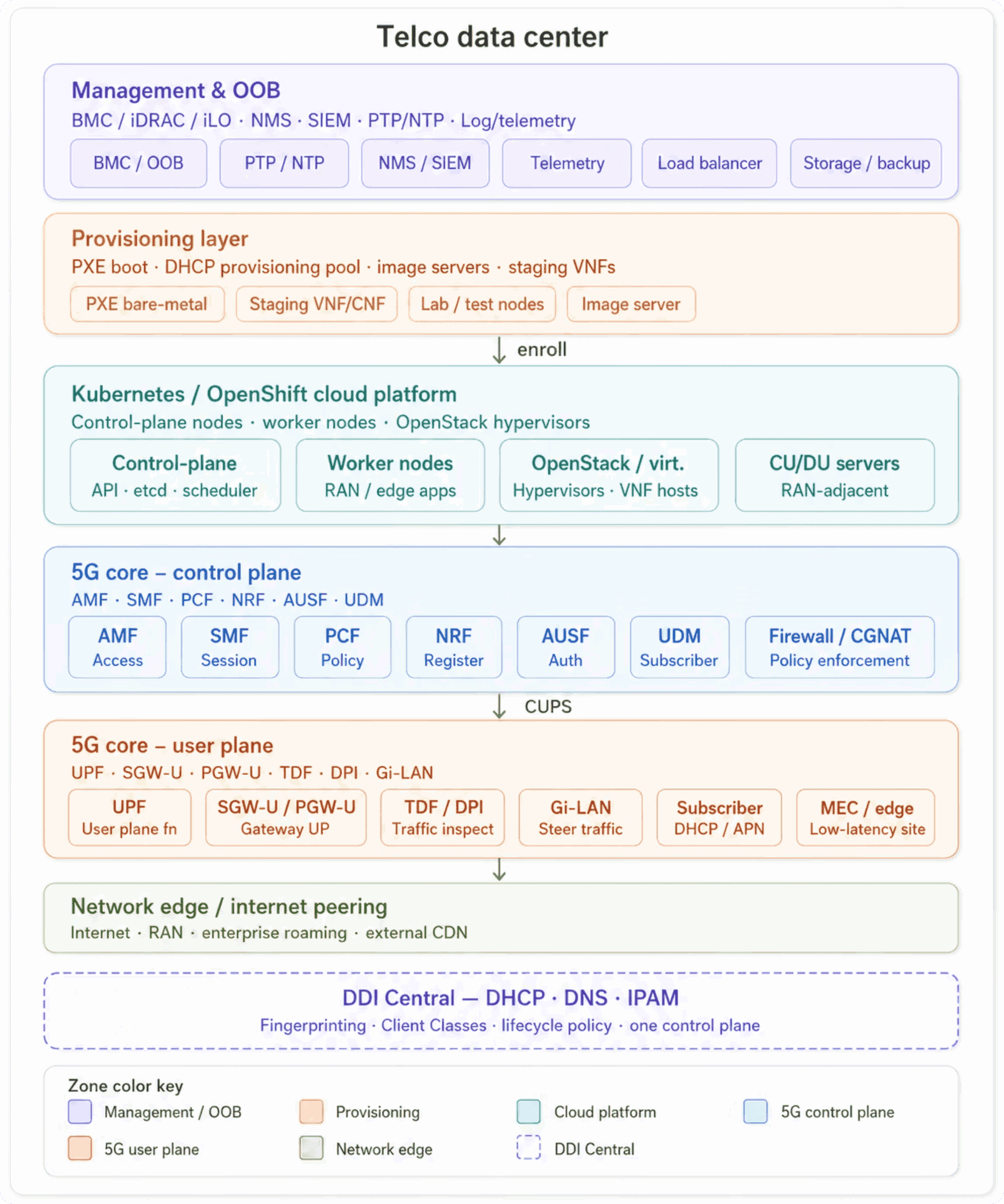
Picture a telco's on-premises data center. Inside it, a 5G core is running, including the AMF, the SMF, the UPF, and the whole apparatus that takes a phone's request to "get online" and turns it into an actual, usable connection. Around that core sit three or more network slices, each behaving like its own private network: one for everyday consumer broadband, one for industrial machines that cannot tolerate a millisecond of hesitation, and one for thousands of small, quiet IoT sensors that wake up, report, and go back to sleep. Tens of thousands of physical devices—routers, switches, base station controllers, and servers—sit in the racks, each one needing an identity before it can do anything at all.
Every one of those devices, slices, and sleepy little sensors needs the same three things before it can exist on the network: an address, a name, and a place to belong. That is the role of DDI: bringing DNS, DHCP, and IP address management together so the network knows what each asset is, where it belongs, and how it should be reached. Instead of treating these as three separate systems bolted together, DDI creates a coordinated operational layer that understands the shape of the network and helps teams make decisions accordingly. ManageEngine DDI Central delivers this unified DDI layer for telco data centers.
A brain that already knows who you are
Here is something remarkable: when a device connects to a telco network for the first time, DDI Central often already has a good idea of what it is and what it requires.
This happens through fingerprinting. Every device, when it asks for an address, reveals small details about itself in the process—fragments of its operating system, hints about its vendor, a particular pattern in how it phrases its request. For instance, an industrial controller phrases this request differently than a consumer smartphone.
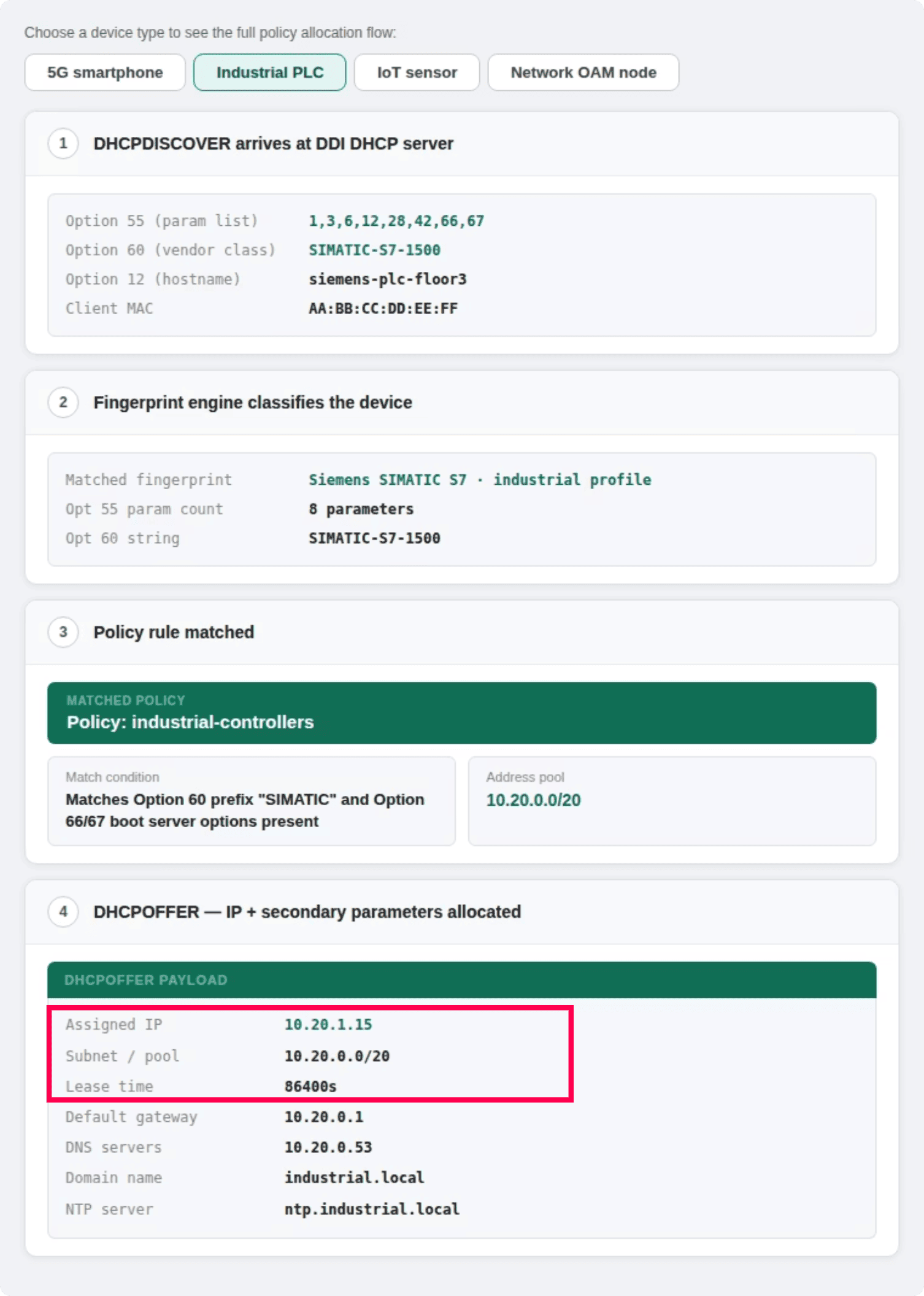
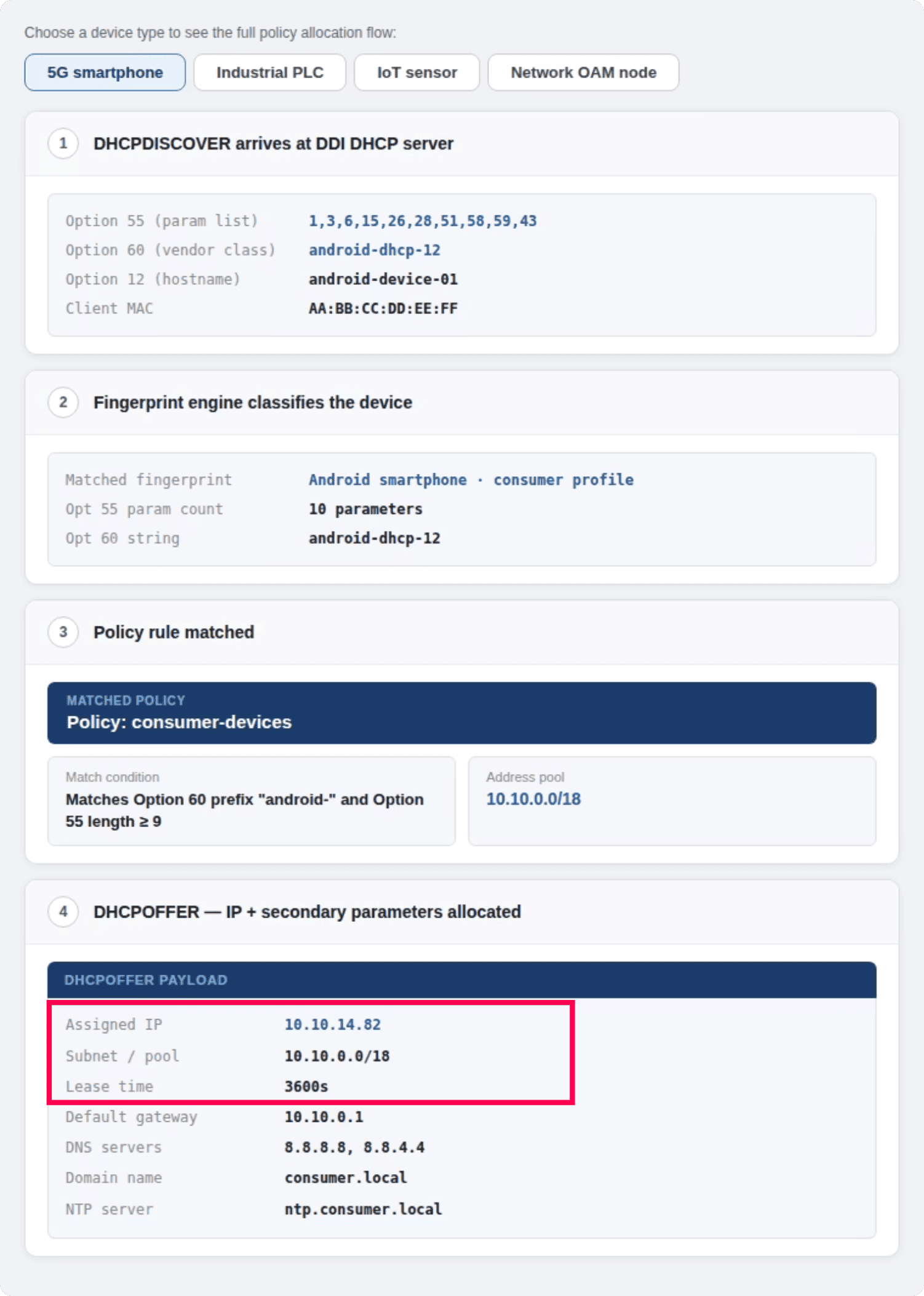
A tiny IoT sensor phrases it differently still. DDI Central reads these fingerprints and matches them against policies defined by the network team in advance.
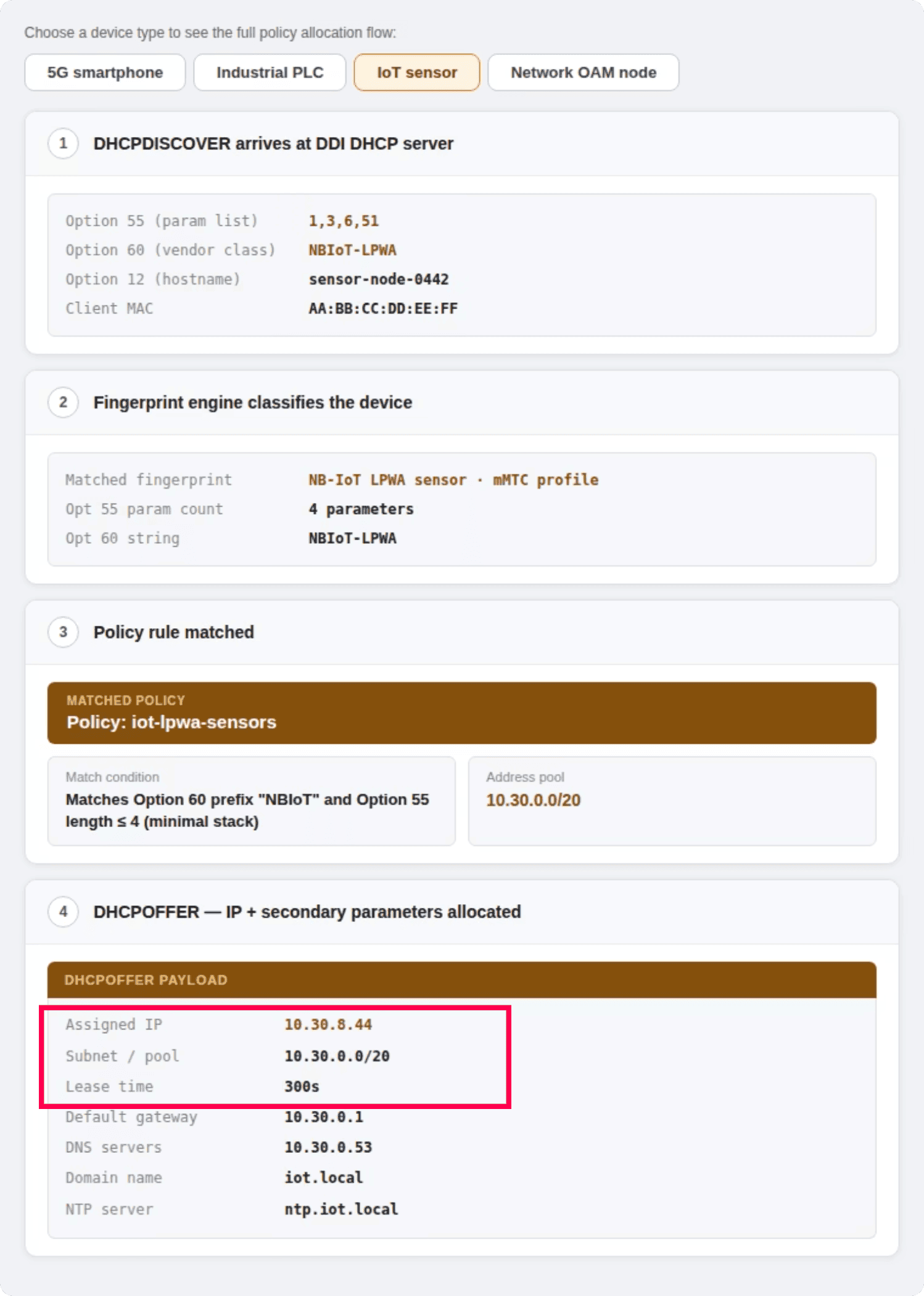
The result is that a smartphone, an industrial robot arm, and a sensor that reports temperature once every five minutes can all connect to the same physical fabric and, without any human input, each receive exactly the network treatment appropriate to what they are. The phone gets a fast, generous lease. The sensor gets a short one, conserving precious address space across what might be millions of similar devices. The industrial controller gets a long, stable one, because the last thing anyone wants is a factory robot losing its network identity mid-task.
This is not configuration. This is recognition. And it happens at the speed of a single network handshake.
A city with many languages, all speaking at once
A modern telco data center is not one network. It comprises many networks, sharing one floor.
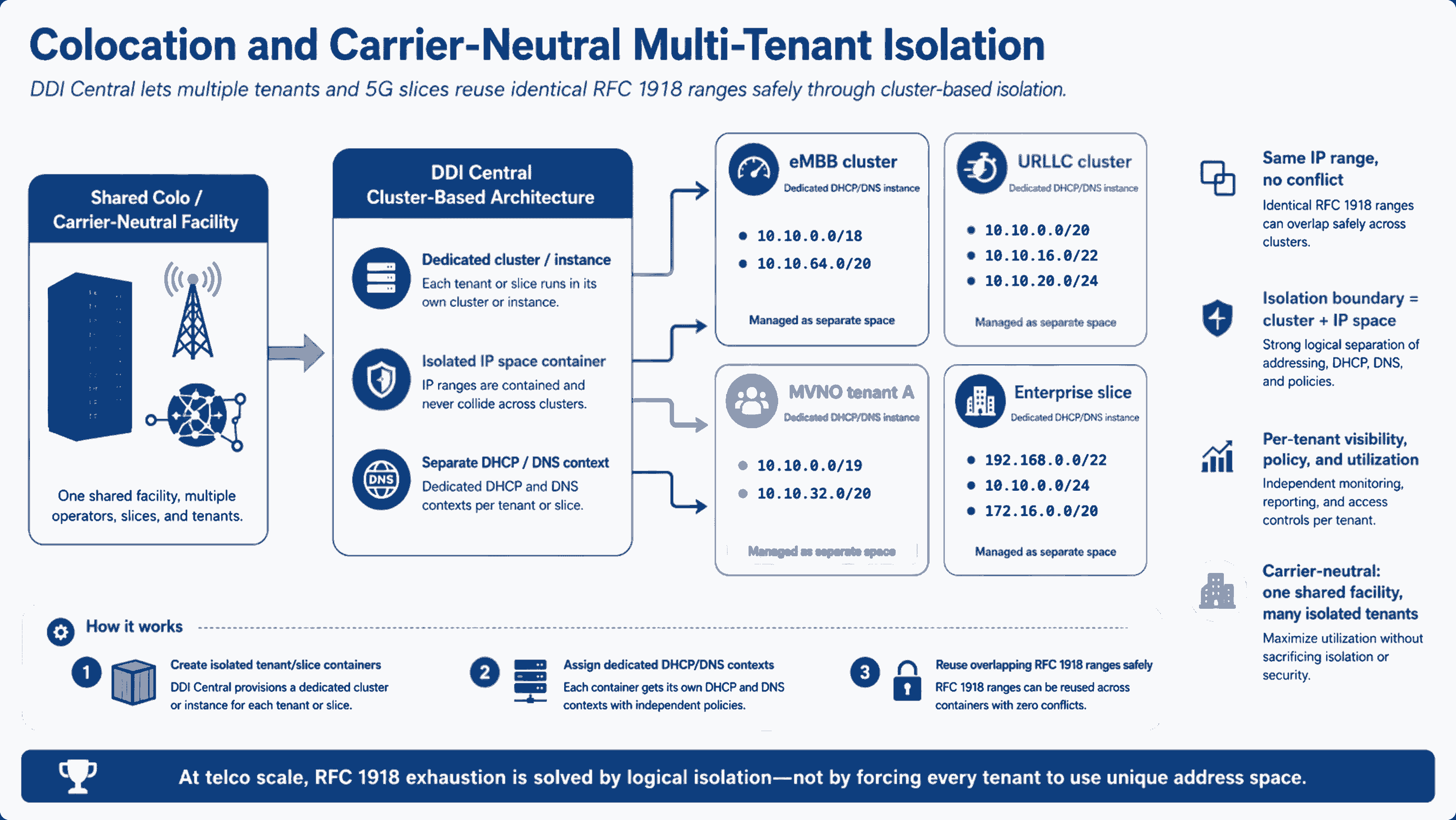
There is the network for everyday mobile data (e.g., 5G). There is a separate network, isolated and protected, for ultra-low-latency applications. Think remote surgery tools, autonomous vehicles, or factory automation—the kinds of things where 100 milliseconds of delay is not an inconvenience but a failure. There is another network entirely for the quiet, numerous world of IoT: sensors monitoring pipelines, smart meters, and environmental tracking. And layered on top of all of this, there are often multiple telco brands and enterprise customers sharing the same physical infrastructure, with each tenant needing a logically isolated network environment that behaves as if it were entirely their own. Their IP spaces, DNS policies, DHCP scopes, and access boundaries must remain separate, even when the underlying infrastructure is shared.
This is where isolation becomes more than a networking preference—it becomes an architectural requirement. These separate worlds can use the exact same private address ranges without colliding. Two different customers can both use what looks, on paper, like the same block of addresses, yet remain completely invisible to each other. DDI Central makes this possible by separating address management at the architectural level: each customer or tenant gets its own dedicated address-management space, sealed off from the others, as if it were operating inside its own private data center within the larger shared environment. The boundaries are not created through after-the-fact workarounds. They are built into the foundation.
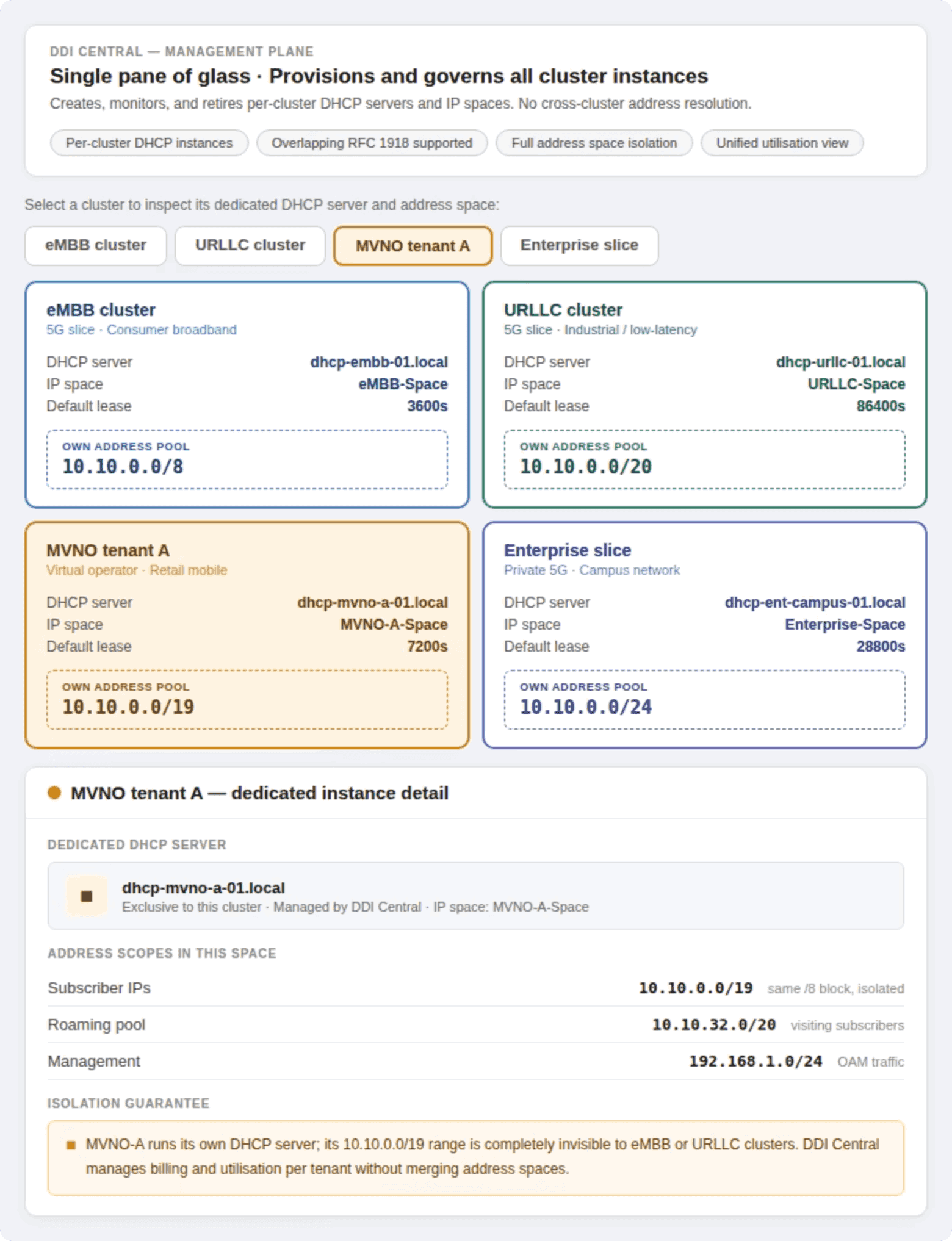
For a telco data center selling capacity to other carriers or a data center hosting competing customers under one roof, this single architectural decision is what makes the entire business model possible.
The same question, four different truths
Let's look at how DDI Central handles naming inside a sliced 5G network. Ask the network "where is the user data server?" and the answer you get depends entirely on who is asking.
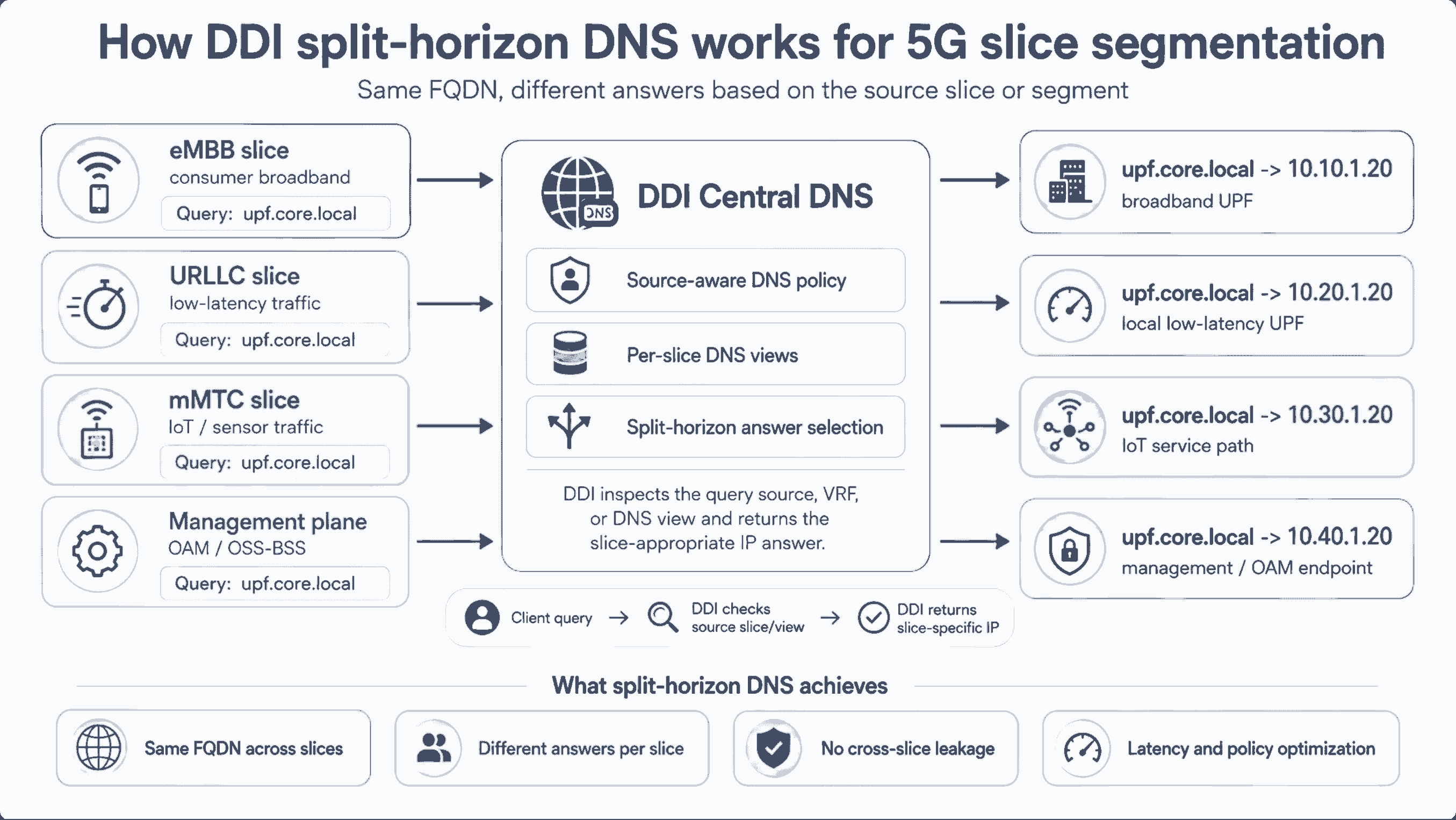
A consumer smartphone asking for upf.core.local is directed to the broadband UPF built for high-throughput activities like streaming, browsing, and app traffic. An industrial controller in a low-latency slice asks for the same name, but receives a different IP address—one that points to a local UPF positioned for the shortest possible path. For that controller, even a small delay can affect the application it supports. An IoT sensor asking the same question is sent to an IoT service path designed to handle large numbers of small, infrequent check-ins efficiently. And when a network engineer queries the same name from an approved management system, the answer resolves to a management or OAM endpoint used for monitoring, configuration, logs, and health checks. That management endpoint is not returned to consumer devices, industrial controllers, or IoT sensors, because those devices only need their own service path.
One name. Four context-specific answers. All correct, all simultaneous, and all enforced by DDI Central through source-aware DNS policy. Instead of exposing the same destination to every requester, DDI Central looks at where the query came from—such as the slice, segment, VRF, or DNS view—and returns the IP address appropriate for that context. The network does not just answer a name; it answers based on who is asking.
When new hardware arrives, the network welcomes it on its own
There is a particular kind of magic in watching a brand-new, blank piece of hardware arrive in a data center, get racked, powered on—and within minutes, without a single person touching a keyboard—become a fully functioning, properly identified, correctly configured part of the network.
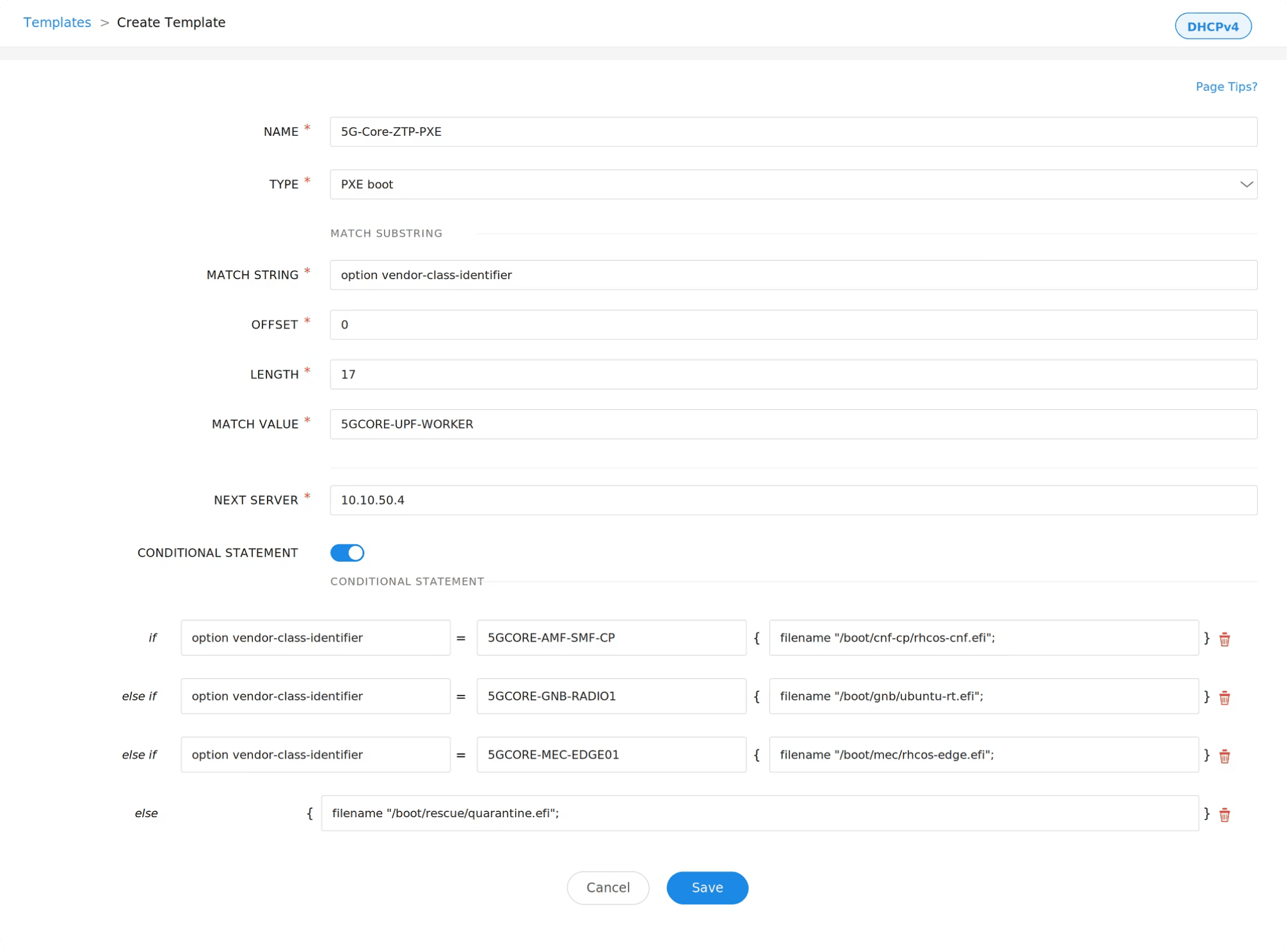
This is what happens when DDI Central’s Preboot Execution Environment (PXE) provisioning capabilities meet a freshly installed server destined to become part of the 5G core. The moment that new machine reaches out, DDI Central recognizes its hardware identity, checks it against the role it is expected to play, and hands it everything it needs: an operating system image appropriate to that role, an address, a name, and a place in the topology. A blank box becomes a UPF node, a control-plane server, a gNB-related component, a MEC edge node, or whatever it was destined to be, with the same inevitability as a seed becoming a plant.
The conditional statement is where that boot-selection logic lives. In this example, the server identifies itself through its vendor-class identifier. DDI Central then uses the PXE template to decide which boot file it should receive. A control-plane node receives the CNF control-plane image. A gNB-related server receives the radio boot image. A MEC edge server receives the edge image. The top-level match handles the expected UPF worker path, while the conditional branches cover the other known roles.
And crucially, there is an else condition at the bottom. That is the safety net. If the machine reaching out does not match any of the known roles—if it is a misconfigured BMC, a contractor’s laptop plugged into the wrong jack, or simply hardware the network was not expecting—it is routed to a quarantine image instead of a production image. It does not get to become part of the 5G core by accident. The network does not answer strangers with production access.
At the scale of a data center adding new capacity continuously, this is the difference between a provisioning process measured in days and one measured in minutes.
The quiet custodian: DDI as a security layer
The DDI system responsible for handing out addresses is also one of the most strategically positioned systems for defending the network.
Think about what passes through DDI Central in the course of an ordinary day. Every name lookup, the very first action almost any digital communication takes, passes through it. Every lease, renewal, and release leaves a trace in it. This gives DDI Central a vantage point that almost nothing else in the data center has—a continuous, real-time view of the entire population of devices and the entire pattern of their behavior.
That vantage point becomes a defense pillar. Malicious domains and known threats can be blocked at the very first moment a device tries to reach them, long before any data ever leaves the building. Unauthorized address-handing servers—the digital equivalent of someone setting up a fake reception desk in the lobby—are detected the moment they begin operating, because DDI Central knows exactly which servers are supposed to exist. Devices attempting to wander outside the boundaries they were assigned, deliberately or by accident, are caught at the addressing layer, before they ever touch the rest of the network. And when something does go wrong and an investigation needs to happen, DDI Central's records become the forensic timeline: which device held which address, at which precise moment, on which part of the network.
This is not DDI doing a security team's job for them. It's DDI giving the security team a kind of visibility that simply does not exist anywhere else in the infrastructure—because nothing else sees every device, every time, the way the addressing layer does.
The ledger that powers every bill
There is one more surprising thing DDI does: billing.
Every bill a telco sends, every usage record, and every dispute a subscriber raises, traces back to the same underlying fact: a particular device held a particular address for a particular window of time. That fact is not generated by the billing system. It is generated by DDI, as a simple byproduct of doing its job. When a lease is handed out, DDI Central creates a timestamp. When a device moves between slices, a record exists of which network it belonged to and when. When a subscriber on a premium, low-latency slice uses the network differently than a subscriber on an ordinary consumer plan, the very address they were assigned already reflects which tier of service they were receiving, because each slice draws from its own dedicated range. The billing system does not need to investigate any of this. It simply asks DDI Central, and DDI Central already knows the answer.
This becomes especially valuable in moments of dispute. A subscriber who insists they were not using their connection at the time they were billed can be answered definitively, because the addressing system kept an exact, timestamped record of who held what, and when. A wholesale partner being billed for capacity on a shared network can be shown, transparently, how much was used and by which isolated tenant, because their traffic was never mixed with anyone else's in the first place. What looks, from the outside like a billing department doing careful detective work is, underneath, simply DDI Central's ordinary records being read.
Why this matters to more people than you might think
It would be easy to assume this is a story only network engineers care about. It isn't. The way a telco manages its addressing infrastructure determines how quickly it can launch a new service, how confidently it can promise a customer dedicated, isolated capacity, how convincingly it can guarantee a five-nines uptime commitment, and how defensible its security posture is when regulators or auditors come asking. Product teams, architects, security leads, and even commercial teams negotiating service-level agreements are all, whether they realize it or not, depending on decisions made at the addressing layer.
DDI is the thread that runs underneath nearly everything else. While it is rarely the headline, it's almost always the reason the headline was possible.
See it for yourself
Reading about a control plane is one thing. Seeing a network slice spin up in under a minute, a device get fingerprinted and policy-matched in real time, and the same name resolve four different ways depending on who is asking is an entirely different kind of understanding.
Start a 30-day, free trial of DDI Centraland explore the platform inside your own environment, at your own pace, with no commitment attached.
Book a personalized demoand let our team walk through your specific telco architecture, your specific scale, and your specific questions, live.