LDAP: What it is, how it works, and why it matters for your network authentication
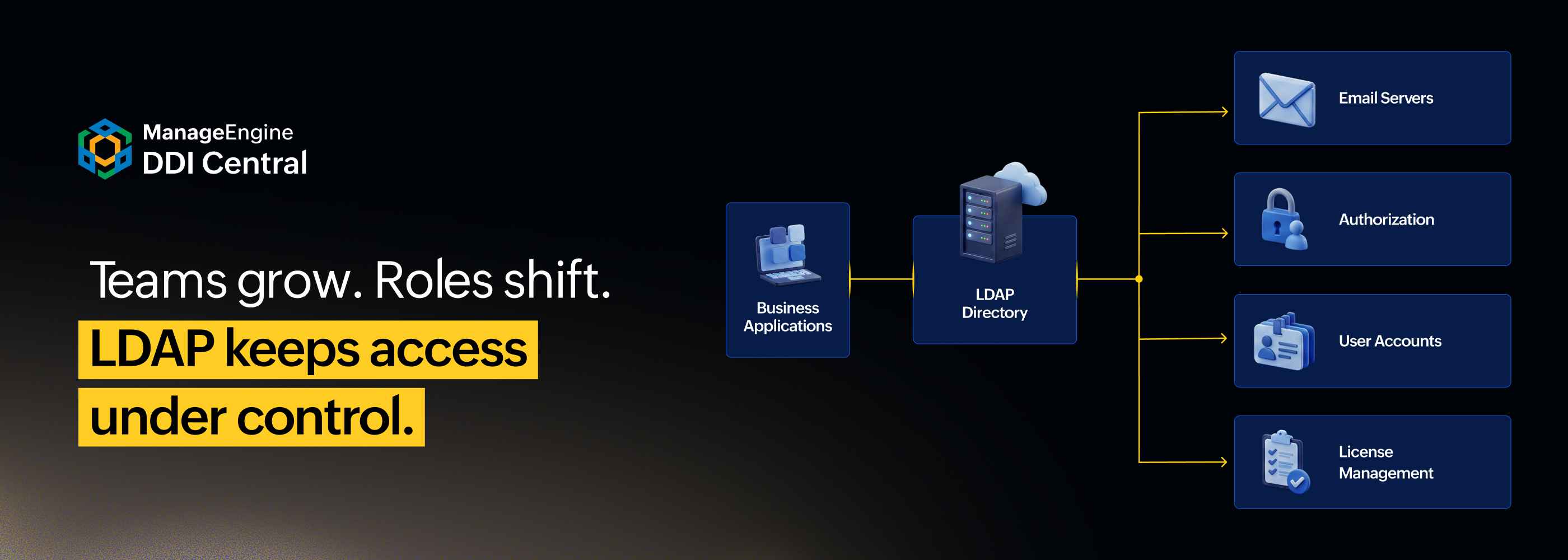
As organizations continue to adopt more applications and digital services, managing user authentication across multiple systems has become increasingly challenging. When user accounts are distributed across multiple platforms, provisioning and revoking access can become both time-consuming and difficult to manage. Ultimately, this increases the risk of unauthorized access and unmanaged credentials.
DDI Central, a centralized platform for DNS, DHCP, and IP address management (IPAM), helps solve this challenge through built-in LDAP authentication support. By integrating LDAP with existing directory services, organizations can manage user access from a single, trusted identity source. This ensures secure, streamlined, and consistent authentication across their network infrastructure.
Download a free 30-day trial today and explore how LDAP integration works seamlessly within DDI Central.
What is LDAP?
Lightweight Directory Access Protocol (LDAP) is a widely used authentication and directory service protocol designed to organize and manage user identity information. LDAP directories typically store and manage details such as:
User accounts and attributes
Group memberships
Access permissions
Organizational information and more
LDAP remains a critical component of modern identity and access management (IAM) strategies. With today’s security improvements, LDAP communications can be encrypted during transmission. Meanwhile outdated and insecure authentication methods are restricted, making LDAP a dependable and enterprise-ready authentication solution.
How does LDAP work?
LDAP functions by connecting applications to a directory server, commonly Microsoft AD, where user credentials and identity information are centrally maintained.
When a user attempts to log in to DDI Central, the provided credentials are validated against the records stored in the LDAP directory. If the credentials match, the user is successfully authenticated and granted access. DDI Central supports two primary LDAP authentication methods:
Simple authentication
A straightforward authentication method where user credentials are sent directly to the LDAP server. This approach is easy to configure and is best suited for environments where secure communication channels are already in place.
NTLM authentication
A more secure authentication mechanism based on Microsoft’s NT LAN Manager (NTLM) protocol. NTLM uses hashing and challenge-response techniques to verify user identity without transmitting passwords in plain text.
DDI Central also supports LDAPS (LDAP over SSL), which encrypts communication between DDI Central and the LDAP server using TLS/SSL certificates. This additional security layer helps protect sensitive authentication data while in transit.
Benefits of LDAP integration for your organization
Centralized identity management
LDAP eliminates the need to maintain separate user accounts within DDI Central. User identities continue to be managed directly through the organization’s existing directory service, ensuring that updates such as password changes, account lockouts, or user deactivations are automatically reflected during login attempts. This reduces administrative effort while minimizing the risk of outdated or orphaned accounts.
Automated user provisioning
DDI Central supports just-in-time user provisioning through LDAP integration. When a user logs in to DDI Central for the first time using LDAP credentials, the application can automatically create the user account without requiring manual administrator involvement. This simplifies onboarding and significantly reduces operational overhead in large environments.
Granular, group-based access control
Instead of managing permissions for individual users, administrators can map AD groups directly to predefined roles within DDI Central. During authentication, users are automatically assigned permissions based on their directory group memberships—such as Administrator, Operator, Guest, or Auditor roles. This approach improves scalability and helps enforce the principle of least privilege.
Improved security
LDAP reduces credential fragmentation and strengthens overall access security by centralizing authentication within the organization’s directory infrastructure. Combined with LDAPS encryption, credential exchanges remain protected from interception and unauthorized access.
For enhanced protection, DDI Central also supports MFA by integrating LDAP credentials with TOTP generated through compatible authenticator applications.
Strengthen access management with LDAP in DDI Central
ManageEngine DDI Central provides organizations with a scalable and reliable approach to authentication management through LDAP integration. By connecting directly to existing directory services, administrators can enforce centralized access policies, automate user onboarding, and maintain tighter control over access to critical DNS, DHCP, and IPAM resources.
It simplifies user authentication by centralizing access management and reducing manual administrative overhead. Its LDAP integration helps ensure that the right users receive the appropriate level of access—securely, efficiently, and consistently across the network infrastructure.