DNSSEC: What it is, what it isn't, and why your DNS infrastructure needs it
DNS, the internet's phone book, has a trust problem.
Every time you type a URL into your browser, your device makes a DNS query—a request to translate a human-friendly name like bank.com into a machine-friendly IP address like 93.184.216.34. This translation happens billions of times a day, silently and invisibly. It's the lookup that makes the internet usable.
But here's the uncomfortable truth: The original DNS, designed in the 1980s, has no built-in way to verify that the answer you get back is the right one. If an attacker can slip a forged response into the conversation, your browser will faithfully connect you to whatever IP that response points to, including a server controlled by the attacker.
This is the gap DNSSEC fills. In this post, we'll cover what DNSSEC actually is (and isn't), why it's no longer optional for serious DNS infrastructure, how it works under the hood, and where it fits in a modern DNS, DHCP, and IPAM (DDI) strategy.
What is DNSSEC
DNSSEC, short for Domain Name System Security Extensions, is a set of cryptographic protocols layered on top of the existing DNS. It uses public-key cryptography to digitally sign DNS records so that resolvers can verify three things:
Authenticity—the data came from the legitimate zone owner.
Integrity—the data wasn't altered in transit.
Authenticated denial of existence—a "this name doesn't exist" response is genuine.
A useful analogy: regular DNS is like getting a letter with no return address—you have no way to know if it's really from your bank or a scammer. DNSSEC is like that letter arriving with a tamper-proof wax seal and a verifiable signature you can cross-check against a trusted registry.
Importantly, DNSSEC is an extension, not a replacement. It adds new record types to DNS while keeping everything backward compatible. A resolver that doesn't understand DNSSEC simply ignores the new records and continues working as before.
What DNSSEC is not
This is where most misconceptions live. DNSSEC is frequently confused with other security technologies, so let's draw the boundaries clearly.
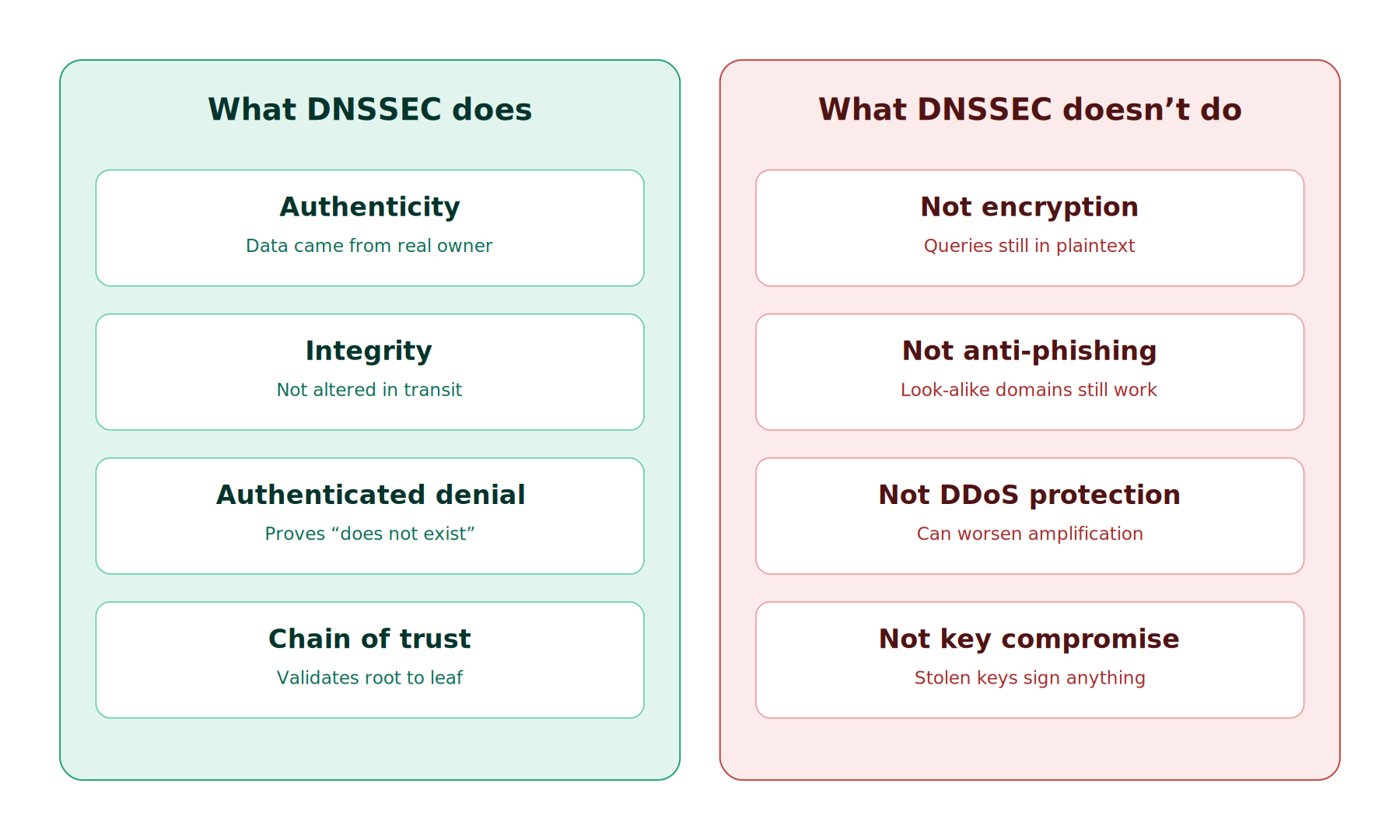
DNSSEC is not encryption. DNS queries and responses remain in plaintext. Anyone watching the network can still see which domains you're looking up. If you want query privacy, you need DNS over HTTPS (DoH) or DNS over TLS (DoT).
DNSSEC is not a TLS replacement. It doesn't protect the content of websites, emails, or any application traffic. Once DNS hands over the correct IP address, what happens next is HTTPS/TLS territory.
DNSSEC does not stop DDoS attacks. In fact, signed responses are larger than unsigned ones, which can make DNS amplification attacks worse if not configured carefully.
DNSSEC does not protect against compromised keys. If an attacker gains control of your signing keys or your DNS hosting provider, DNSSEC offers no protection; they can sign malicious records as easily as legitimate ones.
DNSSEC does not prevent phishing via look-alike domains. If a user types bank-secure.com instead of bank.com, DNSSEC will faithfully validate the attacker's domain. It protects the integrity of a domain's records, not the user's choice of domain.
Understanding these limits is essential. DNSSEC solves one specific, important problem extremely well. It doesn't solve every DNS-adjacent security problem.
Why your DNS infrastructure needs DNSSEC
Without DNSSEC, DNS infrastructure is vulnerable to a class of attacks that exploit the protocol's blind trust in responses.
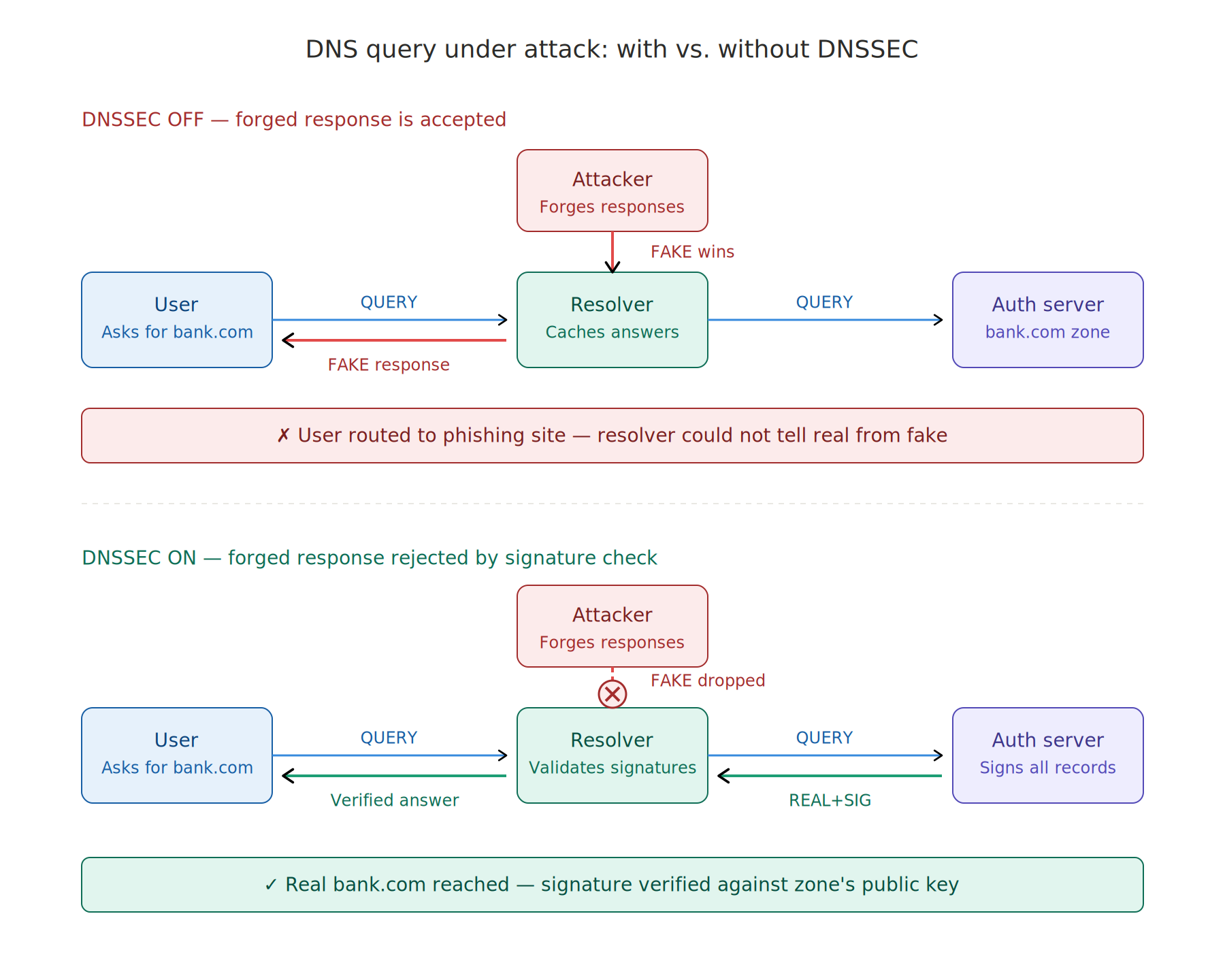
Cache poisoning. An attacker injects forged DNS records into a resolver's cache. Every user querying that resolver gets routed to a malicious server, often with no visible warning. The Kaminsky attack in 2008 demonstrated how trivial this could be at scale.
Man-in-the-middle interception. Attackers on the network path can intercept queries and return fake responses, redirecting traffic to phishing sites or malware distribution servers.
Pharming. Users typing the correct URL get silently redirected to fraudulent sites that look identical to the real ones, leading to credential theft and financial fraud.
Compliance pressure. Regulatory frameworks (PCI DSS, US OMB M-08-23 for federal agencies, and GDPR-adjacent rules in several jurisdictions) now mandate DNSSEC for critical infrastructure.
Foundation for other security protocols. Technologies like DNS-based Authentication of Named Entities (DANE) and SMTP Mail Transfer Agent Strict Transport Security (MTA-STS) rely on DNSSEC as their trust anchor. Without DNSSEC, these can't function securely.
The takeaway: DNSSEC isn't just something that's nice to have anymore. For anything resembling a serious DNS infrastructure—financial services, healthcare, government, e-commerce, SaaS—it's table stakes.
How DNSSEC actually works
DNSSEC's mechanics rest on two ideas: every DNS record set is cryptographically signed, and every signature can be traced back to a trust anchor at the root.
The building blocks
DNSSEC introduces a few new record types:
DNSKEY: The public key for a zone, published in DNS so resolvers can fetch it
RRSIG: The digital signature attached to a DNS record set
DS (Delegation Signer): A hash of a child zone's key, stored in the parent zone, vouching for the child's authenticity
NSEC / NSEC3: Proof that a record doesn't exist (prevents spoofed no such domain replies)
Each zone has two keys: a Zone Signing Key (ZSK) that signs everyday records, and a Key Signing Key (KSK) that signs only the ZSK. The KSK is what the parent zone references in its DS record, creating a chain that goes all the way down to the root.
The DNSSEC chain of trust
This is the heart of DNSSEC. Trust doesn't come from any individual server; it comes from a single hard-coded trust anchor that resolvers ship with, which validates the root zone, which validates each TLD, which validates each domain.
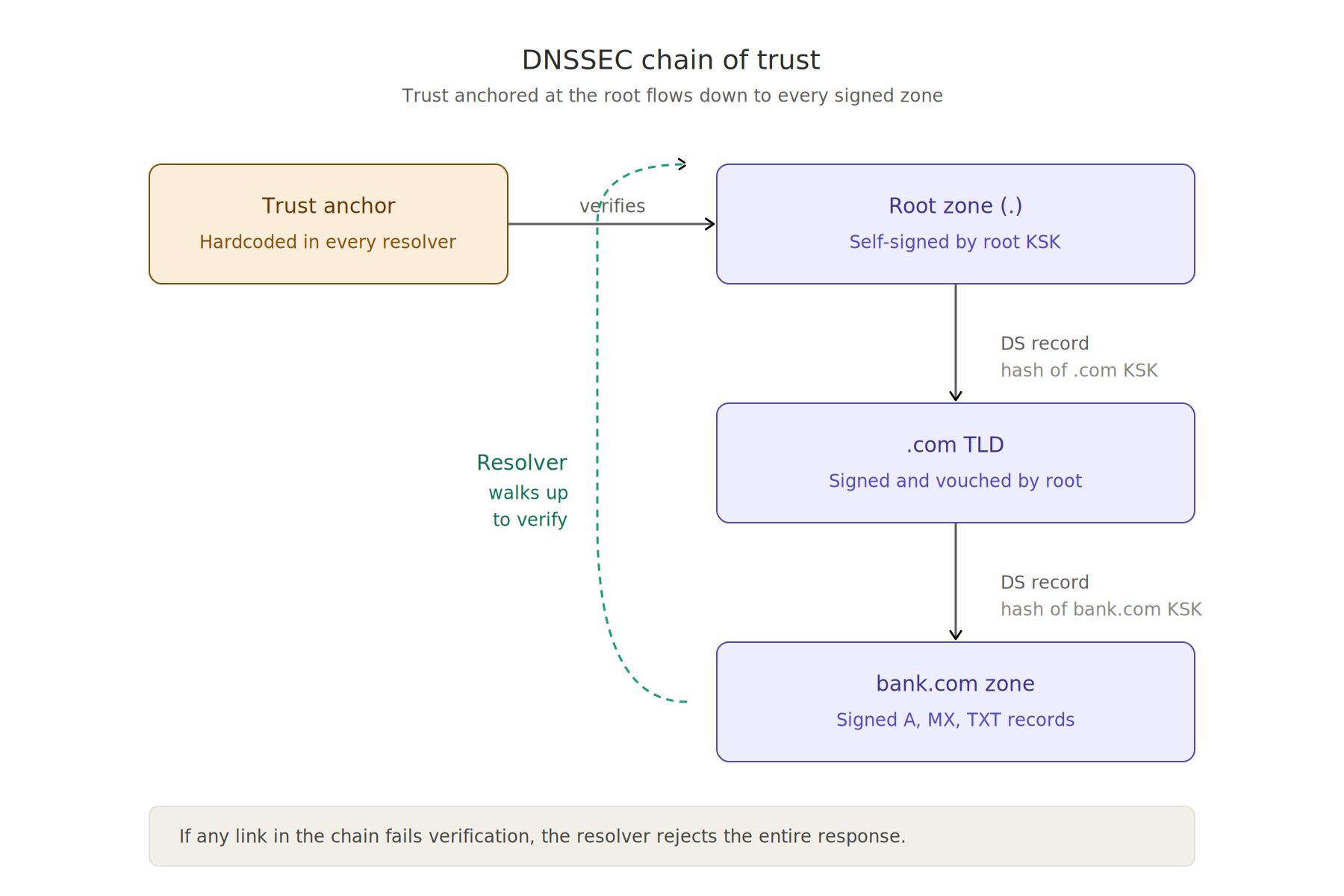
When a resolver receives an answer for www.bank.com, it doesn't just trust the signature on that record. It walks the chain upward: It asks for the bank.com DNSKEY, verifies it against the DS record in .com, asks for the .com DNSKEY, verifies it against the DS record in the root, and finally compares the root key to the trust anchor it already has. If any link in the chain fails verification, the entire answer is rejected.
What the resolver actually does
Here's the validation walkthrough, step by step, for a single query:
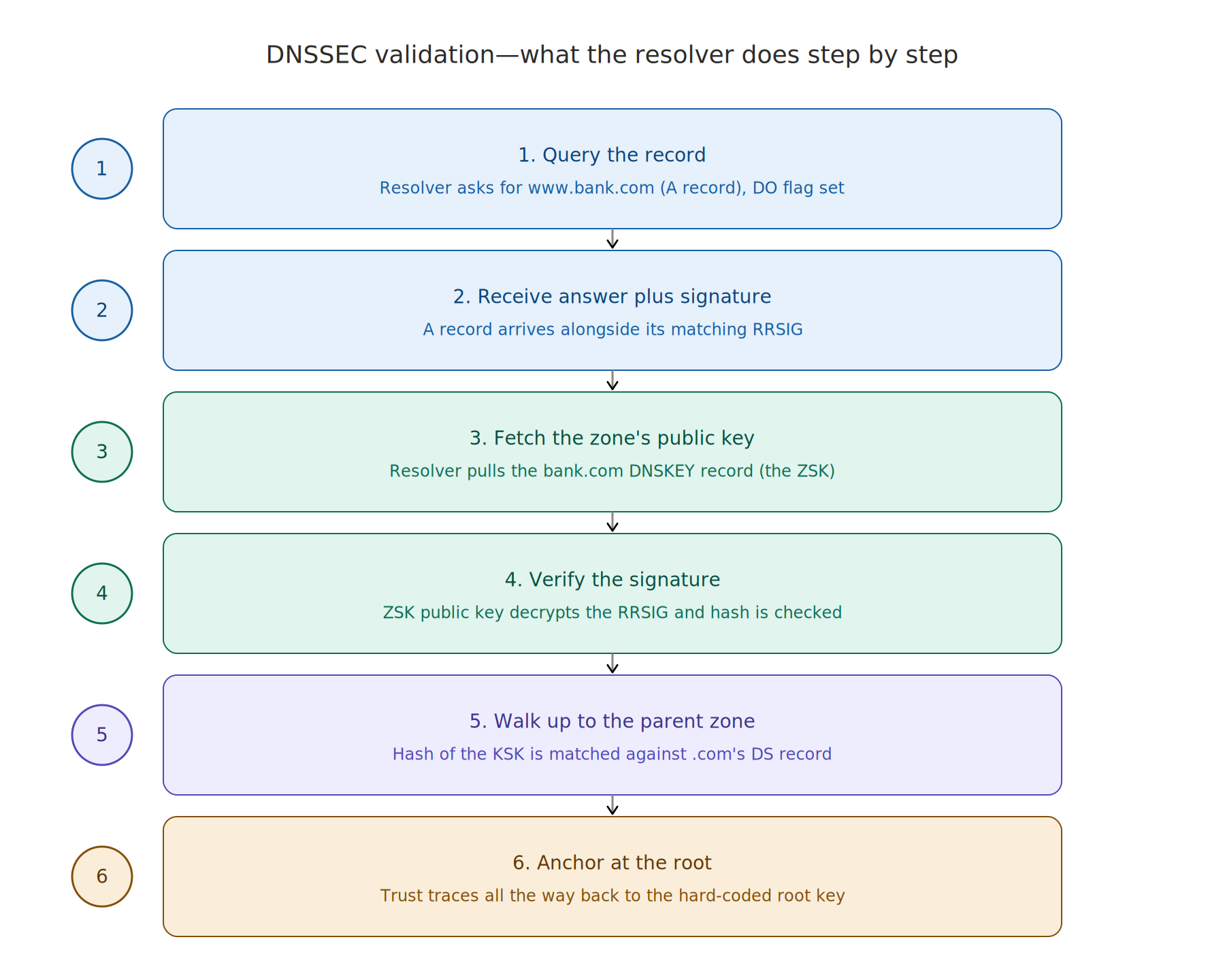
Query the record. The resolver asks for www.bank.com and sets the DNSSEC OK (DO) flag to signal it wants signatures.
Receive answer plus signature. The authoritative server returns the A record alongside its matching RRSIG.
Fetch the zone's public key. The resolver queries bank.com DNSKEY and gets the ZSK.
Verify the signature. The ZSK public key decrypts the RRSIG; the decrypted hash is compared to a freshly computed hash of the data. A match means it's authentic.
Walk up to the parent. The resolver verifies the KSK by hashing it and matching it against the DS record in .com.
Anchor at the root. Trust ultimately traces back to the hard-coded root key every validating resolver ships with.
If any step fails, the resolver returns SERVFAIL to the client. The user gets an error instead of being silently routed somewhere malicious—which, from a security perspective, is the correct outcome.
Why two keys?
A natural question: why does DNSSEC use both a ZSK and a KSK instead of one key?
Cryptographic agility: The ZSK is used frequently and rotated often (weeks to months). The KSK is used rarely and rotated infrequently (a year or more). Smaller, more frequently rotated keys reduce exposure.
Operational simplicity: Rotating the KSK requires coordinating with the parent zone (updating the DS record at the registrar). Rotating the ZSK requires nothing outside your own zone. Separating the two means you can rotate the everyday-use key without touching the parent.
DNSSEC's role in a DDI solution
DDI—DNS, DHCP, and IPAM—is the integrated management plane that ties together name resolution, IP address assignment, and address inventory across an enterprise. DNSSEC is a critical part of any modern DDI platform, and the integration matters for several reasons.
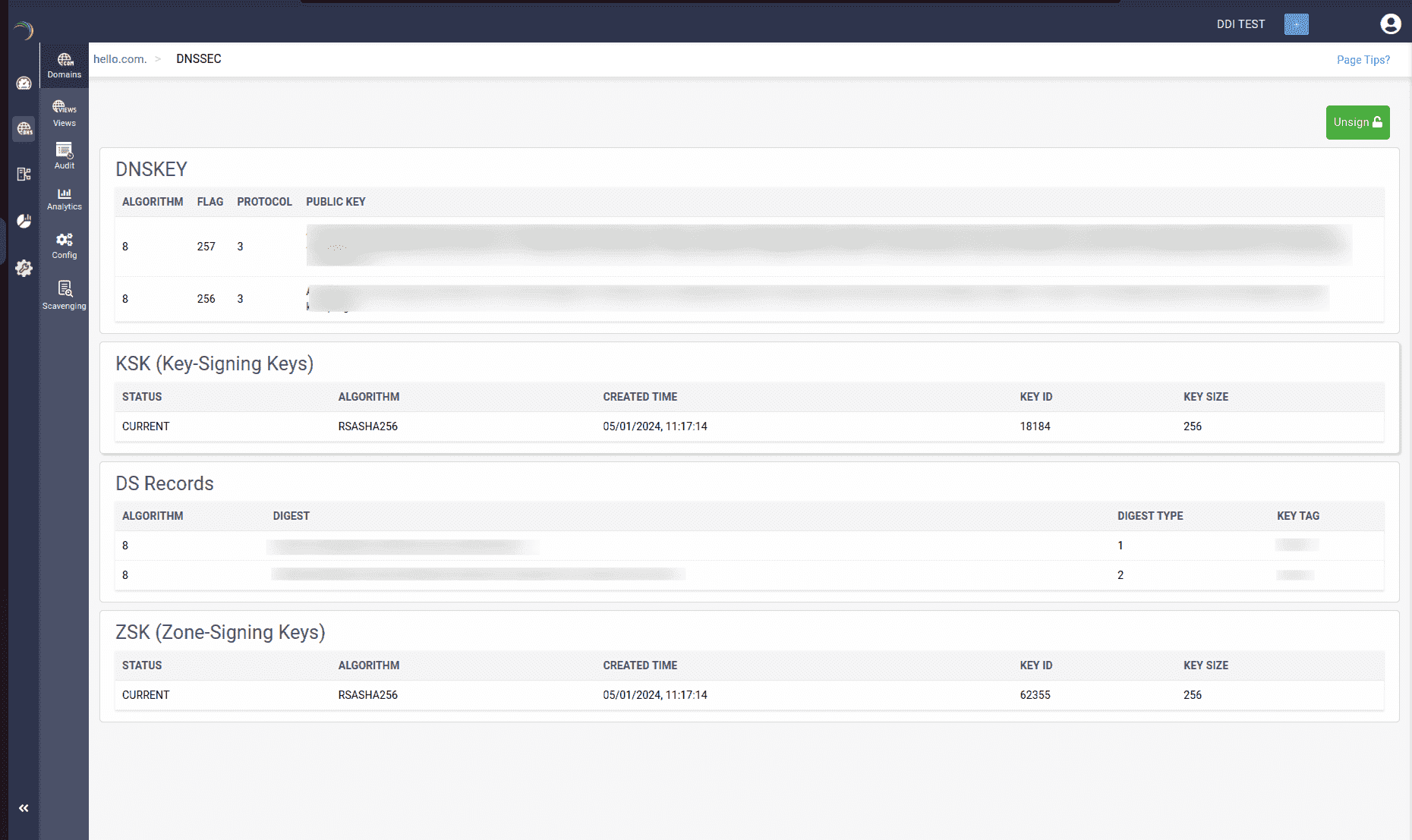
DNSSEC Automated key life cycle management
Every key DDI Central manages carries an explicit state—CURRENT, PUBLISHED, RETIRED, REMOVED—alongside its creation timestamp, key ID, and algorithm. That state field is what turns DNSSEC from a manual operation into a managed life cycle. When a rollover is due, the platform generates the successor key, publishes it, transitions the active key through retirement, and removes it on schedule—all without an admin running commands, editing zone files, or scheduling 2am maintenance windows. Expired signatures, the single biggest cause of DNSSEC outages at major organizations, simply stop being a category of incident you can have.
Visibility and monitoring
DDI dashboards make DNSSEC health visible at a glance. A single screen shows the DNSSEC status of every zone you manage which ones are signed, when they were signed, what algorithms were used, and the key sizes in play. Without this, a silently expired signature can take an entire domain offline. The screenshot above is the visibility layer that showcases which keys exist, when they were created, what state they're in, what the DS records contain, which algorithm is in use—and all of it is visible at a glance.
Compare this to the raw alternative: digging through zone files, running dig DNSKEY hello.com +dnssec, and parsing base64 blobs by hand. The KEY ID column alone (18184, 62355) means you can correlate signatures to keys in logs without parsing them.
Centralized signing infrastructure
Instead of running signing tools on individual authoritative servers, DDI platforms offer a central signing service that signs zones and pushes the signed versions out, keeping private keys in one hardened location.
No more touching BIND configs, running dnssec-keygen from the command line, or managing key files scattered across authoritative servers. DDI Central's signing service generates every key, signs every record, and surfaces every artifact—DNSKEY, KSK, ZSK, DS records, algorithms, key IDs—on a single screen, in one click. Private keys stay inside the central signing infrastructure (HSM-backed where required); your authoritative servers receive only the signed zones. One console, one source of truth, zero key files on the disk to lose or leak.
The honest limits of DNSSEC
It's worth being clear-eyed about what DNSSEC achieves and where its boundaries lie:
It validates the path between resolver and authoritative server. The last mile from your recursive resolver to your device is not protected by DNSSEC alone; that requires DoH/DoT or a validating stub resolver on the device itself.
It only works if both ends participate. If the zone isn't signed, there's nothing to validate. If the resolver doesn't validate, signatures are received but ignored.
It introduces operational complexity. Expired signatures and unsynchronized DS records have caused well-known outages at major organizations.
Adoption is still uneven. Roughly 30–40% of major TLDs have full DNSSEC coverage, though enabling validation on resolvers has grown faster than zone signing.
DNSSEC is best understood as one essential layer of protection alongside a defense-in-depth approach towards network security—paired with DoH/DoT for query privacy,response rate limiting for DDoS resilience, and proper key management practices for operational safety.
The bottom line
DNSSEC fixes a specific, foundational gap in the internet's most-used protocol: it lets you trust that the DNS answer you got is the one that was actually published. That's it. That's the whole pitch. And it's a very large pitch, because everything else (HTTPS, email security, certificate validation, modern authentication) ultimately depends on DNS giving you the right answer.
If you're running serious DNS infrastructure today and you haven't enabled DNSSEC, you're carrying a known, well-understood vulnerability in your stack. And if you've enabled it but you're managing it manually, you're carrying a different kind of risk, operational fragility, that a good DDI platform is built to absorb.
Technology is mature. The tools are ready. The case for adoption isn't theoretical anymore. It's just a question of when you turn it on.
Start your 30-day, free trial. Spin up DDI Central in your environment and sign your first zone in minutes. Full feature access, no credit card required.
Book a personalized demo. Talk to a DDI specialist who will walk you through DDI Central and showcase how it fits into your existing DNS infrastructure.