Introducing IPAM Tower: Smarter IP address management for distributed networks
As networks grow, IP address management becomes harder in a way that traditional IPAM tools do not always solve. At first, the challenge seems to be sheer scale: more sites, subnets, pools, clusters, and environments to manage. But over time, the real problem reveals itself; the difficulty is not just managing more IP data, but navigating it quickly and confidently.
When an admin is troubleshooting, they are rarely asking for a flat inventory. They are trying to answer a live operational question. Where is this subnet being used? Which environment owns it? How is this block structured? Is this IP part of a managed range, an external range, or something unmapped but still operationally relevant? Traditional IPAMs are often strong at recording this information, but not always great at helping admins reach the right destination quickly and with full context. That is the gap DDI Central’s IPAM Tower is built to close.
What is IPAM Tower?
IPAM Tower is DDI Central’s answer to IPAM sprawl across sites, clusters, and supernets. Rather than functioning as just another IP repository, it acts as an operational map for IP address management, giving administrators multiple ways to explore the same IP inventory.
The platform is built around three primary navigation paths:
Site View for location-first navigation
Cluster View for control-plane-first navigation
Supernet View for address-space-first navigation
This is what makes IPAM Tower more than a traditional IPAM tool. It does not force every admin to think in one rigid format. It enables them to start from the perspective that best matches the question they are trying to answer.
Site View: When the investigation starts with location
Sometimes the problem feels physical before it feels technical.
A complaint comes in from a branch office. A region reports an issue. A data center is under reView. In these moments, the admin’s mind does not begin with CIDR blocks or DHCP scopes — it begins with place.
That is what Site View is built for.
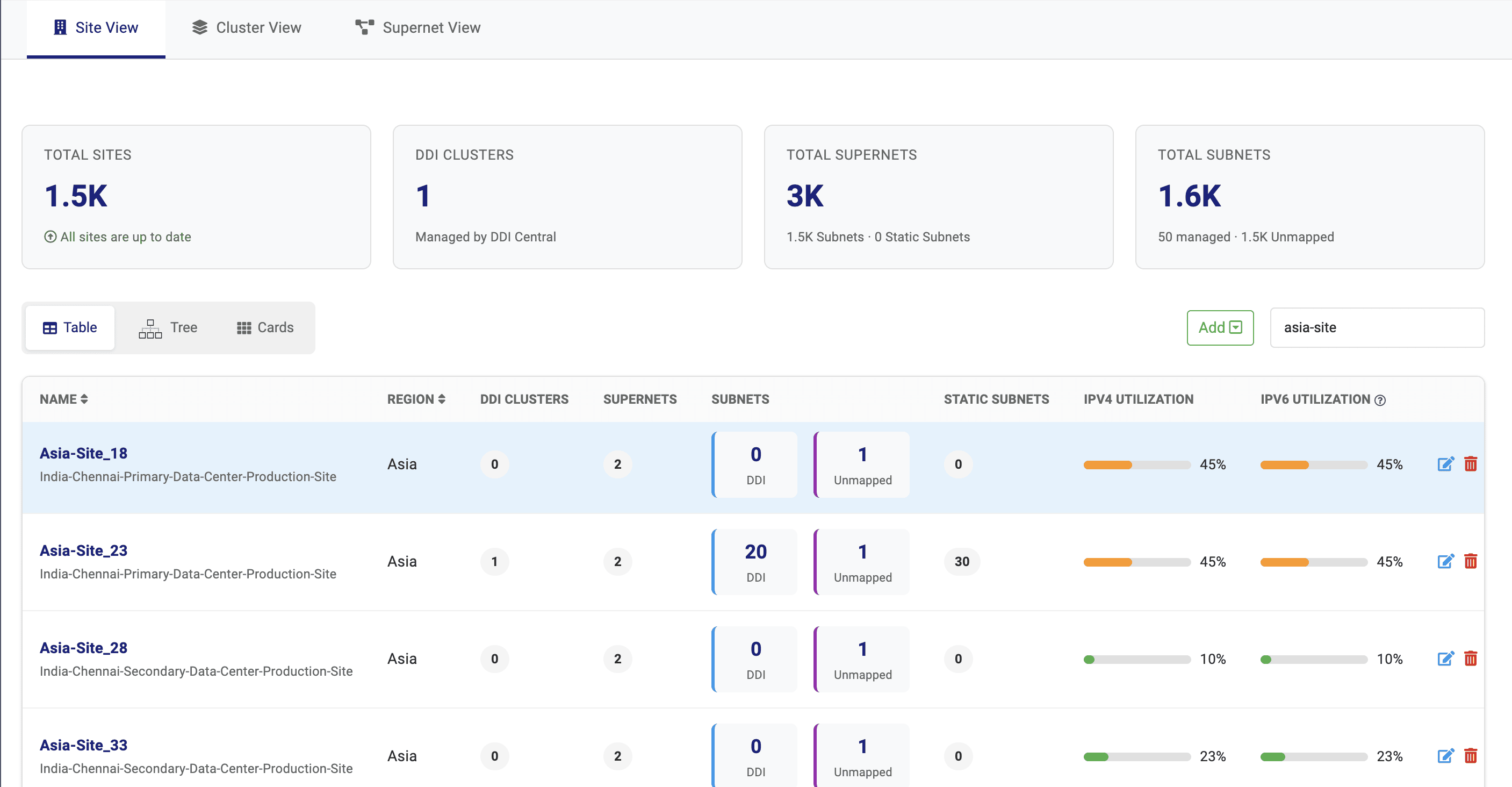
Site View organizes IP resources by physical or geographical location, such as branches, campuses, regions, and data centers. It helps answer a practical question: Where is this IP pool being used?
This brings a few immediate advantages. It enables the admin to correlate IP usage with real-world locations, troubleshoot from a geo-based perspective, and support audit or compliance needs by site. It also brings visibility to not only DDI Central-managed subnets, but external subnets that are still important for operational awareness.
Site View organizes IP resources by physical or geographical location, such as branches, campuses, regions, and data centers. It helps answer a practical question: Where is this IP pool being used?
This brings a few immediate advantages. It enables the admin to correlate IP usage with real-world locations, troubleshoot from a geo-based perspective, and support audit or compliance needs by site. It also brings visibility to not only DDI Central-managed subnets, but external subnets that are still important for operational awareness.
Site View aligns IP address management more closely with how network teams investigate issues in practice starting from the affected site or location and reaching the relevant subnet, scope, or pool faster.
Cluster View: When the investigation starts with ownership and control
On any given day, the admin may not care where the problem is physically located.
The real question may be, Which environment does this belong to?
The answer is production, development, g,uest, and lab — any isolated logical segment with its own operational boundaries.
That is where Cluster View becomes valuable.
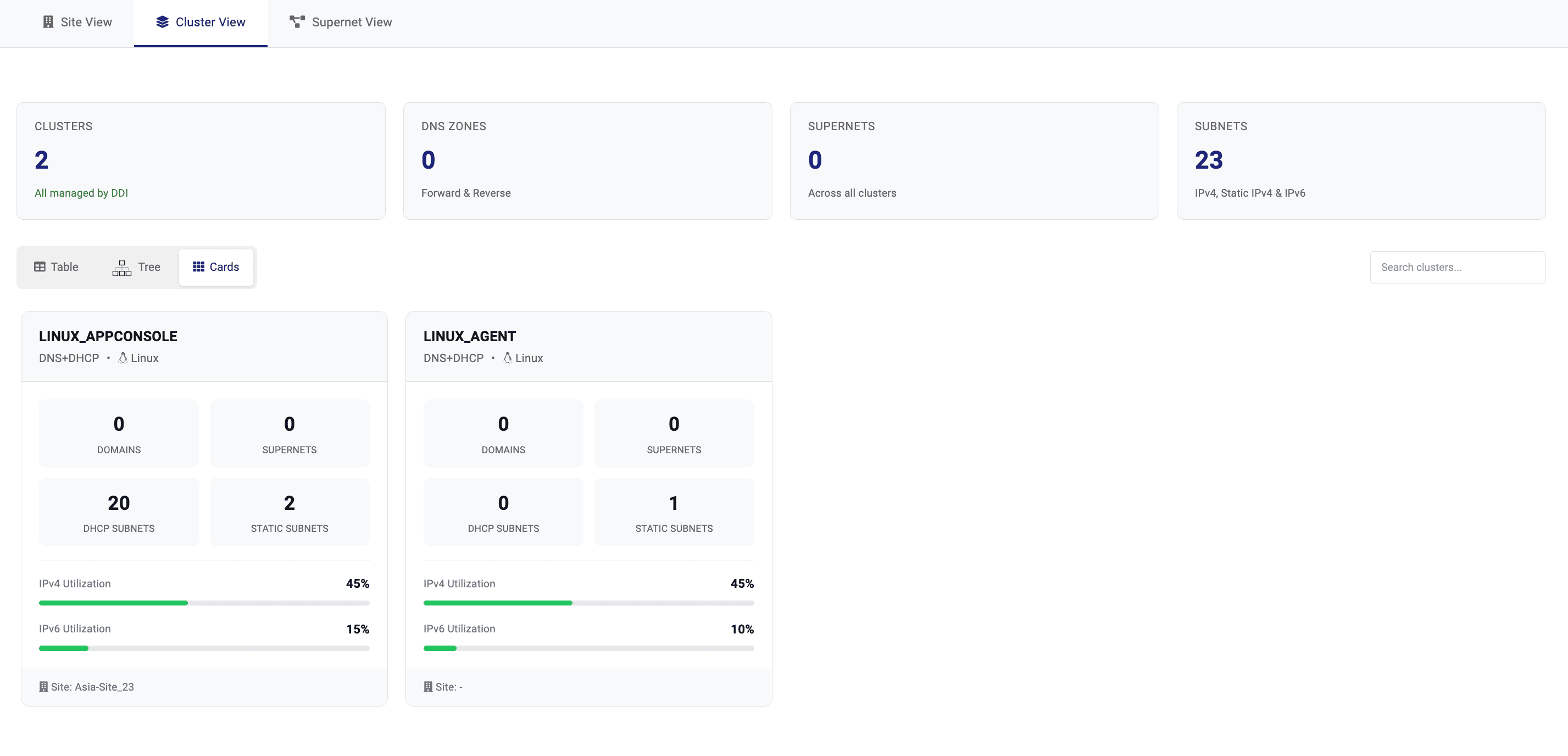
Cluster View lets administrators navigate by logical IP space and service ownership. It reflects the reality of modern enterprise networks, where multiple environments run in parallel, sometimes even with overlapping IP space, but still require clean guardrails and separation.
This is one of IPAM Tower’s strongest value propositions: It does not flatten complex environments into a single undifferentiated inventory. It respects the structure of the network as it actually operates.
Supernet View: When the investigation starts with the address space itself
Then there are the moments when the admin begins with the address block, not with location or ownership.
They know the range andthey know that the problem sits somewhere inside a larger structure. What they need is a way to move from high-level address design into the exact pool, subnet, or IP that matters.
That is where Supernet View comes in.
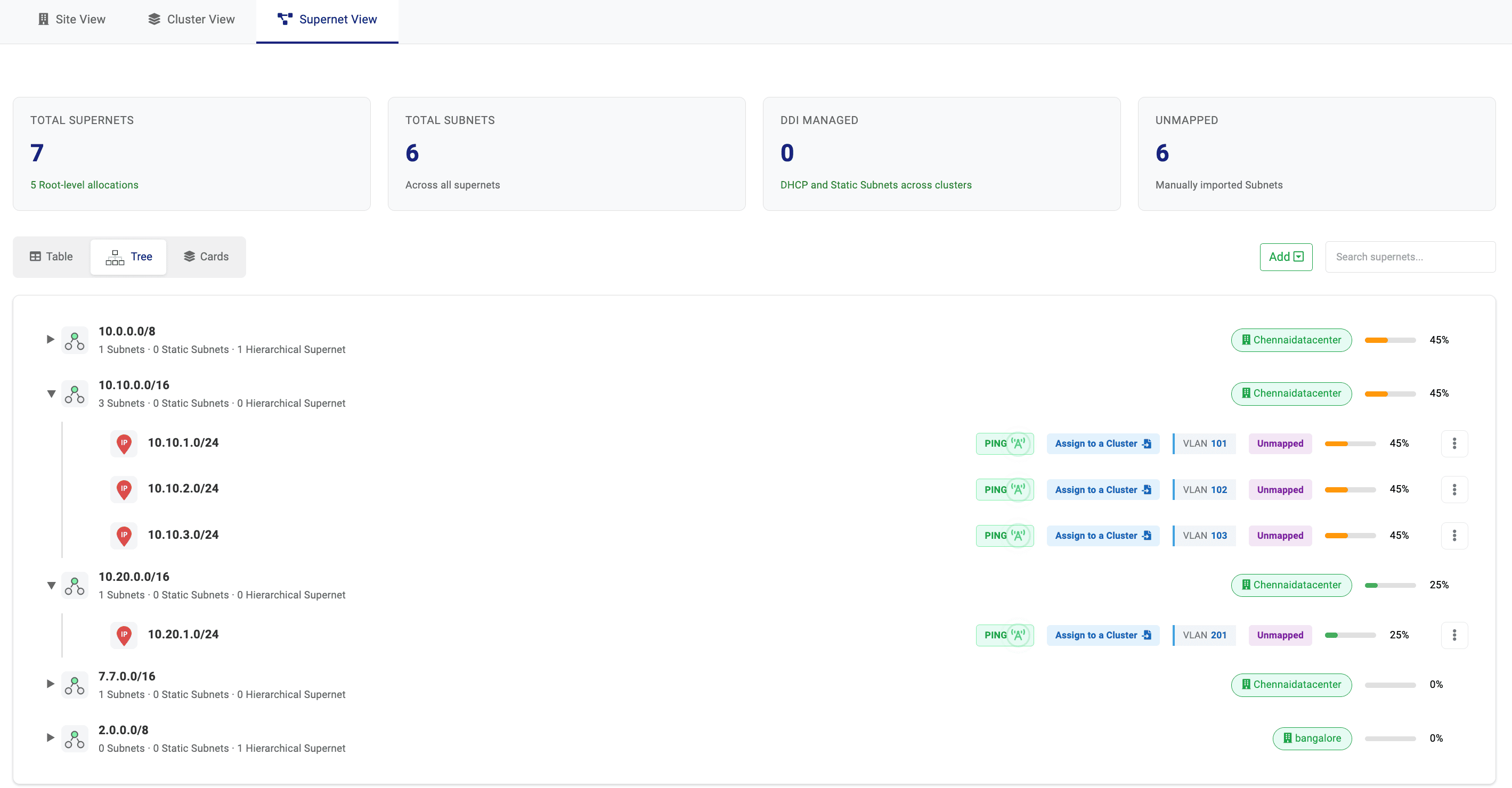
Supernet View gives admins a top-down, hierarchical path through IP space, from supernet to subnet to pool to individual IP. It helps them understand parent-child structure, identify the right scope faster, and spot issues like fragmentation or exhaustion more clearly.
This makes IPAM Tower especially useful in complex, distributed environments where address hierarchy matters just as much as operational ownership.
One inventory, multiple ways to see it
Reaching the right place is only part of the story.
Once inside, different tasks require different visual approaches. Sometimes an admin wants speed and comparability. Sometimes they want hierarchy, andmaybethey want quick triage.
That is why IPAM Tower supports the same inventory in Table, Tree, and Cards modes.
Table mode helps with scanning, sorting, filtering, and comparing at scale.
Tree mode preserves structural context during drilldowns.
Cards mode helps surface quick signals like utilization pressure, hotspots, or exhaustion risk.
This flexibility matters more than it may seem. It means the admin does not need to leave the same operational flow to see the same information in a better format for the task at hand.
How IPAM Tower differs from traditional IPAM software
If traditional IPAMs are designed primarily to store and document, IPAM Tower is designed to guide and operationalize.
It does not treat IPAM as a shelf of records. It treats it as an environment admins need to move through with confidence.
Here's why IPAM tower stands apart:
Built for guided navigation, not just IP consolidation
Offers three natural paths to the same target scope
Keeps unmapped IPs, delegated or static IPs visible along with DHCP-driven IPs inside the same operational map
Supports optional monitoring for unmapped subnets
Brings DHCP-managed, static, delegated, and unmapped ranges into one navigation experience
Keeps Table, Tree, and Cards available across every path
Connects pinpointing, validation, and action in one continuous workflow
Many traditional IPAM tools make teams find the object in one place, validate it in another, and investigate context somewhere else. IPAM Tower reduces that fragmentation.
Traditional IPAM tells you what exists. IPAM Tower helps you find it, understand it, and act on it faster.
Why IPAM Tower matters for modern networks
As enterprise networks become more distributed, the cost of fragmented visibility grows.
When teams operate across multiple sites, multiple environments, overlapping address spaces, and partially governed ranges, speed of navigation becomes critical. The ability to move naturally through the IP landscape is no longer a nice-to-have. It directly affects troubleshooting speed, clarity, and control.
That is why IPAM Tower matters. It brings together the physical, logical, and hierarchical dimensions of IP space into one navigable experience.
Real-world impact: Scale without the sprawl
As networks scale, clarity becomes just as important as control. Traditional IPAMs can document the landscape. IPAM Tower helps you move through it. It gives administrators a more intuitive way to reach the right pool, understand the surrounding context, and act faster without losing momentum.
IPAM Tower offers a better vantage point to run your IP operations. If your network has outgrown flat IP visibility, it may be time to move to an IPAM experience built for navigation. Explore DDI Central’s IPAM Tower and see how a better operational map can lead to faster troubleshooting, clearer context, and stronger control at scale.
Ready to elevate your IPAM strategy?
Climb the DDI Central IPAM Tower see what changes when your IP space is no longer just stored, but truly navigable. Start a 30-day free trial or book a personalized demo today.