
Security operations centers (SOCs) are game-changers in modern cybersecurity, playing a crucial role in strengthening incident response capabilities. In a world where cyberthreats evolve rapidly, swift and efficient incident response is vital to minimizing damage and ensuring business continuity . According to IBM’s Cost of a Data Breach Report, organizations with an incident response team and a formal response plan save an average of $473,706 in breach-related costs. A well-defined incident response process enables organizations to detect, contain, and remediate threats in real time. With a proactive SOC in place, businesses can transform their defense strategy from reactive to resilient.
This article delves deep into the SOC incident response process and how SIEM can be helpful.
Types of incidents that a SOC handles
T he following are the five most common types of incidents that a SOC typically handles:
- Malware infections: Detecting and removing malicious software, such as viruses, worms, ransomware, or Trojans, which can compromise systems or data
- Phishing attacks: Identifying and responding to deceptive emails or messages aiming to steal credentials or sensitive information
- Unauthorized access: Monitoring for and mitigating instances where attackers or insiders gain access to systems or data without proper authorization
- Denial-of-service attacks: Detecting and responding to attacks that flood systems or networks, disrupting service availability
- Data breaches: Investigating and containing incidents involving unauthorized data exfiltration or the exposure of confidential information
The importance of the SOC incident response process
Maintaining an organization's security posture and reducing the impact of cyberattacks depend heavily on the SOC incident response process. It provides a structured, systematic approach to detecting, analyzing, containing, and recovering from security incidents. A robust incident response process ensures compliance with regulations, minimizes damage, speeds up response times, and promotes continuous improvement through the lessons learned. In the end, it helps companies protect critical assets, respond to threats proactively, and maintain stakeholders' trust.
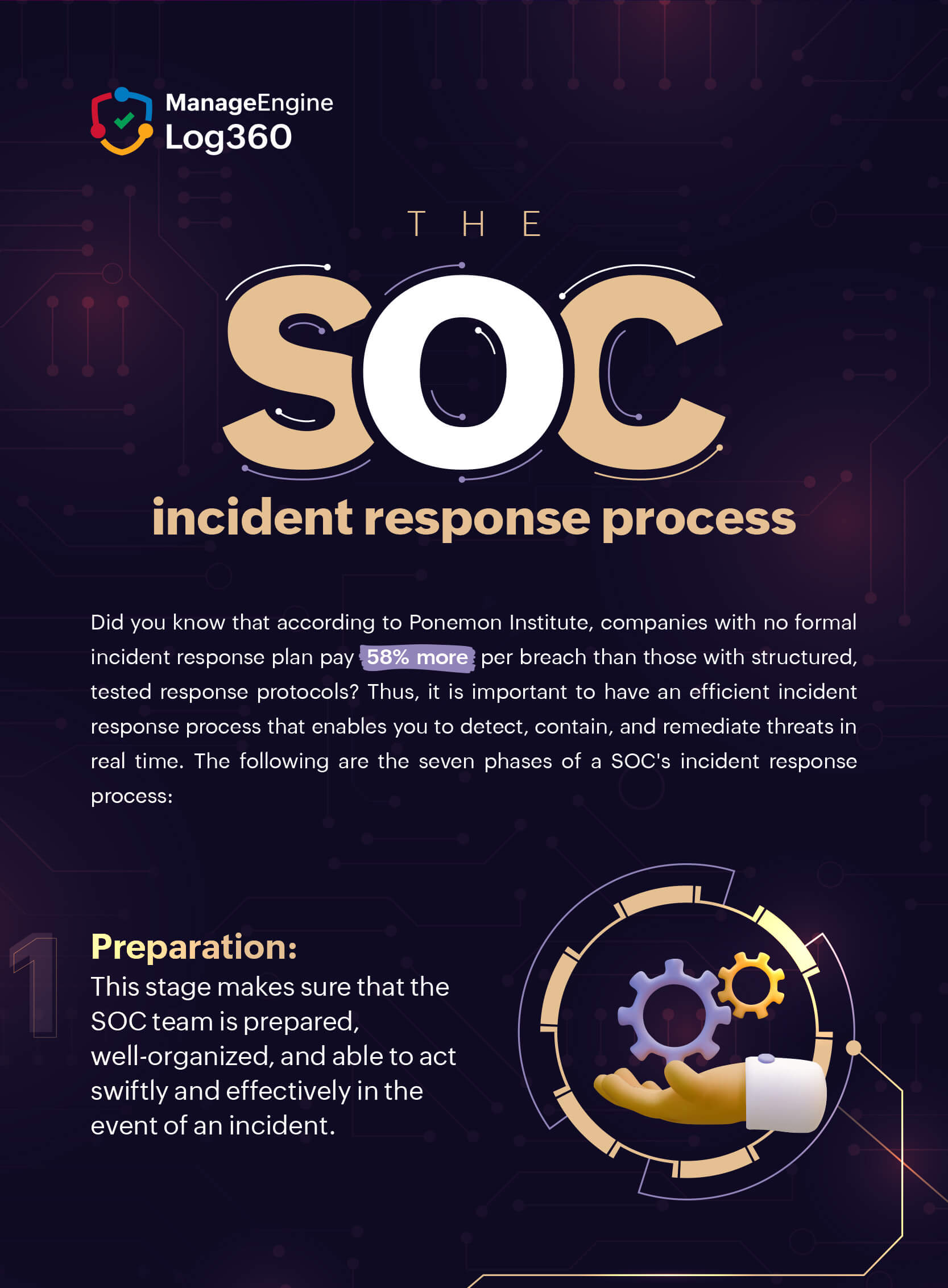
Phases of the SOC incident response process
| Phase | Process |
|---|---|
| Preparation | This is the foundation of a successful incident response process. It entails:
|
| Identification | In this phase, the SOC works to detect and verify that an actual security incident has occurred. This involves:
|
| Containment | Reducing the incident's impact and spread is the aim here. Usually, containment is divided into:
|
| Eradication | The SOC concentrates on eliminating the incident's primary cause after the threat has been contained. This involves:
|
| Recovery | During this stage, the organization brings its systems back to regular functioning while ensuring their security before resuming online operations. Recovery involves:
|
| Lessons learned | After the incident is resolved, the SOC conducts a post-incident review to:
|
| Documentation and reporting | Proper documentation is essential for:
|
Key tools used in the SOC incident response process
For efficient detection and monitoring, the following tools and capabilities can be used:
- SIEM tools: Collect and analyze log data from across the environment to detect anomalies and generate alerts.
- IDSs and IPSs: Monitor network traffic for signs of attacks or policy violations.
- EDR tools: Monitor for and respond to threats at the endpoint level.
The role of SIEM in enhancing the SOC incident response process
| Phase | SIEM solution features |
|---|---|
| Preparation |
|
| Identification |
|
| Containment |
|
| Eradication |
|
| Recovery |
|
| Lessons learned |
|
| Documentation and reporting |
|
For effective containment and protection, you can use the following tools:
- SOAR platforms automate repetitive tasks and orchestrate workflows for faster incident response.
For faster eradication and recovery, you can use the following tools:
- Forensic analysis tools assist in deep analysis of compromised systems to find root causes and malicious artifacts.
- Vulnerability management tools identify vulnerabilities that may have been exploited in an incident, tracking them across endpoints and helping you deploy patches.
For enhanced post-incident review and learning, you can use the following tools:
- Knowledge base management tools help you review your incident response process across various stages and make improvements.
For better documentation and reporting, you can use the following tools:
- Incident tracking and ticketing systems log incidents, track the progress of tickets, and maintain audit trails.
- Threat intelligence platforms aggregate threat data and context to enrich investigations and anticipate future threats.
Challenges of the SOC incident response process
SOC teams face the following challenges:
- Alert fatigue: Every day, SOC analysts may get dozens of alerts, many of which are low-priority or false-positive events. Burnout and missed incidents result from the inability to distinguish real threats from noise. Critical threats may go undetected, or analysts may take too long to address them, increasing the potential damage.
- A lack of skilled personnel: There's a global shortage of experienced cybersecurity professionals with the skills needed for incident response. It is difficult to look into complicated incidents or make prompt, well-informed decisions without qualified analysts. Poor remediation techniques, misinterpreted threats, and delayed responses can increase your organization's risk.
- Tool overload and poor integration: SOC teams frequently utilize a variety of tools that come from many suppliers and are ineffective at communicating with one another. Incident handling is slowed down by interface switching, redundant work, and missing context. Inefficiencies in workflows and incomplete threat visibility lead to uncoordinated, slow responses.
- Insufficient visibility: Many SOCs don't have complete visibility into every aspect of their IT infrastructure, particularly when it comes to the cloud, remote endpoints, or third-party systems. Attackers could take advantage of undiscovered vulnerabilities or activities since we can't protect what we can't see. Insufficient visibility means threats remain hidden longer, leading to greater damage and harder investigations.
- Slow response times: Log analysis, threat containment, and triage are examples of manual procedures that are labor-intensive and prone to human error. Slow operations give attackers more time to move laterally or exfiltrate data. Since every second counts during an incident, this leads to increased downtime, data loss, and reputational damage.
- An evolving threat landscape: Cyberthreats constantly evolve, with attackers using new techniques like file-less malware or AI-generated phishing. SOC teams need to update their detection rules, playbooks, and threat intelligence constantly. Falling behind on threat trends increases the risks of undetected attacks or ineffective response strategies.
Best practices for an effective SOC incident response process
The following are the best practices you can follow to overcome the challenges listed above:
- Fine-tune your SIEM solution's detection rules to reduce false positives.
- Use correlation and context enrichment to focus on meaningful alerts.
- Automate tasks like triage and enrichment using a SOAR platform to lighten the analysts' load.
- Regularly upskill your team with certifications, workshops, and simulations.
- Invest in training analysts on how to use advanced SIEM solution features like search queries and regular expressions.
- Use SIEM or SOAR tools to centralize data and responses in one interface.
- Integrate real-time intelligence into detection and investigation processes.
The role of SIEM in effective SOC incident response
Here's how a SIEM solution can help you overcome the challenges mentioned above:
| Challenge | SIEM features |
|---|---|
| Alert fatigue |
|
| A lack of skilled personnel |
|
| Tool overload and poor integration |
|
| Insufficient visibility |
|
| Slow response times |
|
| An evolving threat landscape |
|
Empower your enterprise
ManageEngine Log360, a unified SIEM solution with data security and cloud security capabilities, stands as your enterprise’s shield, defending against a multitude of cyberthreats with its robust capabilities, such as:
- Unmatched threat detection across your network: Identify threats across endpoints, firewalls, web servers, databases, switches, routers, and cloud sources, ensuring enterprise-wide protection.
- Proactive attack detection with advanced analytics: Harness rule-based attack detection, the MITRE ATT&CK framework, and ML-powered behavior analytics to detect cyberthreats, trigger real-time alerts, and automate incident response for swift mitigation.
- UEBA for deeper insights: Monitor and detect anomalous activities across users, hosts, and other network entities using advanced ML algorithms, strengthening your security posture against insider threats.
- SOAR: Enhance security operations with unified security data analytics, integrated incident management, prebuilt response workflow profiles, and automated ticketing systems, streamlining response and remediation.
- Integrated DLP for sensitive information protection: Prevent data leaks by locating and classifying sensitive information using predefined data discovery policies, enforcing security controls, and restricting access to non-business cloud services.
- CASB capabilities for cloud security management: Gain control over cloud applications, monitor shadow IT, and analyze user interactions with cloud services, ensuring secure access and usage.
- Simplified IT compliance management: Stay ahead of regulations with audit-ready reports, real-time compliance alerts, privileged user monitoring, and incident resolution features that help you meet regulatory mandates effortlessly.
- Real-time security analytics for complete visibility: Monitor network activity, detect anomalies, and manage incidents in real time with interactive dashboards, advanced threat analytics, real-time event correlation, and automated response features, ensuring a proactive security stance.
If you would like to enhance your enterprise's security posture, sign up for a personalized demo of ManageEngine Log360.