
What is a SOC maturity model?
A SOC maturity model is a framework for evaluating and improving a SOC's ability to identify, address, and mitigate cyberthreats. It helps organizations evaluate their SOC's capabilities across people, processes, and technology, progressing from basic (ad hoc) to advanced (optimized) security operations. It provides a structured approach to evaluating current security processes, technologies, and team skills, identifying gaps, and setting goals for progression. Common models that outline the steps from reactive to proactive security include HPE's security operations maturity model (SOMM), Gartner's SOC model, and the CMMI Intstitute's Capability Maturity Model Integration (CMMI).
For a quick and efficient threat response, a mature SOC combines automation, threat intelligence, and predictive analytics. Adopting a SOC maturity model ensures continuous improvement and resilience against evolving cyberthreats.
How does a SOC maturity model help measure the effectiveness of the SOC?
With the implementation of an organized framework for evaluating and enhancing security capabilities, a SOC maturity model aids in measuring the effectiveness of the SOC in the following ways:
- Capability assessment: Assessing the SOC's capacity to identify, address, and mitigate threats at various maturity levels, from ad hoc to fully optimized.
- Gap identification: Organizations can find vulnerabilities in people, procedures, and technology by comparing their current security operations with a predefined maturity model.
- Process standardization: It ensures that SOC operations follow well-defined, repeatable processes, reducing reliance on individual expertise and improving consistency.
- Performance benchmarking: To make sure they are meeting evolving cybersecurity requirements, organizations can assess their SOC maturity against peers and industry standards.
- Continuous improvement: By investing in automation, threat intelligence, and preventive security measures, the model offers a road map for improving SOC capabilities.
What are the common frameworks in a SOC maturity model?
The following are various frameworks that help organizations measure their SOC’s effectiveness, identify gaps, and improve security operations through structured growth and best practices.
Capability maturity model (CMM): This is among the most used models for assessing SOC maturity. Its five-level approach was originally derived by the Software Engineering Institute and maintained by the CMMI Institute, which is used in organizational process optimization and software development.
The CMM levels for SOCs are as follows:
- Level 1 (Initial): Ad hoc, reactive security
- Level 2 (Managed): Basic monitoring and incident response
- Level 3 (Defined): Standardized security processes and SIEM integration
- Level 4 (Quantitatively Managed): Advanced analytics and automation
- Level 5 (Optimized): Proactive threat hunting and AI-driven security
Gartner SOC maturity model: Gartner’s framework classifies SOC maturity into four levels, focusing on automation, threat intelligence, and proactive security measures.
Levels of Gartner SOC maturity:
- Minimal: Basic security tools with minimal security monitoring.
- Reactive: Incident response system and a SIEM exists, but threat detection is limited.
- Proactive: Integration of automation, advanced analytics, and threat intelligence.
- Predictive: Automatic incident response and threat hunting powered by AI.
Although Gartner's approach is simpler than CMM, it emphasizes a SOC's ability to predict and prevent threats rather than only respond to them.
HPE SOMM: This model was created by Hewlett-Packard Enterprise (HPE) and is intended to evaluate an organization's orchestration, risk-based decision-making, and SOC automation.
It also follows a five-level structure similar to CMM:
- Level 1: Minimal Capability: Security operations are unstructured and reactive, with no formal SOC team or defined processes.
- Level 2: Basic Capability: A small SOC team is formed, utilizing basic monitoring and SIEM for log collection.
- Level 3: Documented and Repeatable: Incident response (IR) processes are standardized, with threat intelligence and initial automation integrated.
- Level 4: Measured and Managed: Advanced AI-driven analytics, SOAR implementation, and automated threat detection enhance security operations.
- Level 5: Optimized and Adaptive: The SOC becomes fully autonomous, leveraging predictive threat intelligence, AI-powered security, and continuous attack simulations for proactive defense.
This model is particularly helpful for organizations looking to automate and optimize their SOC functions.
MITRE ATT&CK-based maturity models: The MITRE ATT&CK framework is a knowledge base of real-world attack tactics and techniques used by adversaries. MITRE ATT&CK is currently incorporated into a number of SOC maturity models to detect, investigate, and respond to threats across different attack stages.
MITRE ATT&CK supports SOC maturity in the following ways:
- Aids SOC teams in connecting security alerts to real-world attack methods.
- Identifies missing security controls by providing detection coverage gaps.
- Enables proactive threat hunting by leveraging adversary behavior patterns.
MITRE ATT&CK is used by several advanced SOCs (level 4 and 5 maturity) to improve proactive protection, automation, and threat intelligence.
NIST Cybersecurity Framework (CSF) for SOCs : The NIST CSF is widely adopted for SOC maturity assessments. It comprises five core functions, which align with different levels of SOC maturity:
- Identify: Asset management, risk assessment, governance.
- Protect: Identity management, access control, endpoint security.
- Detect: Continuous security monitoring, anomaly detection, SIEM.
- Respond: Incident response planning, containment, and analysis.
- Recover: Lessons learned, improvement plans, security resilience.
NIST CSF is useful for SOCs aiming for risk-based security operations and regulatory compliance.
The organization's security needs, industry requirements, and current capabilities all influence the choice of the SOC maturity model:
| Requirement | Framework |
|---|---|
| For structured process improvement | CMMI Institute's CMM |
| For automation and AI-driven security | Gartner's SOC maturity model and HPE's SOMM |
| For threat-based security assessment | MITRE ATT&CK framework |
| For compliance-focused SOCs | NIST Cybersecurity Framework (CSF) |
What are the different levels of a SOC maturity model?
The following are the different levels of SOC maturity:
| Level | Characteristics | Key focus |
|---|---|---|
| 1. Initial (ad hoc security) |
|
To enhance threat visibility and incident response |
| 2. Managed (basic SOC capabilities) |
|
Establishing foundational SOC processes and improving detection efficiency |
| 3. Defined (proactive security operations) |
|
Moving towards proactive threat detection and structured response |
| 4. Quantitatively managed (advanced security operations) |
|
Using automation, AI, and threat intelligence to enhance security operations |
| 5. Optimized (predictive and autonomous SOC) |
|
Achieving self-learning, predictive, and fully automated security operations |
What are the key components of a SOC maturity model?
1. People (security team and skillset): The effectiveness of a SOC is dependent on its threat hunters, engineers, and analysts. It requires specialized positions like tier 1, tier 2, and tier 3 analysts, threat intelligence specialists, and incident responders.
2. Processes (security workflows and incident response): It defines how threats are detected, analyzed, and mitigated, including incident response plans (IRP), playbooks, and security policies.
3.Technology (security tools and SIEM): Various security tools like SIEM, SOAR, EDR, and threat intelligence platforms serve as the SOC's foundation. Also, advanced analytics, automation, and AI enhance SOC efficiency.
4. Threat intelligence (proactive threat hunting and IoC integration): This helps the SOC predict potential threats and mitigate them before the attacks can occur. This process can include the usage of IoCs and IoAs.
5. Compliance and governance (regulatory and policy enforcement): This involves ensuring that the SOC meets legal, regulatory, and industry compliance standards in order to avoid data breaches, financial penalties, and reputational damage.
6. Metrics and performance (KPIs for SOC efficiency): In order to improve incident response, threat detection, and risk management, it is crucial to measure the SOC's effectiveness using KPIs. The KPIs include MTTD, MTTR, false positive rate, and incident resolution rate.
The following table explains the maturity level progression scenario of each of the components:
| People | Processes | Technology | Threat intelligence | Compliance and governance | Metrics and performance | |
|---|---|---|---|---|---|---|
| Level 1 | No dedicated SOC team and instead, IT handles security reactively | No formal security processes and incident handling is reactive | Basic tools with minimal security visibility, like firewalls and antivirus | No external threat intelligence is used | No formal compliance processes, and audit failures are common | No security metrics and manual threat tracking implementation |
| Level 2 | Security team with limited expertise | Incident response playbooks exist but are not enforced | SIEM is deployed but used mainly for log collection | Basic threat feeds integrated into SIEM | Log retention is done for compliance (PCI DSS, HIPAA, GDPR) | Logging of basic security metrics with few KPIs |
| Level 3 | Well-trained analysts with 24/7 SOC operations | Well-defined IRP with consistent processes for threat handling. | SIEM, threat intelligence, IDSs, and IPSs utilized for better threat detection | Threat intelligence is correlated with SOC alerts | Automated compliance reporting and security audits | Regular SOC performance reviews based on metrics |
| Level 4 | Advanced threat hunters, security engineers, and forensic experts | Continuous process improvement using security metrics | SIEM, SOAR, and AI-driven analytics for automated threat detection | Active threat hunting with AI-driven IoC analysis | SIEM and SOAR for automated compliance enforcement | Automated KPI tracking with dashboards |
| Level 5 | Fully automated SOC with AI-augmented analysts | Fully automated security workflows | Fully AI-powered SOC with predictive threat intelligence | Fully predictive threat intelligence with automated threat hunting | Fully governance-driven SOC with real-time compliance | AI-driven SOC performance optimization |
What are the challenges faced in SOC maturity development and how can they be prevented?
The following are the key challenges the SOC team faces in achieving SOC maturity and how they can be prevented:
| Challenge | Prevention techniques |
|---|---|
| Lack of skilled or experienced SOC analysts, threat hunters, and incident responders |
|
| Alert fatigue since SOC analysts receive thousands of alerts everyday |
|
| SOCs relying on manual processes instead of automation, which slows down the incident response |
|
| SOCs often lack real-time threat intelligence, leading to delayed threat detection |
|
| Poor log collection from the cloud, endpoints, and network devices leads to visibility issues |
|
| Organizations struggle to comply with the GDPR, the PCI DSS, HIPAA, ISO 27001, and NIST. Also, audit failures have become common due to poor log retention and reporting |
|
| It costs a lot to build and operate a 24/7 SOC (people, tools, infrastructure). Many companies find it difficult to justify to executives the ROI of the SOC |
|
| SOCs struggle to keep up with the evolving threat landscape and sophisticated attacks |
|
How can SIEM help in overcoming the challenges faced in SOC maturity development?
Here is how a SIEM solution helps:
| Challenges faced | SIEM features that help |
|---|---|
| Lack of skilled security professionals |
|
| Alert fatigue and overwhelming false positives |
|
| Inefficient incident response and lack of automation |
|
| Lack of threat intelligence integration |
|
| Poor log management and visibility issues |
|
| Compliance and regulatory challenges |
|
| Budget constraints and cost of SOC operations |
|
| Evolving threat landscape and cost of SOC operations |
|
Ready for the next steps?
Log360 is your enterprise’s shield, defending against a multitude of cyberthreats, with robust capabilities such as:
- Unmatched threat detection across your network: Log360 enables organizations to identify threats across endpoints, firewalls, web servers, databases, switches, routers, and cloud sources, ensuring enterprise-wide protection.
- Proactive attack detection with advanced analytics: Harnessing rule-based attack detection, the MITRE ATT&CK Framework, and ML-powered behavior analytics, Log360 helps enterprises detect cyberthreats, trigger real-time alerts, and automate incident response for swift mitigation.
- UEBA for deeper insights: Monitor and detect anomalous activities across users, hosts, and other network entities using advanced ML algorithms, strengthening security posture against insider threats.
- SOAR: Enhance security operations with unified security data analytics, ITIL-integrated incident management, prebuilt workflow profiles, and automated ticketing systems—streamlining response and remediation.
- Integrated DLP for sensitive information protection: Prevent data leaks by locating and classifying sensitive information using predefined data discovery policies, enforcing security controls, and restricting access to non-business cloud services.
- A CASB for cloud security management: Gain control over cloud applications, monitor shadow IT, and analyze user interactions with cloud services, ensuring secure access and usage.
- Simplified IT compliance management: Stay ahead of regulatory requirements with audit-ready reports, real-time compliance alerts, privileged user monitoring, and incident resolution features that help enterprises meet regulatory mandates effortlessly.
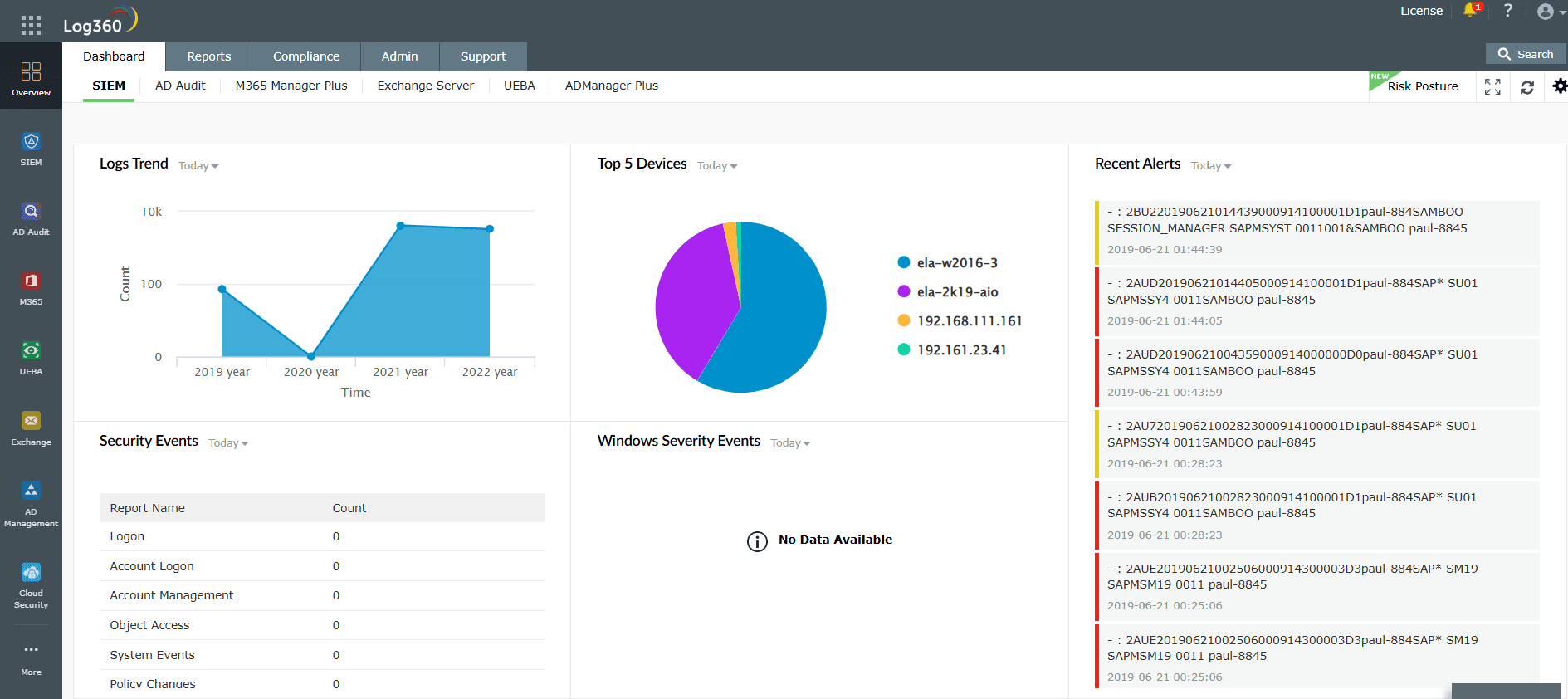
If you would like to enhance your enterprise security posture, sign up for a personalized demo of ManageEngine Log360, a unified SIEM solution with data security and cloud security capabilities.