Chapter 2: Operational excellence for sustainability
The role of a circular economy
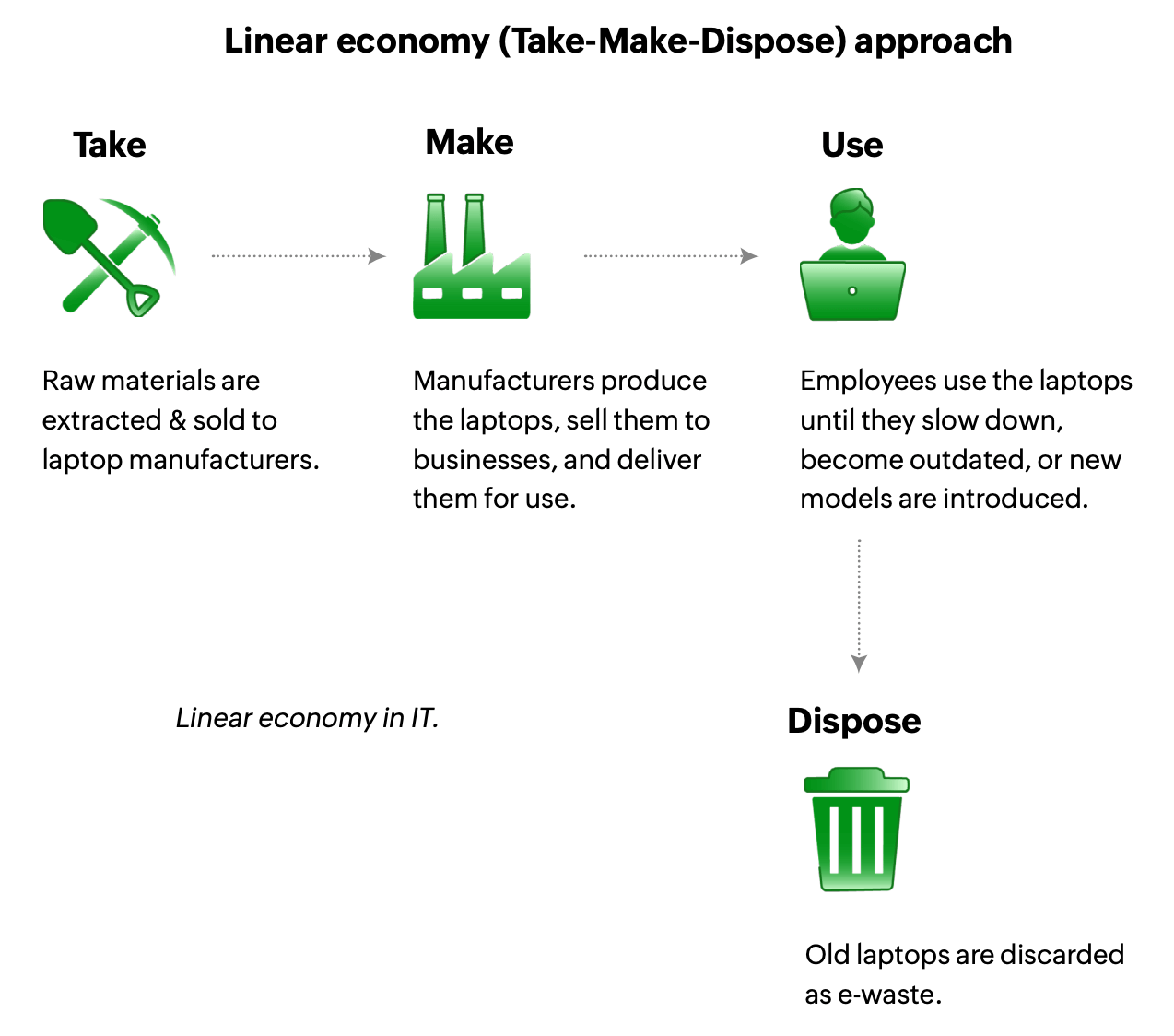
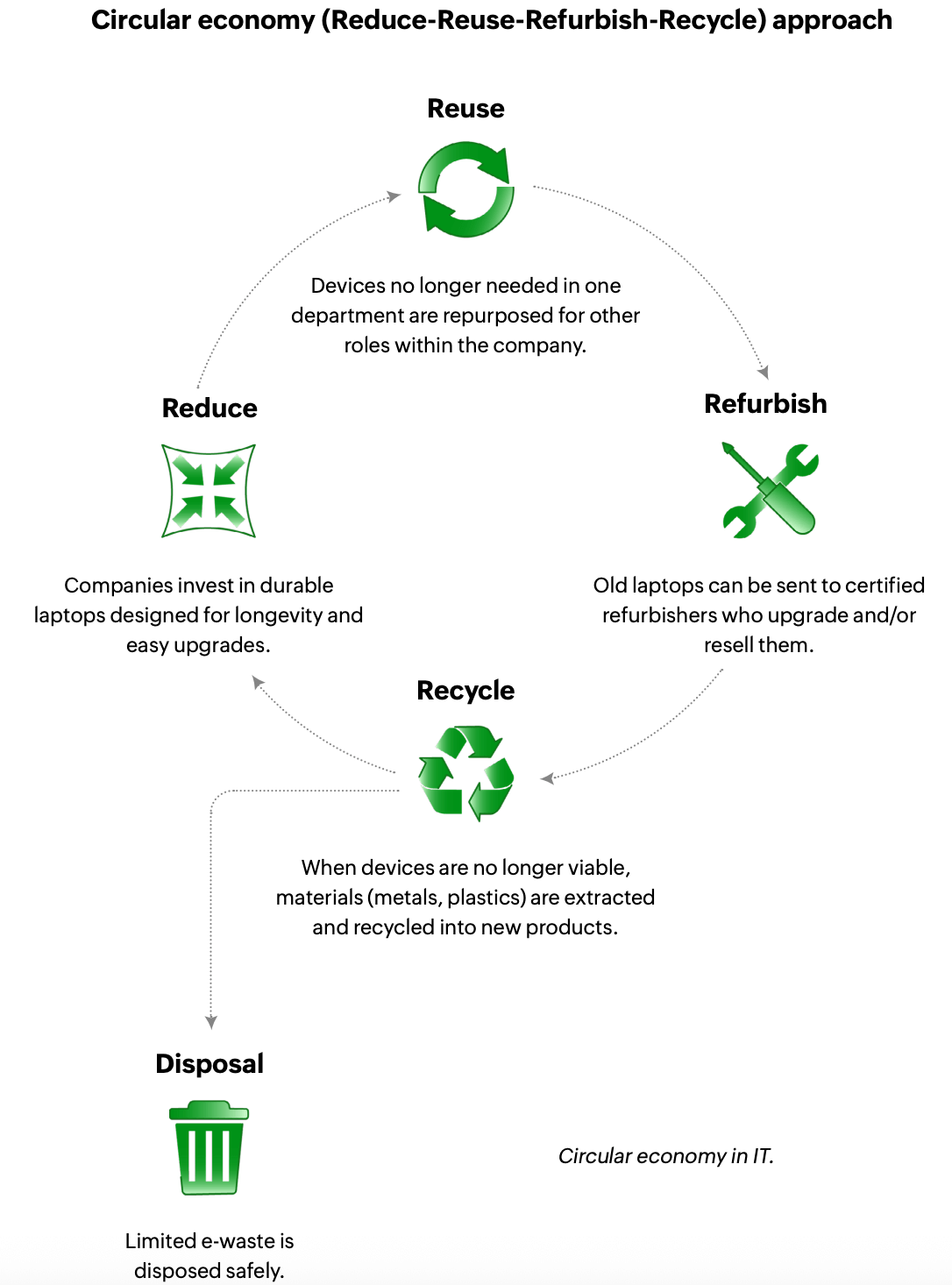
A circular economy focuses on minimizing waste and maximizing the life cycle of resources by reusing, refurbishing, recycling, and sharing IT assets. Unlike the traditional “take-make-dispose” model, a circular economy aims to keep products and materials in use for as long as possible, reducing environmental impact and fostering sustainability.
Linear economy (Take-Make-Dispose) approach
Circular economy (Reduce-Reuse-Refurbish-Recycle) approach
Core principles of a circular economy
Fundamentally, a circular economy is a restorative system. Despite the variations in approach, the core principles are the same. In IT, they revolve around three factors: limiting consumption through efficient design and process, maintaining a closed-loop system, and creating an ecosystem that enables this movement.
Design for longevity:
IT hardware and software should be designed to last longer, with durability, upgradability, and repairability in mind. Software updates, for instance, can be designed to extend product usability instead of forcing obsolescence.
Reduce consumption:
Organizations should encourage employees to use IT equipment for longer by maintaining devices in optimal condition. Businesses can procure modular laptops and desktops that allow for easy upgrades and repairs. Zoho Corp. introduced a wallet-based gadget policy in 2022. Employees are provided with phones, laptops, and other accessories to meet the requirements of their role. Based on their (notional) wallet credits, they can opt for an upgrade every three to four years. This allows the IT team to monitor asset usage accurately and eliminate unnecessary consumption.
Extend product life cycle:
Organizations often discard IT equipment prematurely, leading to significant e-waste. By adopting practices like refurbishing and repurposing old hardware, businesses can minimize waste and the environmental hazards associated with disposal. For instance, instead of disposing of outdated laptops, companies can refurbish and redeploy them for less demanding tasks or donate them to educational institutions.
Responsible disposal:
Gadgets over five years old that have reached the end of their life are sent to an e-waste recycling unit. With nearly 20,000 employees at Zoho Corp. (and each having at least one or two devices), it is crucial to ensure accurate monitoring of device age. The IT team documents details such as the purchase date, serial numbers, and device specifications and sends the information to the e-waste team. These details are communicated to the e-waste vendors, who then collect the devices and provide a confirmation bill. Since the introduction of the wallet-based gadget policy, the number of devices sent for recycling has dropped considerably.
How a circular economy helps with sustainability:
- Promotes resource efficiency.
- Extends product lifespan.
- Lowers carbon footprint.
- Encourages IT asset sharing.
- Reduces e-waste.
- Creates cost savings.
Sustainable procurement practices
Sustainable procurement is crucial for corporate companies because it directly impacts environmental, social, and economic sustainability. Large organizations, in particular, have extensive supply chains, and their purchasing decisions can drive significant environmental and ethical consequences. Integrating sustainability into procurement strengthens brand reputation, attracts eco-conscious customers, and aligns businesses with global sustainability goals.
Establish clear sustainability goals:
Define specific sustainability goals that align with your organization’s values and corporate social responsibility (CSR) strategy. For example, set a goal to source 50% of office supplies from recycled or eco-friendly materials within two years.
Collaborate with sustainable suppliers:
Create a supplier evaluation process that includes sustainability criteria such as environmental impact, labor practices, and ethical sourcing. Prefer suppliers with certifications like ISO 14001.
Review life cycle costing (LCC) and total cost of ownership (TCO):
Factor in maintenance, disposal, and energy usage when evaluating products or services. For example, choose a more energy-efficient machine, even if it has a higher upfront cost, because it reduces long-term energy expenses and environmental impact.
Engage in local sourcing:
Source products locally or regionally to reduce transportation emissions, support local economies, and decrease supply chain risks. Build relationships with local vendors or manufacturers and assess the carbon footprint of shipping and logistics.
Adopt circular procurement practices:
Select products designed for reuse, recycling, or remanufacturing. Choose suppliers offering take-back programs or reusable components and ensure the products can be easily disassembled for recycling.
Integrate sustainability into contracts:
Develop supplier contracts that require regular reporting on sustainability metrics and compliance with environmental regulations. For instance, companies can include clauses that require suppliers to reduce plastic packaging or use sustainably sourced raw materials.