ManageEngine’s green shift: Embracing sustainability in enterprise IT
Chapter 1: Understanding the environmental impact of IT
GenAI has a notable environmental impact.
This sentiment is widely expressed online, but it remains broad and doesn’t explain how GenAI tools contribute to climate change or the associated environmental costs. Here’s the deal: large language models (LLMs) operate on data centers, i.e., energy-intensive servers that consume vast amounts of electricity and emit high levels of carbon dioxide (CO2). These data centers also need water to cool the servers. An average GenAI session with 10-50 responses can effectively use up to half a liter of fresh water.

This isn’t just a technical concern. As the hidden environmental costs of AI come to light, stakeholders are beginning to question not just what a tool can do, but what it takes to do it. The conversation is shifting from focusing solely on performance to embracing performance with responsibility
The modern customer isn’t just looking for cutting-edge technology. They’re also evaluating the environmental impact of their choices. Businesses investing in software solutions are increasingly conscious of sustainability, expecting providers to take responsibility for their environmental, social, and governance (ESG) practices. Buyers now ask tough questions: What are your sustainability initiatives? How energy-efficient is your cloud infrastructure? What steps are you taking to reduce carbon emissions? The answers to these questions directly influence their purchasing decisions.
Transparency is no longer optional. Solution providers must be clear about their sustainability commitments, whether it’s using renewable energy, optimizing data centers for efficiency, or reducing e-waste. A lack of effort, or even misleading by greenwashing, can push potential customers toward competitors who align better with their values. As awareness grows, so does responsibility. Not only is taking real action on sustainability great for the planet, it’s also essential for staying competitive in an increasingly conscious market.
The environmental footprint of IT
The carbon footprint of the IT industry contributes significantly to overall global emissions, making it one of the fastest-growing sources of environmental impact. As more people and businesses rely on digital services, the energy demand from data centers, networks, and electronic devices continues to rise. This digital infrastructure, while often invisible to end users, depends on a vast amount of electricity, much of which still comes from fossil fuels. When combined, the emissions from production, operation, and disposal of IT hardware and services add to a meaningful share of global greenhouse gas output. The rapid expansion of digital technology is shaping a future where IT plays a central role not only in economic growth but also in the planet’s climate trajectory.
1. Data centers
- Energy consumption: Data centers require electricity to power servers, storage, and cooling systems. A large percentage of this energy still comes from non-renewable sources like coal and natural gas.
- Cooling systems: High energy used for cooling infrastructure to maintain optimal server temperatures contributes heavily to global emissions.
- Idle resources: Inefficient server utilization and always-on systems increase energy consumption unnecessarily.
2. Hardware manufacturing and disposal
- Resource extraction: The production of IT hardware, such as servers, networking equipment, and user devices, involves mining rare earth metals and other resources, leading to damaged ecosystems, unfair labor practices, and high carbon emissions.
- Supply chain emissions: Factories manufacturing parts like semiconductors, circuit boards, and casings create carbon emissions. Transportation and distribution of hardware further add to the carbon footprint.
3. E-waste
- Rapid hardware turnover: Hardware lifespans are reduced due to planned obsolescence or compatibility issues, leading to an increase in e-waste.
- Improper disposal: A significant portion of e-waste is improperly disposed of, leading to toxic chemicals leaching into the environment. Recycling rates for IT equipment are low, and much of it ends up in landfills.
- Energy-intensive recycling: Even when recycled, breaking down and reprocessing materials can consume large amounts of energy, especially if facilities are inefficient.
4. Operational inefficiencies
- Poorly optimized code: Software requiring excessive computational resources increases the energy demand of hardware.
- Redundant systems: Duplicate data processing or lack of streamlined workflows leads to energy waste.
Leadership in sustainability
When leaders prioritize sustainability, they set the tone for the entire organization, influencing decisions across operations, supply chains, and corporate strategy. Their involvement ensures that sustainability is not treated as a side project but embedded into the core of business strategy. They create alignment across teams, allocate the right resources, and hold the organization accountable to measurable goals.
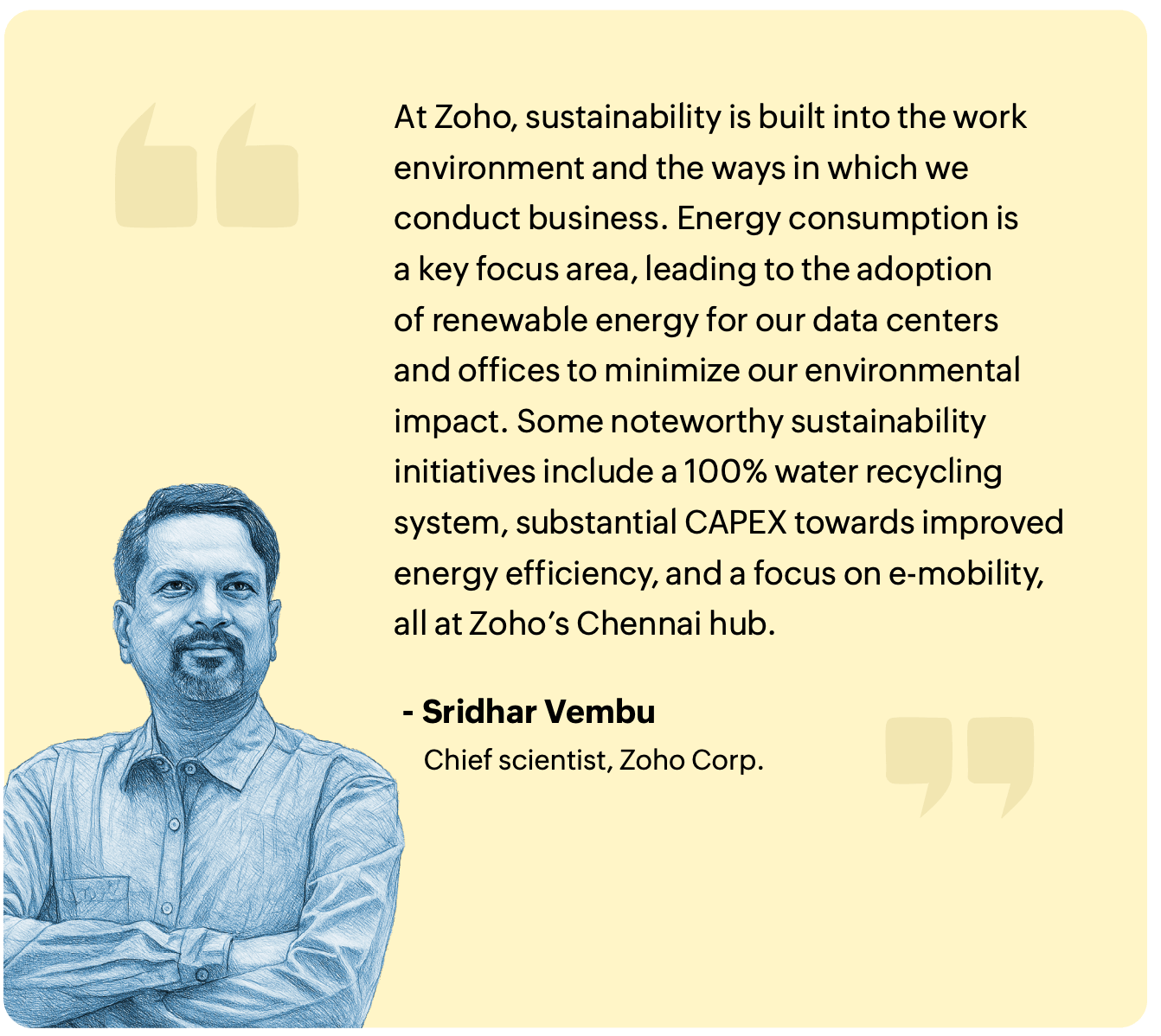
Leaders should be hands-on with their sustainability efforts because their influence directly impacts how seriously the organization approaches environmental responsibility. Their role goes beyond setting vision and endorsements. They should be deeply involved in reviewing progress, making informed trade-offs, and ensuring teams have the authority and resources to act. A visible and committed leadership presence signals to employees, partners, and stakeholders that sustainability is a long-term priority.
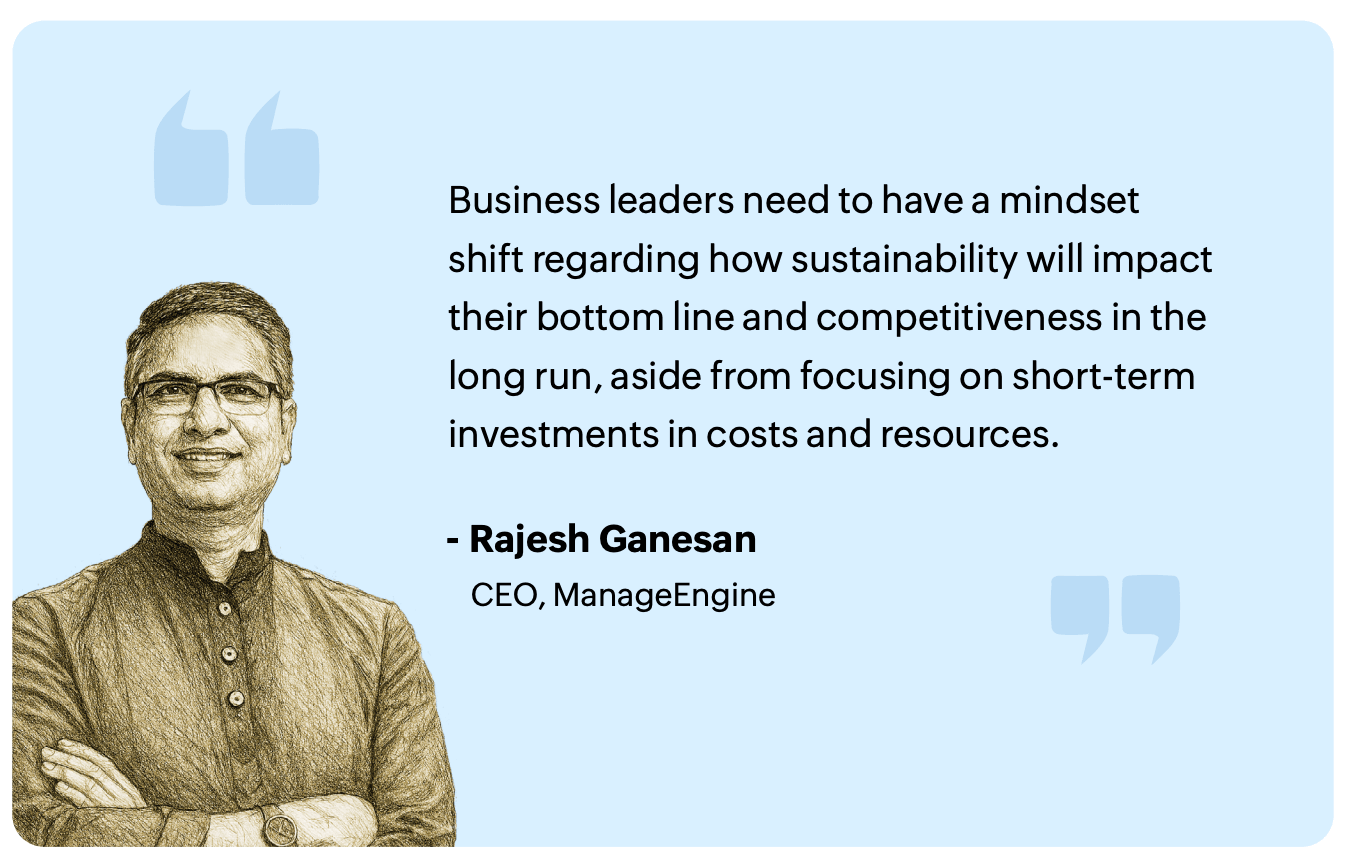
Investors now factor ESG performance into decision-making, while customers expect greater transparency and accountability. As climate risks intensify and regulations tighten across regions, businesses are embedding sustainability into everything from supply chain management and product design to energy sourcing and data center operations. This shift is not limited to large corporations; even mid-sized and emerging companies are trying to align with global frameworks.
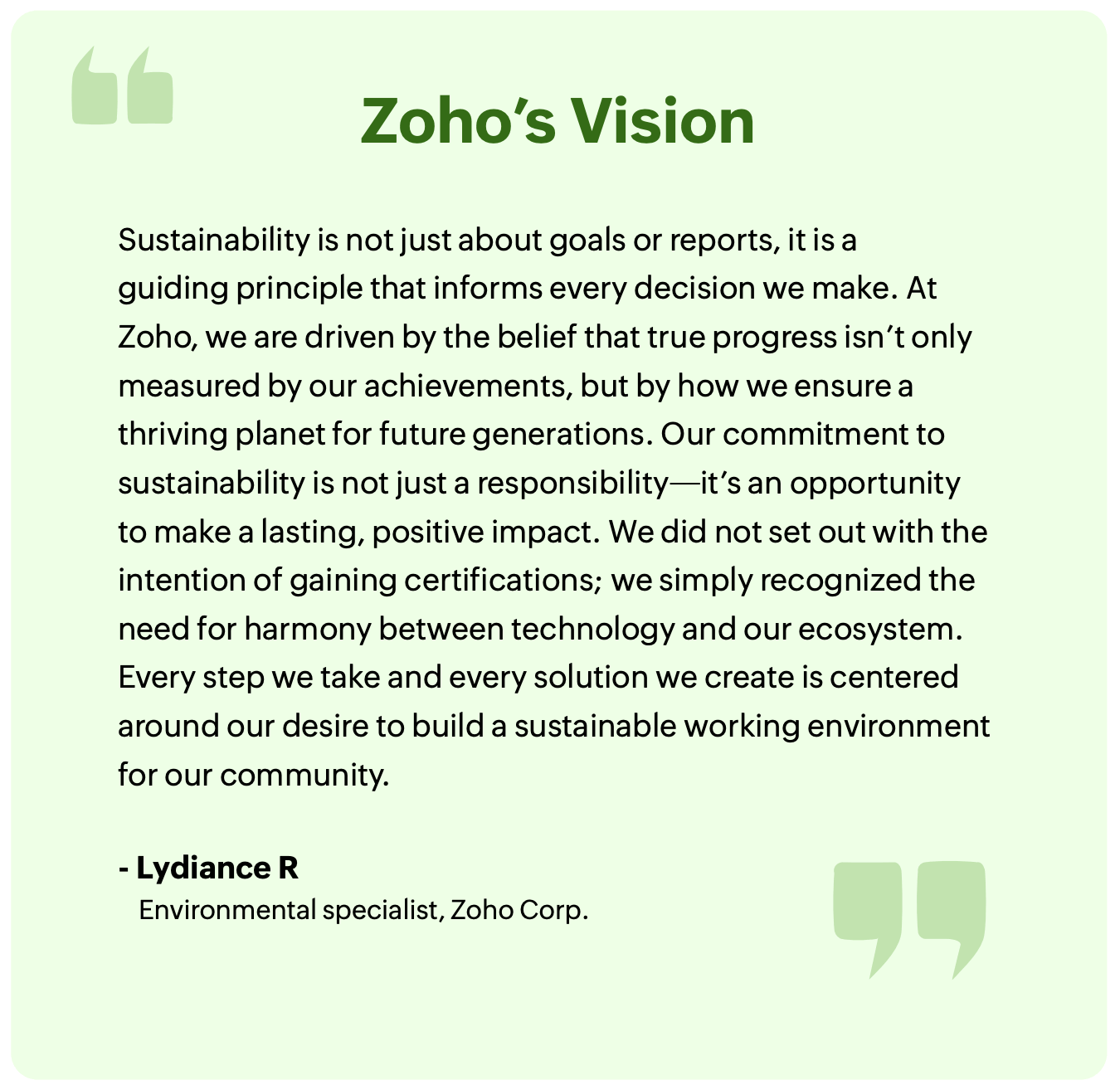
A cultural shift of this magnitude cannot happen overnight. Lydiance, who spearheads the sustainability movement at Zoho Corp., talks about the challenges their team face—particularly in employee awareness. The problem is, people often expect immediate gratification or instant results from their sustainability efforts. Without it, it can become significantly more challenging to adhere to established guidelines or responsible practices. Integrating sustainability requires a top-down approach combined with the understanding that this is an ongoing process.
“If we start today, can we see results in a week or a month? Certainly not. It takes time to sow the seeds and reap its benefits. Most companies are not willing to invest in this because it’s not a revenue-generating initiative. Thankfully, Zoho’s senior leadership has always been about the big picture. In the long run, not only do we save money, we also set an example for other businesses in the tech industry. It can be done, and we are proof. We hope to inspire others and establish ourselves as change-makers for sustainability,” Lydiance said.
For organizations starting from the ground up with a new sustainability team, the first step should be to hire a chief sustainability officer (CSO). Now you may think, if all of these initiatives can be done without a dedicated CSO, why do we need one? What sets a CSO apart is focus, accountability, and influence at the executive level. With access to the boardroom, a CSO can influence high-impact decisions like procurement, product design, and stakeholder relations.
Here’s a quick look at the structure of a corporate sustainability team with a CSO at its helm:
| Roles | Responsibilities |
|---|---|
|
Chief sustainability officer (CSO) |
Sets the sustainability vision and long-term strategy and aligns goals with the corporate mission. Reports to the C-suite or board. |
|
Sustainability program manager / specialist |
Oversees day-to-day implementation, manages timelines and budgets, and ensures compliance. Reports to the CSO. |
|
Subject matter lead |
Vertical expert who collaborates with operational departments to identify opportunities and ensure adherence to regulations. Examples: Environmental compliance lead, energy and resource efficiency analyst, facility liaison |
|
Green supply chain coordinator |
Works with procurement to source sustainable materials and evaluate vendor practices. |
|
Data & reporting analyst |
Tracks KPIs, builds dashboards, and handles sustainability metrics and external disclosures. |
|
Stakeholder engagement/ communications lead |
Develops internal and external campaigns, manages reports, and drives sustainability awareness. |
The role of leadership is predominantly to balance environmental goals with operational efficiency. If environmental goals are pursued without considering operational realities, they risk becoming unsustainable themselves—too costly, disruptive, or difficult to scale. On the other hand, if efficiency is prioritized without environmental accountability, the company may face long-term risks like regulatory penalties, resource scarcity, or reputational damage. Leaders who strike this balance can ensure that sustainability efforts are both impactful and practical.
-
Previous Chapter
‹ - ›