Autonomous endpoint management starts with operational readiness
 Aug 24, 2026
AI is rapidly changing how people work. Tasks that once took hours now take minutes.
Whether it's an AI assistant at your desk, a connected device on the warehouse floor, or an AI-triaged support queue, the pace has changed. And employees expect everything to keep up.
This includes their endpoints.
Device downtime is no longer just an inconvenience. Now it cuts off access to the very AI tools that power modern work. Every interruption is lost productivity.
IT teams are caught in the middle: They must enable AI adoption without friction while simultaneously accelerating patching, enforcing security baselines, preventing policy drift, and controlling AI usage.
Balancing employee productivity with endpoint resilience has become one of IT's most demanding jobs.
Autonomous endpoint management is how IT teams keep up
Autonomous endpoint management (AEM) is already showing up across customer environments.
Autonomous patch management is the most widely adopted use case: prioritizing patches, automating deployments, and cutting manual work, all within admin-defined guardrails.
We're also seeing autonomy extend to self-healing: re-enabling crashed security agents, retrying failed scripts, resolving common issues before IT even notices.
But that's just the foundation. AEM's scope now reaches into real-time security posture enforcement and software life cycle automation:
Zero Trust enforcement
Restrict an endpoint's access to sensitive SaaS applications the moment configuration drift or elevated device risk is detected.
Threat containment and mitigation
Isolate a device or revoke API tokens the instant ransomware behavior is flagged. No waiting on a SOC analyst to triage. Done right, AEM closes the loop entirely: patch the vulnerability (or virtually patch it), then extend that hardening across the rest of the fleet automatically.
License life cycle automation
Reclaim and uninstall unused software, including expensive specialist licenses, after a defined inactivity window, during off-hours.
And it doesn't stop there. The more context your platform has, the more you can build. Most teams haven't scratched the surface of what AEM can do.
So why isn't everyone doing this already?
The potential of AEM remains untapped because most organizations are operationally eager but structurally unready.
Here's what's holding them back:
Fragmented inventories and weak baselines
Endpoint inventory is often stitched together from multiple tools, each updating on its own schedule. The result? Stale and inconsistent data—and autonomy built on it that's prone to misfire. Picture an AEM system mass-rebooting critical servers mid-business-day because of a flawed patch rule.
The black-box trust deficit
IT teams want one thing above all: no downtime. If the autonomous engine can't explain the reasoning behind an action, like why it decided an update was safe, IT teams have no reason to risk the outcome. They default back to manual approval gates.
Siloed incentives
While the IT team wants to ensure uptime and keep endpoints operational, the security team wants to ensure rapid patching and keep them secure. Both teams touch the same endpoint with different goals, resulting in stalled execution.
The fix is making the endpoint estate understandable to automation: accurate, continuously updated inventories. Telemetry that reflects real-time state. Guardrails sized to the risk of each action. Decisions transparent enough that IT can see why they were made. Just as important, security and IT operations agreeing on the outcomes autonomy should optimize for. This ensures that faster response never comes at the expense of business continuity.
Autonomy needs tiers, not a switch
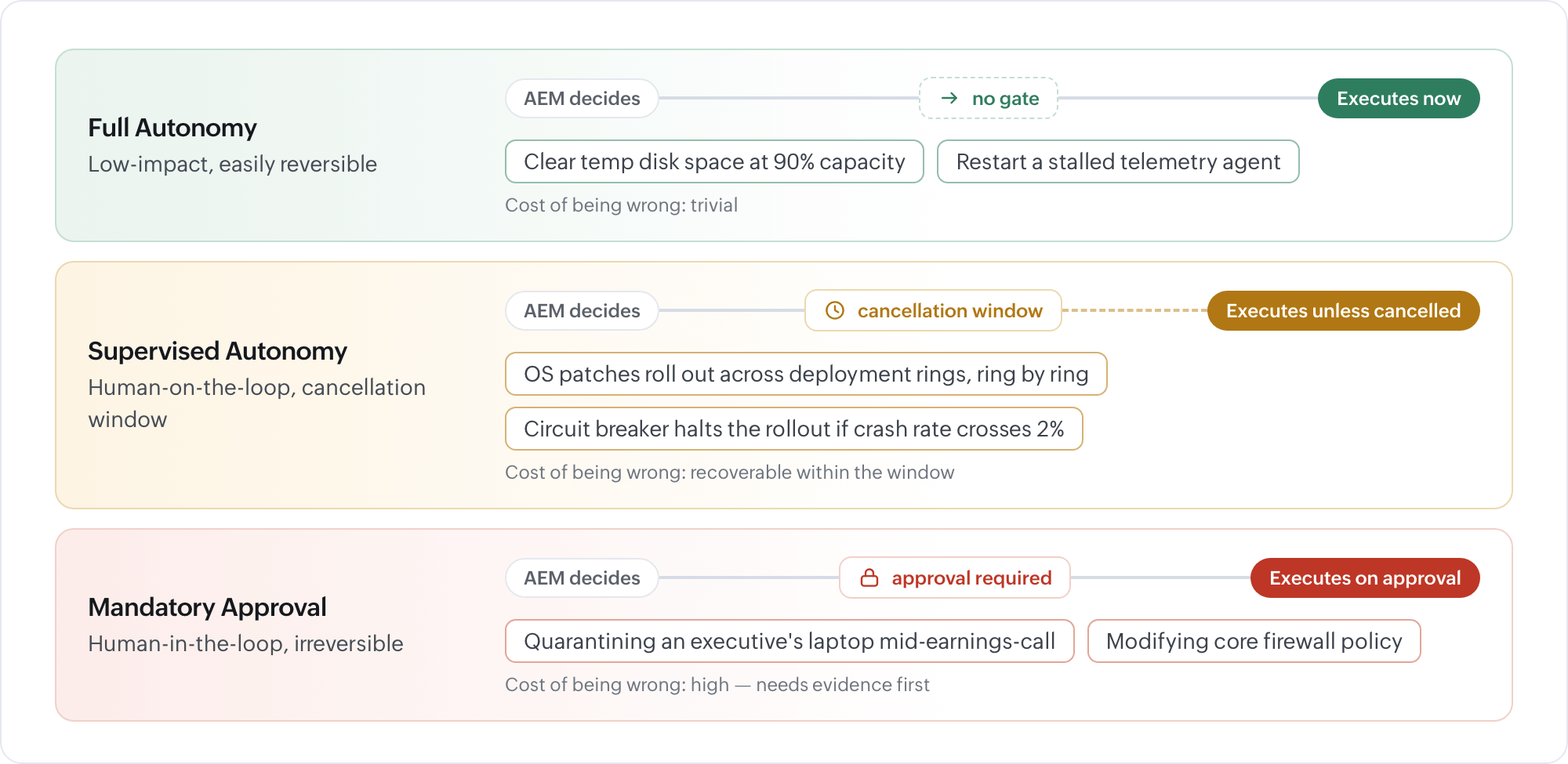
AEM isn't a feature that's flipped on and walked away from. Left unbounded, it can directly hit business continuity. This is why teams need operational guardrails for implementation: Tiered autonomy to limit AI's decision-making authority based on confidence, risk, and business impact.
The AEM system, or any autonomous system for that matter, should have high autonomy for low-impact actions with reversible consequences, and low autonomy for high-impact actions that are hard to recover from.
What comes next
Mean time to resolve (MTTR) has been the benchmark for years. Mean time to prevention (MTTP) is becoming equally important. It measures how quickly autonomous systems can identify and remediate an operational or security issue before it impacts users. Lower MTTP reflects a more effective autonomous operations framework.
As AEM quietly resolves routine Tier 1 issues, IT teams can focus on problems that require human judgment. Their role shifts from executing repetitive tasks to refining the autonomy framework itself, enabling AEM to prevent even more issues proactively and further reduce MTTP.
The payoff? Better employee experience, more resilient endpoints, and higher-value work from the same team. All without giving up control.
The organizations that get this right will be the ones who make autonomous decisions trustworthy through clean data, explainable reasoning, and governance that scales with the risk.