Monitor smarter with Applications Manager's GenAI capabilities
GenAI has moved well past the pilot stage. According to a Gartner® finding, by 2026, more than 80% of enterprises will have used GenAI APIs or deployed GenAI-enabled applications in production.
Today, GenAI is becoming an integral part of how infrastructure and application teams work every day. Organizations are depending on LLMs from a diverse range of vendors—OpenAI, Anthropic, Google AI, and DeepSeek—based on the strengths each offer for different use cases.
At ManageEngine, we believe in evolving with the rapid technology trends and that's exactly why Applications Manager now integrates with the leading GenAI providers, including: Anthropic, Google AI, DeepSeek, Ollama, and SiliconFlow. This enables enterprises to embed the power of AI models into their monitoring workflows.
Compatible for the diverse AI need of organizations
Enterprise customers who are already utilizing Google's ecosystem will find it seamless to extend Gemini and other Google AI models into their IT operations management. This accelerates adoption without disrupting existing workflows.
For organizations handling large data volumes or requiring flexible integrations-particularly those building on MCP-compatible architectures - Claude offers the reasoning depth, larger context window, and extensibility that makes it a natural fit over general-purpose alternatives.
For regional deployments, particularly in markets like China where access to western AI providers is restricted, DeepSeek and SiliconFlow offer compliant, high-performance alternatives that keep operations running without compromise.
Applications Manager gives organizations the flexibility to embed whichever AI model suits their environment; all without forcing a one-size-fits-all approach across every team and use case.
Ensure your data stays in-house: Ollama integration
For teams in regulated industries such as finance, healthcare, and government, sending operational data to an external AI provider isn't always an option. Compliance requirements, data residency rules, or organizational policy hinder them from using cloud based AI models.
This is where Ollama comes in handy.
Ollama lets you run LLMs entirely on your own infrastructure so that no data leaves your ecosystem.
With Applications Manager's Ollama integration you can enjoy this on-premise AI capability in your monitoring workflow. Your incident data, your alarm summaries, your operational insights all processed locally, all staying within your network boundary.
Counter alert fatigue with AI Alarms Summary
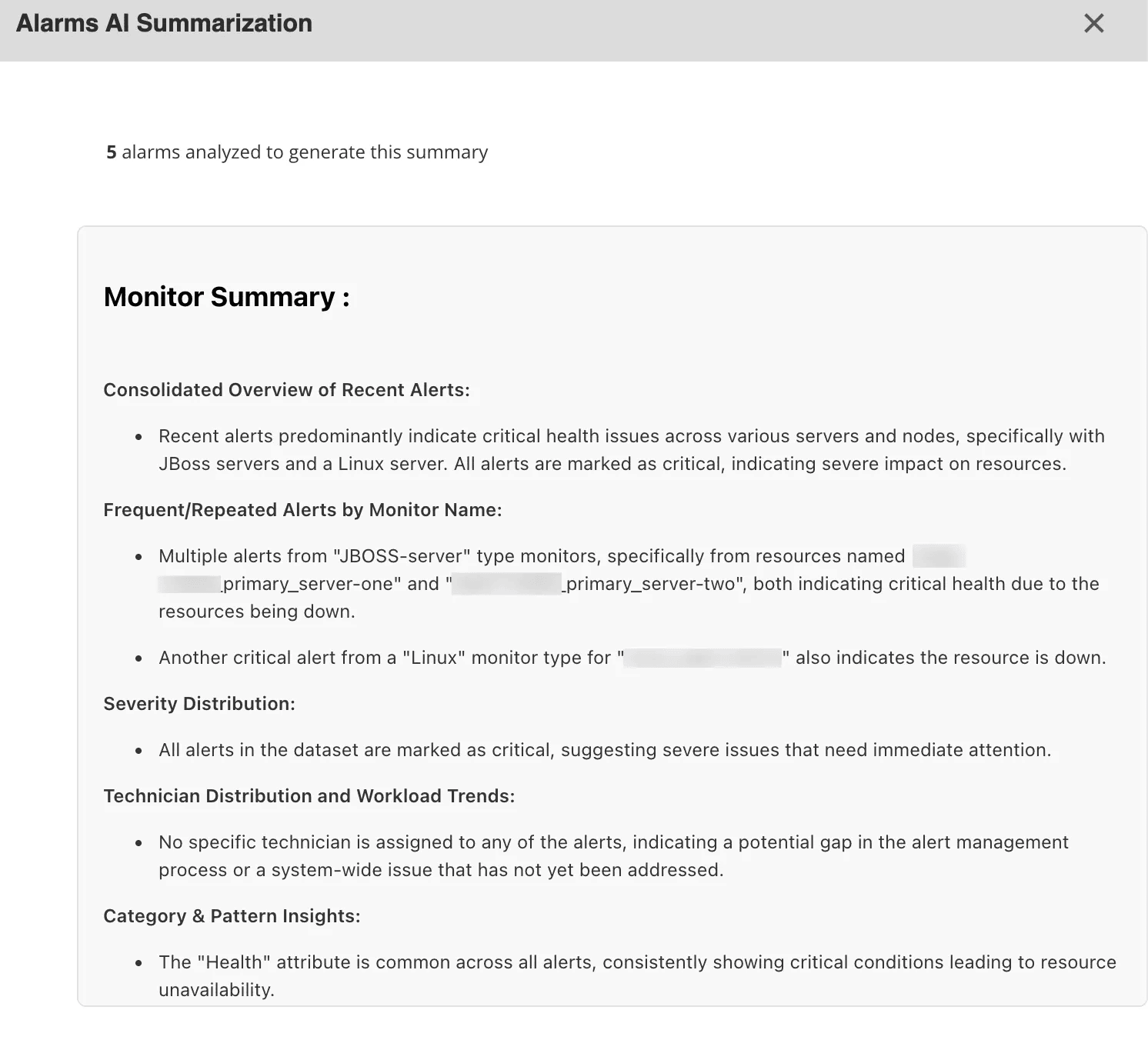
The GenAI based AI Alarms Summary is the first-of-its-kind AIOps feature in Applications Manager.
IT teams get overwhelmed when your monitoring stack generates hundreds of alerts. AI Alarm Summary leverages your configured provider to analyze alarm data and surface a clear, concise summary by consolidating multiple alerts.
It helps you to:
Cut through the noise: Get one clear summary instead of hundreds of raw alerts
Spot what matters most: Critical issues are surfaced first, so nothing slips through
Respond faster: Less time reading alerts means more time fixing problems
Reduce alert fatigue: Teams stay focused without being buried in repetitive notifications
The result is less noise, faster triage, and fewer situations where the critical alert gets buried under routine notifications.
Applications Manager: AI-powered application observability
Applications Manager has always been built around the idea of bringing the entire application stack, visible in a unified console.
That means monitoring across servers, databases, applications, cloud infrastructure, middleware, URLs, and more in a single pane of glass, without the need of switching between tools to correlate data.
Now, that visibility is paired with AI.
Whether your team trusts Anthropic, Google AI, DeepSeek, SiliconFlow, or needs everything running on-premise with Ollama, ManageEngine Applications Manager got it covered.
The goal hasn't changed: give IT teams the clarity they need to keep systems running. AI is simply the next layer that helps them do it faster. Explore it for yourself.